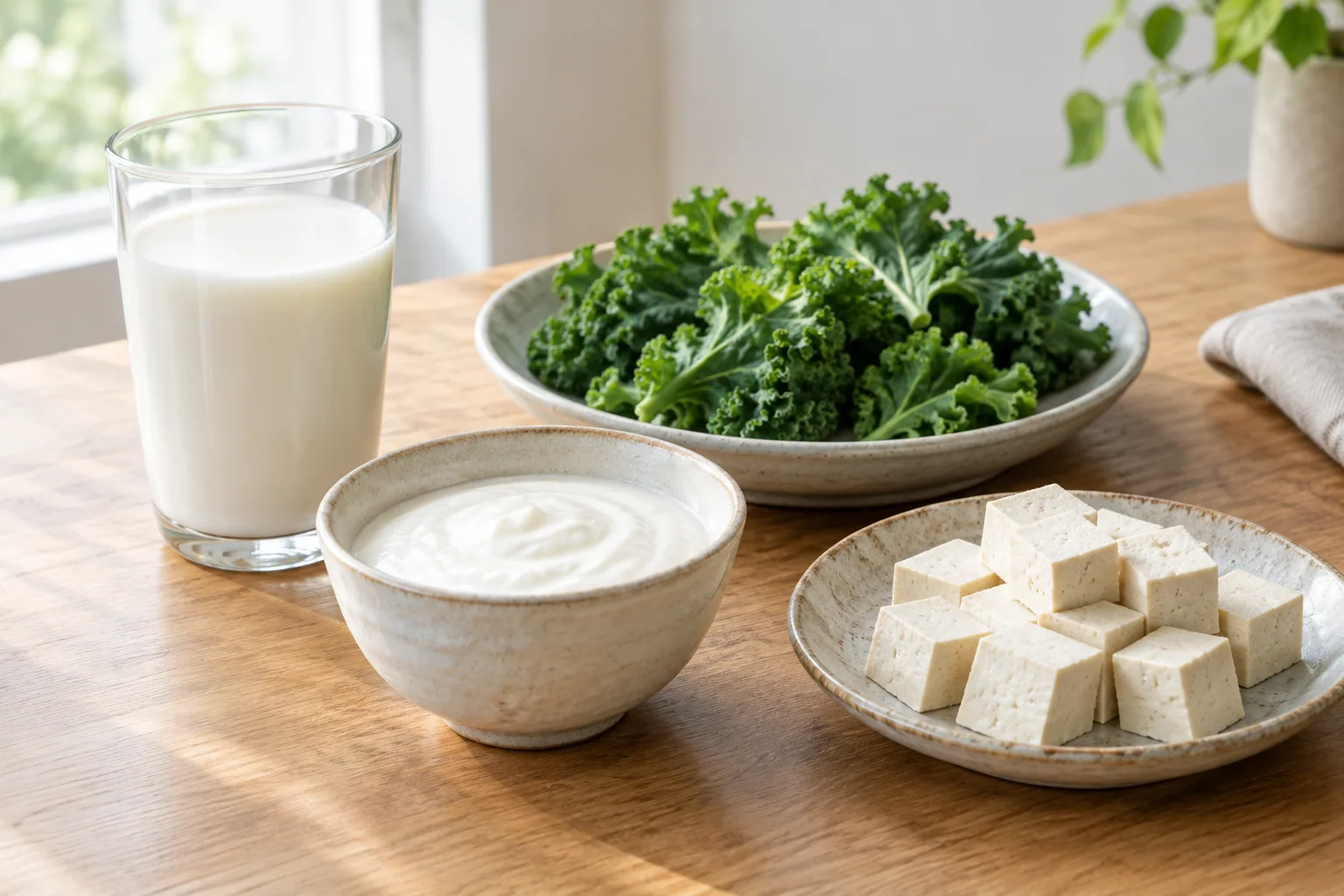
Lactose-free milk and yogurt, calcium-fortified plant drinks, calcium-set tofu, and canned fish with edible bones can all help you get calcium without lactose. Greens also contribute, but portions matter. Lactose-free does not mean milk-free, and a plant-based label does not tell you how much calcium a product contains.
Which lactose-free foods provide calcium?
Use this list to choose foods, then check the amount in the portion you actually eat. Values are approximate where shown; a product’s own nutrition panel is more useful than a general estimate.
| Food | Practical serving | Calcium | Where the calcium comes from and what to check |
|---|---|---|---|
| Lactose-free dairy milk | 1 cup | About 300 mg | Naturally present in milk; confirm the lactose-free label |
| Lactose-free dairy yogurt | 1 container, using its labeled serving size | Check mg per container | Milk provides calcium, but formulations and container sizes differ; ordinary yogurt is not automatically lactose-free |
| Calcium-fortified plant drink | 1 cup | Check mg per cup | Added calcium; confirm fortification rather than relying on “plant-based” wording |
| Fortified plant yogurt | 1 labeled serving | Check mg per serving | Often depends on added calcium; check each product |
| Tofu made with calcium | About ½–¾ cup, depending on the product | Roughly 200–400 mg | Calcium used in making the tofu; check the ingredient list and nutrition panel together |
| Canned salmon with edible bones | 3 ounces | Roughly 200–325 mg | Calcium comes largely from the bones; boneless salmon is not an equivalent choice |
| Cooked collard greens | 1 cup | About 260–270 mg | Naturally occurring calcium |
| Cooked turnip greens | ½ cup | About 120–130 mg | Naturally occurring calcium |
| Kale or bok choy | Measure your portion and specify raw or cooked | Use a matching food-composition entry | Naturally occurring calcium; do not borrow the amounts listed for other greens |
Canned sardines with edible bones are another option. Check the can’s calcium amount and serving size, especially if you are comparing them with salmon or buying a boneless version.
Lactose-free dairy keeps its calcium, but still contains milk
Lactose is milk sugar. Breaking it down does not remove calcium, so lactose-free dairy retains the calcium of its lactose-containing counterpart, according to Beth Israel Deaconess Medical Center’s lactose-intolerance guidance.
A cup of lactose-free milk typically provides about 300 mg of calcium, according to Utah State University’s lactose-intolerance guide. That does not make every carton or yogurt pot nutritionally identical. Compare the actual packages:
- Milk: Confirm “lactose-free,” then read calcium in milligrams for one cup or the stated serving.
- Yogurt: Confirm “lactose-free” separately, then check whether the nutrition panel covers the whole container or only part of it.
- Different package sizes: Compare equal portions before deciding which provides more calcium.
Lactose-free dairy can still contain milk proteins. If you need to avoid milk proteins, it is not a milk-free alternative. Likewise, do not treat ordinary yogurt or aged cheese as automatically lactose-free just because it may contain less lactose.
Compare plant drinks by calcium amount, not front-label claims
“Organic,” “plant-based,” and “dairy-free” do not establish calcium content. Look for calcium in the nutrition panel and check the ingredients for added calcium. Apply the same checks to plant yogurts.
To compare different serving sizes, use:
Calcium per 100 mL = calcium per serving ÷ serving size in mL × 100.
For example, if a label lists 300 mg in 240 mL, that works out to 125 mg per 100 mL. This is a calculation example, not a value to assume for any particular drink. To calculate your portion, multiply the amount per 100 mL by the volume you pour, then divide by 100.
Before buying a plant drink:
- Check calcium in milligrams, not just a percentage or a front-label claim.
- Follow any shake-before-use instructions.
- Compare protein and other nutrients separately. Similar calcium amounts do not make two drinks nutritionally equivalent.
- Check soy, almond, cashew, or other relevant ingredients independently of lactose.
Use this guide to other allergen ingredients in plant-based milks if you are switching between different plant bases.
Choose tofu by its calcium information and fish by its bones
For tofu, look for calcium sulfate or another calcium-containing ingredient, then confirm the amount on the nutrition panel. “Firm” describes texture, not a dependable calcium level. The estimate of roughly 200–400 mg per ½–¾ cup comes from the University of Washington’s food and nutrition curriculum; do not apply it to every block of tofu.
For canned fish, look for salmon or sardines with edible bones and include those bones in the portion you eat. Clemson Extension’s calcium food guide provides the estimate for canned salmon shown above. A boneless product may be convenient, but it should not be counted using the calcium estimate for fish with bones. Plain fish contains no lactose; check added sauces or seasonings separately.
Kale, bok choy, collards, and turnip greens give you more ways to include calcium without dairy. The collard and turnip green amounts above come from Sutter Health’s calcium guidance. Match any nutrient entry to the food’s preparation: one cup raw is not interchangeable with one cup cooked. Spinach is not a direct calcium substitute because its oxalates limit how much of its calcium your body absorbs.
Build meals around a measured calcium-containing portion
These totals count only the specified calcium-containing foods. Fruit, oats, bread, and other additions may contribute more, but they are not included in the estimates.
| Meal or snack | Measured calcium-containing portion | Approximate calcium counted | Relevant allergen checks |
|---|---|---|---|
| Porridge made with lactose-free milk | 1 cup lactose-free milk | 300 mg | Milk; check the oats and toppings separately |
| Calcium-set tofu with turnip greens | A tofu portion supplying 200–400 mg, plus ½ cup cooked turnip greens | 320–530 mg | Soy; check sauces separately |
| Canned salmon on toast | 3 ounces salmon with edible bones | 200–325 mg | Fish; check wheat and other bread ingredients |
| A meal with collard greens and lactose-free milk | 1 cup cooked collards plus 1 cup lactose-free milk | 560–570 mg | Milk; check added seasonings |
For the tofu meal, use the package’s serving size to find a portion within the stated range. You can use bok choy instead of turnip greens, but recalculate rather than keeping the same total.
For a fish-free toast topping, consider calcium-set tofu if soy fits your needs. For a soy-free option, use the lactose-free milk porridge if milk proteins are suitable. Fortified plant yogurt with fruit is another easy snack: count the yogurt’s labeled calcium amount rather than assuming it matches dairy yogurt.
If you avoid several food groups, this guide to building a balanced diet with multiple food restrictions can help you consider the rest of the meal, too. Ask a registered dietitian for help if your restrictions make it difficult to meet your nutrition needs.
Check these details before adding products to your basket
- Confirm lactose suitability. For dairy, look for a lactose-free label rather than assuming “low lactose” means the same thing.
- Compare calcium quantities. Match serving sizes and check whether you will eat the whole listed portion.
- Read the full ingredient list. Check milk proteins and any other ingredients you need to avoid separately from lactose.
- Review relevant precautionary statements. Do not assume that a lactose-free claim answers questions about other allergens or traces.
- Recheck familiar products. Recipes change, and the package label is the final authority.
A barcode-scanning shopping aid for checking dairy products can support this routine. Bokha scans product barcodes to help identify lactose, other supported allergens, traces, and additives, but it does not replace reading calcium information and ingredients. It is a shopping aid, not a medical device or a guarantee of suitability.
Before your next shop, add two calcium-containing foods you already enjoy to your list, along with the portion you plan to eat. At the shelf, compare their labels before choosing the package.