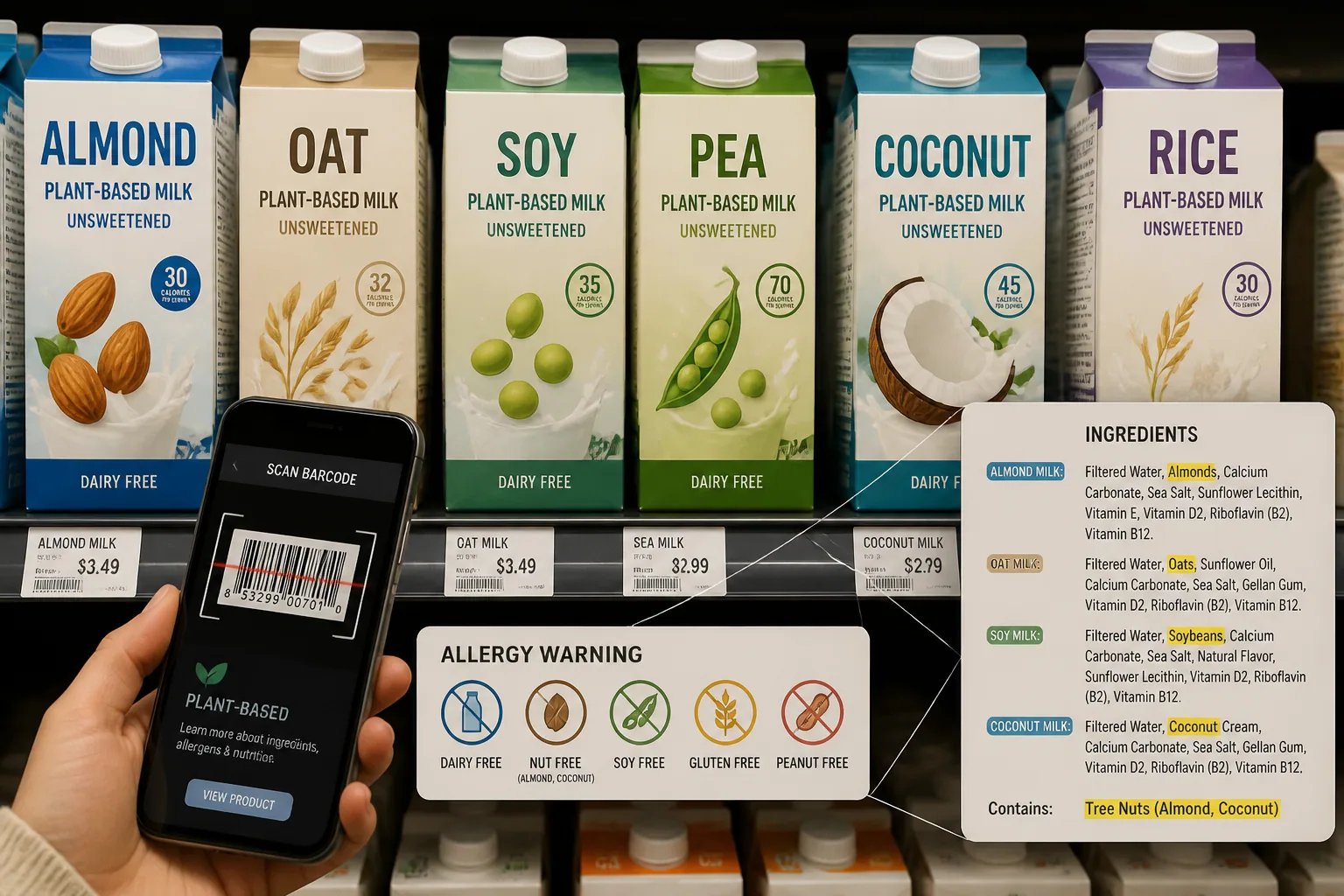
Plant-Based Milks: Hidden Allergen Risks, Processing Insights & Smart Scanning Tips
Plant-based milks have gone from niche alternatives to everyday staples in coffee shops, fridges, and lunchboxes. Almond, oat, soy, pea, coconut, rice, hemp, and cashew drinks now compete with dairy on convenience and variety, and many shoppers reach for them because of lactose intolerance, vegan diets, or a desire to avoid cow’s milk. But the growth of this category also creates a new question that matters a lot for allergy-aware consumers: what hidden allergen risks are actually sitting inside these products?
The answer is not always simple. Some plant milks are built around well-known allergens like tree nuts or soy. Others use newer ingredients such as pea protein, which can create problems for people who were only thinking about peanuts or dairy. On top of that, processing methods can change how allergenic a drink may be, sometimes lowering risk and sometimes leaving enough reactivity to still cause reactions. In other words, a label that looks harmless at first glance may still deserve a closer look.
Why Plant-Based Milks Are Booming, and Why Allergy Questions Matter
The plant-based milk market has expanded because these drinks fit many lifestyles at once. They can be dairy-free, sometimes lower in saturated fat, and often sold in flavors and barista versions that appeal to a broad audience. But the more these products diversify, the more ingredient complexity they introduce. A simple carton of “milk” might contain an allergenic base, added proteins, gums, stabilizers, flavorings, fortifying vitamins, and precautionary wording about shared equipment.
That matters because consumers do not react only to the headline ingredient. They react to proteins, traces, and in some cases to ingredients that cross-react with another allergy they already have. For example, a shopper avoiding peanuts may not immediately think about pea protein, even though Health Canada notes that pea proteins can cross-react with peanut allergens, and some peanut-allergic individuals may also react to pea protein or pea-based ingredients: https://www.canada.ca/en/health-canada/services/food-nutrition/food-labelling/allergen-labelling/information-pea-protein-peanut-allergy.html
The Main Allergens Hiding in Popular Plant Milks
The most obvious risks are in the nut- and soy-based drinks. Almond milk, cashew milk, hazelnut blends, and walnut-based products can contain the same major allergenic proteins that trigger reactions in tree-nut allergic individuals. A recent review of tree nut allergens highlights major proteins such as Pru du 6 in almond, Ana o 1 to Ana o 3 in cashew, Cor a 1, Cor a 8, and Cor a 9 in hazelnut, and Jug r 1 through Jug r 4 in walnut. Their allergenicity depends on protein structure and epitope behavior, which helps explain why some tree nut proteins remain troublesome even after processing.
Soy milk is another major category to approach carefully. Soy is one of the more established food allergens, and it also matters because soy milk is often used as the most dairy-like plant alternative in terms of protein content. That can make it appealing nutritionally, but it also means soy-allergic consumers must be especially vigilant. Research indicates that soybean proteins are relatively heat-stable, with limited reduction in IgE binding after boiling for 30 minutes, and only more substantial changes after longer boiling or pressure cooking. Some allergens, including 7S globulins, can survive even harsh processing.
Oat, rice, coconut, and hemp drinks are often perceived as gentler options, but “gentler” does not mean allergen-free. Oats can be problematic for people who are sensitive to contamination or who react to avenin, while rice drinks may be chosen for simplicity but can still contain additives or be processed in facilities that handle major allergens. Coconut is especially tricky because consumers often assume it behaves like a tree nut, even though botanical classification and clinical relevance are more nuanced. In practice, the safest approach is always to read the specific label rather than rely on assumptions.
Tree Nuts, Soy, Pea Protein and Other Underestimated Risks
Tree nuts and soy are the most obvious risks, but pea protein deserves special attention because it often appears in products marketed as “clean” or “high protein.” Pea is a legume, like peanut and soy, and while it is not currently a major allergen under U.S. law, its presence is not trivial. FDA GRAS notices for pea protein products still require ingredient disclosure, and the FDA notes that precautionary statements are voluntary rather than standardized. That means a product can be compliant while still leaving some uncertainty for highly sensitive consumers: https://www.fda.gov/media/152479/download
This is where cross-reactivity becomes important. Someone with peanut allergy may also react to pea protein, but not everyone will. The same is true for other legumes and related proteins. For allergy-aware shoppers, the key takeaway is that “plant-based” does not mean “low-allergen.” It simply means the protein source has shifted away from dairy, not away from allergy risk in general.
Another underestimated issue is ingredient blending. Many plant milks are not made from a single raw material alone. Manufacturers may combine almond with cashew, oat with pea, or soy with added stabilizers and fortifiers. The more ingredients in the formula, the greater the chance that one ingredient will be relevant to your allergy profile or that a shared processing line will raise cross-contact concerns.
How Processing Can Change Allergenicity
Processing can change a protein’s structure, and that can influence how the immune system sees it. Heat is the most familiar example. In almond proteins, thermal treatments such as baking, boiling, autoclaving, and roasting can reduce allergenicity, but they do not eliminate it. Research on almond protein antigenicity found reduced reactivity under some heat treatments, yet enough activity remained to matter clinically. In other words, a heated ingredient is not automatically a safe ingredient.
Soy shows an important parallel. Boiling, pressure cooking, fermentation, and enzymatic hydrolysis can lower allergenicity for some soy proteins, but the effect is not uniform. A review of soy milk processing notes that combining heat with fermentation can reduce IgE binding of certain soy allergens, while some treatments like pasteurization may not remove heat-stable proteins. This is why a “processed” product can still be allergenic, even when the processing sounds aggressive.
Fermentation and enzymatic treatment are especially interesting because they can break proteins into smaller fragments or alter their shape. That often helps reduce reactivity, but not always enough to make a product universally safe. For consumers, the practical lesson is simple: processing may lower risk, but it does not cancel the need to check allergen information carefully.
Home-Made vs Store-Bought: Is One Safer?
Homemade plant milk can feel safer because you know exactly what went into it. If you blend soaked oats or almonds with water at home, there are fewer mystery ingredients, and there may be less concern about additives or shared factory equipment. That said, homemade drinks also come with limitations. They are harder to fortify, they may separate quickly, and they do not always solve the problem of raw ingredient contamination. If your nuts, oats, or seeds were processed in a facility with other allergens, the base ingredient may already carry risk.
Store-bought plant milks, by contrast, are standardized, fortified, and convenient. They are also more likely to list complete ingredient statements and allergy warnings, which can make them easier to assess. The safest choice depends on the person. For someone with a severe allergy, a short ingredient list is not enough if the source ingredient itself is risky or if cross-contact is possible. For someone without a major food allergy, store-bought fortified options may offer better nutritional consistency.
Nutrition Trade-Offs: Protein, Fortification and Additives
Nutritionally, plant milks vary a lot. A study in Frontiers in Nutrition found that cow’s milk outperforms most plant-based drinks on protein amount and protein quality as measured by DIAAS. Soy milk is one of the few plant beverages that comes closer to dairy milk levels, while many almond, oat, rice, and coconut milks provide very little protein, sometimes less than 1 percent compared with cow’s milk: https://www.frontiersin.org/journals/nutrition/articles/10.3389/fnut.2022.988707/full?s=09
That does not make those lower-protein drinks useless, but it does mean they are not nutritional equivalents. If you are replacing dairy milk for children, older adults, or anyone with higher protein needs, checking the label matters. Fortification also matters. According to The Lancet Planetary Health, plant-based beverages often require added calcium, vitamin D, B12, and sometimes zinc to approach nutritional parity with dairy milk. Without fortification, consumers may face micronutrient gaps over time: https://www.sciencedirect.com/science/article/pii/S2542519622002704
Additives are another practical consideration. Stabilizers, emulsifiers, flavorings, and sweeteners do not always create allergy risk by themselves, but they can complicate label reading and sometimes introduce separate sensitivities. A short ingredient list can be appealing, yet a shorter label is not always the more nutritious option. For allergy-aware shoppers, the goal is to balance nutritional value with ingredient simplicity and personal safety.
How to Read Labels for Hidden Allergen Clues
Label reading is where most of the safety work happens. Start by identifying the base ingredient, then scan the full list for derivatives and secondary ingredients. Look for tree nuts, soy, oat, pea, and any blended bases. Also check whether the product is flavored, barista-style, or “high protein,” because those versions often contain more ingredients and a higher chance of cross-contact.
One useful habit is to look beyond the obvious allergen statement and read the entire ingredient panel. A product labeled “almond beverage” is clearly not appropriate for tree nut allergy, but a product labeled “plant milk” may still contain soy lecithin, pea protein, or nut-derived additives. Another clue is the order of ingredients. If a protein source appears early in the list, it likely makes up a meaningful part of the product rather than a tiny trace amount.
The FDA’s plant-based milk alternative guidance also notes that PBMA products whose nutritional content differs from dairy milk may use voluntary nutrient comparison statements, and fortified soy beverages can count in the dairy group under the Dietary Guidelines for Americans, while most other PBMAs do not unless they meet certain nutrient criteria: https://www.fda.gov/food/nutrition-food-labeling-and-critical-foods/plant-based-milk-alternatives-pbma
What Precautionary Statements and Cross-Contact Warnings Really Mean
Precautionary allergen statements are often the most frustrating part of label reading because they are inconsistent. Phrases like “may contain,” “made in a facility that also processes,” or “not suitable for people with…” are generally voluntary and not regulated in the same way as ingredient declarations. That means the absence of a warning does not guarantee zero cross-contact, and the presence of a warning does not always tell you how likely exposure is.
For highly sensitive consumers, these statements matter because shared equipment can be enough to trigger a reaction. For others, they can serve as a helpful extra screen when comparing products. The best practice is to treat precautionary statements as a risk signal, not a guarantee. If your allergy is severe, recurring, or involves cross-reactive ingredients like peanut and pea, the safest option is often to choose brands with clear allergen controls and consistent labeling practices.
How Barcode-Scanning Tools Can Help Spot Risk Faster
When you are standing in the supermarket aisle, speed matters. Barcode-scanning tools can reduce the burden of reading every label from scratch, especially when you are comparing multiple plant milks with different recipes and processing claims. A good scanner can quickly flag allergens, traces, and additive concerns before the product even goes into your cart.
That is where the Bokha: Food Allergy Scanner App can be especially useful. It scans product barcodes in less than a second and identifies 13 allergens, traces, and additives, which can save a lot of time when you are deciding between oat, soy, nut, or pea-based drinks. You can learn more here: https://findthe.app/bokha
A tool like that does not replace careful reading or medical advice, but it can make routine shopping much easier. It is especially helpful when products change ingredients, when you are traveling, or when you need to make quick decisions without missing a hidden allergen.
Smart Tips for Choosing a Safer Plant Milk
If you are trying to choose a safer plant milk, start with your own allergy profile rather than the category name. If you have tree nut allergy, almond, cashew, hazelnut, walnut, and mixed nut beverages are obvious exclusions. If you have soy allergy, soy milk and soy protein blends require careful avoidance. If you have peanut allergy, pay close attention to pea protein because of possible cross-reactivity.
Next, compare ingredient lists across brands. Simpler formulas are often easier to manage, but do not ignore fortification. A fortified soy milk may be nutritionally stronger than an unfortified oat milk, while a low-ingredient rice drink may still be poor in protein and micronutrients. The goal is not just to avoid a reaction, but also to choose a product that fits your dietary needs long term.
Finally, use a layered strategy: read the label, check the allergen statement, consider the processing method, and if needed, scan with a barcode app before buying. Plant-based milks can absolutely fit into a safe and healthy routine, but only when you approach them with the same care you would use for any other allergen-sensitive food. In a market that keeps changing, a little caution goes a long way.