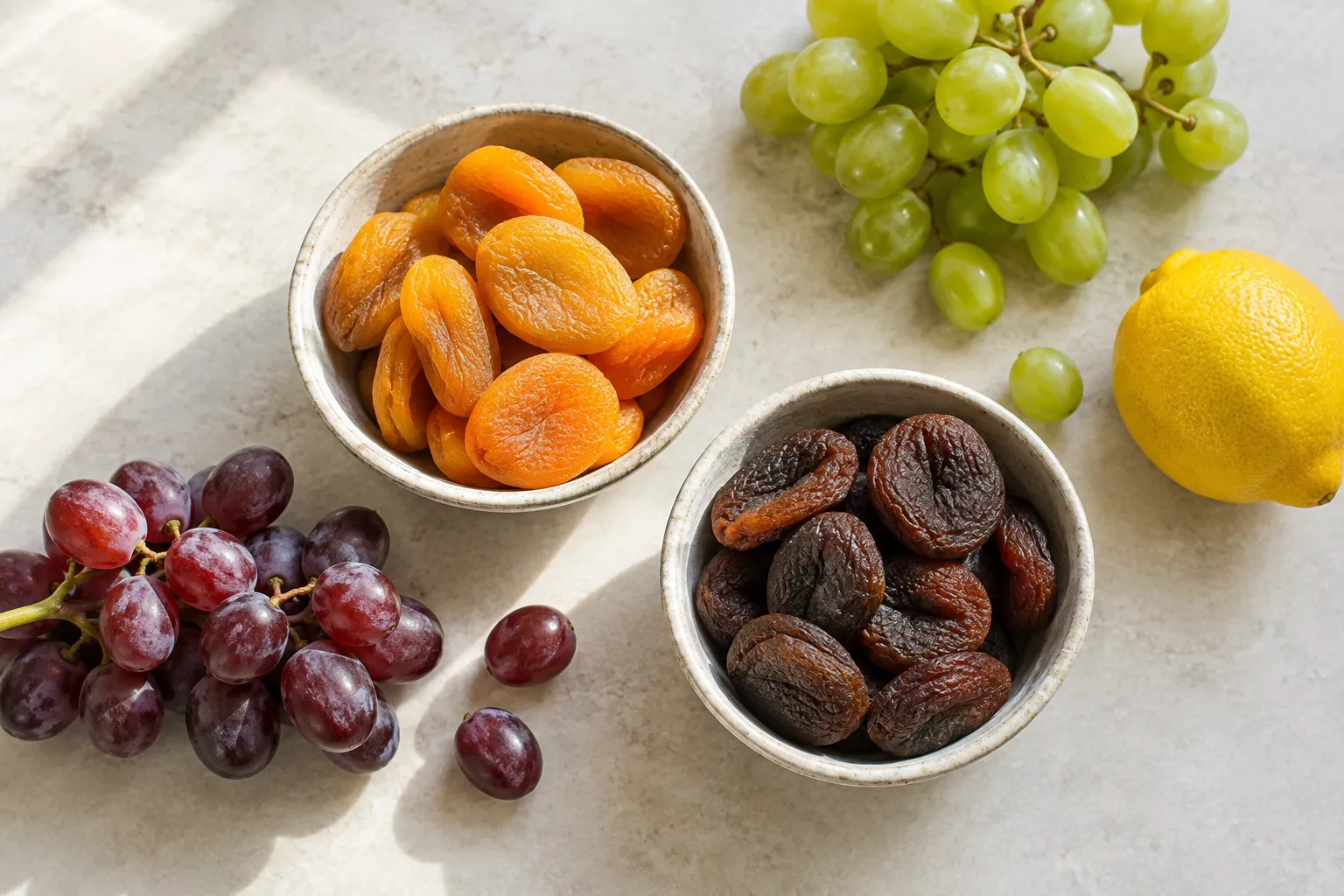
To avoid sulphites while grocery shopping, check likely sources first, read the full ingredient list and allergen information, and compare alternatives before buying. If the information is missing or unclear, ask the manufacturer rather than assuming the product contains none. No declared sulphites does not prove zero sulphite content.
Start with four checks before choosing a product
- Identify likely sources: pay particular attention to dried fruit, wine, cider, bottled citrus juice, prepared potatoes, and prawns or shrimp.
- Read the whole label: check ingredients, compound ingredients in parentheses, and any separate allergen declaration.
- Compare specific products: choose based on their ingredient information, not just their category or front-of-pack claims.
- Resolve uncertainty: ask the manufacturer about the exact product if its ingredients or sulphite information are unclear.
Labels may use either “sulphites” or the American spelling, “sulfites.” Keep both spellings in mind when checking imported groceries or searching a manufacturer’s website.
Foods and drinks worth checking first
Sulphites can be used as preservatives or to help prevent discoloration. These are categories worth checking, not a list of foods that always contain them; the Anaphylaxis UK sulphites guide identifies dried fruit, drinks, potato products, and prawn products among common sources.
| Food or drink | Why sulphites may be present | What to check |
|---|---|---|
| Dried fruit, including apricots and raisins | Preservation and color retention | The fruit’s ingredients, plus any coating or other added ingredients |
| Wine and cider | Added preservation; sulphites can also occur naturally during fermentation | A “contains sulphites” or “contains sulfites” declaration, including outside an ingredient list |
| Some bottled lemon or lime juices | Preservation | Sulphur dioxide or sulphite preservatives in the ingredients |
| Certain prepared, peeled, frozen, or dried potato products | Prevention of discoloration during processing | The potato product itself and any seasoning, sauce, or other components |
| Some prawns or shrimp | Treatment to limit discoloration | Ingredients and treatment information, including supplier information for loose products |
Also read labels on sauces, pickled foods, processed meats, soft drinks, and juice concentrates. A product outside the main categories can still contain sulphites through one of its ingredients.
Recognize sulphite names and E-numbers
A label may name the preservative rather than simply say “sulphites.” The UK government’s approved additive list lists the following sulphur dioxide and sulphite additives. These entries are not permission to use every additive in every food, and they should not be treated as a list of US authorizations.
| E-number | Name to recognize | Other wording you may encounter |
|---|---|---|
| E220 | Sulphur dioxide | Sulfur dioxide |
| E221 | Sodium sulphite | Sodium sulfite |
| E222 | Sodium hydrogen sulphite | Sodium bisulphite or sodium bisulfite |
| E223 | Sodium metabisulphite | Sodium metabisulfite |
| E224 | Potassium metabisulphite | Potassium metabisulfite |
| E226 | Calcium sulphite | Calcium sulfite |
| E227 | Calcium hydrogen sulphite | Calcium bisulphite or calcium bisulfite |
| E228 | Potassium hydrogen sulphite | Potassium bisulphite or potassium bisulfite |
Do not memorize this as “every number from E220 through E228.” E225 is deliberately absent from this reference list.
For example, if an ingredient list says “preservative: sodium metabisulphite”, you have identified a sulphite preservative even if the label does not use the general word “sulphites” in that spot. You can look up sodium metabisulfite, E223 when comparing labels.
Two caramel color names also deserve attention: E150b, caustic sulphite caramel, and E150d, sulphite ammonia caramel. These are colors, not entries in the preservative table; Allergy UK’s sulphites information identifies them as sulphite-related additives. If one appears without clear sulphite information, ask the manufacturer rather than estimating the finished product’s content.
Understand what a sulphite declaration can tell you
UK labels use a declaration threshold, not a zero-content standard
In the UK, sulphur dioxide or sulphites must be declared when the finished product contains more than 10 mg/kg or 10 mg/litre, expressed as total sulphur dioxide. The rule includes sulphites carried over from another ingredient, not only preservatives added directly to the final product, according to the official UK allergen-labeling guidance.
Read the complete ingredient list rather than checking only a separate “contains” box. Sulphite information may appear within the ingredients, including inside a compound ingredient such as a sauce or fruit preparation.
That declaration threshold is a labeling rule, not a personal suitability threshold. If you need guidance on what level of avoidance is appropriate for you or your child, ask a qualified healthcare professional.
Check imported foods and alcohol without assuming the UK rules apply
For EU or US products, read the labeling supplied for the country where you are shopping. On US packaging, search for “sulfite,” “bisulfite,” “metabisulfite,” and “sulfur dioxide,” as well as a separate “contains sulfites” statement.
Check wine and other alcoholic drinks separately from ordinary packaged foods. A bottle may not present ingredient information in the same way as a food package, so the absence of an ingredient list is not evidence of absence; ask the producer if the declaration does not answer your question.
“No added sulphites” does not mean none are present
Sulphites can occur naturally, including during fermentation. A “no added sulphites” claim addresses addition, not necessarily the total amount in the finished product.
Likewise, a missing declaration does not establish zero content. Use the site’s reference information on sulphur dioxide and sulphites to help recognize terms, then seek product-specific clarification when needed.
A “may contain” statement serves a different purpose from an ingredient declaration. If you are checking other allergens on the same package, read this explanation of precautionary allergen wording rather than treating all label warnings as interchangeable.
Compare alternatives using their actual ingredients
Use these comparisons to narrow your choices. None establishes that an alternative is universally suitable.
| Your starting product | Alternative to compare | Decision to make from the label |
|---|---|---|
| Dried fruit with declared sulphites | Dried fruit without declared sulphites | Check the full ingredients and any no-added claim; do not infer zero content |
| Bottled lemon or lime juice with a sulphite preservative | Fresh citrus, or another bottled juice with different ingredients | Decide whether squeezing fresh fruit meets your cooking needs, or check the replacement bottle independently |
| Prepared potato product with a sulphite preservative | Plain whole potatoes, or a simpler prepared product | Check any processing ingredients, seasonings, and sauces before choosing |
Do not choose dried fruit by color alone. Appearance cannot tell you the ingredient list or sulphite concentration.
“Organic” and broad “free-from” wording are not enough either. Read exactly what the claim excludes, then check the ingredients for the substance you need to avoid.
For loose dried fruit, seafood-counter products, or other unpackaged foods, ask for ingredient and supplier information. In the UK, allergen information requirements also apply to non-prepacked food, although it may be provided differently from a packaged ingredient list; the government’s food-information guidance explains these distinctions.
Try this wording: “Does this product contain sulphur dioxide or any sulphite treatment? Can you check the supplier’s ingredient and allergen information for this exact product?” If staff cannot confirm, compare a packaged option with clearer information.
Repeat this check for every grocery purchase
- Inspect the specific package. Match the product name, variety, and size, then read all ingredients and declarations.
- Scan as an additional check. Bokha, available on iOS and Android, scans product barcodes and identifies supported allergens, including sulphites, along with traces and additives. Its barcode-scanning support for sulphite checks can help you review packaged groceries alongside the label.
- Compare the result with the package. A scan does not measure sulphite concentration or guarantee suitability. Recipes change, and the package label is the final authority; Bokha is a shopping aid, not a medical device.
- Pause if information conflicts. Do not use a scan result to dismiss an ingredient declaration. Ask the manufacturer to clarify the exact product before buying it.
For a manufacturer inquiry, include the product name, barcode, and batch or lot number if available. Ask: “Are sulphites added directly, used in processing, or present through another ingredient? Does ‘no added sulphites’ describe only direct additions, and what information can you provide about total sulphite content?”
Save a photo of the label with the reply so you can match the information to the product. At your next shop, start with one frequently purchased item and compare two packages using this routine.
FAQ
Are sulphites in food gluten free?
Sulphites are not gluten, so a sulphite ingredient does not by itself mean a food contains gluten. The rest of the product may contain gluten, however, so check its ingredients and relevant allergen information separately.
Are sulphites in food vegan?
A sulphite declaration does not tell you whether the whole food is vegan. Check the other ingredients and product-specific vegan information rather than accepting or rejecting a product based only on sulphites.
Are sulphates and sulphites the same thing?
No. Sulphates and sulphites are different chemical compounds, and “sulfate” is not another spelling of “sulfite.” When checking a label, match the exact ingredient name to the sulphite reference table rather than rejecting every ingredient containing the word “sulphur” or “sulfur.”