The Gray Zone of “May Contain”: Understanding and Navigating Precautionary Allergen Labels
For families living with food allergies, the hardest part of shopping is often not the ingredient list. It is the gray area that comes after it. A package may be free of your allergen as an ingredient, yet still carry a warning like “may contain,” “made in a facility with,” or “produced on shared equipment.” Those phrases can feel alarming, but they are also frustratingly vague. They do not always mean the same thing, and they do not always reflect the same level of risk.
That is why precautionary allergen labels, often called PAL, create so much confusion. They are meant to warn about possible cross-contact, but in the U.S. they are voluntary, not standardized, and not based on one single rule. For parents and caregivers, that means learning how to read beyond the words and make decisions with a mix of science, caution, and practical judgment.
Why Precautionary Allergen Labels Feel So Unclear
If a label says an allergen is present, the meaning is simple. Under U.S. law, major allergens that are intentionally included as ingredients must be clearly declared. The FDA lists nine major allergens: milk, eggs, fish, shellfish, tree nuts, peanuts, wheat, soy, and sesame, and the requirement comes from laws including FALCPA and the FASTER Act. The challenge begins when the allergen is not listed as an ingredient, but is mentioned in a warning instead. The product may still be safe for some people, unsafe for others, or impossible to judge without more information.
This uncertainty is exactly what makes families uneasy. One brand says “may contain peanuts,” another says “shared equipment,” and another says nothing at all. It can feel like every company is speaking a different language. In reality, they often are.
What Counts as a Precautionary Allergen Label?
Precautionary allergen labeling is any voluntary statement used to signal the possible presence of an allergen due to cross-contact during manufacturing, packaging, or transport. Common examples include “may contain,” “made in a facility with,” “produced on shared equipment,” and “may be processed in a plant that also handles.” These phrases are not ingredient disclosures. They are warnings about risk, not confirmations of contamination.
The important point is that PAL is not a single regulated format. A company can choose the wording it wants, and there is no federal threshold that tells every manufacturer exactly when to use a warning. The FDA guidance from 2025 makes clear that precautionary labeling remains completely voluntary in the U.S., with no mandated format or threshold governing its use.
What the Law Requires, and What It Does Not
U.S. food law draws a sharp line between intentional ingredients and potential cross-contact. If an allergen is used as an ingredient, it must be disclosed plainly on the label. That is the legal requirement. But if an allergen might have gotten into the food unintentionally, the law does not require a warning, and it also does not require a company to explain its manufacturing risk in detail.
That gap is where uncertainty lives. A product can be made with allergen controls, tested regularly, and still carry a cautious warning. Another product might have no warning even though cross-contact risk exists. Because there is no mandatory threshold in U.S. law, the presence or absence of a PAL cannot be treated as a perfect measure of danger. The FDA has also not established regulatory allergen thresholds, which means there is still no official U.S. rule saying exactly how much allergen is too much for a warning to appear.
This is why so many allergy experts emphasize that label reading is only one part of risk management. The label can help, but it cannot tell the full story.
The Difference Between “May Contain,” “Shared Equipment,” and “Same Facility”
These phrases sound different, but in practice they are not reliably ranked from safest to riskiest. A product labeled “may contain peanuts” is not automatically more dangerous than one labeled “made in a facility that also processes peanuts.” The wording often reflects brand policy, legal caution, or marketing style as much as it reflects actual contamination probability.
Research supports this caution. In one U.S. and EU study of peanut residues, products with different PAL statements showed similar risk levels, which means the specific phrase did not predict a clearly different allergen presence. A 2007 U.S. study found that among 200 products carrying peanut advisory labels, 10% had detectable peanut residues, and about 6.5% had clinically significant levels. Yet even with those findings, consumers often misunderstood what the different phrases were really telling them.
In other words, the wording may sound precise, but the system is not. A “shared equipment” warning may reflect a short production run on the same line, while “same facility” might mean the allergen is only present somewhere else in the building. Or it may simply be the phrase a company’s legal team prefers. The consumer usually cannot know from the label alone.
What Science Says About Cross-Contact Risk
Cross-contact risk is not binary. It exists on a spectrum, shaped by factors like cleaning procedures, production schedules, ingredient handling, and whether the allergen is in dust, liquid, or a hard-to-remove residue. That is why the science around precautionary labeling increasingly focuses on dose, not just presence.
The FAO and WHO have developed reference doses, or RfDs, which estimate the amount of allergen protein below which most allergic individuals are unlikely to react. These scientific benchmarks are being proposed globally to give PAL a quantitative foundation instead of leaving it purely qualitative. For gluten-containing cereals, recent FAO and WHO expert modelling recommends an RfD of 4 mg of gluten per eating occasion as a threshold trigger for applying PAL.
That matters because it points toward a more rational system. Rather than warning on everything out of caution, manufacturers could eventually base warnings on measurable risk. The problem is that this is not yet the norm in the U.S. Today, families still have to make decisions in the absence of a harmonized threshold system.
Why Brands Use Precautionary Labels So Differently
If you compare labels across grocery aisles, you will quickly notice how inconsistent PAL use can be. Some brands include warnings on nearly everything. Others use them sparingly. Research across Europe found that around half of food product labels included precautionary allergen statements, but the exact type and frequency varied a lot by brand and product category.
That variation happens for several reasons. Some companies use a highly conservative approach and apply warnings whenever there is any conceivable shared risk. Others use internal testing, supplier controls, and allergen-management programs to narrow the number of products that carry PAL. Different facility layouts, different supplier chains, and different corporate risk tolerances all influence the final label. The result is that two similar products can look completely different on the shelf even if their actual contamination risk is not drastically different.
This is one reason families sometimes feel like they have to become detectives. The label tells you what the brand decided to print, not necessarily what the food safety team knows in detail.
How Allergy Scanner Apps Read These Warnings
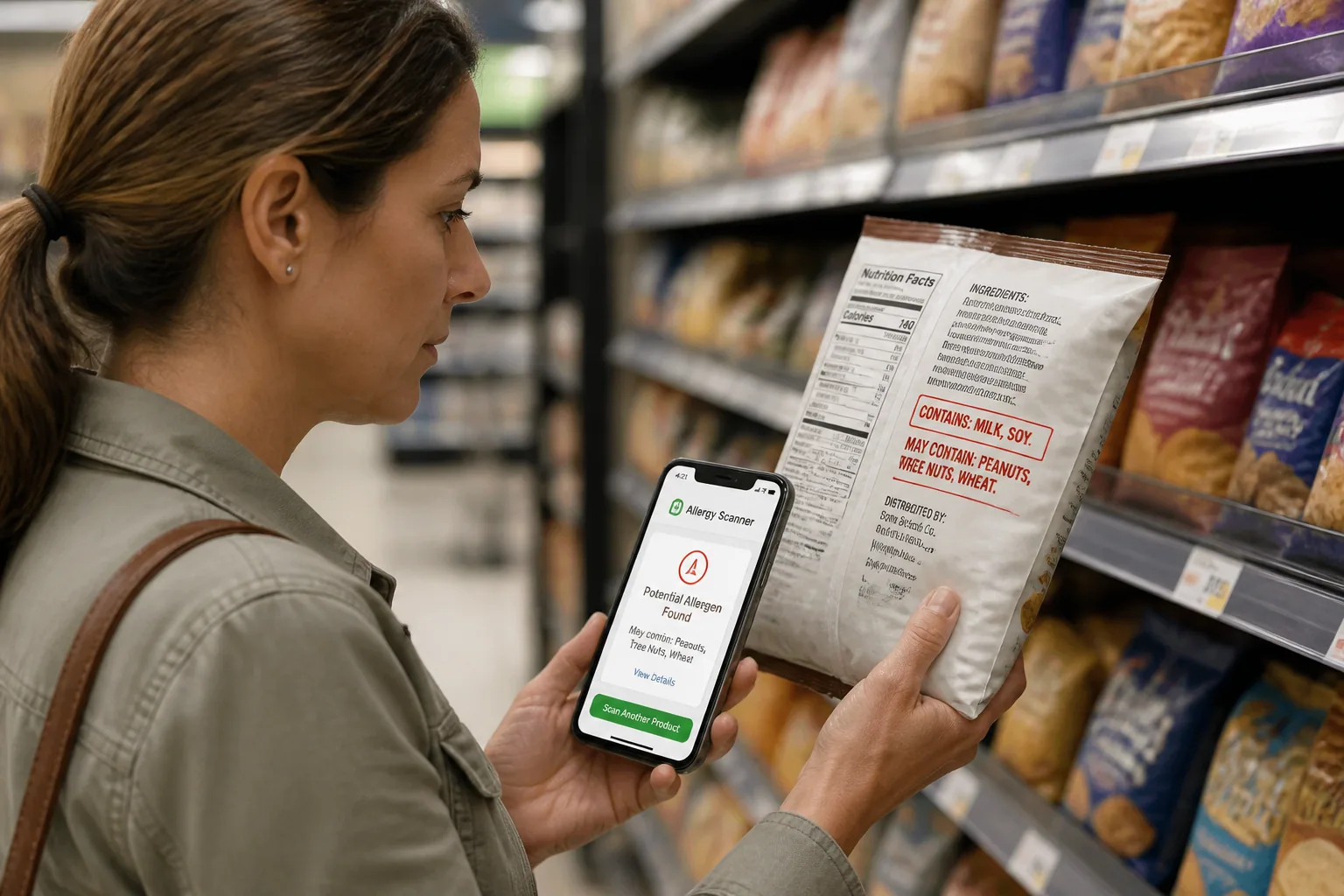
Food scanner apps can be very helpful in the supermarket, especially when you are trying to move quickly and reduce stress. Most of them rely on barcode data, product databases, or optical character recognition to read ingredients and display allergen warnings. In a simple sense, they help translate the label into something easier to act on.
But their usefulness depends on how current and complete their data is. If a manufacturer changes a recipe, updates its facility statement, or adds a new warning, an app may not reflect that change immediately. Some apps also handle voluntary warnings in oversimplified ways, treating any PAL as an absolute yes-or-no answer without context. That can make them feel more certain than they really are.
This is where a tool like Bokha: Food Allergy Scanner App can be useful. It lets you scan a barcode and see allergens, traces, and additives in less than a second, which can save time when you are comparing products in store. Still, like any scanner, it should support your judgment, not replace it.
When to Trust the Label and When to Dig Deeper
A clear ingredient disclosure should always be taken seriously. If the allergen is intentionally included, that is not a gray area. But when you are looking at precautionary language, the question becomes less about whether the warning exists and more about what it means for your specific situation.
You may want to trust the label more when your child has had severe reactions, when the allergen is known to trigger symptoms at very low doses, or when the product category has a history of high cross-contact risk. You may want to dig deeper when a product is otherwise valuable, when the wording is ambiguous, or when you have reason to believe the company has strong allergen controls but uses broad warnings.
In practice, digging deeper can mean checking the manufacturer website, contacting customer service, or asking about cleaning procedures, shared lines, and testing. A label is a starting point, not the final answer.
Questions to Ask Manufacturers Before Trying a Product
If you are deciding whether to introduce a new food, a few focused questions can help you get beyond the vague wording on the package. Ask whether the allergen is present in the same facility or on the same line, how equipment is cleaned between runs, whether allergen testing is performed, and whether the company has changed suppliers recently. You can also ask whether the precautionary statement is based on actual measured risk or on a general policy applied across many products.
These questions are especially useful because the same phrase can hide very different realities. A brand may use “may contain” because a supplier cannot guarantee separation, while another may use the same phrase because its legal department requires a blanket warning for an entire product line. The more specific the answer, the better you can judge the risk.
A Practical Decision Guide for Parents and Caregivers
A simple way to think about PAL is to separate food into three buckets. First, products with the allergen as an ingredient should be avoided unless you have medical guidance saying otherwise. Second, products with a precautionary warning need a risk decision. Third, products with no warning still deserve ordinary caution, because no warning is not a guarantee.
For younger children, newly diagnosed families, or anyone with a history of severe reactions, many caregivers choose to avoid products with any PAL for the relevant allergen. That approach can reduce uncertainty, though it may also narrow food choices significantly. For older children or families with established tolerance thresholds and guidance from an allergist, some products with PAL may be considered on a case-by-case basis.
The key is consistency. Create a rule that matches your household’s risk tolerance, medical advice, and daily reality. The goal is not to be fearless. The goal is to be predictable and informed.
Common Mistakes to Avoid When Reading Allergen Warnings
One common mistake is assuming every PAL means the same thing. It does not. Another is believing that a product with no warning is automatically safe. That is not guaranteed either. A third mistake is treating scanner apps as final authorities when they may not have the latest data or may flatten nuance into a simple icon or alert.
It is also easy to overread “free from” or “peanut-free” language as an absolute promise. In one Canadian study, about 5% of products carrying peanut-related precautionary statements tested positive for peanut protein, and some products labeled “peanut-free” still showed low-level residues. That does not mean labels are useless. It means they must be interpreted carefully and in context.
Another common trap is assuming a company’s wording reflects a universal standard. It usually reflects that company’s internal policy. What feels like a classification system is often just a patchwork of business decisions.
Building a Safer, More Confident Shopping Routine
The best label-reading routine is one that reduces decision fatigue. Start with the ingredient list, then check for legally required allergen disclosures, then scan for PAL language, and finally decide whether you need a second layer of verification. Over time, you may find that certain brands become trustworthy for your family, while others are too inconsistent to rely on.
This is also where technology can help, as long as it stays in its lane. A scanner app can speed up the first pass and help spot allergens and traces quickly, but your own rules, your child’s medical history, and direct communication with manufacturers still matter. The strongest routine combines all three.
And there is reason to be hopeful. The broader food allergy community is moving toward more science-based labeling. FDA stakeholders, including consumers, industry, and clinicians, have recently expressed broad support for a harmonized, risk-based framework for allergen thresholds that could make precautionary labels more meaningful and less confusing. That kind of system would not eliminate risk, but it could make the gray zone a little less gray.