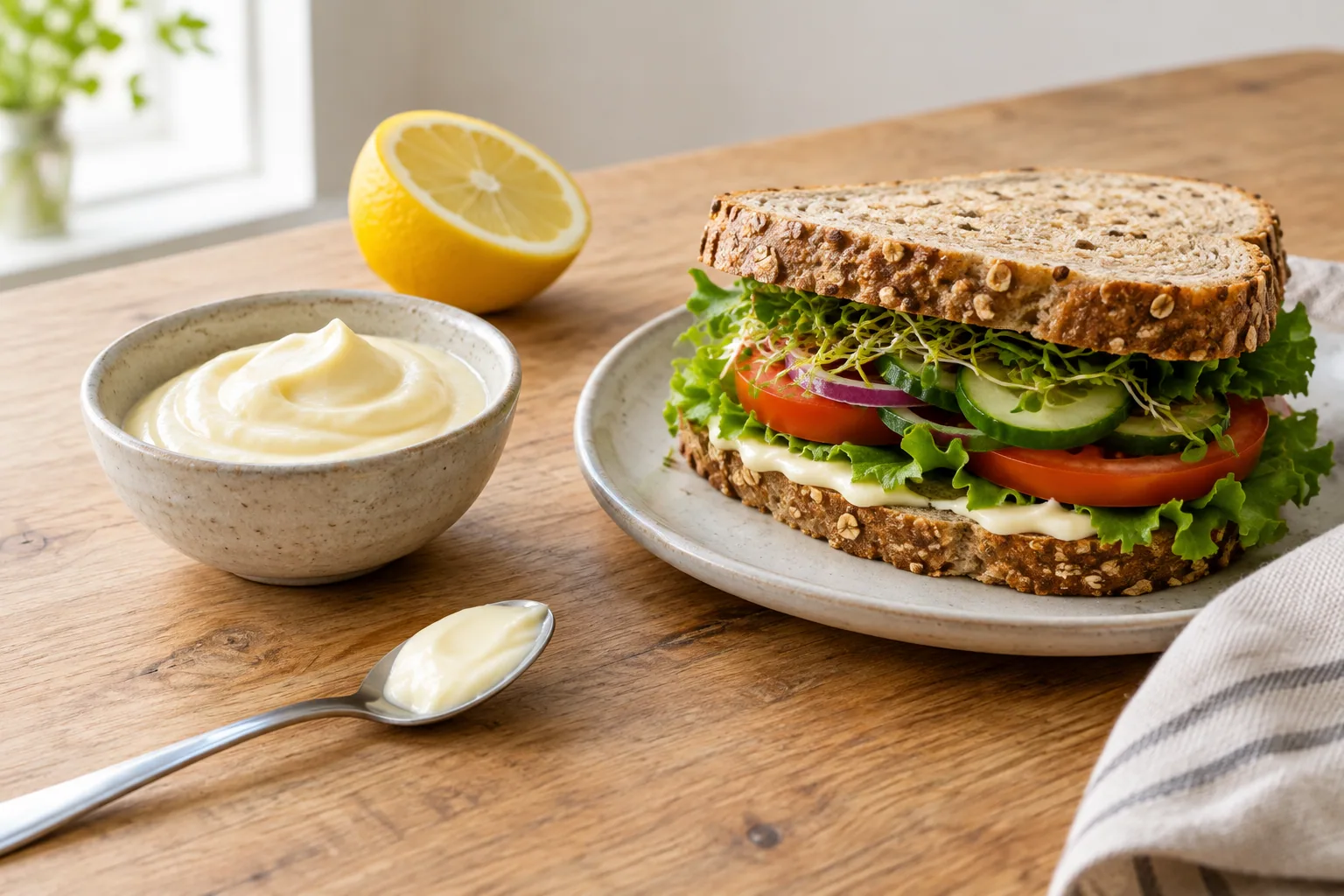
For an egg-free mayo that also avoids soy, start by comparing Follow Your Heart Soy-Free Vegenaise and JUST Mayo Plant-Based Spread. If you also avoid mustard, Soy-Free Vegenaise is not a match: it contains mustard flour, while JUST’s mustard information still needs checking on the package. There is no universally best jar, so choose by your ingredient restrictions first, then by how you plan to use it.
Egg-free mayo options at a glance
Use these four products as a shopping shortlist, not confirmation of local stock. This guide is dated October 10, 2026, but live availability, shelf prices and current package labels have not been verified; the gaps below are left visible rather than filled with guesses.
| Product | Market or shopping context | Base ingredients supported by product information | Egg, soy and mustard information | Price per 100 g | Suggested first use* |
|---|---|---|---|---|---|
| Follow Your Heart Soy-Free Vegenaise | U.S. brand; check local stock | High-oleic safflower oil, water, vinegar and pea protein; also contains mustard flour and lemon juice concentrate | Egg-free and soy-free formulation; contains mustard flour | Calculate from your shelf label | A small sandwich trial if mustard fits your restrictions |
| JUST Mayo Plant-Based Spread | U.S. retailer listing | Pea protein; inspect the package for the complete oil and ingredient list | Listed as egg-free, soy-free and dairy-free; mustard and precautionary statements need checking | Calculate from your shelf label | A candidate to compare if you avoid both egg and soy |
| Follow Your Heart Original Vegenaise | U.S. brand; check local stock | Check the current jar; do not substitute the Soy-Free variety’s ingredient list | Mustard appears in the manufacturer’s older allergen chart; check the current label for soy and trace wording | Calculate from your shelf label | A sandwich-spread candidate if its current label fits |
| Hellmann’s / Best Foods Vegan Mayo | Brand name and formulation vary by market | Check the exact local product | Vegan wording alone does not settle allergy suitability; check egg, soy, mustard and precautionary wording | Calculate from your shelf label | Compare with the other jars available in your store |
*These are suggested ways to try a product, not taste-test rankings. The available information does not support declaring one jar the creamiest, least tangy or best value.
Follow Your Heart’s May 2021 allergen chart lists mustard across its listed Vegenaise varieties, including Original and Soy-Free. That is a useful reason to inspect the mustard information closely, but an older chart cannot establish a current jar’s full formulation.
Compare flavor and texture with the food you actually make
A useful mayo replacement should work in your usual lunch, not just taste pleasant from a spoon. Without documented side-by-side testing, there is no reliable basis here for ranking these jars by tanginess, sweetness or thickness.
For a first purchase, use these criteria:
- Sandwiches: Look for a spread that stays where you put it and does not overwhelm the filling. Try it plain before adding mustard, relish or other seasonings.
- Potato salad: Start with a thicker dressing, then loosen it gradually. Warm or wet potatoes can change the finished texture, so drain them well before mixing.
- Dips: Choose a mayo you like on its own. You can add lemon juice and herbs, but those additions will not remove an unwanted sweet or mustard-heavy flavor.
The ingredient list can tell you that a jar contains mustard, vinegar, lemon juice or sugar. It cannot reliably tell you how strong those flavors will taste. Buy the smallest practical pack before committing to a large jar.
Compare unit prices, not just jar prices
Use the shelf’s price-per-100-g figure when it is available. Otherwise, calculate:
Jar price ÷ net weight in grams × 100 = price per 100 g.
Compare equivalent sizes where possible, and keep flavored spreads separate from plain mayo. A larger jar is only better value if you will use it within the package’s storage instructions.
Also separate products sold refrigerated from those labeled for room-temperature storage before opening. Do not assume that every egg-free mayo has the same storage requirements or opened shelf life.
What replaces egg in egg-free mayonnaise
Conventional mayonnaise uses egg yolk to help oil and water stay mixed. Egg-free versions use other emulsifying or stabilizing ingredients to create a similar spreadable texture.
Common alternatives include soy protein, pea protein, aquafaba, modified starch and gums. These ingredients have different roles: some help stabilize the oil-and-water mixture, while others help thicken it, as described in research on plant-based mayonnaise formulations.
Two examples in the shortlist use pea protein: Soy-Free Vegenaise and JUST Mayo Plant-Based Spread. Soy-Free Vegenaise combines it with safflower oil and water, so choosing a soy-free version does not mean choosing a protein-free formulation.
Keep these label terms separate:
- Conventional mayonnaise: Usually contains egg. Do not assume a familiar brand’s regular jar is interchangeable with its vegan version.
- Egg-free mayonnaise: Identifies the ingredient being excluded, but does not automatically mean every ingredient is vegan.
- A mayo labeled vegan is intended to exclude animal-derived ingredients, including egg, but the claim alone does not establish suitability for an egg allergy.
- Dairy-free mayonnaise: Can still contain egg. Dairy and egg are different ingredients and need separate checks.
For more background on what you are checking, read Bokha’s guide to egg as a food allergen.
Check egg, soy and mustard in three places on the package
Read the exact variety in your hand, including flavored versions and regional formulations. Recipes change, and the package label is the final authority for the product’s ingredient and allergen information.
- Read the ingredient list. Check for intentionally added egg, soy and mustard. Do not stop at a front-label “plant-based” or “dairy-free” claim.
- Read any separate allergen declaration. Use it alongside the ingredients, not instead of them. Label formats differ between markets.
- Read precautionary wording. Statements such as “may contain egg” concern possible cross-contact, rather than egg deliberately included in the recipe. The absence of such wording is not proof that cross-contact cannot occur.
If the label leaves an unanswered question, ask the manufacturer about the exact product. For guidance on how precautionary wording fits your own restrictions, ask your allergy professional.
Soy-Free Vegenaise: soy-free does not mean mustard-free
The manufacturer’s ingredient information names mustard flour, even though the product is called Soy-Free Vegenaise. If you avoid mustard, that ingredient is enough to rule out this formulation for your shopping list.
Still inspect the physical jar’s allergen declaration and precautionary statements. A product name cannot answer all three checks.
JUST Mayo: a soy-free claim does not answer the mustard question
The retailer lists JUST Mayo Plant-Based Spread as egg-free, soy-free and dairy-free, with pea protein. Those claims are useful for shortlisting, but they do not supply a complete mustard or cross-contact assessment.
Before buying, read its full ingredient list and any allergen or precautionary wording. Do not turn an unverified mustard status into a mustard-free recommendation.
Choose a jar for sandwiches, potato salad or a quick dip
Narrow your choice in this order:
- Remove jars that contain ingredients you avoid. For egg plus soy avoidance, Soy-Free Vegenaise and JUST are candidates to inspect. For egg plus soy plus mustard avoidance, the information here does not establish a suitable jar.
- Check what your store actually carries. Match the exact product name and variety, not just the brand.
- Compare unit price and storage instructions. Choose a pack you can realistically finish.
- Try it in your most common meal. Buy a small pack before buying in bulk.
These small starting portions let you adjust without wasting a whole dish:
- Sandwich spread: Start with 1 tablespoon per sandwich, then add more if needed.
- Potato salad dressing: Start with ¼ cup mayo for 1 pound of cooked, cooled potatoes. Add more a tablespoon at a time.
- Lemon-herb dip: Mix ¼ cup mayo with 1 teaspoon lemon juice and 1 teaspoon chopped herbs. Add a little water if you want a thinner dip, and check every added ingredient against your restrictions.
While shopping, you can scan a mayonnaise barcode with Bokha to review listed egg, soy, mustard and trace information, then compare the result with the package. It is a shopping aid, not a medical device, and a scan is not a guarantee of suitability.
For help checking other packaged foods, use the guide to checking groceries for egg with a barcode scanner. After choosing your mayo, find ideas for other spreads and sauces in these allergen-friendly condiment swaps.
FAQ
Is egg-free mayonnaise always soy-free?
No. Egg-free mayonnaise can use soy ingredients, while other versions use pea protein or different emulsifiers. Check the exact variety’s ingredients, allergen declaration and precautionary statements, even if another jar from the same brand is labeled soy-free.
Does egg-free mayonnaise need to be refrigerated?
Follow the instructions on the exact jar. Some products require refrigeration before opening, while others allow unopened room-temperature storage; removing egg does not determine the storage rule. Before buying, check both where to store it and how long the package says to keep it after opening.