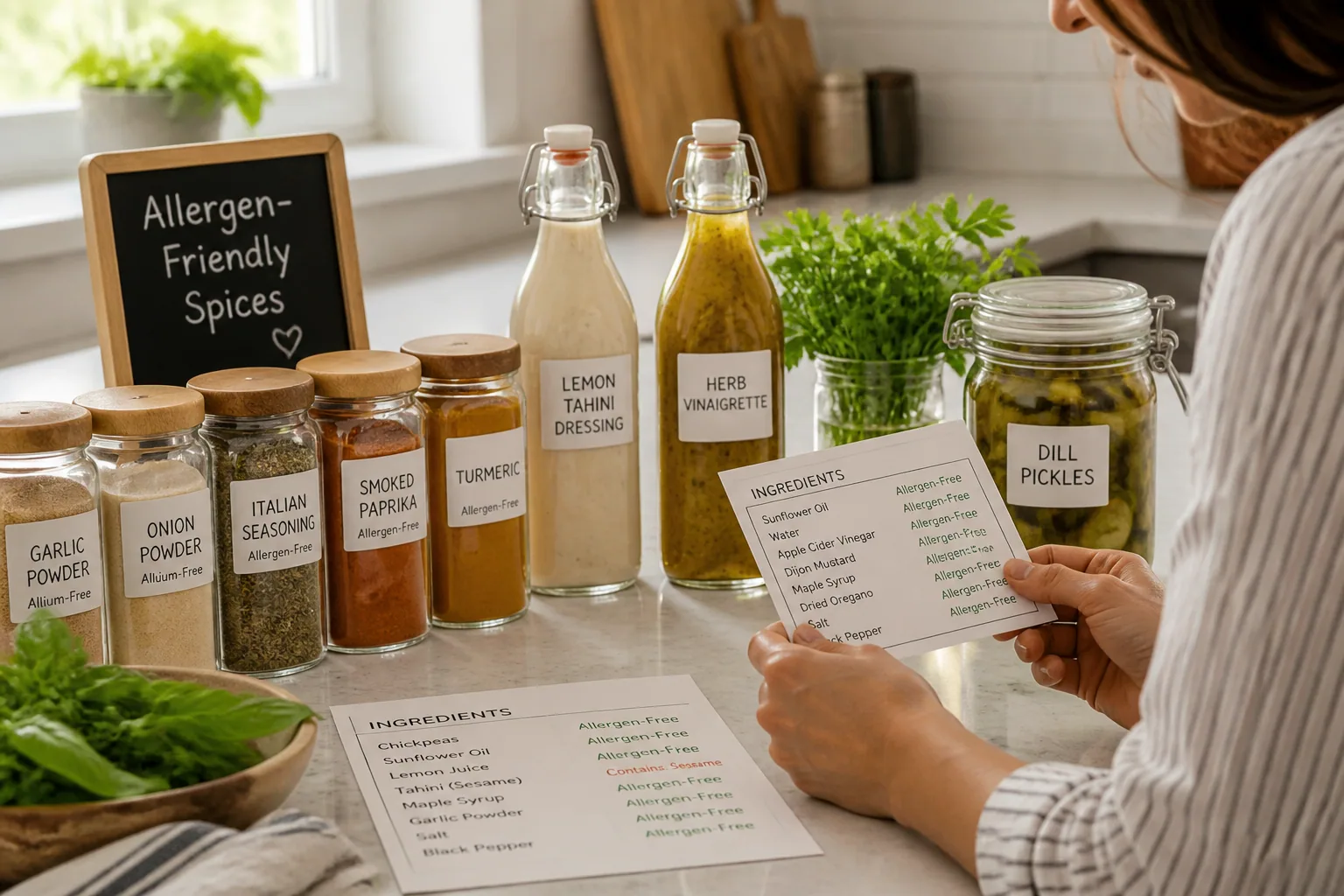
Safe Swaps for Flavor: Allergen-Friendly Seasonings & Condiments to Boost Your Meals
Condiments and seasonings are the quiet heroes of everyday cooking. A spoonful of dressing, a splash of sauce, or a pinch of spice can completely change a meal. But for anyone cooking around food allergies, those same flavor boosters can also be a hidden source of risk. Allergen ingredients are not always obvious, and cross-contact during manufacturing can make an otherwise simple product unsafe.
The good news is that you do not need to give up bold, satisfying food to stay safe. With a little label-reading skill, an understanding of warning statements, and a few smart substitutions, you can keep meals flavorful while reducing exposure to common allergens.
Why Condiments and Seasonings Are a Hidden Allergen Risk
People often think of allergen risks in the context of obvious foods like milk, eggs, peanuts, or shellfish. Yet many of the most everyday flavor products are more complicated than they look. Sauces, marinades, spice blends, pickles, salad dressings, barbecue sauces, and even seasoning mixes can contain ingredient sources that are not immediately recognizable.
This is partly because these products often rely on blended ingredients such as thickeners, flavorings, stabilizers, or preservatives. It is also because some terms on labels are broad by design. A product may taste like a simple herb mix or vinegar-based sauce, while still including ingredients derived from major allergens or being made on shared equipment with them.
That is why condiments deserve the same careful review as main dishes. A safe meal can become unsafe if the sauce, seasoning packet, or pickle relish on top is not checked first.
Common Allergens Found in Sauces, Spice Blends, Pickles, and Dressings
The U.S. FDA requires packaged foods to clearly label the nine major food allergens when they are present as ingredients: milk, eggs, fish, crustacean shellfish, tree nuts, peanuts, wheat, soybeans, and sesame. That is a helpful baseline, but it does not mean every risky ingredient will be easy to spot at first glance. More on the FDA’s allergen labeling framework can be found here: https://www.fda.gov/food/conversations-experts-food-topics/current-food-allergen-landscape
In condiments and seasonings, some of the most common problem ingredients include soy-based sauces, wheat-based thickeners, dairy-derived powders, mustard, sesame, and nut oils. Hidden gluten is especially common in sauces, salad dressings, BBQ sauces, and pickles, where wheat-derived ingredients may be used for texture or flavor even when the product does not obviously seem bread-based. A useful overview of this issue is available here: https://checkgluten.com/blog/hidden-gluten-in-sauces-and-condiments/
Even when a product does not list an obvious allergen by name, ingredients like lecithin, flour, whey, or natural flavor may be derived from a major allergen and must be clearly indicated under U.S. rules. The USDA notes that these derivatives should be identified, often through a parenthetical source statement or a “Contains:” line: https://www.fsis.usda.gov/food-safety/safe-food-handling-and-preparation/food-safety-basics/food-allergies-big-9
For allergy-aware shoppers, the key habit is not only checking the front of the package, but scanning the full ingredient list every time. Formulas change, and a favorite sauce can become unsafe after a recipe update.
How to Read Ingredient Labels for Hidden Allergen Clues
Ingredient labels are designed to help, but you need to know where to look. Start with the obvious allergen callouts, especially any “Contains:” statement. Then read the ingredient list slowly, looking for not just the allergen itself, but ingredient names that may be derived from it.
Terms like natural flavor, flavorings, spice extractives, flour, whey, casein, albumin, and lecithin deserve attention. Some of these ingredients are perfectly safe for many people, but for someone avoiding a specific allergen, the source matters. For example, lecithin can be sourced from soy, and flour can mean wheat unless otherwise specified.
The challenge is that labels do not always tell the whole story in an obvious way. “Natural flavors” and “spices” can be collective terms rather than fully itemized ingredient lists, which means the exact source may not be visible on the front label. If a product is important to your household and the label feels unclear, contact the manufacturer directly before serving it.
A practical rule is to treat vague language as a prompt to investigate, not as proof of safety. If you are cooking for someone with allergies, certainty is better than assumption.
What Cross-Contact and Shared Equipment Warnings Really Mean
Warning statements such as “May contain…,” “Made in a facility that also processes…,” or “Shared equipment” are often called precautionary allergen labeling. These statements are voluntary, not required by law, and the wording is not standardized in a way that reliably tells you how much actual risk is present. The FDA explains that these warnings are not a precise measure of contamination likelihood: https://www.fda.gov/food/conversations-experts-food-topics/current-food-allergen-landscape
That matters because some shoppers assume a softer warning means lower risk, while a stronger warning means a bigger problem. In reality, the phrasing alone does not give you a dependable safety scale. One company may use a warning out of extra caution, while another may not warn even if the product still has some cross-contact risk.
Cross-contact can happen when allergen-containing ingredients touch shared surfaces, utensils, scoopers, tanks, or conveyor lines. In seasoning and condiment production, where multiple powders or liquids may be processed in the same facility, the risk can be especially relevant. Safe manufacturing practices often include scheduling allergen-free batches first, using color-coded utensils, storing allergenic and non-allergenic ingredients separately, and cleaning equipment thoroughly between runs. These are the kinds of sanitation and separation practices recommended to reduce contamination risk: https://experts.gohaccp.com/blog-prevent-cross-contamination
For home cooks, this is a reminder to think beyond the ingredient list alone. A product may appear allergen-free on paper but still be unsuitable if the packaging warns about shared equipment and the allergy is severe.
Certified Allergen-Free Condiments: What to Look For
When you want more confidence, third-party certification can help narrow the field. For gluten avoidance in particular, the Gluten-Free Certification Organization, or GFCO, offers certification that products meet specified gluten-free thresholds and follow strict ingredient and source verification processes: https://gfco.org/
Certification does not replace personal judgment, but it adds another layer of accountability beyond a simple brand promise. That is especially useful for condiments and seasonings, where hidden gluten can show up in unexpected places and where a small amount of contamination can matter a lot.
If you are shopping for an allergy-friendly pantry, look for products that clearly identify the allergen status, have a short and understandable ingredient list, and ideally carry a relevant third-party certification when your household needs one. The more transparent the company is about sourcing and testing, the easier it becomes to trust the product.
This is also where technology can save time. The Bokha: Food Allergy Scanner App lets you scan product barcodes and check allergens in less than a second on iOS and Android, which can be especially useful when comparing sauces, spice mixes, and dressings in the supermarket. You can learn more here: https://findthe.app/bokha
Homemade Alternatives for Safer Flavor at Home
One of the easiest ways to reduce risk is to make a few staple condiments yourself. Homemade versions give you full control over ingredients, which means you can avoid hidden allergens and reduce uncertainty from manufacturing cross-contact. They also let you adjust salt, acid, sweetness, and heat to match your family’s taste.
For example, if you need a substitute for Worcestershire-style depth, a simple combination of tamari or coconut aminos with vinegar and a little honey or sugar can recreate much of the salty, umami, sweet, and acidic balance. That type of substitution is especially useful because it preserves flavor structure rather than just replacing one sauce with another random liquid.
Homemade vinaigrettes are another easy win. A basic ratio of oil, vinegar or citrus, mustard if tolerated, herbs, and a touch of sweetener can replace many store-bought dressings. If mustard is not safe, you can still build body with a little maple syrup, salt, and finely minced shallot or garlic, depending on what is tolerated in your household.
For spice blends, making your own mix lets you avoid hidden fillers and anti-caking agents that may be unnecessary or risky. A pantry-friendly blend of salt, paprika, garlic powder, onion powder, black pepper, cumin, and dried herbs can cover a lot of everyday cooking without relying on a pre-made packet.
Smart Ingredient Swaps That Keep Flavor Balanced
The best substitutions are the ones that preserve the job the original ingredient was doing. In cooking, condiments usually contribute one or more of five core flavor functions: saltiness, acidity, sweetness, heat, and umami. If you understand which role the ingredient plays, you can swap more confidently.
If a sauce provides salt and umami, try tamari if soy is safe, or coconut aminos if soy and wheat are not. If you need acidity, use vinegar, lemon juice, or pickle brine from a safe source. If sweetness is part of the balance, a little sugar, honey, or maple syrup can smooth sharp flavors. If heat is missing, use chili flakes, cayenne, or a trusted hot sauce. And if richness is the goal, a bit of safe oil or tahini substitute can help, depending on the allergy profile.
The trick is not to chase exact replicas every time. It is to create a balanced flavor profile that delivers the same eating experience. That mindset makes allergen-friendly cooking feel less restrictive and much more practical.
Tips for Building an Allergen-Safer Pantry
A safer kitchen starts with a pantry that is easy to navigate. Keep a short list of trusted condiments and seasonings that you know have been checked carefully, and store them separately from higher-risk items if that makes meal prep easier. Clear labeling at home can also help, especially if multiple people cook in the same kitchen.
Buy smaller quantities of specialty sauces and use them before ingredient formulas change. Recheck labels regularly, even on items you have purchased before. If a brand changes packaging, adds a new facility note, or updates its ingredient list, assume it needs to be reviewed again.
It is also useful to organize by purpose rather than by brand. Keep one safe item for acidity, one for salt and umami, one for sweetness, one for heat, and one or two seasoning blends that cover your favorite cuisines. That way, you can build meals quickly without reaching for uncertain products.
Mistakes to Avoid When Cooking for Someone With Allergies
One common mistake is assuming a familiar product is safe because it has always been safe before. Ingredients change, suppliers change, and manufacturing lines change. Another mistake is relying only on front-of-pack claims like “natural” or “simple ingredients” without checking the full label.
A second mistake is ignoring precautionary allergen statements because they are voluntary. While not every warning means the same thing, it is still a meaningful clue that the manufacturer sees a possible cross-contact risk. For a person with a severe allergy, that clue matters.
A third mistake is forgetting that condiments are often shared at the table. Double-dipping knives into jars, using the same spoon for multiple sauces, or letting breadcrumbs fall into a dip can create avoidable cross-contact at home. Clean utensils, separate serving spoons, and clearly labeled jars can make a big difference.
Finally, do not assume homemade always means safe unless you control every step. Homemade sauces can still be risky if they include ingredients from an unsafe source, or if they are prepared in a kitchen where cross-contact is likely. Careful sourcing matters just as much as careful cooking.
Final Checklist for Adding Flavor Without Compromising Safety
Before serving a seasoning or condiment to someone with allergies, check the ingredient list for major allergens and their derivatives, look for vague terms like natural flavors or spice blends, review any precautionary warning statements, and confirm whether the product is certified if that level of assurance is important to your household. If anything is unclear, contact the manufacturer or choose a different product.
At home, keep a few safe flavor builders on hand so you are not tempted to improvise with uncertain products when you are tired or rushed. A good pantry should make safe cooking easier, not more stressful. And if you want a faster way to screen packaged products while shopping, Bokha: Food Allergy Scanner App can help you check labels in seconds and compare options with less guesswork: https://findthe.app/bokha
Flavor should be the fun part of cooking, not the dangerous part. With the right habits, you can keep your meals vibrant, satisfying, and far safer for everyone at the table.