Why Precautionary Allergen Labels Cause So Much Confusion - And How Shoppers Can Stay Safe
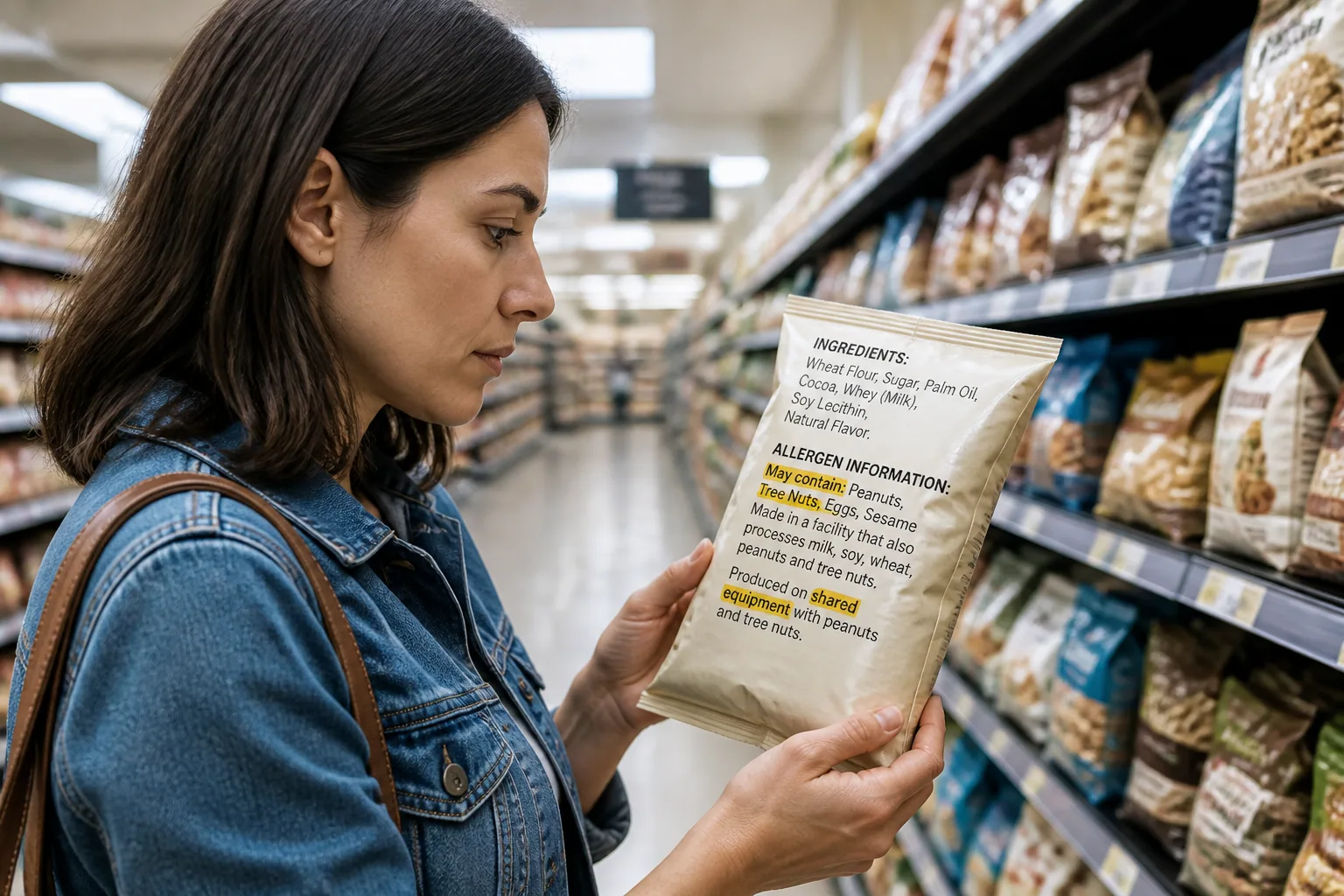
If you live with a food allergy, you already know that the hardest part of shopping is not always the ingredient list. It is the small warning sentence that appears after it: “may contain,” “made on shared equipment,” or “processed in the same facility.” These precautionary allergen labels, often called PALs, are supposed to help shoppers avoid accidental exposure. In practice, they often do the opposite. They leave people wondering whether the product is genuinely risky, whether the warning is just legal caution, or whether the label means nothing at all.
That confusion is not accidental. PALs are widely used, but they are not tightly standardized in many places, including the U.S. The result is a system where the same kind of allergy risk can be described in many different ways, with no universal rule for when a warning should appear or what exact wording should be used. For shoppers trying to make safe choices, that creates stress, delays, and sometimes unsafe assumptions.
Why Precautionary Allergen Labels Frustrate So Many Shoppers
The main problem with PALs is that they are meant to communicate risk, but they do not clearly explain how much risk exists. A label that says “may contain peanuts” sounds serious, but does it mean the product definitely has traces of peanuts, or only that the manufacturer wants to protect itself from liability? A phrase like “shared equipment” sounds more specific, yet it still does not tell you whether the line was cleaned thoroughly, whether cross-contact is frequent, or whether the chance of contamination is tiny.
This ambiguity makes shopping exhausting. People with allergies do not just need labels. They need reliable signals. When wording varies from one brand to another, or even from one product to another within the same company, shoppers cannot build a simple rule they can trust. That is why PALs often feel less like useful guidance and more like a warning system with the volume turned up but the meaning turned down.
What Counts as a Precautionary Allergen Label?
Precautionary allergen labels are voluntary statements used by manufacturers to warn consumers about possible cross-contact with allergens during production. The three most common forms are “may contain [allergen],” “manufactured on shared equipment with [allergen],” and “manufactured in the same facility with [allergen].” According to a recent review in PMC, these statements are not required by the FDA, even though they are widely used in the food supply. Source: https://pmc.ncbi.nlm.nih.gov/articles/PMC11250542/
This is important because PALs are not the same as the mandatory ingredient disclosure used for major allergens. A product can be fully compliant with labeling law and still include a PAL as an extra warning. That means the presence of a PAL is not proof that an ingredient is included, and the absence of a PAL is not a guarantee that a product is completely free from cross-contact risk.
The U.S. Rules: What’s Regulated - and What Isn’t
In the U.S., the law is much clearer about what must be declared when an allergen is intentionally used than about what must be said when contamination is only possible. The Food Allergen Labeling and Consumer Protection Act established mandatory labeling rules for major allergens, and the FASTER Act added sesame as the ninth major allergen in 2021. Sesame now has to appear in the required “contains” statement when it is intentionally used. But precautionary warnings remain voluntary, and there is still no FDA rule that forces manufacturers to use a PAL in a specific situation or phrase it in a specific way.
That lack of regulation is a big reason shoppers feel lost. A 2026 study noted that although PAL is widely used in the U.S., there are no existing regulatory standards for when a manufacturer must use it or how it should be worded. The study also linked this lack of standardization to anxiety and confusion among people with food allergies and caregivers. Source: https://www.sciencedirect.com/science/article/abs/pii/S1081120626002000
In other words, U.S. law gives strong rules for ingredients that are intentionally present, but much weaker guidance for possible contamination. That gap is where most of the confusion lives.
How Other Countries Handle PALs Differently
The international picture is also uneven. Some countries, such as Japan and Switzerland, prohibit precautionary labeling altogether. Others, including the EU, Australia, New Zealand, Canada, and the U.S., allow PALs but do not fully harmonize thresholds, wording, or enforcement. Source: https://pmc.ncbi.nlm.nih.gov/articles/PMC11250542/
That means a shopper may see one approach in one country and something entirely different in another. It also means multinational brands often adapt labels to local expectations rather than using one universal risk language. For allergy sufferers, this creates a patchwork of rules that is difficult to interpret consistently.
There is, however, broad agreement among many international experts that PAL should be simplified. Multiple bodies, including FAO/WHO and the World Allergy Organization through the ACT-UP! consensus, favor a single standardized phrase, especially “may contain [X],” along with evidence-based reference levels or thresholds. Source: https://pmc.ncbi.nlm.nih.gov/articles/PMC13470184/
What “May Contain,” “Shared Equipment,” and “Same Facility” Actually Suggest
These common phrases can sound like a ranking system, but in practice they are not always a reliable one. Intuitively, many shoppers assume “may contain” is the strongest warning, “shared equipment” suggests a moderate level of risk, and “same facility” sounds like the weakest. That hierarchy may seem logical, but real-world manufacturing is more complicated than the wording suggests.
A study summarized in the PMC review examined peanut and milk residues in products carrying different PAL statements. Among products labeled “may contain peanut,” peanut residues were found in 2 out of 51 products. For “shared equipment,” 3 out of 57 products contained peanut, and for “shared facility,” 7 out of 68 did. For milk, contamination appeared in 60.7 percent of “may contain” products, 33.3 percent of “shared equipment” products, and 28.6 percent of “shared facility” products. Source: https://pmc.ncbi.nlm.nih.gov/articles/PMC11250542/
The key takeaway is not that one phrase is always safer than another. It is that wording alone does not consistently predict risk. A more alarming phrase may sometimes appear on a lower-risk product, while a milder phrase may hide a more serious issue. That is why shoppers should never treat PAL wording as a scientific measurement of contamination.
Why PAL Wording Doesn’t Always Match Real Risk
There are several reasons the label may not match the actual risk. First, manufacturers may use PAL conservatively to avoid liability, even when the true chance of cross-contact is very low. Second, some companies may use a generic warning across many products rather than assessing each line separately. Third, different plants, ingredients, and cleaning procedures can create very different contamination scenarios that a simple sentence cannot describe.
This is why the same wording can mean different things from one brand to another. It is also why some products with no PAL may still be risky if a company has weak allergen controls, while some products with a PAL may still be safe enough for certain people depending on the allergen and their sensitivity. The label alone does not tell the whole story.
Consumer behavior data also shows that shoppers interpret these warnings inconsistently. In a Canada and U.S. survey, 46 percent of respondents were unsure or incorrectly believed PAL was required by law, and 29 percent believed PAL indicates there is a minimum allergen level specified. Source: https://pubmed.ncbi.nlm.nih.gov/27818137/
That misunderstanding matters because it shows that many people are reading PAL as something more official and precise than it really is.
Best-Case vs. Misleading Examples of PAL Use
The best-case use of a precautionary allergen label is simple and consistent. A company identifies a credible cross-contact risk, uses a single standardized warning, and applies it only when the risk assessment supports it. In that scenario, the label is at least trying to be informative rather than defensive.
A misleading example is the opposite. A manufacturer might place a PAL on nearly every product in a line, even when only one item in a batch truly presents a risk. Another misleading case is when different products from the same brand use different phrases for what appears to be the same exposure scenario. This can make shoppers think the wording is meaningful when it may simply reflect internal habit, marketing concerns, or legal caution.
Large-scale data shows how common these warnings have become. In a survey of 20,241 unique U.S. food products, 17 percent had some sort of PAL, and in categories like chocolate candy and cookies, more than 50 percent carried PAL statements. Source: https://pmc.ncbi.nlm.nih.gov/articles/PMC11250542/
When a warning is everywhere, it becomes harder to know when it matters most.
How Shoppers with Allergies or Intolerances Can Make Safer Decisions
Because PALs are inconsistent, shoppers need a strategy instead of a single rule. The safest approach is to treat PAL as one piece of evidence, not the final answer. Start with your own allergy profile. Some people react to even tiny traces, while others may tolerate very low-risk cross-contact depending on the allergen and their medical guidance. Your personal threshold matters, and it may be stricter than the label suggests.
Next, compare products from different brands. If one brand uses PAL on nearly everything and another is more specific, the second may offer more useful information. Then check the full ingredient list carefully, because intentional allergens must be declared differently from precautionary warnings. If a product raises doubt, look for the company’s allergen policy or contact the manufacturer directly. A company that can explain its cleaning procedures, line separation, and testing practices often gives you more useful information than the sentence on the package.
It also helps to remember that health literacy affects PAL interpretation. One study found that consumers with lower health literacy perceived PAL risk as higher than those with higher literacy, and fewer than 40 percent of participants found PAL information comprehensible. Source: https://pubmed.ncbi.nlm.nih.gov/34288165/
That means confusion is not a personal failure. The system is genuinely hard to read.
How Tools Like Bokha Can Help Decode Labels Faster
For people who need to move quickly in the supermarket, a good scanning tool can reduce a lot of guesswork. Bokha, a food allergy scanner app available on iOS and Android, lets you scan product barcodes and discover allergens in less than a second. It detects 13 allergens, traces, and additives, which can help users quickly screen products before they end up in the cart. You can learn more here: https://findthe.app/bokha
A tool like this is especially useful when you are comparing many products in a short amount of time. Instead of reading every package from scratch, you can use the scan as a first filter, then follow up on any product that needs closer review. That kind of speed is valuable for families shopping with children, people managing multiple intolerances, or anyone who wants a faster, more confident routine.
What Needs to Change for Labels to Become More Trustworthy
The biggest improvement would be standardization. If manufacturers had to follow one simple phrase, one evidence-based threshold, and one clear rule for when a PAL is allowed, shoppers would have a much better chance of understanding what the warning actually means. That is why so many experts favor a unified approach rather than the current patchwork of phrases.
Better transparency would also help. If labels were tied to documented risk assessments, cleaning validation, or contamination thresholds, consumers would not have to guess whether a warning is generic or specific. More consistent enforcement would make a difference too, because rules without oversight do little to improve trust.
Until that happens, shoppers will keep facing a system where the label is often a clue, not a conclusion. The safest path is to stay skeptical, compare carefully, and use every available tool to interpret the warning in context. PALs may be useful, but right now they are still too vague to stand on their own.