Why “Free From” Labels Can Be Misleading - What You Really Need to Know
If you shop with food allergies, intolerances, or a child’s safety in mind, front-of-pack promises can feel reassuring at first glance. A label that says “free from” sounds simple and comforting. But in real life, it is not always a guarantee that a food is safe for everyone. The key problem is that legally required allergen disclosure and voluntary marketing claims are not the same thing. One is designed to tell you what is in the product. The other is often designed to help sell it.
That distinction matters. A product can be honestly marketed as “free from” a specific ingredient and still be made in a facility where cross-contact is possible. Meanwhile, a “may contain” warning might appear on products that never actually tested positive for the allergen. For allergy-aware shoppers, this can make label reading feel confusing, inconsistent, and frustrating. The goal here is to help you understand what these labels do, what they do not do, and how to shop more safely without relying on assumptions.
Why “Free From” Doesn’t Always Mean Risk-Free
The phrase “free from” sounds absolute, but food labeling is rarely that simple. A product may be free from one ingredient in the finished recipe while still carrying a small risk of unintended allergen presence from shared lines, shared equipment, or facility traffic. In other words, “free from” usually describes the intended formulation, not necessarily the full manufacturing environment.
This is why the front of the package should never be your only source of truth. The most important question is not whether the product claims to be free from something. It is whether the allergen is legally declared, whether there is a precautionary warning, and whether the manufacturer has considered cross-contact risk carefully. Those are separate issues, and they do not always line up neatly.
Legally Required Allergen Labels vs Voluntary Marketing Claims
In the United States, the Food Allergen Labeling and Consumer Protection Act requires that if a product contains any of the nine major allergens, the label must list them by name immediately after the ingredient list. Those major allergens are milk, eggs, peanuts, tree nuts, soy, wheat, fish, shellfish, and sesame. This is the core disclosure rule that allergy-aware shoppers can rely on most consistently. The FDA explains this requirement clearly in its FALCPA guidance: https://www.fda.gov/food/food-allergensgluten-free-guidance-documents-regulatory-information/food-allergen-labeling-and-consumer-protection-act-2004-falcpa
By contrast, voluntary claims like “free from,” “may contain,” or “made in a facility” are not governed the same way. That means the wording, placement, and meaning of these statements can vary widely from one brand to another. A product may use a claim to reassure shoppers, but the law does not force every company to use the same language or apply the same threshold for risk.
There is also an important nuance in U.S. free-of claim rules. Under 16 CFR § 260.9, even a truthful “free from” statement can still be considered deceptive if it is not clearly qualified and if it risks misleading consumers. That regulation focuses on whether the product truly lacks the substance being claimed, but it does not solve the separate issue of unintentional cross-contact. In plain terms, a claim can be technically accurate and still not tell you enough about allergy safety: https://www.law.cornell.edu/cfr/text/16/260.9
What “May Contain” Really Means for Allergy Safety
“May contain” is one of the most misunderstood phrases on food packaging. It is not a standardized legal promise, and it does not always mean that the allergen was actually found in the product. In practice, it usually means the manufacturer believes there is some potential for cross-contact during production, packaging, or handling. But the language can be broad, inconsistent, and sometimes used defensively rather than precisely.
Recent expert commentary in Allergic Living noted that precautionary allergen labels are voluntary in the U.S. and there are no standardized rules governing their wording or placement. That lack of standardization creates confusion because different companies may use different phrases for similar situations, or even use similar phrases for very different levels of risk: https://www.allergicliving.com/2026/05/07/need-to-know-expert-on-pros-cons-of-threshold-allergen-labels/
Research supports that confusion. A 2023 PubMed review found that in many countries, including many EU nations, precautionary allergen labeling remains largely unregulated, which can lead to overuse and inconsistent application. That means many products with PAL do not contain detectable allergens, while some products without any warning do contain allergen residue at risky levels. The label alone is not a perfect predictor of what is inside: https://pubmed.ncbi.nlm.nih.gov/36682535/
How Cross-Contamination Risk Is Assessed in Food Manufacturing
Cross-contamination, also called cross-contact in allergen contexts, is the accidental transfer of an allergen from one product or ingredient to another. Manufacturers may assess this risk by looking at shared equipment, production schedules, cleaning procedures, ingredient sourcing, ingredient transport, and packaging flow. Theoretically, a company can reduce risk substantially with strong controls. In practice, the quality of those controls varies a lot.
This is why two products from different brands can have similar ingredient lists but very different real-world risk profiles. A company with rigorous allergen management may produce a safer product without needing a broad precautionary warning, while another company may use a vague warning on many items as a blanket defense. The problem is that shoppers usually cannot see the internal assessment behind the label.
The evidence shows that precautionary wording is not a reliable signal by itself. Surveys have found that phrases like “may contain,” “manufactured on shared equipment,” and “made in the same facility as” are often used interchangeably, yet testing does not show that any single phrase reliably means higher or lower risk. That means you should treat the wording as a clue, not a measurement: https://pmc.ncbi.nlm.nih.gov/articles/PMC11250542/
When “Free From” Claims Are Reliable - and When They Can Mislead
A “free from” claim is more trustworthy when it refers to a clearly defined ingredient, is consistent with the ingredient list, and is backed by transparent allergen disclosure or a reputable manufacturer’s process. For example, a product that clearly states it is free from a specific allergen, has no trace of that allergen in its ingredient list, and comes from a brand that explains its allergen controls in detail is more reassuring than a vague front-label promise with no context.
But a “free from” claim can mislead when it encourages consumers to stop reading further. It can also be misleading if the product is free from one allergen but still vulnerable to another, or if the manufacturer changes suppliers, equipment, or formulas without making the label meaning obvious. A product can look safe from the front and still deserve a second look on the back.
This is especially important because precautionary labels are widespread in some food categories. Large-scale audits have found that about 17% of more than 20,000 unique U.S. food products carry some form of precautionary allergen label, and in categories like cookies, snacks, and confectionery, the share is much higher. In other words, the issue is not rare or isolated: https://pmc.ncbi.nlm.nih.gov/articles/PMC4005619/
Common Label Red Flags Parents and Allergy-Aware Shoppers Should Watch For
There are a few label patterns that should make you pause. The first is inconsistent wording. If one product says “free from,” another says “may contain,” and a third says “shared equipment,” but all three are from the same brand and category, you should not assume the risk level is comparable. The wording may reflect legal caution more than actual testing or manufacturing risk.
Another red flag is a label that seems to change without explanation. A product that used to have no precautionary statement and suddenly adds one may indicate a formula, supplier, or production-line change. The reverse can also happen. If a warning disappears, that does not automatically mean the risk disappeared too. It may simply mean the company changed its label policy.
You should also be cautious with products that are heavily processed in high-risk categories such as confectionery, cookies, snack mixes, and baked goods. Research shows that certain categories are much more likely to carry precautionary warnings, and testing has shown that some products with no allergen statement at all still contain detectable allergens. UK data found that 8.2% of items without an allergen declaration or PAL contained detectable milk allergen, and 6.1% had gluten, with hazelnut and peanut also occasionally detected when no warning was present. That is a reminder that silence is not always safety: https://www.food.gov.uk/research/food-allergy-and-intolerance-research/quantitative-risk-assessment-of-food-products-cross-contaminated-with-allergens
At the same time, not every precautionary warning means the product is unusable. Some PAL-labeled products contain no detectable residue at all. But when tests do find allergen presence, the risk can be meaningful. A UK survey found that 80% of PAL-labeled items that tested positive posed a risk to allergic individuals, and dark chocolate products with milk PAL were predicted to trigger reactions in a significant share of simulated eating occasions for people with milk allergy. That means you cannot assume a warning is meaningless, even if many products with warnings are ultimately safe for some consumers: https://science.food.gov.uk/article/158382-quantitative-risk-assessment-of-food-products-cross-contaminated-with-allergens/attachment/333045.pdf
How to Use Barcode-Scanner Apps Without Relying on Them Blindly
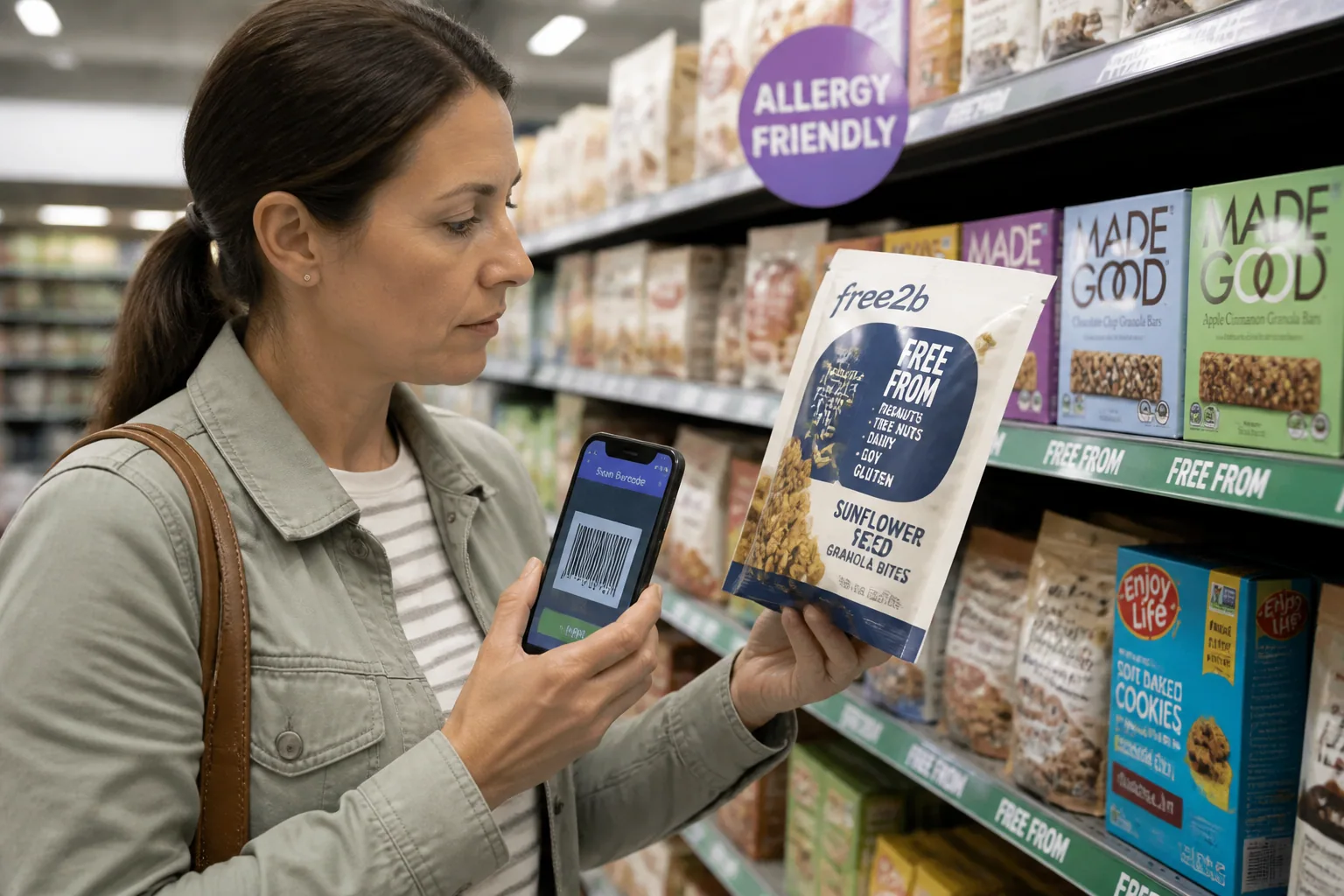
Barcode-scanner apps can be very helpful, especially when you are standing in a supermarket aisle and trying to compare several products quickly. They are best used as a first filter, not a final decision. A good app can help you identify obvious allergen problems fast, save time, and reduce the chance of missing an ingredient you should avoid. But an app cannot replace a fresh label check, because formulas and warnings can change.
This is where a tool like Bokha: Food Allergy Scanner App can be useful. Bokha is available on iOS and Android, and it scans product barcodes to reveal allergens in less than a second. It can detect 13 allergens, traces, and additives, which makes it practical for a quick first pass when you are comparing products in-store: https://findthe.app/bokha
Still, the safest workflow is to treat the app as a shortcut, not a verdict. Scan the item, then confirm the ingredient list, any allergen statement, and any recent label changes yourself. If the app and the package disagree, trust the most current packaging and, if needed, contact the manufacturer. Apps are excellent for speed, but they are only as good as the data they use.
A Safer Shopping Checklist for Food Allergies and Intolerances
A practical shopping routine can reduce stress and mistakes. Start by checking the ingredient list for the specific allergen you need to avoid. Then look for the legally required allergen disclosure after the ingredients, especially for the nine major allergens covered under U.S. law. Only after that should you read the precautionary warning, if one is present.
Next, look at the product category. Items that are more likely to be produced on shared lines, like snacks, baked goods, chocolate, and confectionery, deserve extra caution. If the product has changed packaging, new artwork, or an updated nutritional panel, do not assume the recipe stayed the same. A new look often means a new review is needed.
Also pay attention to repeated purchases. A product that was safe last month may not be safe today if the supplier changed or if the factory started producing a new item on the same line. The safest shoppers are not the ones who memorize one label forever. They are the ones who recheck routinely and treat packaging as current evidence, not permanent truth.
When to Contact the Manufacturer Before You Buy
Contact the manufacturer when the label is vague, when the precautionary wording seems inconsistent, or when the product is important enough that you need more certainty than a package can give. This is especially useful if the product is for a child, if the allergy is severe, or if the food is something you buy regularly and want to verify over time.
When you call or email, ask specific questions. Does the product contain the allergen as an ingredient? Is it produced on shared equipment? Is the facility dedicated or multi-use? What cleaning and verification procedures are used? Has the formula, supplier, or production line changed recently? The more specific your question, the more useful the answer is likely to be.
If the manufacturer is unable or unwilling to answer clearly, that itself is information. It may not mean the product is unsafe, but it does mean you have less basis for trusting it. For high-stakes allergies, uncertainty is often reason enough to choose a better-documented alternative.
The Bottom Line: Read Beyond the Front of the Pack
The front of the package is designed to catch your eye. The ingredient list and allergen statement are designed to protect you. That is the first and most important distinction to remember. “Free from” can be useful, but it is not the same as a regulated safety guarantee, and “may contain” is not a standardized measurement of danger. Both need context.
The safest approach is to combine sources of information: read the legally required allergen disclosure, interpret precautionary language cautiously, watch for label changes, use barcode-scanner apps as a fast first check, and contact manufacturers when the stakes are high. Research shows that precautionary labels are inconsistent and imperfect, but it also shows that some unlabeled products contain detectable allergens while some labeled ones do not. That is exactly why careful, layered label reading matters.
If you live with food allergy or shop for someone who does, the goal is not to become paranoid. It is to become systematic. Read beyond the front of the pack, verify what matters most, and never let a reassuring phrase replace actual allergen checking.