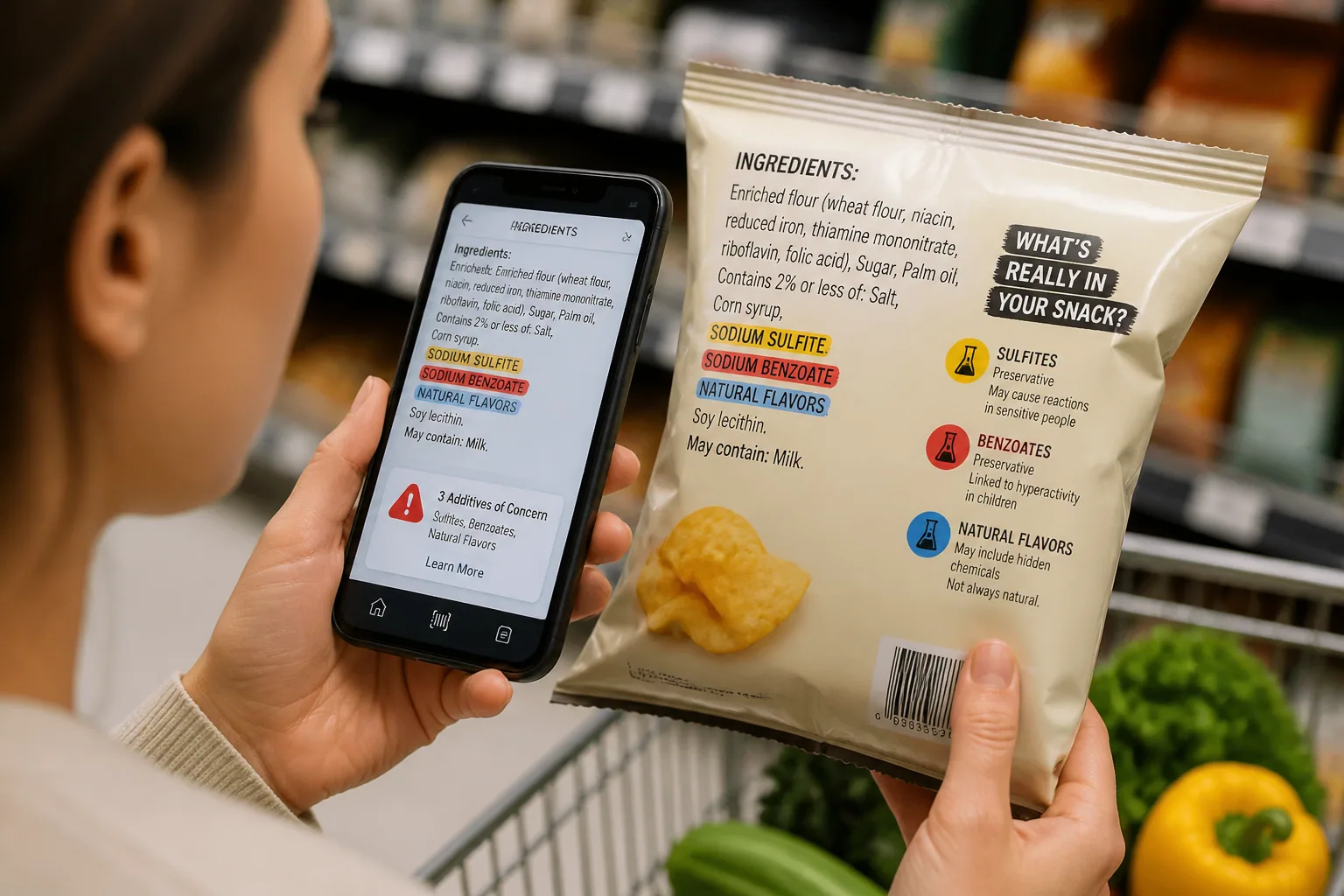
Why Additives & Preservatives Slip Past Allergy Scanners and How to Catch What Barcodes Miss
Barcode scanners have become a huge help for people managing food allergies and intolerances, but they still have an important blind spot: additives and preservatives. A product can look safe at a glance because it avoids the obvious major allergens, while still containing colorants, flavorings, stabilizers, emulsifiers, or preservatives that may trigger symptoms in sensitive people. That is exactly why scanning the barcode is a smart first step, but not the whole story.
The problem is bigger than many shoppers realize. There are more than 3,900 substances added to foods in the U.S., spanning colorings, preservatives, flavorings, antioxidants, stabilizers, and emulsifiers. Research also suggests that additive reactions are not just theoretical, with food additive reactions in children estimated at 1 to 2% overall in Denmark, and 2 to 7% in children who are already atopic. In other words, if you are already allergy-prone, additives deserve real attention, not a quick glance and a hopeful scan.
Why Major-Allergen Checks Aren’t Enough Anymore
Most scanner apps are built around the allergens people hear about most often, such as peanuts, milk, eggs, wheat, soy, fish, shellfish, tree nuts, and a few others. That is useful, but it leaves out a large universe of ingredients that can still cause problems. Some people react to sulfites. Others are sensitive to benzoates, dyes, or even certain flavoring systems. Some additives can trigger true allergic-type reactions, while others are more about intolerance or non-IgE sensitivity. Either way, the result can be the same for the shopper: discomfort, symptoms, and uncertainty.
This is one reason additive awareness has become such an important layer of food safety. A barcode app can tell you whether a product contains a major allergen, but it may not fully capture the smaller, harder-to-classify ingredients inside a product formulation. If the app’s database is incomplete, outdated, or too focused on headline allergens, the hidden risk can slip right through.
The Additives Most Likely to Cause Problems
Additives and preservatives are not one single category. They include a wide range of ingredients that serve different jobs in a product. Colorants and dyes make food look brighter. Preservatives and antimicrobials keep products from spoiling. Flavor enhancers intensify taste. Stabilizers and emulsifiers improve texture and shelf life. Antioxidants slow down rancidity. For most people, these ingredients are harmless in normal amounts, but for some consumers they are meaningful triggers.
The challenge is that people often think of “food allergy” as only the main protein allergens. In practice, the ingredient list can hide the real issue in a less obvious form. A product may not contain milk as a declared allergen, but it could still contain a flavor system, stabilizer, or processing aid that matters to someone with a specific sensitivity. That is why additive literacy matters just as much as allergen literacy.
Sulfites, Benzoates, Dyes, and Other Ingredients to Watch
Among the best-known problem additives are sulfites. Research estimates sulfite sensitivity at 3 to 10% among people with asthma, and reported reactions can include bronchospasm, urticaria, and gastrointestinal symptoms. That makes sulfites especially important for people with asthma or a history of respiratory reactions.
Benzoates are another ingredient family worth watching. Case reports have shown sodium benzoate triggering asthma exacerbations in children sensitive to it, with responses confirmed under challenge using benzoate-containing formulations. This does not mean everyone needs to avoid benzoates, but it does mean that a scanner that only flags common allergens can miss a meaningful risk for some users.
Artificial dyes and colorants can also be a concern for sensitive individuals. Some people report reactions to certain synthetic color additives, and color terms on labels are not always detailed enough to make a quick judgment. Then there are flavor enhancers, stabilizers, and emulsifiers, which may sound harmless but can include complex blends that vary by country, brand, or product line. Even when the final ingredient is listed, the path to that ingredient may not be obvious.
Why Food Labels Still Leave Dangerous Gaps
The label seems like it should solve the problem, but food labeling has real limitations. In the U.S., almost all food ingredients must be listed by name, but there are notable exceptions. FDA guidance explains that some color additives exempt from certification can appear more generally as “artificial color,” and flavorings, spices, natural flavor, and artificial flavor may not require a detailed breakdown of every component. That creates a disclosure gap that matters a lot for people trying to avoid hidden triggers.
Those gaps are not just theoretical. A large-scale survey of U.S. packaged foods found that “natural flavor” appears on more than 30% of labeled branded products. Another audit of 20,241 supermarket products found that non-specific labeling terms like “natural flavors” and “spices” appeared in 65% of products, and 83% of those did not specify what ingredients were actually being referred to. For allergy and sensitivity management, that kind of vagueness is a serious obstacle.
The broader issue is that the ingredient list may be legally compliant without being practically informative. A label can technically meet the rules while still leaving you unable to tell whether a product contains something that personally affects you.
How Vague Terms Like “Natural Flavors” Confuse Allergy Scanners
Terms like “natural flavors,” “artificial flavors,” and “spices” are especially frustrating because they can hide a large number of specific substances inside a single umbrella term. According to FDA ingredient guidance, the components behind these terms often do not need to be individually disclosed. That means an app scanning the front end of a barcode database may only see the generic term, not the underlying ingredients inside it.
For someone with a defined allergen, this can create false confidence. The app may say the product is okay because it does not list your main allergen directly. But if you are sensitive to certain flavor carriers, spice blends, colorants, or preservation systems, the generic wording leaves an information gap the scanner cannot reliably fill. This is one reason why additive detection is much harder than ordinary allergen detection.
The issue is made worse by the fact that formulations change. A product that was safe last month may be reformulated today, especially if the manufacturer adjusts flavor systems, stabilizers, or preservatives. If the database has not been updated yet, the scanner can only reflect old information.
Why Barcode Apps Can Miss Additives and Preservatives
Barcode apps are only as good as their data. If the database was built from incomplete product records, old packaging, or user-submitted information without verification, the app may not capture every additive. Another challenge is that additives are often hidden inside broad categories instead of appearing as neat standalone entries. A product page might list “natural flavors” without describing the actual compounds inside the blend, so the scanner cannot warn you about a specific preservative or dye if it was never explicitly recorded.
There are also international naming differences. The same product can be labeled differently across countries, and the same ingredient may have different legal names depending on the region. That creates a real challenge for cross-market apps, especially when products are imported or reformulated for local regulations. What looks like a match in one country may be incomplete in another.
This is why additive checks should be viewed as an extra layer of safety rather than a final answer. The scanner can still save time and reduce risk, but for additive-sensitive shoppers it should be paired with label reading and, when needed, a direct verification step.
What the New FDA Proposal in August 2026 Could Change
A potentially important shift is coming from the regulatory side. On August 10 to 11, 2026, the FDA proposed a new rule that would require food manufacturers to notify the agency before introducing new food ingredients or additives, replacing the current voluntary GRAS notification system. FDA’s Human Foods Program 2026 priorities also point to a planned regulation requiring submission of GRAS notices for all new substances claimed to be GRAS, with the aim of improving transparency.
If implemented as expected, this could make ingredient oversight stronger and reduce some of the uncertainty around newly introduced substances. For shoppers, the long-term benefit would be better visibility into what is entering the food supply, which could eventually improve scanner databases too. Better disclosure upstream usually means better data downstream.
That said, even a stronger notification system will not instantly solve the everyday problem of reading a label in the supermarket. It may improve the future ecosystem, but shoppers still need practical tools now. The current reality is that hidden additives can still be hard to catch, especially when the wording is vague or the database has not kept pace.
How to Read Ingredient Labels With Additives in Mind
When you are checking a label, it helps to shift from looking only for headline allergens to scanning for ingredient families. Start by looking for sulfites, benzoates, artificial colors, preservatives, emulsifiers, stabilizers, thickeners, and flavor enhancers. Then watch for umbrella terms like “natural flavor,” “artificial flavor,” and “spices,” because those can hide more specific compounds.
It also helps to slow down when a product looks especially processed. The more shelf-stable, brightly colored, or highly flavored the food is, the more likely it is to contain additives that deserve a second look. Single-ingredient foods are easier to evaluate. Packaged snacks, sauces, desserts, ready meals, and beverages are where hidden additive risks often show up.
If you already know you react to a specific additive family, it can be useful to create your own personal watch list. That list might include sulfites, sodium benzoate, artificial dyes, carrageenan, gums, or other ingredients you have learned to avoid. A scanner app can help, but a personal pattern of known triggers is often more valuable than a generic safe or unsafe result.
Smart Ways to Use Bokha and Other Scanner Apps More Safely
Apps like Bokha can still be extremely helpful, especially when you need to decide quickly in a supermarket aisle. Bokha scans barcodes in less than a second and can detect 13 allergens, traces, and additives such as colorants and preservatives. That makes it a practical first pass for people who want speed without giving up caution. You can learn more here: https://findthe.app/bokha
To use scanner apps more safely, treat them as decision support, not final authority. If the app flags a problem, take it seriously. If it says a product is safe, still glance at the ingredient list, especially for highly processed foods or products with vague flavoring language. If the app allows custom preferences or sensitivity settings, turn them on. The more specific the profile, the better the result can match your actual risk.
It is also smart to update your app regularly and submit feedback when a product seems mislabeled or incomplete. Databases improve when users report problems. That is particularly important for additives, because they are often the exact ingredients most likely to be hidden behind non-specific label language.
When to Double-Check With Manufacturers or Ingredient Databases
There are times when a barcode scan is not enough and you should verify directly. If the product contains vague terms like “natural flavors,” if it is imported, if it has recently changed packaging, or if you have had symptoms from similar products before, it is worth contacting the manufacturer. Ask specifically whether the product contains the additive or preservative you are avoiding, and whether any flavoring systems, colorants, or processing aids could contain it.
Ingredient databases can also help fill gaps, especially for packaged products that appear in multiple regions. Still, remember that no database is perfect. Always think in terms of layered verification: barcode scan, label review, and manufacturer confirmation when the risk is high enough. That is the safest path when your health depends on detail.
How Bokha Users Can Help Improve Additive Detection
One of the best ways to make the whole ecosystem better is to contribute better data. If you are a Bokha user, help improve additive detection by reporting unknown ingredients, submitting label photos, and flagging products whose ingredient lists are incomplete or outdated. Those small actions can improve future scans for everyone.
This matters because additive detection depends on richer product data than simple allergen detection. A clean barcode match is useful, but the real win comes when the database can interpret ingredient nuances, version changes, and label ambiguities more accurately. User reports and fresh label images help close the gap between what is on the shelf and what is in the app.
If enough users feed accurate information back into the system, scanners can become much more useful for people who are not only avoiding major allergens, but also tracking additives, preservatives, and hidden sensitivities.
A Safer Shopping Checklist for Hidden Ingredient Risks
A good shopping routine does not need to be complicated. Start with the barcode scan, then check the ingredient list for sulfites, benzoates, artificial colors, flavor enhancers, emulsifiers, and preservatives. Pay close attention to vague terms like “natural flavors,” “artificial flavors,” and “spices.” If the product is highly processed or the label looks unusually broad, assume there may be more hidden complexity than the scan can show.
If something still feels uncertain, pause and verify. Use the manufacturer when necessary, and do not ignore your own history of reactions. The best allergy strategy is usually not a single tool, but a system. Scanner app, label reading, personal trigger list, and a willingness to double-check when the risk is high. That combination can catch what barcodes miss and make everyday shopping far safer.