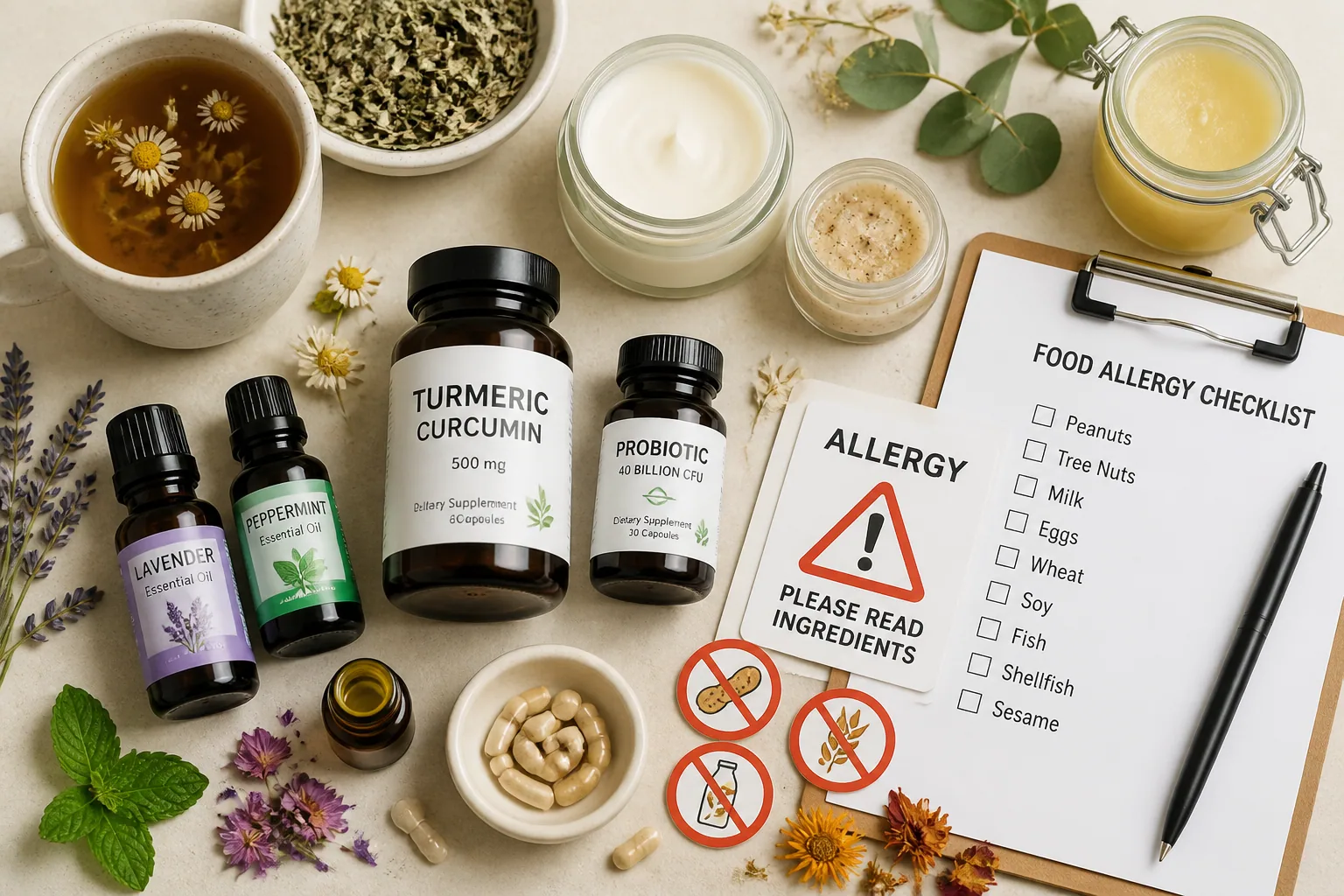
When “Natural” Isn’t Safe: The Hidden Risks of Homemade Remedies and Supplements for Food Allergy Sufferers
“Natural” sounds reassuring. It suggests simple ingredients, fewer chemicals, and something closer to what you can recognize and trust. But if you live with a food allergy, natural does not automatically mean safe. In fact, herbal supplements, homemade remedies, small-batch skincare, and DIY wellness products can be harder to evaluate than standard commercial items because they often rely on unclear labeling, variable ingredients, and less consistent quality control.
That matters because a product can look gentle on the surface and still contain hidden allergen sources, cross-contact from production, or ingredient names that do not clearly reveal what is inside. For someone managing peanut, tree nut, soy, egg, milk, sesame, wheat, fish, or shellfish allergies, those gaps can create real risk. The good news is that there are practical ways to lower that risk without giving up on wellness goals entirely.
Why “Natural” Feels Safer, and Why That Can Be Misleading
People are often drawn to natural products because they feel less processed and more transparent. A homemade balm, an herbal tea, or a supplement from a small brand can seem easier to understand than a long ingredient list from a big company. The problem is that this impression can be misleading. Natural products are not automatically simpler, and they are often less standardized than regulated packaged foods.
One of the biggest issues is variability. A homemade product may be made differently each time. An herbal supplement may use different plant parts, extraction methods, or carriers from batch to batch. Even the same plant can contain different compounds depending on how it was grown, processed, or stored. For people with allergies, that uncertainty makes it harder to know whether a product is safe today, tomorrow, or in the next jar from the same maker.
There is also a psychological trap. Because a remedy is labeled natural, people may assume it is gentler on the skin or better tolerated in the body. But natural ingredients can still contain potent allergens, and skin exposure is not harmless. In some cases, repeated exposure through creams or ointments can even contribute to sensitization over time.
Hidden Allergens in Supplements, Herbal Remedies, and Natural Products
Supplements and herbal blends are a common place for hidden allergens to show up. They may include binders, capsule fillers, flavorings, plant extracts, or oils that are not obvious from the front label. A product marketed for immunity, relaxation, digestion, or energy may still contain soy-derived ingredients, nut oils, or other allergen-related components in its inactive ingredients.
Soy is a particularly good example. Johns Hopkins Medicine notes that people with soy allergy need to watch for additives and ingredient names such as lecithin, natural flavors, vegetable gums, or botanical names that may come from soy, even when the word soy is not immediately visible on the front of the package. The same guidance also explains that highly refined soybean oil or soy lecithin often lacks detectable soy protein, but the source still matters when you are assessing a product carefully. Source: https://www.hopkinsmedicine.org/health/wellness-and-prevention/soy-allergy-diet
Another issue is mislabeling. In a U.S. study of herbal and dietary supplements, more than half of the products tested were mislabeled, meaning the chemical contents did not match the ingredients listed on the label. The problem was especially high in sexual performance or steroid-type products, weight loss products, and botanical supplements. Source: https://pmc.ncbi.nlm.nih.gov/articles/PMC6545864/
That kind of mismatch is especially dangerous for allergy sufferers because the label may not reflect what is actually in the bottle. Even if the product does not contain a classic food allergen, a mislabeled supplement can still introduce unexpected excipients, contaminated ingredients, or undeclared botanical components that are difficult to trace.
Real-world recalls show that this is not just a theoretical issue. In March 2026, Vital Nutrients Aller-C dietary supplements were voluntarily recalled because of undeclared egg, hazelnut, and soy in certain lots. Those allergens were present even though they were not listed on the label. Source: https://www.foodallergy.org/living-food-allergy/food-allergy-essentials/allergy-alerts/egg-tree-nut-and-soy-allergy-alert
The Risks of DIY Skincare, Cleaning Products, and Homemade Health Tonics
DIY products can be appealing because they feel customizable. You may think you are avoiding problematic ingredients by making a balm, face cream, cleaning spray, or wellness tonic at home. But homemade products can still be risky because they often rely on ingredients that seem benign while actually carrying allergen exposure.
One example is nut oils. Research has shown that unrefined or minimally processed tree nut and peanut oils can retain residual proteins that bind to IgE antibodies in people with nut allergies, creating a risk of sensitization or allergic reactions through skin contact. Source: https://pubmed.ncbi.nlm.nih.gov/9111495/
There is also older clinical evidence that creams and ointments containing peanut oil may contribute to peanut sensitization in otherwise non-allergic individuals, especially when applied to the skin. Source: https://pubmed.ncbi.nlm.nih.gov/8704557/
This is why a homemade lotion that uses almond oil, peanut oil, walnut oil, or a nut-based butter should not be treated as inherently safe just because it is homemade. Skin is not a sealed barrier against allergy risk, particularly when a product is left on the skin for long periods or used frequently.
Cleaning products and wellness tonics can also be deceptive. A homemade drink might include herbal extracts, flavor syrups, or oils that are not fully identified. A natural cleaner might use plant-based surfactants or essential oils derived from botanical sources that are not obvious to the user. If the maker does not clearly understand the ingredient origin, allergen assessment becomes guesswork.
How Cross-Contamination Happens in Small-Batch and Homemade Products
Cross-contact is one of the biggest problems in artisanal and homemade production. Even when the recipe itself does not include your allergen, the product can still be contaminated during preparation, storage, or packaging. Shared utensils, hands, bowls, blenders, counters, funnels, and jars all create opportunities for allergen transfer.
Research shows that cross-contact is a significant contributor to accidental allergen exposure. In restaurant settings, shared cooking or serving equipment was reported in about 22% of allergic reactions traceable to cross-contact. Source: https://pmc.ncbi.nlm.nih.gov/articles/PMC6324195/
The same concern applies even more strongly to small businesses or one-person operations that may not have robust allergen controls. A study of small food businesses found that allergen transmission vectors like hands, utensils, storage, and surfaces were often not adequately controlled. Many of the businesses did not regularly test or maintain formal plans to prevent cross-contact, which increased the risk of accidental contamination in artisanal products. Source: https://www.sciencedirect.com/science/article/pii/S0956713521009154
That means a small-batch granola, a handmade protein bar, a tincture from a local maker, or a natural skincare product made in a home kitchen may carry more uncertainty than a larger packaged item with stronger allergen protocols. Small scale does not automatically mean safer. Sometimes it means less oversight.
How to Read Labels Beyond Common Ingredient Names
For allergy sufferers, label reading has to go beyond the obvious. The front of a supplement jar or herbal bottle may highlight “organic,” “botanical,” or “clean,” but the ingredient list is where the real work begins. Under U.S. labeling law, packaged foods and dietary supplements containing major allergens such as peanuts, tree nuts, soy, milk, eggs, fish, crustaceans, wheat, and sesame must declare them by their food source name. FDA guidance explains this clearly in its consumer labeling resources. Source: https://www.fda.gov/consumers/consumer-updates/have-food-allergies-read-label
Still, labels can be vague. Botanical common names may not make allergen sources obvious. A product might list “lecithin,” “vegetable gum,” or “natural flavor” without making it easy to tell whether the source is soy, corn, or something else. For someone with soy allergy, that ambiguity matters. For someone with a tree nut allergy, an oil or extract name may hide a risky source.
It is also important to distinguish between what a label says and what the product may actually contain. Even if a supplement is not supposed to include an allergen, sourcing problems, shared equipment, or formulation changes can introduce risk later. That is why label reading should be combined with other forms of verification, not used as the only safety check.
Questions to Ask Small Producers and Natural Brands Before You Buy
When you are considering a homemade or natural product, asking direct questions can reveal a lot. The goal is not to interrogate every maker, but to gather enough information to make a safer decision.
Useful questions include: What are the exact ingredient sources? Are any ingredients derived from major allergens? Is the product made in a shared facility or with shared equipment? What steps are taken to prevent cross-contact? Are supplier specifications available? Has the formula changed recently? Can the maker confirm whether botanical extracts, flavorings, or carrier oils come from allergen-free sources?
The quality of the response matters as much as the response itself. A careful producer should be able to explain sourcing and handling practices clearly. If the answer is vague, defensive, or inconsistent, that is a warning sign. In allergy management, uncertainty is a risk factor, not a minor inconvenience.
You should also pay attention to batch consistency. If a small producer says they buy ingredients from multiple suppliers depending on availability, or they cannot guarantee the same source each time, the product may be too unpredictable for someone with significant food allergies.
How to Vet Products Using Certifications, Research, and Bokha
Certifications can help reduce uncertainty, although they are not a perfect shield. A third-party allergen certification, a transparent manufacturing policy, or a documented quality-control process can make a product easier to trust than an unverified homemade item. But it is still worth reading the details of any certification, because standards differ.
Research is also valuable. If you are considering an ingredient or supplement and you do not recognize it, look for evidence about whether it is derived from a major allergen, how it is processed, and whether it is likely to contain residual protein. That matters especially for oils, emulsifiers, botanical extracts, and “natural” additives that sound harmless but may have allergen relevance.
A practical tool can also help here. Bokha: Food Allergy Scanner App lets you scan product barcodes and see allergens in less than a second. It detects 13 allergens, traces, and additives, including peanut, egg, soy, tree nuts, gluten, milk, fish, shellfish, wheat, mustard, celery, mint, and sulphites. If you are comparing supplements or packaged natural products, it can help you quickly screen items before you buy. You can learn more at https://findthe.app/bokha
That said, even the best app should be one part of a wider strategy. Use it to save time and catch red flags, then confirm uncertain products with the manufacturer or your clinician when needed. For people with severe allergies, the safest decision is often the one that avoids guesswork entirely.
Safer Ways to Try New Remedies When You Have Food Allergies
If you want to try a new remedy or supplement, take a cautious, step-by-step approach. Start by reviewing the ingredient list closely, then check for allergen source names, botanical ingredients, hidden carriers, and any mention of shared equipment or facility warnings. If the product is homemade or from a small producer, ask directly about sourcing and cross-contact controls.
Introduce only one new product at a time so that if a reaction occurs, you can identify the likely cause. Avoid trying a new item right before travel, before exercise, or when you will be far from medical care. If your doctor has prescribed epinephrine, keep it with you whenever you test a new food-related product or ingest a new supplement. For people with a history of severe reactions, medical guidance is especially important before using anything that is unverified or complex.
When a product is for skin use rather than eating, do not assume that lowers the risk to zero. Skin exposure can still matter, especially with oils, ointments, and leave-on products. Patch testing at home is not a substitute for allergy advice if the ingredient source is unclear or if you have reacted to similar items before.
The safest path is usually the least dramatic one: choose products with transparent labeling, consistent manufacturing, and clear allergen controls. If you cannot get enough information to feel confident, it is reasonable to pass.
Balancing Wellness Goals with Real Allergy Safety
The point is not to fear every natural product or avoid all supplements forever. Plenty of people use herbal remedies, homemade skincare, or wellness products without incident. But food allergy changes the equation. What is soothing or “clean” to one person may be risky to another, especially when allergen sources are hidden in ingredients that do not advertise themselves clearly.
A balanced approach means respecting both your wellness goals and your allergy boundaries. Favor transparency over marketing, verification over assumptions, and caution over convenience when the product history is unclear. Remember that natural does not mean allergen-free, homemade does not mean controlled, and small-batch does not mean safer.
If you build your habits around careful label reading, direct questions, trustworthy certifications, and tools that help you screen products faster, you can reduce a lot of unnecessary risk. In food allergy management, that extra scrutiny is not paranoia. It is smart prevention.