What to Know Before You Donate Blood If You Have Food Allergies
If you live with food allergies, donating blood can feel a little uncertain at first. The good news is that a food allergy diagnosis by itself usually does not stop you from giving blood. What matters most is whether you are healthy on donation day, whether you have had a recent severe reaction, and whether any medications or symptoms could affect your safety as a donor.
Most blood centers want to help eligible people donate safely, not turn donors away unnecessarily. That said, allergy history still deserves careful attention. If you have had anaphylaxis, are actively reacting, or are taking medications because of a recent serious episode, the center may ask more questions or temporarily defer you until you are stable. This is less about the label of “food allergy” and more about your current health status and risk of another reaction.
Can People With Food Allergies Usually Donate Blood?
In many cases, yes. People with food allergies alone are not automatically disqualified from blood donation by major U.S. organizations such as the FDA and AABB. The donor eligibility focus is usually on general health, recent illness, medications, and recent allergic reactions rather than the allergy diagnosis itself. In other words, having a peanut, egg, milk, shellfish, or other food allergy does not automatically mean you cannot donate.
That is reassuring for many donors, but it is still important to remember that blood donation is a health screening process. If you feel unwell, are recovering from a serious reaction, or need rescue medication because of ongoing symptoms, you should not assume you are eligible until the center reviews your situation.
What U.S. Blood Donation Guidelines Say About Food Allergies
U.S. donation centers generally follow FDA and AABB-based donor eligibility standards. One important part of that process is the Donor History Questionnaire, or DHQ, which donors complete on the day of donation. The DHQ asks about overall health, medications, travel, and recent medical events. It is designed to identify issues that could make donation unsafe for you or, in some cases, affect the blood supply.
What it usually does not do is ask whether you ate a specific allergen that morning. That matters because many people worry that having recently eaten peanuts or shellfish, for example, might automatically disqualify them. In most cases, it does not. Centers are much more concerned about whether you are having active allergic symptoms, have recently needed treatment for a severe reaction, or are otherwise not in good condition to donate.
AABB guidance and donor safety screening emphasize being healthy on the day of donation. If you are feeling good, breathing normally, symptom-free, and not in the middle of an acute allergic episode, you are often still a candidate. The key is honest screening and clear communication with staff.
How Rules Compare in the UK, Canada, Australia, and Other Regions
Outside the U.S., the basic idea is similar, but local rules can differ. Blood services in the UK, Canada, Australia, and other regions often focus on the same broad safety questions: Are you well today? Have you had a recent severe reaction? Do you take medications or have a condition that could make donation risky? The exact wording and deferral periods vary by country and by blood center.
Because policies are not identical everywhere, the best rule is simple: if you have significant food allergies, a history of anaphylaxis, or recent allergy treatment, check with your local blood bank before you go. This is especially useful if you have had a recent emergency visit, are using steroids, or have needed epinephrine within the past days or weeks.
When a Severe Allergic Reaction May Affect Eligibility
A severe allergic reaction, including anaphylaxis, can change the picture more than the allergy itself. If you have just experienced anaphylaxis from food or any other trigger, blood centers may temporarily defer you until the reaction has fully resolved and you are no longer at immediate risk. The exact waiting period depends on the severity of the episode and the center’s policy.
This is because donation should happen only when you are stable and well. Someone who is recovering from an acute allergic event may still be dealing with inflammation, fatigue, dehydration, medication effects, or a risk of recurrence. Donation staff are trying to protect both donor and recipient by making sure the donor is in a safe condition before proceeding.
If your allergy history includes emergency treatment, repeated reactions, or a recent hospital visit, it is wise to call ahead rather than guessing. A short conversation with the center can save you time and prevent an unnecessary trip.
What Donation Centers Ask During Screening and Why Disclosure Matters
Donation centers ask screening questions for a reason. They are trying to identify anything that could make the donation unsafe, affect the collection process, or indicate that you need to wait. For allergy-aware donors, the most important part is disclosure. If you have had a recent reaction, use an epinephrine auto-injector, take antihistamines regularly, or have a history of severe symptoms, say so clearly during screening.
This does not mean you will be turned away. Often it just means the staff may ask follow-up questions about timing, severity, treatment, and whether you are fully recovered. If you hide a recent reaction, you may increase your own risk during donation. Blood donation can lower blood pressure and cause lightheadedness, which is not ideal if your body is already recovering from an allergic event.
Honest disclosure also helps staff choose the safest setup for you. For example, they may be able to avoid certain materials or better prepare for a donor who is sensitive to latex, antiseptics, or other contact triggers.
Is Donated Blood Tested for Food Allergens?
No, donated blood is not routinely screened for food allergens or food proteins. Blood banks do not normally test for peanut protein, egg allergens, milk proteins, or donor IgE levels before blood is released for transfusion. That can sound surprising, but it reflects how transfusion medicine works in practice.
Most allergic transfusion reactions are not caused by food allergens in the donor’s blood. They are more often linked to plasma proteins or, in some rare cases, IgA deficiency and anti-IgA antibodies in the recipient. Severe allergic transfusion reactions are rare, with surveillance data suggesting roughly 1.2 to 5.9 per 100,000 blood components transfused in certain settings. Source: Canadian Blood Services surveillance on anaphylactic transfusion reactions and IgA deficiency, https://professionaleducation.blood.ca/en/transfusion/publications/anaphylactic-transfusion-reactions-and-iga-deficiency
There are rare case reports showing that food-specific IgE or food antigens may be passively transferred in unusual circumstances, such as from platelet products, but these are exceptional rather than routine. Source: PMC case report on passive transfer of food-specific IgE, https://pmc.ncbi.nlm.nih.gov/articles/PMC4126020/
The practical takeaway is simple: your own food allergy usually does not make your donated blood unsafe for recipients. The system is not built around excluding donors for ordinary food allergy histories, and there is no standard pre-donation allergen testing for that purpose.
What Donors Should Tell Staff About Allergies, Anaphylaxis, and Medications
Tell the staff if you have a history of anaphylaxis, if you have used epinephrine recently, or if you are currently taking allergy medications because of a recent event. Medications such as antihistamines, epinephrine, and steroids are generally not a problem by themselves if you are symptom-free and fully recovered, but they can signal that a recent reaction deserves closer review.
Allergy shots are usually allowed as well, but centers may ask about timing and whether you had any reaction to the injection. Again, the main concern is not the medication label. It is whether your body is stable enough to donate safely that day.
If you have a latex allergy, iodine sensitivity, or reactions to antiseptics, mention that too. Some hidden exposures are not about food at all. They are about the donation environment, materials, or prep supplies used by the center.
Hidden Allergen Risks Before, During, and After Donation
Food allergy risks around blood donation are often indirect. For example, you may be exposed to allergens during the trip to the donation site, while checking in, while sitting in the waiting area, or when staff offer snacks afterward. If the center provides packaged foods, drinks, or refreshments, ingredients can vary widely. Someone with multiple food allergies may need to ask before eating anything on site.
There can also be contact-related exposures. If you are sensitive to latex or certain disinfectants, ask what materials are used at the center. AABB donor information notes that donors should disclose reactions such as iodine sensitivity, which helps staff choose appropriate supplies. Source: AABB about blood donation, https://www.aabb.org/for-donors-patients/about-blood-donation
If you are traveling to donate, the same advice applies. Carry your own allergy-safe food, avoid relying on unknown snacks, and make sure you can treat any accidental exposure quickly. For many donors, the biggest risk is not the blood draw itself. It is the unexpected food or contact exposure surrounding the appointment.
How to Prepare Safely for a Blood Donation Appointment
A little preparation makes donation easier and safer. Start with a balanced meal before you go. Blood centers commonly recommend eating beforehand and staying hydrated so you are less likely to feel weak or dizzy. A good pre-donation meal should be filling, but not overly greasy or heavy. Source: BloodCenter donor guidance, https://www.bloodcenter.org/donate/donor/
For allergy-aware donors, preparation should also include food safety. Eat something you know is safe, and do not experiment with a new snack right before your appointment. If you are prone to delayed reactions, it may be smart to keep your routine very simple on donation day.
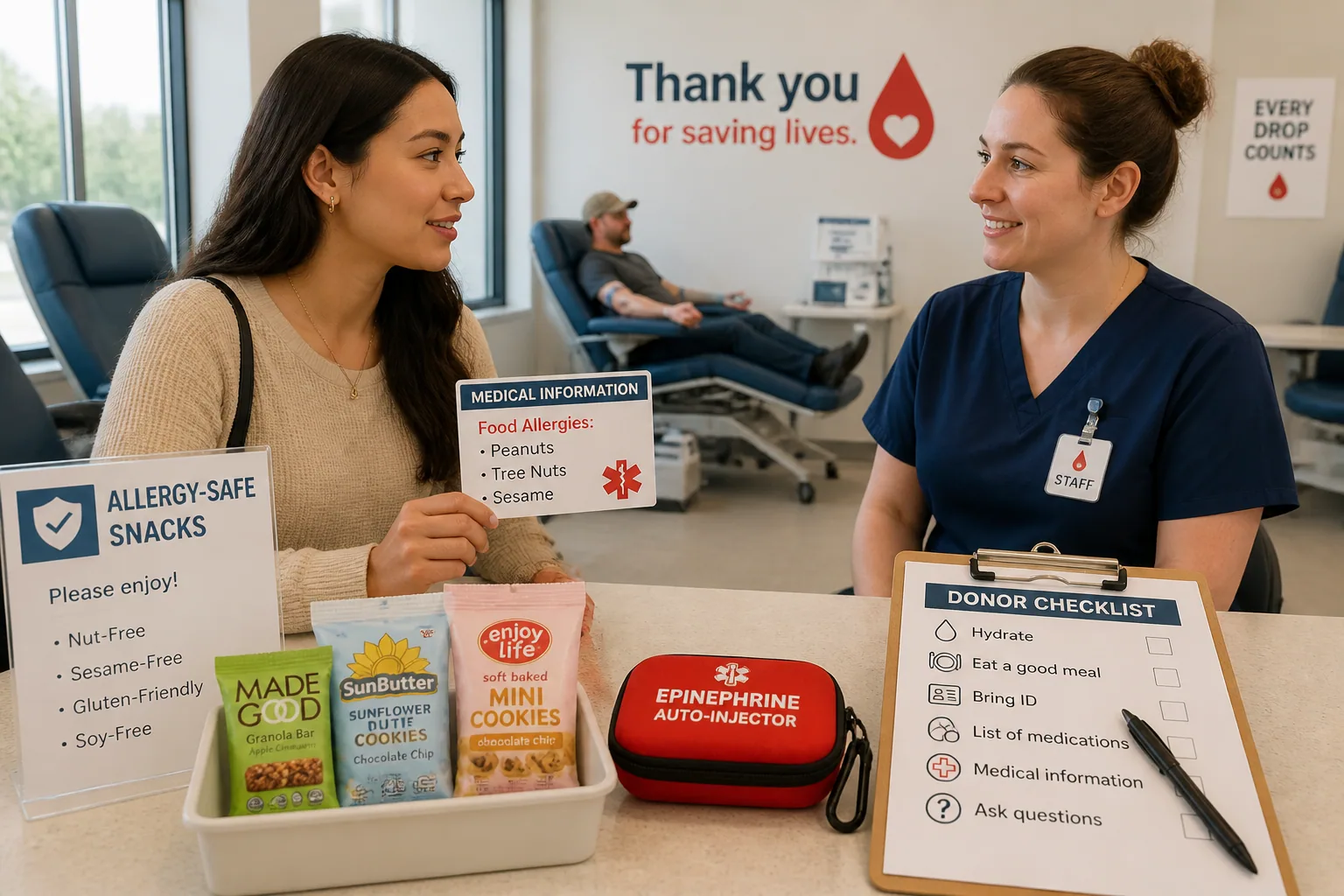
Bring your emergency medication with you, including your epinephrine auto-injector if you have one. Even if you never need it, having it nearby can reduce stress. If possible, also carry any important medical information, such as your allergy list, emergency contacts, and details of previous severe reactions.
What to Bring: Safe Snacks, Medication, and Emergency Information
A small donation-day kit can make a big difference. Consider bringing safe snacks you already trust, a bottle of water, and any medications you may need. If you have multiple food allergies, this is especially helpful because you may not want to rely on the center’s refreshments after donation.
It is also wise to know what is in the post-donation food area. You can politely ask staff about ingredients, shared surfaces, or packaged options. That is normal and reasonable, especially if you are managing severe allergies or cross-contact concerns.
If you want one practical tool to help you stay confident about foods before and after the appointment, the Bokha: Food Allergy Scanner App can be a useful backup. It lets you scan product barcodes and identify allergens quickly, which can be handy when you are checking snacks on the way to or from donation: https://findthe.app/bokha
Myths vs Facts About Food Allergies and Blood Donation
Myth: If I am allergic to peanuts, my blood will harm someone with peanut allergy. Fact: That is extremely unlikely. Blood is not routinely screened for food allergens, and passive transfer causing a reaction is rare. The occasional case report does not mean this is a common or expected problem. Source: PMC case report on passive transfer of food-specific IgE, https://pmc.ncbi.nlm.nih.gov/articles/PMC4126020/
Myth: Having food allergies disqualifies me. Fact: Food allergies alone usually do not prevent donation. What matters more is whether you are currently having symptoms, have recently had anaphylaxis, or are taking medication for a reaction that has not fully settled.
Myth: Donation centers will ask what I ate before I came in. Fact: The DHQ focuses on health, medications, travel, and medical events, not on detailed allergen ingestion from the same day. That said, if you are having symptoms after eating something, you should absolutely mention it.
When to Call Ahead or Ask Your Allergist Before Donating
You should call the blood center ahead of time if you have had recent anaphylaxis, have needed emergency treatment, are unsure whether a medication could affect eligibility, or have multiple allergies that make the appointment logistically difficult. A quick phone call can clarify what the center wants and help you avoid unnecessary stress.
It can also be helpful to speak with your allergist if your reactions have been severe, unpredictable, or recent. Your allergist can help you think through whether donating is reasonable right now and whether any precautions are needed. This is especially important if you carry epinephrine, have asthma that flares with allergies, or have had repeated systemic reactions.
When in doubt, do not rely on internet myths or well-meaning guesses. Local rules can vary, and medical history sometimes matters more than the allergy label itself.
A Safe-Donation Checklist for Allergy-Aware Donors
Before you go, make sure you can answer a few basic questions honestly: Are you feeling well today? Have you had any recent allergic reaction, especially anaphylaxis? Are you symptom-free and stable? Have you brought your emergency medication? Do you know what snacks are safe for you afterward?
Also remember to tell staff about latex, iodine, antiseptic, or other contact sensitivities. Bring your own safe food if needed. Drink water. Eat a balanced meal beforehand. And if anything about your allergy history feels unclear, call the center or your allergist first rather than guessing.
The bottom line is encouraging: many people with food allergies can donate blood safely. The important part is not whether you have an allergy diagnosis, but whether you are healthy, stable, and prepared on the day of donation. With a little planning, you can often give generously while still protecting your own health.