What to Know Before Pregnancy If You or Your Partner Has Food Allergies: Planning, Risks & Best Practices
Planning a pregnancy already comes with a long list of choices, and food allergies can make that list feel even longer. If you or your partner live with food allergies, it is normal to wonder whether those allergies could be passed on, what you should eat or avoid before conception, and how to stay safe once pregnancy begins. The good news is that there is a lot you can do to prepare, and some of the most common fears are based more on myths than on evidence.
This guide breaks down what current research suggests about inherited allergy risk, what it does not support, and how to plan ahead in a way that protects both health and peace of mind. We will also look at nutrition, cross-contact, medication safety, emergency planning, and how a tool like Bokha can make everyday food choices less stressful.
Why Food Allergies Matter Before Pregnancy
Food allergies matter before pregnancy for two big reasons. First, they can affect your nutritional intake if you are avoiding major food groups like dairy, egg, wheat, soy, peanuts, tree nuts, or seafood. Second, family history is one of the strongest known risk factors for food allergy in children, so understanding your own allergy profile helps you prepare for your future child’s care needs.
That does not mean a child will definitely develop a food allergy. It means the risk may be higher, especially if one or both parents have allergies. Knowing this early gives you time to build a pregnancy plan that supports nutrition, reduces accidental exposures, and sets up a calm, informed care team from the start.
Can Parental Allergies Increase Allergy Risk in Children?
Yes, family history appears to increase risk, although it is not destiny. Research shows that children with a family history of food allergy have significantly higher odds of developing food allergy. One review found that maternal food allergy was associated with an odds ratio of about 1.98 and a risk difference of 4.4%, while paternal allergy showed an odds ratio of about 1.69 and a risk difference of 3.2%. When both parents were allergic, the odds ratio rose to about 2.07 with a risk difference of 4.8% [https://pmc.ncbi.nlm.nih.gov/articles/PMC12887841/
The same research also notes that family history of any allergic disease in a parent or sibling is among the strongest credible risk factors for food allergy in children younger than 6 [https://pmc.ncbi.nlm.nih.gov/articles/PMC12887841/ In practical terms, this means that a personal or partner history of food allergy, eczema, asthma, or allergic rhinitis deserves attention during prenatal planning.
At the same time, it helps to keep the numbers in perspective. Across multiple countries, the overall incidence of confirmed food allergy by age 6 is around 4.7% when diagnosis is based on food challenge confirmation [https://pmc.ncbi.nlm.nih.gov/articles/PMC12887841/ A higher risk is still only a risk, not a guarantee.
It is also worth remembering that sensitization is not the same as a true allergy. In siblings of food-allergic children, one study found that about 53% were sensitized but asymptomatic, while only 13.6% were both sensitized and clinically reactive to the same allergen [https://pmc.ncbi.nlm.nih.gov/articles/PMC5010481/ That is one reason testing and symptoms both matter, rather than test results alone.
What Research Really Says About Preventing Allergies
A lot of people still hear older advice that pregnant people should avoid common allergens to prevent allergies in their babies. Current evidence does not support that approach. Avoiding allergenic foods during pregnancy does not reliably reduce the risk of food allergy in offspring, and guidelines generally do not recommend that pregnant people without allergy avoid foods such as peanut, egg, or milk unless there is a medical reason to do so [https://www.nutrition.org.uk/nutrition-for/pregnancy/dietary-concerns-during-pregnancy/
This is an important myth to clear up before conception. If you are not allergic to a food, removing it from your diet is not a proven prevention strategy, and it can make nutrition harder than it needs to be. For people who do have allergies, the goal is not unnecessary restriction, but safe, complete substitution.
The natural history of allergies also varies by allergen. More than 50% of children with cow’s milk or egg allergy become tolerant by ages 2 to 10, while only about 10 to 20% of children with nut or tree nut allergies gain spontaneous tolerance [https://www.mdpi.com/2072-6643/16/7/1087 That difference matters when parents think about long-term family planning, because not all allergies behave the same way over time.
Preconception Planning: Questions to Ask Your Doctor
Before pregnancy, it helps to gather your full allergy history and bring it into a focused conversation with your OB-GYN, allergist, midwife, or primary care clinician. If you have a known food allergy, ask what your current trigger foods are, whether your diagnosis is clear, and whether any repeat testing or specialist review is useful before conception.
If your partner has food allergies, mention that too. Even though your partner’s allergy does not affect your own diet directly, it still contributes to the baby’s family history and may influence how you prepare the home environment after birth. Ask whether your family history places your child in a higher-risk category and what the team recommends for newborn feeding and follow-up.
This is also the right time to discuss any history of anaphylaxis, asthma, eczema, allergic rhinitis, latex allergy, medication allergies, and reactions that were never formally evaluated. Bring a list of all current medications, supplements, rescue inhalers, and allergy treatments. If you have ever needed emergency epinephrine, make sure that is clearly documented.
You can also ask about nutrition support early, especially if your diet already excludes several major foods. A dietitian can help you identify safe substitutions and make sure your intake remains balanced as pregnancy demands increase.
Safe Allergen Avoidance Without Missing Key Nutrients
Pregnancy increases nutritional needs, but not in a way that requires extreme eating. One clinical guide notes that pregnancy typically adds about 300 extra calories per day in the second and third trimesters, and protein needs rise by about 10 to 15 grams per day above pre-pregnancy levels [https://www.nwh.org/patient-guides-and-forms/maternity-guide/maternity-chapter-1/diet-and-nutrition-during-pregnancy The goal is steady, adequate nutrition, not perfection.
If you avoid milk, egg, nuts, or other nutrient-dense foods, the key is substitution. For example, fortified plant milks can replace dairy when they provide enough calcium and vitamin D. Protein can come from legumes, soy if tolerated, seeds, meat, poultry, fish if safe for you, and other allergen-safe options. Depending on your restrictions, you may also need special attention to iron, omega-3s, folate, vitamin B12, and overall protein quality [https://www.nwh.org/patient-guides-and-forms/maternity-guide/maternity-chapter-1/diet-and-nutrition-during-pregnancy
This matters because pregnancy is not the time to guess. If your diet has become narrow due to fear of exposure, or if you are eliminating foods without a confirmed diagnosis, that is worth discussing with a clinician. Sometimes the most helpful intervention is not another restriction, but a clearer plan for food selection and a few targeted replacements.
Managing Cross-Contact Risks at Home and While Eating Out
Cross-contact is one of the biggest practical concerns during preconception and pregnancy, especially if you have severe allergies. It can happen when safe food comes into contact with trace amounts of an allergen through utensils, cookware, shared fryers, countertops, toaster crumbs, condiment jars, or food prep surfaces.
At home, the best approach is usually a combination of organization and routine. Keep allergen-safe foods clearly separated, use dedicated utensils or cookware if needed, clean surfaces thoroughly, and check ingredient labels every time you buy a product, even if you have purchased it before. Ingredient changes happen more often than people expect.
Eating out deserves extra caution because ingredient lists are less visible and cross-contact controls vary widely. Call ahead when possible, explain your specific allergy rather than saying you only “avoid” a food, and ask how the kitchen handles prep, oil use, sauces, and desserts. If the restaurant cannot confidently explain their process, it is reasonable to choose somewhere else.
During pregnancy, many people find this part emotionally exhausting. That is normal. Reducing uncertainty with a consistent routine can help: choose a few trusted brands, keep backup snacks in your bag, and limit impulsive food choices when you are tired or hungry.
Medication Safety in Pregnancy: Epinephrine, Antihistamines, and More
Medication questions are especially important in pregnancy because people often hesitate to treat allergy symptoms quickly. For severe reactions, the priority is clear: epinephrine is the first-line treatment for anaphylaxis during pregnancy, and there are no absolute contraindications to its use in pregnant patients. It should be used the same way it would be used in a non-pregnant person [https://consultqd.clevelandclinic.org/anaphylaxis-highlights-from-the-practice-parameter-update
That point is worth repeating because delay is dangerous. If anaphylaxis is suspected, epinephrine should not be replaced by an antihistamine. Antihistamines may help hives or itching, but they do not treat a severe systemic allergic reaction.
For everyday allergy symptoms, several over-the-counter antihistamines are commonly considered safe in pregnancy, including chlorpheniramine, dexchlorpheniramine, loratadine, and cetirizine. By contrast, oral decongestants such as pseudoephedrine are generally avoided in the first trimester because of a small risk of abdominal wall birth defects [https://www.acog.org/womens-health/experts-and-stories/ask-acog/what-medicine-can-i-take-for-allergies-while-im-pregnant
Corticosteroid nasal sprays such as budesonide, Nasonex, Nasacort, or Flonase are also regarded as safe allergy or airway medications during pregnancy when used at recommended dosages [https://www.drugs.com/medical-answers/you-antihistamines-pregnant-3562255/ As always, the best choice depends on your symptoms, trimester, and medical history, so confirm your plan with your provider.
What Your Prenatal Care Team Needs to Know
Your prenatal team can support you much better if they know the full picture early. Share the exact foods you react to, what happens during a reaction, how quickly symptoms appear, whether you have ever had breathing trouble or fainting, and what medications you carry. If you have a written allergy action plan, bring it to your first visits.
It also helps to tell them about any accidental exposures in the past year, any recent allergy testing, and whether your prescription or over-the-counter treatments have changed. If you are seeing multiple specialists, ask for the plan to be consistent across OB-GYN, allergist, midwife, and dietitian visits.
If you are planning breastfeeding or formula use, that is another helpful topic to raise. Your team may guide you on how to interpret family history, when to introduce allergens after birth, and when to seek early evaluation if an infant develops symptoms.
Handling Emergencies and Updating Your Allergy Action Plan
A pregnancy-safe allergy plan should be simple enough to follow during stress. It should tell you what your symptoms are, when to use epinephrine, when to call emergency services, and what medications you can take afterward. Keep it in your phone, in your bag, and at home where your partner or family can find it quickly.
If you carry epinephrine, check expiration dates before pregnancy and again during pregnancy. Make sure you know how to use your device, and make sure your partner does too. In an emergency, the person nearby may be the one who needs to act first.
It is also smart to review your plan after any change in symptoms, any new diagnosis, or any medication adjustment. Pregnancy can change how people feel physically and emotionally, so keeping your plan updated can reduce panic if something unexpected happens.
How Bokha Can Support Safer Food Choices and Lower Stress
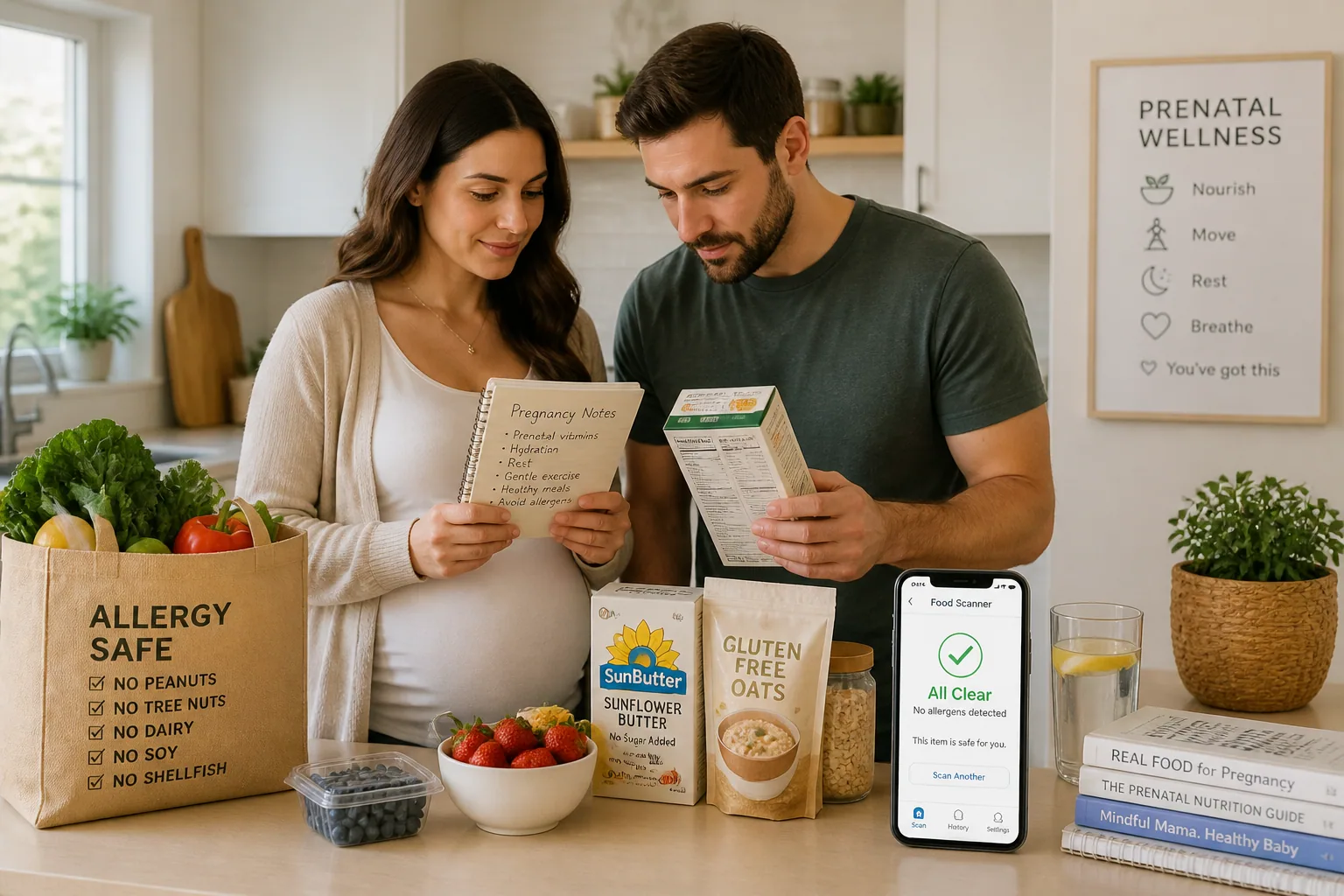
One of the most draining parts of living with food allergies during pregnancy is the constant label reading. A small mistake can feel high-stakes, and when you are already tired or nauseated, scanning ingredient lists at the store can become overwhelming. That is where Bokha can help.
Bokha is a food allergy scanner app that lets you scan product barcodes and discover allergens in less than a second. It detects 13 allergens, including lactose, gluten, peanut, egg, soy, fish, shellfish, tree nuts, wheat, mustard, celery, mint, and sulphites, along with traces and additives. If you want a quicker way to compare products while grocery shopping, you can learn more here: https://findthe.app/bokha
Used alongside medical guidance, a scanner app can reduce decision fatigue and make grocery trips feel more manageable. That does not replace reading labels carefully, but it can make the process faster and less stressful when you are choosing between several packaged foods or trying to avoid an unfamiliar ingredient.
Best Practices for a Confident, Allergy-Safe Pregnancy Journey
If you or your partner has food allergies, the best pre-pregnancy strategy is usually not fear, but preparation. Understand your risk, avoid unnecessary dietary restrictions, confirm which foods truly need to stay out of your diet, and build a support team that includes your OB-GYN and allergist. If your diet is limited, work with a dietitian early rather than waiting until symptoms, weight concerns, or nutrient gaps appear.
A few practical habits make a big difference: keep your allergy list updated, carry your rescue medication, check product labels every time, and plan for cross-contact both at home and when eating out. Use pregnancy-safe medications only with provider guidance, and treat anaphylaxis urgently with epinephrine if it ever occurs.
Most importantly, do not assume that a family history of allergies means your child will definitely have one. Family history does increase risk, but it is only one part of the story. The more informed and organized you are now, the easier it becomes to focus on a healthy pregnancy and a calmer food routine later.