What the Newest Food Allergen Labeling Laws Mean for You in 2026
Food allergen labeling is not just a packaging issue anymore. In 2026, it’s one of the most practical tools consumers have for staying safe, especially if you live with a food allergy, manage an intolerance, or shop frequently across borders. The problem is that labels do not work the same way everywhere. What must be declared in the United States is not identical to what appears on a label in the EU or the UK, and precautionary statements like “may contain” still leave a lot of room for confusion.
That matters because the difference between a legally required allergen declaration and a voluntary warning can change how you shop, what you trust, and which products you avoid. It also matters when you travel or buy imported foods, where the same product may follow a completely different labeling standard. In this article, we’ll break down the newest rules, the biggest differences between markets, and how to read labels more safely in real life.
Why food allergen labeling laws matter more than ever
Allergen labeling laws exist for one reason: to reduce the chance that a consumer unknowingly eats something that could make them seriously ill. But the modern food system is complicated. Ingredients are blended, processed, repackaged, imported, and sold through channels where the original source may not be obvious. That’s why allergens have to be called out clearly, and why shoppers still need to be cautious even when a label looks complete.
The challenge is that not all labels tell the same story. Some allergens must be declared by law, while others may be hidden inside compound ingredients, flavorings, or processing aids. And in many places, “may contain” statements are still voluntary rather than standardized. That means consumers cannot treat every label as equally strict or equally useful.
For people with allergies, the law is important, but so is knowing its limits. A label can help you avoid a risk, but it cannot guarantee absolute safety. That is why understanding the rules behind the label is just as important as reading the label itself.
The biggest recent changes in U.S. allergen labeling
The most important recent U.S. change is the addition of sesame as the ninth major food allergen. Under the FASTER Act, sesame became a major allergen in U.S. law, and as of January 1, 2023, FDA-regulated foods and dietary supplements must clearly label sesame when it is used as an ingredient. The FDA explains this change on its official guidance page: https://www.fda.gov/food/food-allergies/faster-act-sesame-ninth-major-food-allergen
That update matters because sesame is easy to miss. It can appear in spice blends, baked goods, natural flavors, sauces, and toppings that many shoppers might not immediately associate with an allergen risk. The sesame rule also reflects a broader shift in consumer awareness: labels are expected to be more transparent, not less.
The other U.S. major allergens remain milk, eggs, fish, shellfish, tree nuts, peanuts, wheat, and soybeans. The FDA’s general food allergy page summarizes the U.S. allergen framework here: https://www.fda.gov/food/food-labeling-nutrition/food-allergies
The FDA also updated its Food Allergen Q&A Guidance in 2025. One useful clarification is that “milk” includes milk from ruminant animals beyond cows, and “eggs” includes eggs from birds other than chickens. That may sound technical, but for consumers it means the law is broader than many people assume. It also shows why labels can’t always be read with everyday assumptions.
In the U.S., another important point is that precautionary allergen labeling is not legally required. A statement like “may contain” is voluntary, and it is meant to communicate possible cross-contact only when the manufacturer has credible risk controls and still cannot fully eliminate the chance of unintended allergen presence. The FDA’s position is summarized on its food allergy page.
How EU and UK allergen labeling rules differ from the U.S.
The EU and UK are more expansive than the U.S. when it comes to the number of allergens that must be disclosed. Under EU rules, there are 14 allergens that must be declared if they are used as ingredients in pre-packed foods. These include gluten-containing cereals, milk, eggs, peanuts, tree nuts, soy, sesame, and several others. A useful summary is available here: https://www.eclarion.com/en/support/resources/14-allergens-labelling-rules/
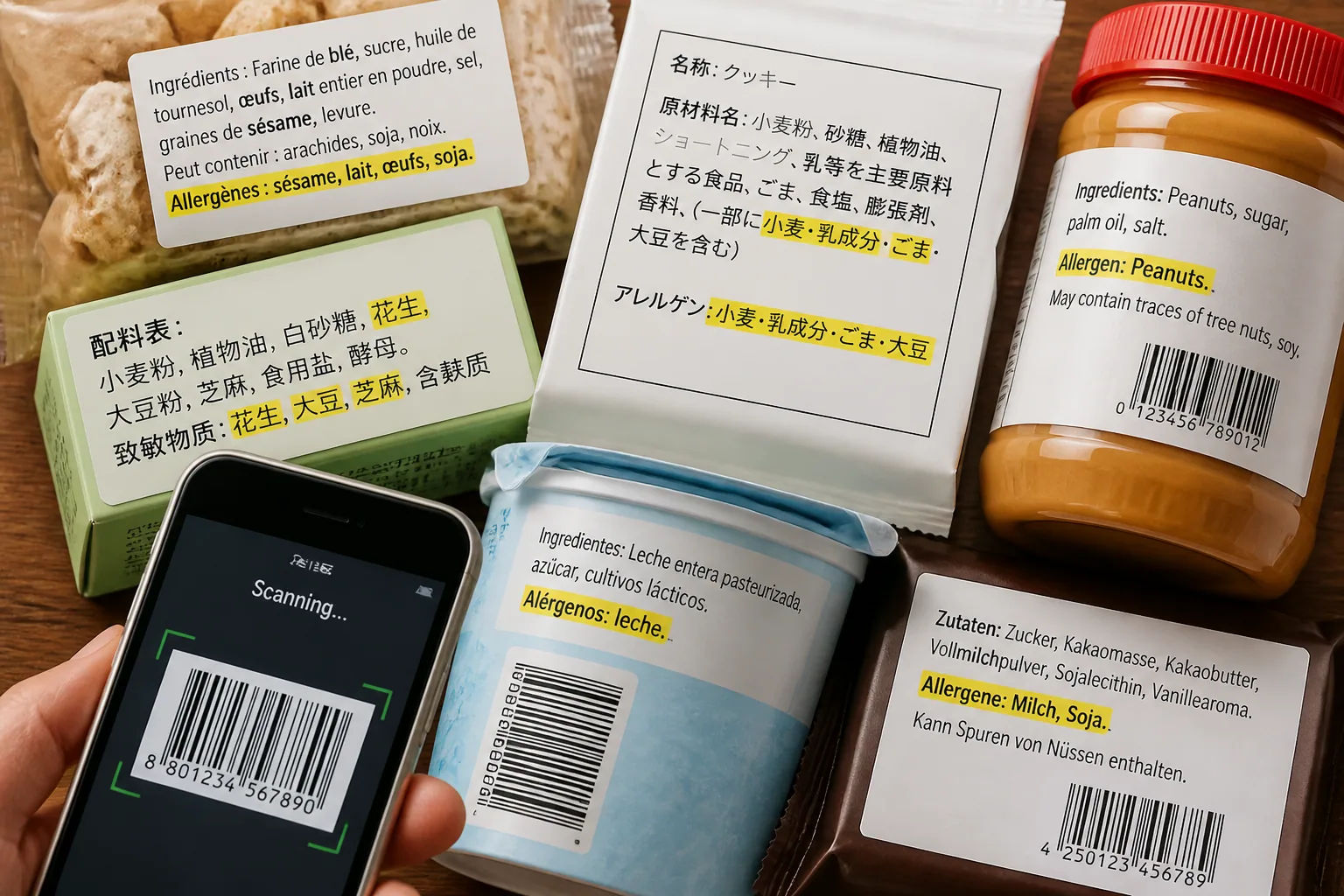
Another major difference is formatting. In the EU, allergens must be visually emphasized in the ingredient list, using bold text, a different font, a different background, or another clear visual cue. The point is to make allergens immediately noticeable rather than buried in a long ingredient statement. The European Commission’s allergen page highlights this requirement.
The UK largely inherited EU-style rules after Brexit. That means the same 14 priority allergens still have to be declared in pre-packed foods, including sesame. The UK government’s food labeling guidance remains the key reference for businesses and consumers: https://www.gov.uk/guidance/food-labelling-giving-food-information-to-consumers
For non-prepacked foods, such as restaurant meals, deli items, takeaway food, or anything served loose, the EU and UK expect allergen information to be available as well. It may be verbal, but there has to be a clear and accessible way for the customer to get it. That is very different from relying only on a package label, because in these settings the consumer often has to ask before ordering.
One more practical difference: the UK has been updating its technical guidance on allergen labeling and information requirements, especially around precautionary labeling. The Food Standards Agency’s guidance summary is here: https://www.food.gov.uk/business-guidance/food-allergen-labelling-and-information-requirements-technical-guidance-summary?trk=public_post_comment-text&utm_source=openai
What brands must disclose on food packaging
At the most basic level, brands must declare ingredients in a way that makes allergens identifiable. In the U.S., this usually means either naming the allergen directly in the ingredient list or using a separate “Contains” statement. For example, a label might say whey (milk) or lecithin (soy), so the source is clear.
In the EU and UK, the allergen has to appear within the ingredient list and be visually emphasized. That is useful for shoppers, because it avoids confusion when the allergen is part of a compound ingredient. Still, the consumer needs to know which names to look for, especially when the allergen is hidden in a processed ingredient rather than named in an obvious way.
This is where legal disclosure and practical shopping experience sometimes diverge. A label may be technically compliant while still being hard to interpret quickly in a store. The law can require the allergen to be named, but it cannot always make the language intuitive for every shopper.
That is also why imported foods deserve extra attention. A product that looks familiar may follow the labeling rules of its country of origin, not the rules you are used to at home. If you shop across the U.S., EU, and UK markets, you should expect differences in both allergen lists and presentation style.
What “may contain” and precautionary allergen labels really mean
Precautionary allergen labels, often shortened to PAL, are one of the most misunderstood parts of food labeling. In simple terms, they are warnings about possible unintentional cross-contact. But they are not the same thing as a required ingredient declaration, and they are not a guarantee that a product is unsafe.
In the U.S., PAL is voluntary. That means a manufacturer may use “may contain” language if it believes cross-contact risk exists, but it is not required by law to do so. The FDA notes that such statements should be tied to credible risk assessment and control practices rather than used as blanket legal protection.
In the UK and EU, PAL is also voluntary, but the expectations around it are stricter in practice. UK guidance says statements should name the specific allergen, such as “may contain peanuts,” rather than vague phrases like “may contain nuts.” It should also not conflict with a “free from” claim, because that would be misleading.
The biggest takeaway is that “may contain” is a risk signal, not a standardized safety measure. Some people with allergies choose to avoid any product with PAL. Others make a more nuanced decision based on the allergen, the product type, the brand, and their own medical advice. The key is not to assume that every PAL statement means the same thing.
The UK’s discussion of precautionary allergen labeling and thresholds is especially useful for understanding this debate: https://www.food.gov.uk/board-papers/precautionary-allergen-labelling-and-allergen-thresholds
Why hidden ingredients and additive names still confuse shoppers
Even when labels are legally correct, shoppers can still get tripped up by ingredient names that sound harmless or technical. “Natural flavors,” “spice mix,” “hydrolyzed protein,” or “emulsifier” may all hide allergen sources depending on the product and market. That does not necessarily mean the label is incomplete, but it does mean the consumer has to be alert.
Additives can create another layer of confusion. A product may be free of a major allergen but still include additives, colorants, preservatives, or processing ingredients that some people want to avoid for intolerance or sensitivity reasons. The label may not spell out every practical concern a shopper has, even if it satisfies legal requirements.
This is why reading the full ingredient list matters more than relying on front-of-pack claims. A bold “gluten-free” badge or “nut-free” claim can be helpful, but the fine print still tells you whether the product was made in a facility that handles your allergen or includes another ingredient you need to avoid.
For many consumers, the difficult part is not just spotting one allergen name. It is learning the many ways allergens can appear under different names in different regions. That learning curve is exactly where tools and scanning apps can become useful.
How to read labels safely when traveling or buying imported foods
If you travel between the U.S., EU, and UK, or shop online from foreign sellers, assume that allergen labeling will not look identical from country to country. The safest approach is to slow down and check three things: the ingredient list, the allergen emphasis, and any precautionary statement.
When you are in the U.S., look for the explicit source of major allergens and remember that sesame is now part of the major allergen list. For EU and UK products, scan the ingredient list for visually emphasized allergens and do not assume that a product safe in one market has the same formulation elsewhere.
Restaurant and loose-food settings require even more caution. In the EU and UK, allergen information should be available, but you may need to ask directly. In the U.S., point-of-sale disclosures are still evolving, although California is becoming a notable exception for large restaurant chains starting in 2026.
The practical rule is simple: when in doubt, verify. Ask questions, look for written allergen notices, and avoid assuming that a familiar brand uses the same recipe in every country.
When barcode scanners and ingredient tools can help
For many shoppers, the biggest challenge is speed. Reading every package in a busy supermarket aisle is exhausting, especially if you are comparing multiple products and trying to interpret unfamiliar labels. That is where barcode scanners and ingredient tools can be genuinely helpful.
A good scanning app can quickly surface allergen information, highlight traces, and flag additives that may matter to you personally. For example, Bokha: Food Allergy Scanner App lets you scan a product barcode and discover allergens in less than a second, which can save time and reduce uncertainty at the store. You can learn more here: https://findthe.app/bokha
Tools like this do not replace careful label reading, but they can make the process faster and less stressful. They are especially useful when you are comparing products from different regions, checking imported goods, or trying to spot ingredients that are easy to miss in long labels.
That said, no app can override a legal label or your own medical guidance. The best use of barcode tools is as a support system: they help you make a faster first pass, then confirm the details yourself when the product is new, reformulated, or uncertain.
Key takeaways for people managing food allergies in 2026
The biggest lesson from the newest allergen labeling laws is that transparency has improved, but consistency is still limited. In the U.S., sesame is now a major allergen and must be declared, while the EU and UK still require a broader 14-allergen framework. Across all three markets, precautionary “may contain” statements remain voluntary and imperfect.
That means safe shopping still depends on a mix of legal knowledge, label reading, and practical caution. Read the ingredient list, watch for unfamiliar names, treat PAL as a warning rather than a guarantee, and be especially careful with imported foods or restaurant meals.
If you manage allergies or intolerances every day, the best strategy is to build a habit of checking labels consistently and using tools that reduce mistakes. The law can help, but your own process is what turns that legal protection into real-world safety.