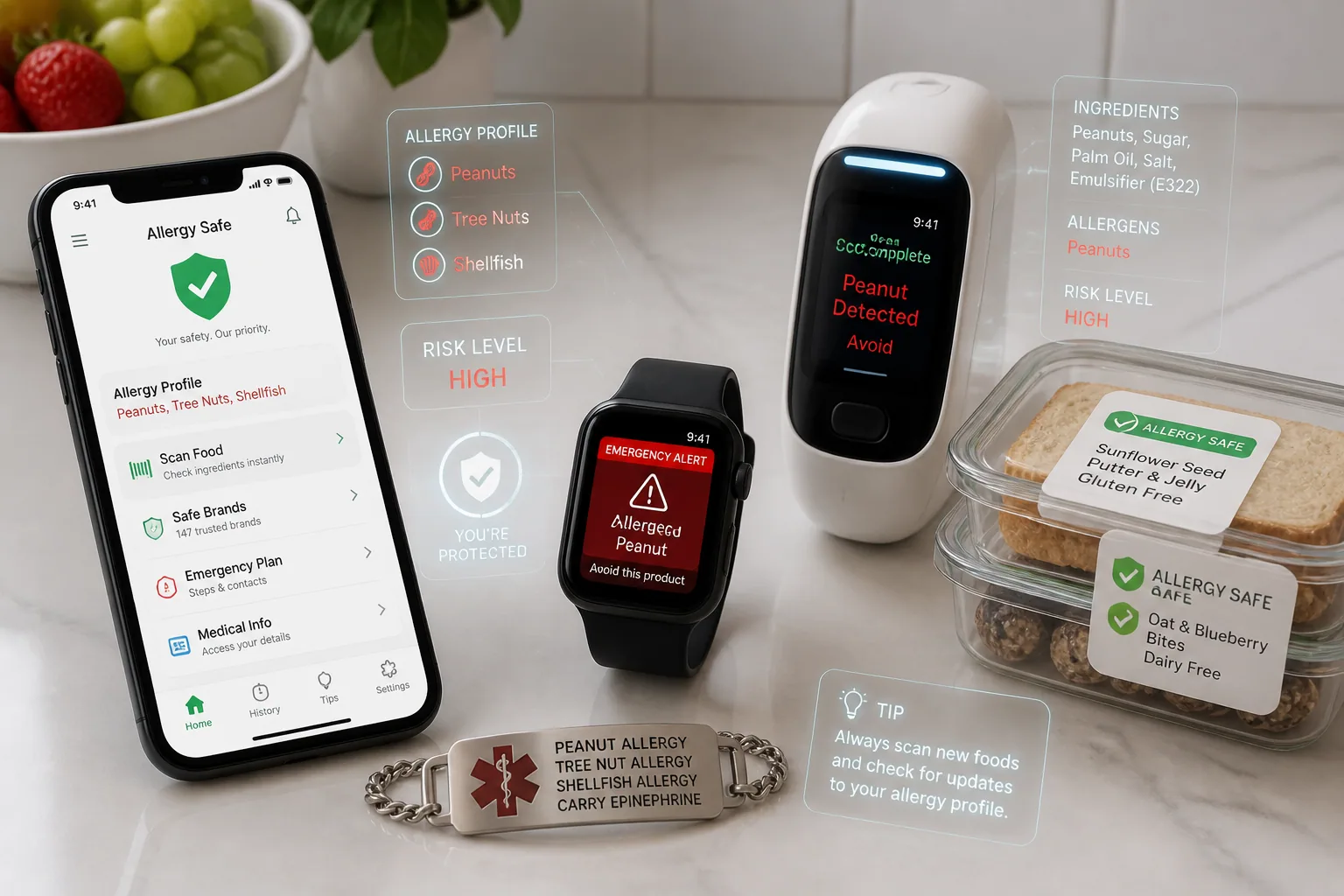
What Apps, Tools & Wearables Help You Stay Safe With Food Allergies in 2026?
Food allergy safety in 2026 is no longer limited to reading labels twice and hoping a restaurant server gets it right. The ecosystem has become much broader, with barcode scanners, AI menu tools, wearable detectors, smart kitchen devices, and emergency-response integrations all trying to reduce risk in different ways. For tech-savvy people living with allergies, and for parents and caregivers trying to build safer routines, the big question is not just what exists, but what is actually reliable enough to use in daily life.
That matters because allergy errors can be serious. A missed ingredient, a hidden alias, a trace contaminant, or a confusing menu description can turn an ordinary meal into an emergency. At the same time, many new tools are still evolving. Some are excellent at saving time, some are better at flagging hidden risks, and some are promising but not yet ready to replace clinical guidance or common sense. The smartest approach in 2026 is to understand what each tool category does well, where it can fail, and how to build a layered safety system around it.
Why Food Allergy Tech Matters More Than Ever in 2026
The food environment has become more complex, not less. Modern grocery products often include long ingredient lists, processing aids, allergen aliases, and occasional reformulations that make label reading harder than many people expect. Eating out is also more complicated, with delivery apps, ghost kitchens, rotating menus, and cross-contact risks that are not always obvious from a photo or a web listing. In that environment, technology can be genuinely helpful, especially when it reduces repetitive work and catches human oversight.
The strongest allergy tools in 2026 are no longer just simple scanners. They increasingly combine database matching, image recognition, conversational AI, portable sensors, and risk-level explanations. That shift is important because a plain yes-or-no warning often misses context. A product may not contain an allergen directly, but may still be made in a facility that handles it, or use a hidden alias that only a better database will catch. The best tools help users make decisions with more nuance, not less.
Still, it is crucial to remember that technology can reduce uncertainty, but it cannot eliminate it. Database gaps, labeling errors, false positives, and false negatives all remain real. For allergy management, that means the role of tech is support, not substitution. It should work alongside your allergy action plan, not in place of it.
The New Allergy Safety Ecosystem: Beyond Simple Scanner Apps
A few years ago, the main consumer allergy-tech category was the barcode scanner app. In 2026, that is only one piece of the picture. Today’s ecosystem includes mobile apps that interpret ingredient labels, AI tools that read restaurant menus from photos, wearable devices designed to detect allergens or physiological warning signs, kitchen gadgets that test food samples, and connected workflows that can link useful alerts to care plans and emergency readiness.
This broader ecosystem is useful because allergy risk does not happen in just one setting. Grocery shopping, meal prep at home, school lunches, travel, and restaurant dining all create different failure points. A barcode scanner is great for packaged foods, but it is not designed to explain a menu special, detect cross-contact on a shared grill, or warn a parent that a child may be showing early signs of a severe reaction. Different tools solve different problems, and the best choice depends on the setting.
In other words, the 2026 allergy tech stack is becoming more like a layered safety system. One layer might help identify packaged product risk. Another might reduce uncertainty at restaurants. Another may provide an extra warning signal when a reaction may be developing. The key is not to ask a single app to do everything.
Apps Like Bokha: What They Do Best for Everyday Decisions
For everyday supermarket decisions, apps like Bokha are especially practical because they focus on speed and simplicity. Bokha is a mobile app on iOS and Android that scans product barcodes and surfaces allergen information in less than a second. That kind of instant response matters when you are standing in an aisle comparing multiple items, trying to avoid decision fatigue, or shopping with a child in tow.
Bokha is also useful because it goes beyond a narrow allergen list. It detects 13 allergens, including lactose, gluten, peanut, egg, soy, fish, shellfish, tree nuts, wheat, mustard, celery, mint, and sulphites, while also flagging traces and additives such as colorants and preservatives. That broader coverage can help users catch products that are technically safe by one narrow standard but still unsuitable for their personal sensitivities or family rules. You can learn more here: https://findthe.app/bokha
The real strength of this category is convenience. A good scanner app reduces cognitive load and makes label checking faster. That can be a major quality-of-life improvement, especially for people who shop frequently, manage multiple allergies, or need to check products many times per week. In practice, tools like Bokha are most effective as a first-pass filter that helps you shortlist safer options before you read the label more carefully.
At the same time, even the best barcode app has limits. If a product barcode is missing, outdated, or tied to a reformulated item, the app may not reflect the most current ingredient list. If you rely on packaged-product data alone, you can also miss manufacturing changes, regional differences, or allergen statements that are updated faster than databases are synced. That is why scanner apps are helpful for routine shopping, but should not be treated as perfect or final authority.
Ingredient Recognition Wearables and Portable Detection Devices
One of the most exciting developments in 2026 is the move from pure information tools toward physical detection devices. Amulet, for example, is a wearable rapid electrochemical sensor device designed to detect food allergens in about one minute, using proprietary sensors calibrated in parts-per-billion to parts-per-million. That speed makes the category attractive for people who need a real-time check on the go, especially when food origin or contamination history is uncertain.
There is also growing work on wearables that do not just detect the allergen itself, but detect the body’s reaction earlier. Anaphero, a wrist-worn wearable under development as of January 2026, aims to identify early signs of anaphylaxis in children within about 60 seconds by tracking biometric changes that may precede a severe reaction. A team at the University of Michigan is also prototyping a wearable meant to detect the earliest physiological markers of anaphylaxis so that an EpiPen can be administered earlier. Those projects point to a major shift: from telling people what might be risky to helping them recognize when the body is already entering danger.
This category is promising, but it is also where expectations need to stay grounded. A wearable sensor can be valuable, yet it may depend on calibration, proper placement, environmental conditions, or a narrow set of target substances. A device that works brilliantly for one use case may be less dependable in a crowded real-world setting. It may also be expensive or still in prototype form, which means families should be careful not to overinterpret early results as fully mature consumer protection.
Portable allergen-testing gadgets are also emerging. At CES 2026, bioMérieux showed “Allergen Alert,” a gadget designed to detect gluten and dairy in meals within a few minutes, with an expected cost around $200. That kind of product can be appealing for travelers, cautious diners, and households that want an extra check before serving food. But sample testing also has limitations: it only tests the sample you submit, not the entire dish, and food matrices can interfere with results. A negative readout is useful, but it is not a guarantee of complete safety.
Smart Kitchen Gadgets That Reduce Cross-Contact at Home
Home is where many families build their most reliable safety systems, and smart kitchen devices are becoming a practical part of that process. The most useful gadgets are often not the most glamorous ones. They are the tools that reduce cross-contact by making cleanup easier, tracking ingredients more carefully, or helping households maintain a consistent allergy-safe routine. In many homes, prevention is still the most powerful technology.
The reason smart kitchen tools matter is that cross-contact can happen in tiny, invisible ways. Shared utensils, condiment jars, cutting boards, toasters, air fryers, and even dishwashing habits can all create risk. Devices that support separate preparation zones, automated reminders, or better ingredient tracking can lower the odds of an accidental exposure. For families managing severe allergies, that can be just as valuable as a scanner app.
The next wave of home allergy tech is likely to be more connected. Imagine kitchen systems that recognize ingredients as they enter the house, flag high-risk items in a household inventory, or sync with shopping lists to avoid repeated mistakes. We are not fully there yet, but the direction is clear: allergy safety is moving from single-task apps toward more integrated household systems.
AI Meal Planners, Grocery Assistants, and Restaurant Tools
AI is changing allergy management mostly by making information easier to interpret. MenuBuddy is a good example of this new style. It uses AI to process photos of menus and then lets users explore allergens, dietary preferences, and hidden ingredients through conversation. That can be especially useful in restaurants where menu descriptions are vague, dishes are complex, or ingredients are not obvious from the name alone.
The practical value of tools like this is that they convert static menu text into something users can interrogate more naturally. Instead of manually scanning every line for clues, a person can ask follow-up questions, compare dishes, and dig into hidden components. For busy parents, teens, or travelers, that saves time and may reduce mistakes born from rushing.
Grocery assistants and meal planners are also becoming more helpful. They can suggest safer recipes, build shopping lists, and identify replacement ingredients that fit both taste and allergy constraints. This is especially useful in households where multiple allergies overlap with other dietary goals. A good planner can reduce the stress of last-minute meal decisions and help create a more predictable routine.
The limitation, of course, is that AI is only as good as the data and prompts behind it. Restaurant tools can miss hidden sauces, shared fryers, or seasonal ingredient changes. Grocery planners can overlook local product differences or substituted ingredients in a recipe. Users should treat AI-generated recommendations as a starting point for verification, not as a final answer.
How Reliable Are These Tools? Accuracy, Gaps, and Risk Trade-Offs
Reliability is the central issue in allergy technology. A tool can look sleek, feel fast, and still be unsafe if it misses critical information. That is why the most important question is not whether an app is popular, but whether it is accurate enough for the decision you are making. A grocery app that occasionally misses a hidden alias can create different risk than a restaurant app that misses cross-contact language, and both are different from a wearable that fails to trigger in time.
The academic evidence suggests caution. A 2023 study assessing 48 food allergy apps in the App Store found many fell short on clinical evidence, consistency with dietary advice, educational content, and reliability of information. That does not mean all allergy apps are poor. It does mean users should assume variability until a tool proves otherwise through transparent data, strong curation, and regular updates. The study is a reminder that app quality can be uneven even in a high-stakes category. Source: https://pmc.ncbi.nlm.nih.gov/articles/PMC9753233/
Database quality is another weak spot. If an app does not track synonyms, aliases, and formulation changes, it can miss ingredients that matter. That is why tools like Subfy are interesting, because they track more than 5,000 alternative or allergen-alias names such as whey, albumin, casein, and semolina. More alias coverage can reduce false negatives, which is one of the most dangerous failure modes in allergy tech. Source: https://subfy.app/
Some platforms also add better risk language. SYE, for example, distinguishes between “contains,” “may contain,” and “facility-level” risk. That kind of distinction is useful because it mirrors how people actually make decisions. Not all warnings carry the same meaning, and flattening every warning into a single red flag can either create unnecessary anxiety or hide genuinely important nuance. Source: https://shouldyoueatit.app/en/
False Positives vs. False Negatives: What Users Need to Understand
In allergy tech, false positives and false negatives are not just technical terms. They shape trust, behavior, and safety. A false positive might tell you a food is unsafe when it is probably acceptable for your allergy profile. That can be frustrating, but it may still be safer than missing a real threat. A false negative, by contrast, says a food is safe when it is not, and that can lead to dangerous exposure.
This trade-off affects how you should use every tool. Some apps may intentionally err on the side of caution, which can make them feel overly restrictive. Others may prioritize ease of use and end up being less conservative. Wearables and portable sensors can also produce ambiguous results if the sample is limited or the environment interferes. The right mindset is to understand what kind of error is more likely in each product category, then plan around that risk.
For many families, the safest workflow is layered verification. Use a scanner to narrow down choices, read the label for confirmation, review manufacturer or restaurant information when needed, and keep emergency readiness in place in case something still goes wrong. Technology should reduce uncertainty, but it should never be the only thing standing between a user and a reaction.
Cost, Convenience, and Accessibility for Daily Use
An allergy tool is only useful if people can realistically keep using it. Cost matters, but so does friction. A subscription that costs a few dollars per month may be acceptable if the tool saves time every week. But if an app requires repeated manual setup, camera permissions, spotty internet access, or a learning curve too steep for caregivers and kids, adoption tends to fall off quickly.
SafeBite is a good example of the kind of compromise many users consider. It can work offline for previously scanned menus, which is a major advantage for travel or low-signal environments. But it also requires a subscription after trial, around $4.99 per month or $29.99 per year. That trade-off may make sense for frequent diners or travelers, while casual users may prefer a simpler or one-time tool. Source: https://apps.apple.com/gb/app/safebite-menu-allergy-scanner/id6760122465
Accessibility is broader than price. A caregiver may need a tool that is easy to use under stress, while a teenager may want something fast and discreet. An app that reads a label in one second is much more useful if it works on the first try, with clear language and minimal setup. For many households, the best tools are the ones that fit naturally into routines rather than requiring extra effort at every meal.
Privacy, Data Sharing, and the Hidden Risks of Health Tech
Privacy is an underappreciated issue in allergy tech. Many food and health apps collect location data, device identifiers, usage patterns, and sometimes health-related information. That can create real convenience features, such as location-aware restaurant recommendations or synced profiles, but it also creates data governance questions that users should not ignore.
Research on direct-to-consumer AI and digital health apps has shown that HIPAA often does not apply in the way many users assume, and that legal protections vary by state and by app type. In practice, that means an allergy app may handle sensitive data without the same safeguards people expect from a clinical system. Sources: https://www.sciencedirect.com/science/article/pii/S266652122200014X and the broader digital health discussion in allergy care, https://www.sciencedirect.com/science/article/pii/S266652122200014X
This is especially important for families managing children’s allergy data. Location history, eating habits, and health status are all sensitive information. Before committing to an app, it is worth checking what it stores, what it shares, whether it supports account deletion, and whether the data can be exported or minimized. Convenience is valuable, but privacy should not be treated as an afterthought.
Can Allergy Tech Integrate With Medical Advice and ER Action Plans?
The best allergy tools should complement, not replace, medical guidance. A formal allergy plan from a clinician, plus clear emergency instructions, should remain the foundation. Tech can help people follow that plan more consistently by making information easier to access and by speeding up decisions in everyday situations.
The most useful integrations are the ones that support action, not just information. For example, a wearable that suggests early anaphylaxis warning signs is only useful if the user or caregiver knows what to do next. A scanner app is only useful if the family’s avoidance rules are clear. A restaurant tool is only useful if it aligns with a doctor-approved risk threshold and the user’s personal history. Without that coordination, even very good tools can create confusion.
This is where future allergy platforms may become more valuable. Imagine connected medical IDs, emergency plans that sync across devices, and household systems that know which foods are safe for which family member. That future is plausible, but only if it is designed around clinical oversight, data accuracy, and user control.
Who Should Use What: Best Fits for Adults, Parents, Teens, and Caregivers
Different users need different tools. Adults managing their own allergies often benefit most from fast, low-friction shopping tools and AI restaurant helpers that save time during routine decisions. For this group, a barcode scanner plus a menu tool can cover a large part of daily life, especially when paired with strong label-reading habits.
Parents and caregivers usually need the most layered setup. They may want a reliable scanner for groceries, a restaurant tool for family outings, and possibly a wearable or emergency-linked device if they are managing a child with a history of severe reactions. For this audience, the best tool is often the one that is easiest to trust under pressure, not the one with the most features.
Teens may prioritize speed, privacy, and independence. They often want tools that work quietly in the background and help them navigate school lunches, sports travel, or restaurant visits without drawing attention. Accessibility and offline function can matter a lot here, especially if the teen is learning to self-manage more of their allergy routine.
Caregivers for elderly relatives or people with multiple conditions may need the clearest, most conservative systems possible. In those cases, a simple, dependable scanner and a well-documented emergency plan may be more valuable than a fancy AI interface. The best fit is the one that supports the real household workflow.
What Emerging Allergy Tech Could Look Like Next
The next generation of allergy safety tech is likely to become more multimodal. Instead of relying on one input, future systems may combine barcode scans, ingredient text, image recognition, wearable biometrics, and portable sensing in a single workflow. That would help reduce blind spots and could make results more trustworthy when multiple signals agree.
Sensor science is advancing quickly as well. New nucleic acid-based electrochemical sensors are being developed with better specificity and stability than protein assays, while also moving toward lower cost and greater portability. Source: https://pubmed.ncbi.nlm.nih.gov/41516698/ Microfluidic systems using PDMS prototypes are also advancing toward multiplex detection, meaning they may eventually test for multiple allergens at once and be scaled for broader use. Source: https://www.sciencedirect.com/science/article/pii/S0924224426002712
That matters because the biggest future gain may not come from a single perfect detector. It may come from combining several imperfect tools so that one can catch what another misses. The long-term vision is a smarter, more integrated safety network that includes the kitchen, the grocery store, the restaurant, and the emergency response layer.
How to Build a Smarter, Safer Allergy-Tech Stack Without Overtrusting It
A good allergy-tech stack in 2026 is layered, practical, and humble. Start with a scanner app for packaged foods, especially one that has strong alias coverage and clear risk categories. Add a restaurant or menu tool for eating out. Consider a wearable or portable detector only if it fits a real need and you understand its limitations. Keep your emergency plan current, and make sure everyone who needs it knows how to use it.
The smartest users do not ask, “Can this app make food safe?” They ask, “What decision does this tool help me make, what can it miss, and what is my backup if it fails?” That mindset prevents overconfidence, which is one of the biggest risks in digital health. It also helps users choose tools based on actual life patterns rather than marketing promises.
If you want a simple starting point for packaged-food checks, a fast barcode scanner like Bokha can be a very practical first layer. From there, you can build outward with menu tools, emergency readiness, and family-specific routines. The goal is not to become dependent on tech. The goal is to use tech to make safer habits easier to sustain.