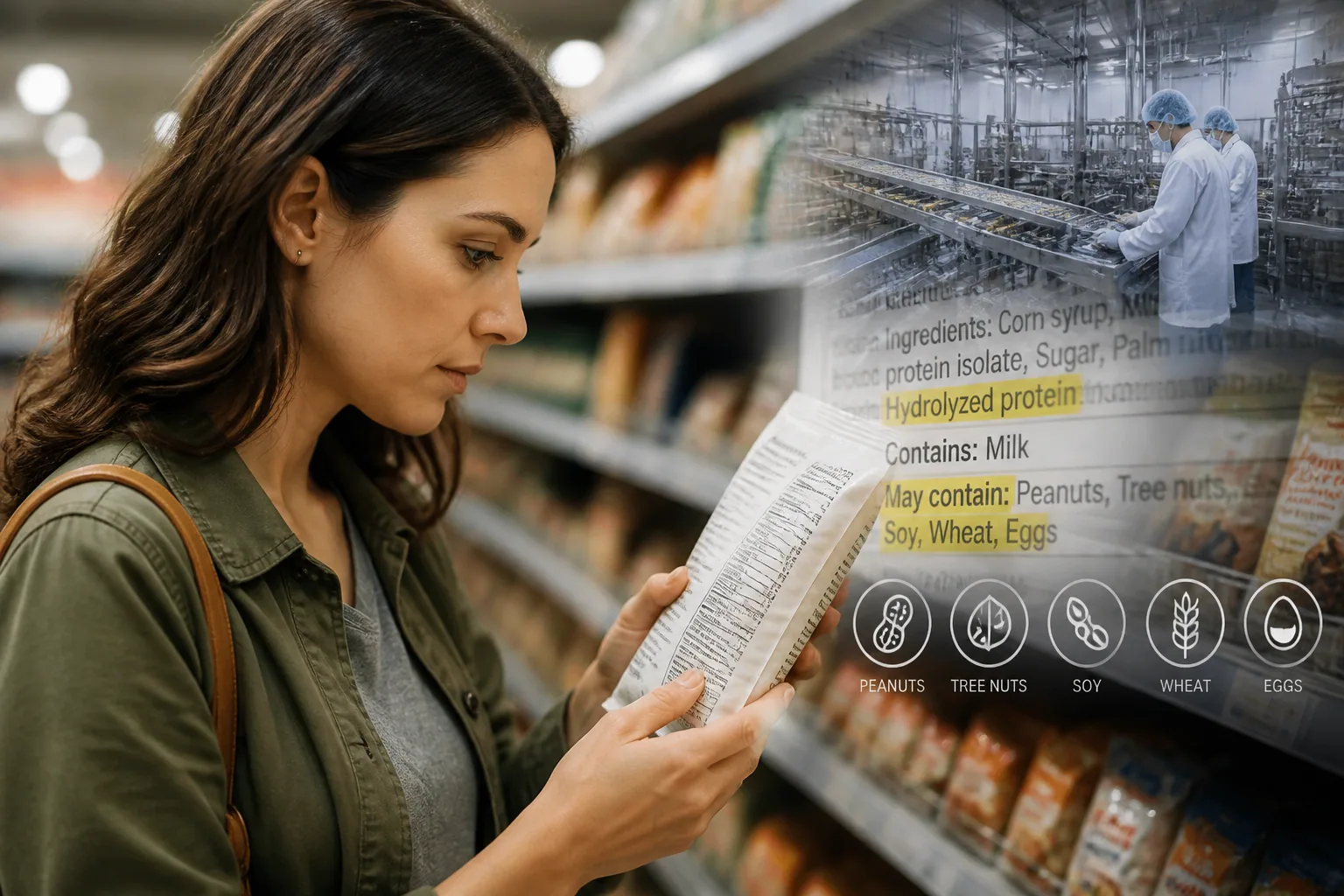
Unseen Dangers: How Routine Food Processing Can Create Hidden Allergens in Packaged Goods
For many people, reading a label feels like the final checkpoint before buying a packaged food. But in the real world of modern manufacturing, the label is only part of the story. Allergens can be introduced through shared equipment, concentrated by processing, or changed by heat, fermentation, and enzymatic treatment in ways that make them harder to predict. That is why a product that looks simple on the shelf can still be risky for someone with food allergies.
This matters for busy professionals trying to shop quickly, parents managing family meals, and anyone living with allergies or intolerances. Packaged foods are convenient, but convenience often comes with complex supply chains and processing steps that are invisible to the shopper. Understanding those hidden risks can make a major difference in how safely and confidently you buy food.
Why Hidden Allergens Are a Growing Concern in Packaged Foods
Hidden allergens are becoming a bigger issue because packaged food production has become more complex. A single facility may produce multiple products on the same line, use shared storage and transport systems, or switch between recipes throughout the day. Even when a brand is careful, the reality of high-volume processing can make accidental allergen exposure difficult to eliminate completely.
There is also a second problem: processing itself can change how an allergen behaves. In some cases, heat or other treatments can reduce detectability without actually making the food safe. In other cases, processing can alter protein structure in a way that makes the allergen more resistant to digestion or still capable of binding to IgE antibodies. So a food that appears less allergenic in one test may still be dangerous for sensitive consumers.
This is why hidden allergens are not just a labeling problem. They are a manufacturing, chemistry, and risk-management problem at the same time.
How Food Processing Can Change Allergen Behavior
Food allergens are usually proteins, but proteins are not fixed objects. They unfold, bond, aggregate, break apart, and interact with sugars and other ingredients during processing. That means the same allergenic source can behave very differently depending on whether it is raw, boiled, roasted, fermented, or enzymatically treated.
Some processes reduce how much intact allergen can be measured in a product, while others change the protein so it becomes harder to detect but still biologically active. This distinction is crucial. A lower measurable level does not always mean a lower immune response.
Research on peanuts is a strong example. Heating and roasting peanuts, especially when sugar is present, can actually increase allergenic potential. Vissers et al. found that roasted Ara h-1 and Ara h-2 bound IgE from peanut-allergic patients at much higher levels than the same proteins from raw peanuts, and were more resistant to digestion and heat treatment: https://pubmed.ncbi.nlm.nih.gov/21801247/
Other studies show that wet heat can reduce soluble allergen levels, but that does not always eliminate the risk. Shi Meng et al. reported that boiling, frying, steaming, roasting, and high-pressure treatments reduced soluble proteins such as Ara h-1, Ara h-2, and Ara h-3, yet roasted and fried peanuts still produced fragments with strong IgE binding: https://pmc.ncbi.nlm.nih.gov/articles/PMC6694862/
Comstock et al. also showed that boiling and frying peanuts can reduce detection of Ara h-1 and Ara h-2 in soluble fractions, but the proteins may aggregate or change form and still trigger immune reactions. In other words, a product can look “less allergenic” on paper while still being unsafe for real consumers: https://pmc.ncbi.nlm.nih.gov/articles/PMC4911009/
Cross-Contact in Factories: The Risk You Can’t See on the Front Label
Cross-contact is one of the most common ways hidden allergens end up in packaged foods. It happens when an allergen is unintentionally transferred from one food to another through shared machinery, airborne dust, processing surfaces, rework ingredients, or even packaging areas. Unlike deliberate ingredients, these traces do not always show up in a simple ingredient list.
The most concerning part is that cross-contact can happen even in well-run facilities. Production lines are often designed for efficiency, not for perfect separation. If a plant makes milk chocolate in the morning and a dairy-free product in the afternoon, there may be residues left behind unless cleaning and validation are extremely thorough. The same problem can appear with nuts, sesame, soy, wheat, and other major allergens.
Real-world recalls show how common this issue is. In 2025, Weaver Nut Company recalled chocolate nonpareils because of undeclared milk, with cross-contact from shared equipment cited as the cause in reporting tied to the FDA announcement: https://www.cbsnews.com/news/chocolate-nonpareils-recall-weaver-nut-company/
A Canadian food inspection report found undeclared milk and sesame in products marketed as dairy-free dark chocolate, again pointing to cross-contamination from handling and shared lines: https://inspection.canada.ca/DAM/DAM-food-aliments/STAGING/text-texte/undclrd_allrgn_gluten_candies_choc_prod_1711566640336_eng.pdf
These examples underline an uncomfortable truth: a product can be manufactured with good intentions and still carry hidden exposure risk. That is why the front label alone is never a complete safety guarantee.
Roasting, Fermenting, and Hydrolyzing: When Processing Doesn’t Make Food Safer
It is easy to assume that processing always makes food safer for allergy sufferers. The reality is more complicated. Some processes reduce allergenicity under certain conditions, but others can preserve, hide, or even intensify allergenic potential. The effect depends on the food source, the exact process, and the final structure of the proteins involved.
Roasting is a perfect example. With peanuts, roasting can drive Maillard reactions, especially when sugars are present, and this can increase the IgE-binding capacity of major peanut allergens. So while roasting may improve flavor and shelf life, it may also make the allergen more troublesome for sensitive individuals.
Fermentation and hydrolysis can sometimes reduce allergenic epitopes, but not always in a predictable way. A recent review in Trends in Food Science & Technology explains that hydrolysis is often more effective when combined with pre-processing or assisted processes. Heating, ultrasound, high hydrostatic pressure, pulsed electric fields, fermentation, and cold plasma can improve enzyme access or alter epitope structure, but the outcome depends heavily on the allergen source and processing conditions: https://www.sciencedirect.com/science/article/pii/S0924224423003631
The same review also notes that glycation can mask epitopes, which can make an ingredient appear less reactive in some tests without eliminating the underlying risk. That is why “processed” does not automatically mean “safe” for allergy-conscious consumers.
Enzymatic treatment can help in some cases. Bi et al. reported that papain hydrolysis combined with electrostatic field treatment significantly reduced the IgE-binding capacity of ovalbumin in egg-allergic models: https://www.sciencedirect.com/science/article/pii/S0308814626007855
The takeaway is simple. Processing is not a magic fix. It can reduce risk, shift risk, or hide risk, depending on the method used.
Real-World Cases of Unexpected Allergen Exposure
Unexpected allergen exposure usually becomes visible only after people get sick or a product is tested and recalled. That is one reason these incidents can feel so frustrating. The packaging may look safe, the brand may sound trustworthy, and the product may even be marketed as a specialty item like dairy-free or allergen-friendly.
But incidents involving undeclared milk, sesame, peanuts, or tree nuts are reported frequently enough to show that packaged-food risk is not theoretical. The causes often include shared lines, incomplete cleaning, ingredient supplier issues, or a change in formulation that was not communicated clearly enough to consumers.
For consumers, these cases are a reminder that caution is not paranoia. It is a rational response to a supply chain where small mistakes can have serious consequences.
How to Read Ingredient Lists for Processing Clues
Ingredient lists are still important, but they require a careful reading. Start with the obvious allergens, then look for ingredient derivatives that may not stand out immediately. For example, milk can appear as whey, casein, lactose, butterfat, or skim milk powder. Soy may appear as soy lecithin or textured soy protein. Wheat may appear through flour, starch, malt, or semolina.
Then look for processing clues. Terms like hydrolyzed protein, enzyme-modified, fermented, roasted, toasted, or protein isolate can signal that the ingredient has been altered in a way that affects allergen behavior. That does not automatically make it unsafe, but it tells you the food has gone through a process that may change its allergenic profile.
You should also pay attention to products that seem “clean” but are highly processed behind the scenes. Snack bars, baked goods, spice mixes, plant-based dairy alternatives, sauces, desserts, and coated candies often involve multiple sub-ingredients and shared production environments, which increases the chance of both obvious and hidden allergens.
When in doubt, processing terms should prompt more questions, not less.
What ‘May Contain’ and Other Precautionary Statements Really Mean
Precautionary allergen labeling, often shortened to PAL, includes phrases such as “may contain,” “produced in a facility that also processes,” or “made on shared equipment.” These statements are widely used, but they are voluntary and not standardized in a way that guarantees a predictable risk level.
Research on environmental food exposure notes that manufacturers often rely on PAL even when they use preventive allergen controls, partly because official threshold levels for many allergens are still not established in regulation. That means the wording is often a reflection of risk management practices rather than a precise safety threshold: https://pmc.ncbi.nlm.nih.gov/articles/PMC6324195/
For consumers, this creates a difficult reality. A “may contain” statement does not mean the allergen is definitely present, but it also does not mean the product is safe. It is a warning that the manufacturer recognizes some chance of cross-contact and is choosing to disclose it.
The absence of a precautionary statement is also not a guarantee. Some brands do not use PAL consistently, and not all hidden contamination is detected before a product reaches the shelf. That is why people with severe allergies often need to evaluate labels conservatively and rely on brand-specific knowledge over time.
How Apps Like Bokha Can Help and Where They Fall Short
For everyday shopping, tools that save time can be genuinely useful. Bokha: Food Allergy Scanner App lets you scan product barcodes and discover allergens in less than a second. It detects 13 allergens, traces, and additives, which can be helpful when you are comparing packaged foods quickly in a supermarket: https://findthe.app/bokha
That kind of speed matters, especially for families balancing work, school, and meals. An app can make it easier to spot obvious ingredients, compare products, and reduce the mental burden of reading every label from scratch.
But apps also have limits. They can help identify listed allergens and some trace or additive information, but they cannot see what happened in the factory last week, how carefully a line was cleaned, or whether a supplier changed an ingredient without clear shelf-level clues. Hidden manufacturing risks, especially cross-contact and processing-driven changes in allergen behavior, are often beyond what any scanner can verify.
So a scanning app is best viewed as one tool in a broader safety strategy. It can support faster decisions, but it cannot replace careful label reading, brand research, or professional medical advice for severe allergies.
Smart Shopping Strategies for Allergy-Conscious Households
The safest grocery strategy is not to assume perfection. Instead, build a system that helps you reduce risk consistently. Start with a short list of trusted brands and products that have a strong track record for clear labeling and stable formulations. If a product changes packaging or ingredient wording, treat it as a new product until you verify the details.
When possible, favor foods with simpler ingredient lists and fewer processing stages. The more complex a product is, the more opportunities there are for hidden allergens to enter through one of its many ingredients or production steps. That does not mean all simple foods are safe, but complexity tends to raise uncertainty.
It also helps to separate levels of concern. Mild sensitivities, intolerances, and severe IgE-mediated allergies are not the same risk category. If someone in the household has a history of anaphylaxis, the tolerance for uncertainty should be very low. In that case, products with vague precautionary labeling, ambiguous derivatives, or unclear brand policies may not be worth the gamble.
Finally, do not let convenience override verification. A few extra minutes spent checking a label or brand website can prevent a much bigger problem later.
What Consumers Should Ask Brands When Safety Isn’t Clear
When a label leaves too many questions unanswered, direct contact with the brand can be useful. Ask whether the product is made on shared equipment, whether allergens are handled in the same facility, and whether cleaning procedures are validated for the allergen of concern. If the answer is vague, that vagueness itself is informative.
You can also ask whether the formulation has changed recently, whether ingredient suppliers are audited for allergen control, and whether the company uses any allergen testing before release. For products that are marketed as dairy-free, nut-free, or gluten-free, ask how the company verifies those claims in practice.
It is worth remembering that a company’s answer may reflect their current production setup, not a future guarantee. Manufacturing can change quickly. Still, asking questions helps you identify brands that take allergen management seriously and avoid those that rely on unclear wording or generic assurances.
In a processed-food world, safety comes from layers of caution, not one perfect label. Understanding processing effects, cross-contact risks, and the meaning of precautionary statements can help you make smarter choices and reduce surprises in the cart, the kitchen, and the lunchbox.