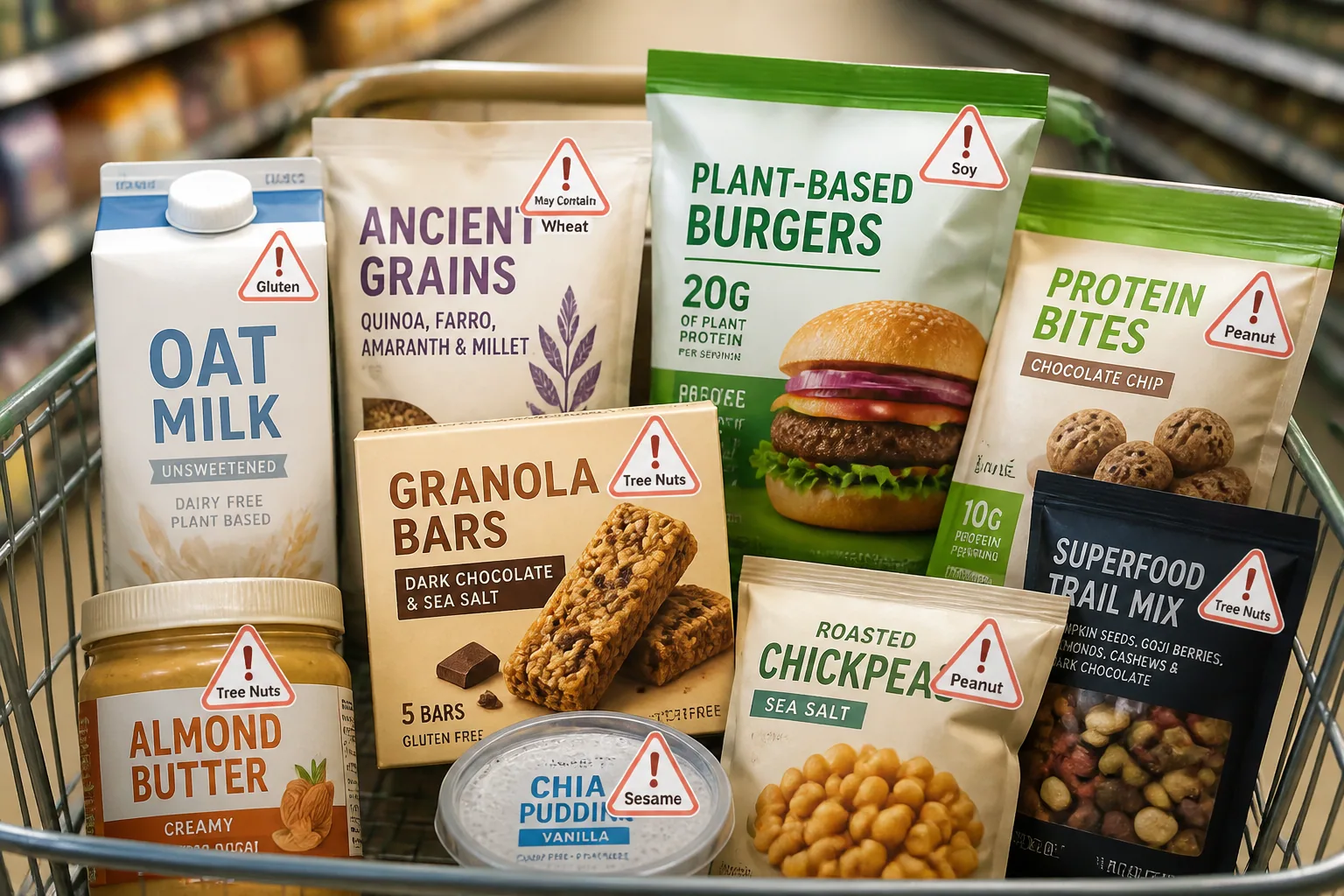
Unexpected Allergens in Popular “Healthy” Foods: What Labels Don’t Tell You
A lot of foods are sold as healthy because they look simple, modern, and better for you. Plant-based bars, clean-label snacks, organic granola, gluten-free baked goods, dairy alternatives, and superfood blends all sound reassuring at first glance. But for people managing food allergies or intolerances, those labels can hide real risk. Healthy marketing is not the same thing as allergen safety, and a product can be natural, functional, or vegan while still containing milk, gluten, soy, nuts, sesame, or traces from shared equipment.
The problem is not just obvious ingredients. It is also how foods are made, sourced, reformulated, packed, and labeled. A product can change suppliers without changing its front label. It can be made on the same line as allergens. It can contain vague ingredients like natural flavors or seasoning that are not as transparent as shoppers expect. That is why reading the marketing claims is never enough. You need to look at the full ingredient list, advisory statements, and the brand’s production habits before assuming a product is safe.
Why “Healthy” Does Not Mean Allergen-Safe
The strongest mistake shoppers make is assuming that better-for-you positioning means lower allergy risk. In reality, many of the categories most associated with wellness are also the categories where cross-contact is common. Granola bars often include peanuts, tree nuts, milk chocolate, or soy. Protein snacks may use whey, pea protein mixed on shared equipment, or flavor systems that include hidden milk or soy derivatives. Dairy alternatives frequently rely on processing facilities that also handle milk. Ancient grains and oat-based products may be exposed to gluten during farming, transport, or milling. Superfood blends can include sesame, nut powders, or spice blends that are not obvious from the package front.
Research repeatedly shows that marketing words do not guarantee allergen control. In a Canadian study of 124 prepackaged foods with vegan or plant-based claims, 18% of vegan-labeled items carried precautionary allergen labeling for milk and 12% for egg. Of 87 tested items, 5.7% had detectable milk protein. In other words, a vegan or plant-based claim did not mean the product was free from allergen concerns. The study is a good reminder that the front label and the actual risk profile are two different things. Source: https://pmc.ncbi.nlm.nih.gov/articles/PMC10464346/
What Marketing Terms Like Clean-Label and Plant-Based Really Mean
Terms like clean-label, natural, organic, functional, and plant-based are marketing terms first. They may tell you something about brand identity or ingredient philosophy, but they do not tell you whether an item was made in an allergen-controlled environment. A clean-label snack may avoid artificial colors and preservatives, yet still contain milk powder or be packed on a line that handles peanuts. A plant-based meal may avoid meat and dairy ingredients, but still include soy, gluten, or hidden allergens in sauces and seasonings.
One common issue is that the front of the package highlights what is not there, while the back of the package reveals what is. A product can say dairy-free and still carry an advisory statement about shared equipment. A bar can say gluten-free and still be at risk if oats were contaminated earlier in the supply chain. A functional drink can advertise added protein or adaptogens while using flavor systems or stabilizers that are not transparent enough for people with allergies. These claims may be useful for general shoppers, but they should never replace a careful label check.
The FDA has also noted that consumers often misinterpret vague terms such as natural flavors, flavors, spices, or seasoning. Those terms can legally conceal allergenic ingredients such as milk, soy, wheat, or sesame when they are part of a flavor blend or seasoning system. Source: https://www.fda.gov/food/conversations-experts-food-topics/current-food-allergen-landscape
The Hidden Allergen Risks in Popular Healthy Food Categories
Granola bars are one of the clearest examples of how healthy branding can create a false sense of safety. They are often sold as wholesome, whole-food snacks, but many formulas include honey roasted nuts, chocolate chips, crisped rice, soy lecithin, or oat ingredients that may have cross-contact issues. Even bars that look simple can be made in facilities processing multiple major allergens. The result is that the best-looking snack on the shelf may still be one of the riskiest choices for someone avoiding allergens.
Protein snacks have a similar problem. The category includes protein bars, bites, cookies, and drinks that are marketed around fitness and nutrition. But protein sources themselves can be allergen-heavy. Whey means dairy. Soy protein is common. Nut butters are often used for texture and flavor. Even pea protein products may contain advisory statements because they are processed alongside milk, egg, or tree nuts. If you are relying on a protein snack as a safe on-the-go option, you need to inspect the label with the same care you would use for any processed food.
Dairy alternatives deserve special attention because they are often bought by people who are specifically avoiding milk. Almond milk, oat milk, cashew milk, coconut yogurt, and vegan cheeses are all built around the idea of substitution. Yet substitution does not equal immunity from allergen risk. They may contain nuts, soy, oats, or added flavor systems, and they may be produced on lines that also make dairy products. Even if the ingredient list seems acceptable, the packaging may still include a precautionary statement that matters a lot to milk-allergic shoppers.
Meatless products can also be misleading. Burgers, nuggets, sausages, and deli slices made from plants often depend on soy, wheat gluten, pea protein, or spice blends to mimic the texture and taste of meat. That means the product can be highly processed even when it is marketed as simple or clean. For someone avoiding soy or gluten, the plant-based label may actually hide a more concentrated allergen profile than a conventional product would have.
Ancient grains and superfood blends feel especially safe because they sound old-fashioned, earthy, and nutrient-rich. But ancient grains like quinoa, millet, amaranth, or buckwheat can still be exposed to gluten through farming or manufacturing. Oat products are an even clearer case. A review of oat-containing foods tested between 2011 and 2023 found that 11% had detectable gluten at or above 5 ppm, and 7% had more than 20 ppm, even when oats were the first or only ingredient. Another systematic review of 56 studies covering 27,806 food samples found that about 11% of labeled gluten-free foods contained more than 20 ppm gluten. Source: https://pmc.ncbi.nlm.nih.gov/articles/PMC10702567/ and https://www.sciencedirect.com/science/article/abs/pii/S2405457725031602
How Cross-Contamination Happens Through Processing and Shared Equipment
Cross-contact can happen at almost any stage. Ingredients may be grown or harvested near allergen-containing crops. They may be stored in shared silos or transported in shared containers. During manufacturing, the same mixers, ovens, coating drums, filling machines, or packaging lines may be used for multiple products. Even if the facility cleans between runs, residue can remain. This is why “made in a facility that also processes…” statements matter, but they are still imperfect and inconsistent.
Advisory statements are especially tricky because they are not uniform. Some brands use them only when the risk is meaningful. Others use them broadly to reduce liability. Consumer research shows that fewer than half of allergic individuals find precautionary allergen labeling clear, and practices vary widely from one company to another. That means shoppers often have to make decisions using a warning that is vague, nonstandard, and difficult to compare across brands. Source: https://pmc.ncbi.nlm.nih.gov/articles/PMC8519062/
The data also show that advisory statements are not always overly cautious. In a U.S. survey of dark chocolate and chocolate-containing products labeled dairy-free, 210 samples were tested and 13 were positive for milk. Twelve of those positives were under 80 ppm, while one reached 1,083 ppm. All had advisory statements about shared equipment or facilities. In another survey, some dark chocolate bars labeled dairy-free or similar had much higher milk levels than shoppers would expect, and even some vegan-labeled bars contained milk. Source: https://www.fda.gov/food/hfp-constituent-updates/fda-releases-results-sampling-retail-dairy-free-dark-chocolate-and-chocolate-containing-products and https://pubmed.ncbi.nlm.nih.gov/28304196/
Surprising Examples of Allergens Found in Better-For-You Products
Chocolate is a useful example because it is often marketed as an indulgent but still wholesome treat, especially when it is dark, organic, or dairy-free. Yet testing has repeatedly shown that milk can still appear in products carrying those claims. In Europe, 4.4% of reported undeclared allergen incidents involved products with labels such as vegetarian, vegan, gluten-free, or dairy-free. Among those incidents, milk was the largest share, but non-animal allergens like nuts, soy, gluten, mustard, peanuts, and celery also appeared frequently. This shows that the risk is not limited to dairy. Source: https://pmc.ncbi.nlm.nih.gov/articles/PMC9026746/
Snacks with egg or milk precautionary statements are another surprise. In a Chinese study of prepacked snacks, 18.11% of products with egg PAL contained measurable egg protein, and 29.82% of products with milk PAL contained measurable milk protein. Most positives were baked goods. In a separate survey of imported Thai snacks, over 80% of products would have been classified risk-free under VITAL 3.0 despite carrying PAL, which shows how hard it is to rely on a warning alone. Source: https://www.sciencedirect.com/science/article/abs/pii/S0956713521000190
Oats are another surprise for many shoppers. Oatmeal cups, granola, oat bars, and oat milk are frequently marketed as simple and wholesome, especially in gluten-free and plant-based aisles. But oats are vulnerable to contamination throughout the supply chain, and testing shows that a meaningful share of oat-containing products contain detectable gluten. For anyone with celiac disease or gluten sensitivity, the package can look reassuring while the actual risk remains very real.
How to Decode Ingredient Lists and “May Contain” Statements
The ingredient list is still the most important starting point. Look for the major allergens you already know you must avoid, and do not skip over sub-ingredients. A chocolate coating may contain milk. A flavoring may include soy. A grain blend may hide wheat. A sauce or seasoning packet may contain sesame or mustard. If a label uses terms like natural flavor, spice blend, seasoning, or flavoring, treat it as a prompt to investigate further rather than a guarantee of safety.
The next layer is the advisory statement. Phrases such as may contain, processed in a facility with, made on shared equipment with, or manufactured in a facility that also processes should be treated seriously, especially if your allergy is severe. These statements are not legally standardized in many markets, but they are still useful signals. If the product has changed suppliers or has been reformulated, the advisory statement may also change even when the front of the package looks identical.
If you are shopping for a child, a highly sensitive adult, or someone with a history of anaphylaxis, the safest rule is to avoid products with unclear or inconsistent labeling. When in doubt, checking the brand’s official allergen policy or contacting customer service can help, but that is not realistic in the middle of a grocery run. That is why scanning tools and saved product histories can make such a difference.
Smart Shopping Tips: Barcodes, Brand Checks, and Allergy Apps
A practical allergy routine should be fast enough to use in real life. Start with a short list of brands that are consistently transparent. Check the company’s allergen page before you shop if possible. Save products that are safe for your household and note which versions or flavors have changed. Be extra careful with seasonal items, limited editions, and new packaging, because reformulations often happen there first.
Barcode-scanning tools can reduce a lot of guesswork. They are especially useful when you are comparing multiple snacks that look similar but differ in allergens, traces, or processing notes. Instead of reading every package from scratch, you can scan, compare, and move on. That is particularly helpful in crowded categories like protein bars, dairy alternatives, and gluten-free baked goods, where a few small ingredient changes can dramatically change the risk.
Apps like Bokha are built for exactly this kind of quick decision-making. Bokha: Food Allergy Scanner App lets you scan a product barcode and see its allergens in less than a second, including 13 allergens, traces, and additives, so you can spot hidden risks faster while shopping. For people who need speed and consistency, that kind of support can turn a stressful store visit into a more manageable routine: https://findthe.app/bokha
How Bokha Can Help Flag Hidden Risks Faster
The real advantage of an allergy app is not just convenience. It is pattern recognition. If a brand repeatedly shows hidden milk risk in supposedly dairy-free products, or if a snack line frequently carries gluten traces despite gluten-free positioning, an app can help you notice the pattern before you buy again. That is especially important when labels are ambiguous or when companies use the same design across many product variations.
Bokha can also help when you are comparing different allergens at once. Someone avoiding gluten, soy, and dairy does not just need a yes-or-no answer. They need to know whether a product contains any of those allergens, whether traces are listed, and whether additives or processing details change the decision. A fast scan gives a much more complete picture than the front of the package ever can.
A Safer Way to Shop for Healthy Foods
The safest mindset is simple: healthy is not the same as allergen-safe, and natural is not the same as transparent. The best-looking products can still hide milk, gluten, soy, nuts, sesame, or other major allergens because of ingredient sourcing, shared equipment, or loose advisory labeling. Once you accept that reality, shopping becomes less about trusting the marketing and more about checking the evidence.
A safer routine means reading beyond the front label, paying close attention to advisory statements, learning the brands you trust, and rechecking products when packaging changes. It also means using the tools that make the process faster, because speed matters in a supermarket aisle. With a barcode scanner, a careful label-reading habit, and a healthy skepticism toward wellness claims, you can reduce surprises and buy with more confidence.