Traveling Abroad with Food Allergies: How to Stay Safe, Sane, and Snack Smart
Traveling with food allergies is not just a matter of being careful. It changes the entire rhythm of a trip. A simple meal becomes a decision. A quick snack becomes a research project. A long layover can turn into a stress test. And when you are far from home, the stakes feel higher because you may not understand the labels, the language, or the local food culture well enough to make fast decisions with confidence.
That extra layer of vigilance is real. A global review found that food-related allergic reactions among travelers happen in about 6.9 to 10.0 percent of cases, with reactions in airports and during transit ranging from 1.7 to 3.0 percent. The same review noted that peanuts and tree nuts were among the most common triggers, and that although many travelers carried epinephrine, only a minority used it during reactions. In other words, preparation matters, but so does knowing how to act quickly when something goes wrong. Source: https://pmc.ncbi.nlm.nih.gov/articles/PMC12860081/
The good news is that international travel with food allergies has become more manageable. There are better labels in some markets, more airline accommodations, stronger translation tools, and more practical ways to build a backup food plan. You still need to stay alert, but you do not need to travel in a constant state of panic.
Why Travel Feels Different When You Have Food Allergies
Food allergy travel is stressful because so much of travel depends on spontaneity. You eat when you are hungry, buy snacks when you see them, and trust that hotels, trains, and airports will have safe options. Allergies interrupt that convenience. You are not just asking, “What sounds good?” You are asking, “What is safe, what is cross-contact risk, and who can answer my questions clearly?”
That constant decision-making creates fatigue. It can also create social pressure, especially if you feel awkward asking a server to repeat ingredients, or you worry that you are slowing everyone else down. Many travelers also experience anxiety before the trip even starts, because one uncertain meal can feel like it could ruin the entire journey.
The key mindset shift is to treat allergy travel as a system, not a series of one-off emergencies. The more you can standardize your preparation, your documents, your snack kit, and your fallback options, the less energy you spend improvising abroad.
What to Research Before You Leave Home
Research is your first layer of safety. Before you leave, look up how allergen labeling works in your destination country, what the most common local ingredients are, and how restaurants usually handle special requests. International labeling varies widely, even when countries follow Codex Alimentarius guidance, so you cannot assume that allergen disclosure will look the same everywhere. Source: https://pmc.ncbi.nlm.nih.gov/articles/PMC10169132/
If you are traveling from the United States, it helps to remember what you are used to at home. FALCPA requires labeling of the Top 8 allergens, and sesame was added as a ninth major allergen in 2023. Outside the U.S., the set of required allergens and the format of labels can be very different, so it is worth checking country-specific rules in advance. Source: https://en.wikipedia.org/wiki/Food_Allergen_Labeling_and_Consumer_Protection_Act
It is also smart to research practical logistics, not just regulations. Find out whether your hotel has a kitchenette, whether grocery stores are nearby, whether your destination has major chain supermarkets, and what time stores close. If you are heading somewhere where English is not widely spoken, search for allergy-friendly restaurants, medical facilities, and local support communities before you go.
The CDC recommends starting your health prep at least one month before departure, packing enough medication including epinephrine, and carrying allergy cards with translated e-versions. That timeline gives you room to solve problems instead of rushing through them at the last minute. Source: https://wwwnc.cdc.gov/travel/page/allergies
How to Pack for Safety, Comfort, and Backup Meals
Packing for allergy travel should follow one rule: assume you may need to feed yourself safely for longer than expected. Delays happen. Restaurants close early. The airport meal you counted on may not work out. A train station may have only vending machines. Bring enough medication, but also bring enough food to bridge the gaps.
Your core kit should include prescribed emergency medication, a few shelf-stable snacks, a reusable water bottle, antihistamines if your clinician recommends them, copies of prescriptions, and any medical documentation you may need at security or in a clinic. If you use epinephrine, keep it where you can reach it instantly, not buried in checked luggage.
It also helps to pack food that is familiar, compact, and low-mess. Think protein bars, plain crackers, allergy-safe instant oatmeal, tuna or bean packets if allowed by customs rules, and nonperishable snacks that can survive heat and travel days. The goal is not to replace local cuisine. It is to prevent hunger from forcing you into risky decisions.
One useful habit is to create a “first 24 hours” bag. Put in it the snacks, medication, charger, translation cards, and a small backup meal you will need if arrival is delayed or your first meal abroad is harder than expected. That one bag can reduce a surprising amount of anxiety.
Using Translation Cards and Allergy Phrases That Actually Help
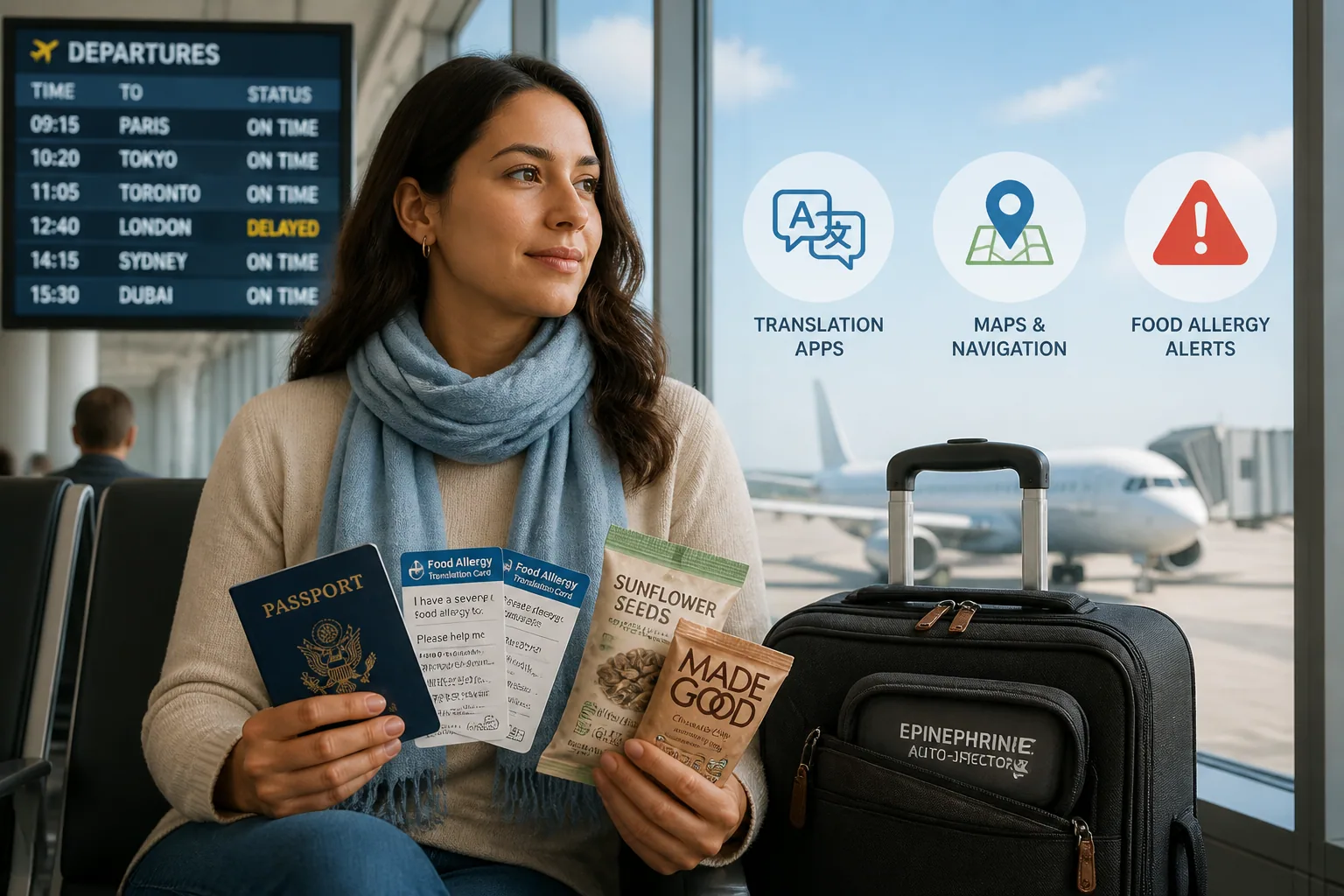
A good translation card is more than a list of allergens. It should say what you cannot eat, what cross-contact means for you, and what you need staff to do differently. For example, a card that says “I have a severe allergy to peanuts and tree nuts. Even small amounts can make me very sick. Please check ingredients and avoid cross-contact” is often more useful than a single-word list.
Carrying chef or translation cards is widely recommended. FARE provides chef cards in many foreign languages, and Allergy UK offers durable plastic allergy translation cards in 35 languages that can cover up to 200 allergens. Source: https://www.foodallergy.org/resources/food-allergy-chef-cards
The best cards are the ones you will actually use. Keep a digital copy on your phone, a printed copy in your wallet, and, if possible, a more direct version for kitchen staff. Some tools also make this easier by formatting cards for different situations. TrustBite offers allergen safety cards in 24 languages and includes barcode scanning and AI label photo analysis, while AllergyCard and MyChefCard provide multilingual card options designed for restaurant communication. Source: https://trustbite.me/
Try to learn a few spoken phrases too. “I am allergic to” is useful, but so are questions like “Does this contain…” and “Was this cooked in the same oil or on the same equipment?” Even if your pronunciation is imperfect, a short, clear script can lower confusion and make staff more likely to take your request seriously.
Understanding Allergen Labels in Other Countries
Labels abroad are one of the most important things to decode. Some countries bold allergens in ingredient lists. Some use a separate allergen box. Others rely more heavily on advisory statements or package icons. And some packaged foods may have less detail than you are used to at home.
This is why you should not rely only on whether a product looks familiar. A brand name you know may be made differently in another country. A “safe” snack back home may contain different oils, flavorings, or processing aids abroad. When in doubt, verify every package as if you have never seen it before.
Tools that scan barcodes or analyze labels can be especially helpful here. They can save time when you are standing in a grocery aisle and trying to compare several items quickly. For travelers, that matters because the real risk is not just one dangerous ingredient. It is the accumulation of rushed choices made when you are hungry, tired, and in a language you do not fully understand.
How to Eat Safely on Airplanes, Trains, and Buses
Transit is one of the most overlooked risk zones. Airports are noisy, rushed, and full of shared surfaces. On planes, the challenge is not only what is served, but also what other passengers bring onboard. Trains and buses can be even trickier because you may have very little control over where food is opened or eaten.
Airlines can sometimes help. Delta, for example, says it may refrain from serving peanut products, offer alternate snacks, allow early boarding so the seating area can be cleaned, and help with seat changes for passengers with severe allergies. But even with these accommodations, airlines do not guarantee an entirely allergen-free environment. Source: https://www.delta.com/us/en/accessible-travel-services/dietary-needs-and-allergies
That means your strategy should be layered. Eat before you board if possible. Carry your own food. Wipe down tray tables and armrests. Keep your medication accessible. If your allergy is severe, inform the airline in advance, but also assume you still need to manage the environment yourself.
On trains and buses, the safest move is often to reduce uncertainty rather than eliminate it completely. Choose seats where you can control your immediate space better, avoid eating if you are not sure about cleanliness, and do not be afraid to decline snacks handed out casually by fellow passengers unless you have verified them.
Restaurant Strategies for Clearer, Safer Communication
Restaurants can be wonderful or stressful depending on how they handle questions. The most effective strategy is to communicate early, clearly, and calmly. Tell the server about your allergy before ordering, not after. If possible, ask whether the kitchen can accommodate you before you get emotionally attached to a dish.
When speaking with staff, keep your message short and concrete. Say what allergen you must avoid, how serious it is, and what you need them to check. Avoid vague language like “I am kind of allergic” because it can sound optional. You want the kitchen to understand that this is a safety issue, not a preference.
It can also help to ask about shared fryers, grills, utensils, sauces, and dessert toppings. Cross-contact often hides in the details. A dish may look safe on the menu but be finished with a sauce, dusting, or garnish that changes everything.
If a restaurant seems uncertain, take that as useful information. Uncertainty is not the same as danger, but it is a sign to slow down, ask more questions, or choose a different place. The goal is not to force every restaurant into being safe. The goal is to identify the ones that can communicate clearly enough for you to make an informed choice.
Navigating Supermarkets, Convenience Stores, and Street Food
Supermarkets are often the easiest place to regain control because packaged food offers more information than restaurant food. This is where having a good scanner tool can save time. For example, Bokha: Food Allergy Scanner App lets you scan product barcodes and see allergens in less than a second, including 13 allergens, traces, and additives. For travelers trying to decode unfamiliar packaged foods quickly, that kind of speed can make grocery shopping far less stressful. https://findthe.app/bokha
Convenience stores are useful for emergency snacks, but they are also where assumptions can be dangerous. Flavored nuts, chocolate bars, sandwich fillings, pastries, and even drinks can contain unexpected allergens. Read every label, even on products that seem obvious.
Street food requires a different kind of caution. In some places it may be fresh, delicious, and relatively simple. In others, ingredient lists are invisible and cooking surfaces are heavily shared. If you want to try it, do it when you are not starving, ask direct questions, and choose vendors who can explain their ingredients with confidence. If your allergy is severe, there is nothing wrong with skipping street food entirely.
The Best Apps and Tech Tools for Allergy-Safe Travel
Technology does not replace judgment, but it can reduce the number of times you have to guess. Translation apps can help you verify ingredients in real time. Map-based restaurant review platforms can help you identify places with better communication or more experience handling dietary restrictions. Scanner tools can quickly flag packaged foods that are not safe.
Some travelers also use telemedicine options so they can reach a clinician if a reaction, medication issue, or symptom question comes up while abroad. That is not a substitute for emergency care, but it can help you make smarter decisions faster, especially if you are trying to distinguish a mild reaction from a more serious one.
Among newer tools, travel-focused allergy apps are especially appealing because they combine several functions in one place. Translation, scanning, and card sharing all reduce friction. The less time you spend manually decoding every product or restaurant menu, the more energy you have for the trip itself.
What to Do in an Emergency Overseas
If a reaction happens, act quickly and do not wait for symptoms to “get worse” before taking them seriously. Follow your emergency plan, use epinephrine as prescribed if you have signs of a severe reaction, and seek emergency medical help right away. Do not assume that being abroad changes the urgency of the situation.
Before you travel, learn the local emergency number, the nearest hospitals to where you are staying, and how to explain your allergy in the local language. Keep that information both digitally and on paper. If you are traveling with companions, make sure at least one of them knows where your medication is and what to do if you cannot speak clearly.
A simple emergency card can be useful too. It should include your allergens, medication list, emergency contacts, and any important medical notes. If you get separated from your phone or internet access, that small paper backup can become very important.
Managing Anxiety, Social Stress, and Decision Fatigue While Traveling
The emotional burden of food allergy travel is often underestimated. Studies and advocacy groups note frequent travel anxiety, fear of reactions, social isolation, and avoidance of travel or activities because of allergy concerns. Source: https://www.foodallergy.org/sites/default/files/2026-02/FARE_NIR_FINAL 1.pdf
That anxiety is not a sign that you are overreacting. It is a sign that you are carrying a real safety responsibility in a context that is already unpredictable. The goal is not to eliminate the anxiety completely. The goal is to reduce uncertainty enough that the anxiety becomes manageable.
One practical way to do that is to make more decisions before you leave home. Decide which snacks you will pack, which phrases you will use, what your backup meals are, and what threshold will make you skip a restaurant. Pre-deciding lowers fatigue later because you are not reinventing your rules when you are tired.
It also helps to lower the emotional stakes. Not every meal abroad has to be memorable. Some meals are just logistics. If you frame your travel food plan around safety and consistency, rather than culinary excitement at every stop, you will likely feel less pressure and enjoy the good moments more.
Building a Repeatable Food Allergy Travel Routine
The best allergy travel system is one you can repeat. Before each trip, use the same checklist: research the destination, update translation cards, refill medication, pack backup food, save emergency contacts, and identify nearby grocery stores and hospitals. A routine reduces the chance that you will forget something important when you are excited or rushed.
You can also create different versions of the routine for different trip types. A city break may require grocery mapping and restaurant research. A long-haul flight may require more snacks and seat prep. A business trip may require restaurant scripts and hotel-room food planning. Once you identify the pattern, each new trip becomes easier to manage.
Most importantly, give yourself permission to travel in a way that fits your reality. You do not need to eat everything. You do not need to say yes to every shared meal. And you do not need to prove that your allergy makes you less adventurous. Good travel is not about taking unnecessary risks. It is about building enough safety into the trip that you can actually relax.