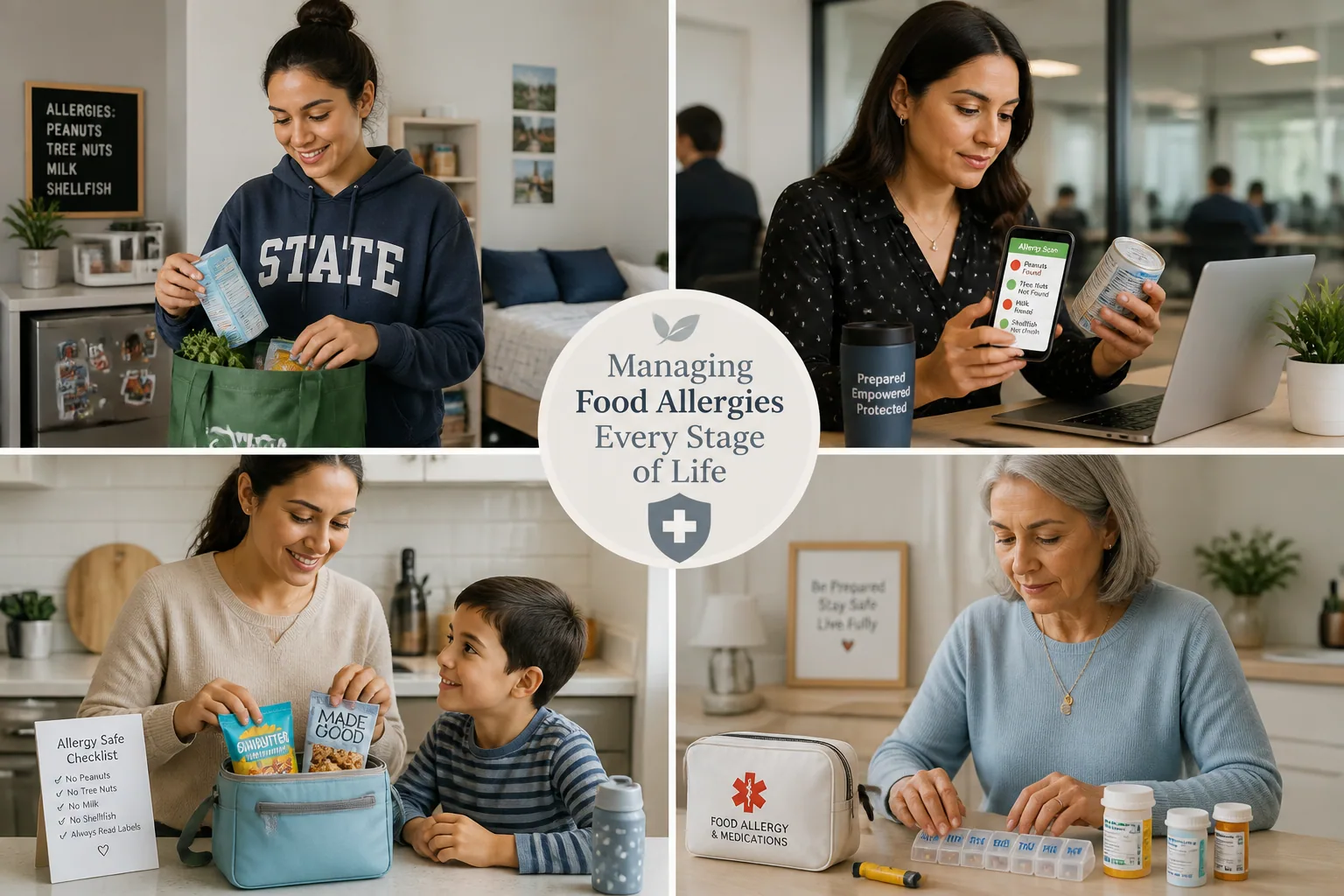
Thriving With Food Allergies at Every Age: Smart Strategies From College to Older Adulthood
Managing food allergies does not look the same at 18, 28, 48, or 78. The risks can change, the environments get more complicated, and the responsibilities around you keep shifting. What stays the same is the need for clear routines, quick decision-making, and a plan that works in real life, not just on paper.
Food allergies are also more common in adulthood than many people realize. An estimated 10.8% of U.S. adults, or more than 26 million people, have one or more convincing food allergies, while nearly 19% believe they do. Even more striking, 48% of adults with confirmed food allergies developed at least one after age 18, which means this is not just a childhood issue that disappears with time. Severe reactions are common too, with 51% of adults with food allergies reporting at least one severe reaction, and only about 24% currently having a prescription for epinephrine. Those numbers make one thing clear: adult food allergy management deserves serious attention at every stage of life. Source: https://pmc.ncbi.nlm.nih.gov/articles/PMC6324316/
The good news is that adults can build strong, flexible systems. From shared kitchens and workplace lunches to travel, parenting, and aging, a few smart habits can reduce stress and make safety feel more automatic. The key is to adapt your approach as your life changes.
Why Food Allergy Management Changes Across the Adult Lifespan
In childhood, food allergy management is often built around parents, teachers, and caregivers. In adulthood, the responsibility gradually shifts to you, and sometimes to a partner, children, coworkers, or healthcare professionals. That shift is not always smooth. New environments bring new risks, and each major life stage introduces different exposure points.
College may mean shared fridges and unpredictable dining halls. Early career life often includes office kitchens, catered events, and business travel. Partnership and home life bring the challenge of balancing two sets of habits. Parenthood adds another layer because now you are protecting your children while also managing your own allergies. Later in life, aging can bring memory changes, multiple medications, and more medical appointments, all of which can complicate routine allergy management.
That is why the best allergy strategy is not one rigid checklist. It is a living system that can evolve with you. The goal is to make safe choices easier, faster, and more repeatable, even when your schedule gets messy.
College and First-Time Independence: Shared Spaces, Tight Budgets, and New Routines
College is often the first time many people manage food allergies without a parent checking every label or planning every meal. That independence can feel empowering, but it also means you need to create your own safety habits from scratch. Shared kitchens, unpredictable roommates, and late-night eating all increase the risk of accidental exposure.
One of the biggest challenges is cross-contact. A spoon left in a peanut-containing spread, a shared toaster, or a communal cutting board can create problems even when ingredients seem safe. It helps to set up your space early. Label your food clearly, keep allergen-safe items on a separate shelf, and use containers that reduce mix-ups. If you share a fridge, consider a small locked bin or a designated drawer for your foods.
Dining halls are another major issue. The research on colleges in the U.S. and Canada shows that 94% of dining services have cross-contact procedures in made-to-order areas, about 90% allow meal pre-orders, and 59% publish ingredient information online. That is encouraging, but it also shows that safety systems vary. The safest move is to ask specific questions, not assume the school will automatically protect you. Ask how they prevent cross-contact, whether staff are trained on your allergens, and how to speak with a manager if you need special preparation. Source: https://pmc.ncbi.nlm.nih.gov/articles/PMC10468845/
Budget also matters in college. When money is tight, it can be tempting to gamble on cheaper food choices, but inconsistency usually leads to more stress. A good strategy is to build a short list of reliable safe meals and snacks you can buy or prepare quickly. If you have access to a kitchen, learn a few low-cost recipes that are naturally allergy-friendly. The more familiar your routine becomes, the less mental energy you spend guessing.
This is also a good stage to start using digital tools. Food allergy symptom trackers or patient diaries can help identify patterns, track reactions, and improve diagnostic accuracy. Barcode scanners can be especially useful for checking packaged foods before you buy or eat them. A tool like Bokha: Food Allergy Scanner App can make that process faster by scanning product barcodes and identifying allergens in less than a second, which is helpful when you are shopping on a student schedule and need quick answers. Product link: https://findthe.app/bokha
Finally, college is the time to practice speaking up. Tell roommates, friends, and dining staff what you need in clear language. Short scripts help: “I have a severe allergy, so I need separate utensils” or “Please check the ingredient list before serving me anything.” The earlier you get comfortable saying it, the easier adulthood becomes.
Early Career Life: Office Kitchens, Work Travel, and Speaking Up at Work
The workplace introduces a different kind of challenge. Unlike college, where food issues are often concentrated in dining spaces, work life spreads them out across meetings, break rooms, conferences, and social events. You may no longer control what is ordered for lunch, what snacks are stocked in the kitchen, or whether a coworker understands the seriousness of your allergy.
Office kitchens are a common source of accidental exposure because people move quickly and often do not read labels carefully. The safest approach is to create boundaries that are practical, not awkward. Keep your own mug, utensils, and storage bin clearly marked. Wipe down surfaces before use. Avoid assuming a labeled container is safe if it has been opened or shared. Small habits prevent a lot of uncertainty.
Speaking up at work can feel uncomfortable, especially early in your career when you do not want to seem difficult. But food allergy management is not a personal preference. It is a health need. If a workplace meal is being planned, let the organizer know in advance. If you are traveling for work, review restaurant options and bring backup food for transit days. If a catering company is involved, ask for ingredient lists and cross-contact procedures before the event begins, not after the trays are on the table.
Work travel deserves extra attention because routine breaks down quickly on the road. Airports, delayed flights, hotel breakfasts, and unfamiliar restaurants all increase uncertainty. Pack safe snacks in your carry-on, keep your medications in the same place every time, and save restaurant options ahead of the trip. If you are flying, carry emergency medication with you rather than putting it in checked luggage. The goal is to reduce the number of decisions you have to make while tired, rushed, or hungry.
It is also important to remember that adult-onset food allergy is common. Studies of adult-onset food allergy show shellfish as the most common trigger, followed by tree nuts, non-shellfish fish, soy, and peanut, and around 16% of people react to more than one food. That means even if your allergy started later in life, or your list of triggers has changed, you are not unusual. You simply need a plan that matches your current reality. Source: https://pmc.ncbi.nlm.nih.gov/articles/PMC4578642/
Partnership, Home Life, and Building a Safe Shared Kitchen
Living with a partner can make food allergy management easier in some ways and more complicated in others. On one hand, you may have help with shopping, meal planning, and emergency response. On the other hand, you now share responsibility for kitchen routines, grocery choices, and hosting guests. Clear communication matters more than ever.
A shared kitchen works best when both people understand what safety looks like. That may mean keeping one shelf or one drawer allergen-free, using separate cutting boards, and agreeing on cleaning rules for counters, knives, and appliances. If your partner eats foods that are dangerous for you, you may need a strict storage system. That is not overreacting. It is simply designing your home to support both people safely.
This is also the stage when many adults stop treating allergy preparedness as a solo task. Partners should know where medications are stored, how to use them, and when to call emergency services. If you have had severe reactions before, make sure your household knows the symptoms that matter most to you, because anaphylaxis does not always look dramatic at first. In adults, serious reactions are common, and emergency department visits are not rare, so planning for the worst is part of responsible routine care. Source: https://pmc.ncbi.nlm.nih.gov/articles/PMC6324316/
A home safety plan should also include label habits. When grocery shopping together, check ingredient lists every time, even on familiar brands, since formulas can change. Keep a list of trusted products on your phone. If you do most of the shopping yourself, a barcode scanner can reduce risk and save time by confirming allergens before an item ever reaches the cart.
Parenthood With Food Allergies: Protecting Kids While Managing Your Own Needs
Parenthood changes everything because your safety decisions now affect more than one person. If you have food allergies and children, you may be balancing your own avoidance needs with your child’s meals, school snacks, birthday parties, and extracurricular events. That can be emotionally exhausting if you try to do it all perfectly.
The first step is to avoid making the home feel like a battlefield. Many families do best with a clear system: some foods are never brought into the kitchen, some are only eaten in designated areas, and everyone knows where handwashing and clean-up rules begin. Children do better when the household expectations are simple and repeated often.
If your child also has allergies, your own experience can be a strength. You may spot warning signs faster, ask better questions, and recognize dangerous situations earlier than parents without firsthand experience. At the same time, it can be emotionally hard to manage your own health while advocating for theirs. Build support where you can. That may mean sharing tasks with a partner, involving grandparents in the plan, or using digital reminders for medications and shopping lists.
School events and birthday parties bring special pressure because they often involve treats and shared food. Prepare in advance with a safe snack or dessert so your child is not left out, and so you are not forced to improvise under stress. The same principle applies to your own eating. When you are the one running late for school drop-off or a pediatric appointment, your safe snack matters too.
If you are a parent with food allergies, the emotional lesson is important: you do not have to eliminate every risk to be a good caregiver. You just need a system that keeps your family informed, prepared, and consistent.
Travel, Holidays, and Big Family Gatherings at Any Age
Travel and holidays combine many of the hardest allergy challenges at once. You are away from your usual kitchen, surrounded by unfamiliar food, and often pressured to be flexible for the sake of the group. That is exactly when routines matter most.
Before traveling, research your destination. Save restaurants with clear allergen policies, pack shelf-stable safe snacks, and bring any medications you need in more than one place if possible. A digital symptom tracker or diary can also be useful if travel exposes you to new foods, because it helps you notice patterns and document concerns if a reaction occurs. The more information you have, the faster you can act.
At family gatherings, boundaries can get tested. Relatives may say they cooked something special for you or that “a little bit” will be fine. Be ready with short, calm answers. “I appreciate the effort, but I can only eat food I have checked myself” is often enough. If you host, keep your own kitchen rules visible to reduce confusion. Clear labeling, separate serving utensils, and a clean prep area go a long way.
Holidays can also be emotionally loaded. Food is often tied to tradition, belonging, and comfort. If you cannot safely eat a particular dish, find another way to participate. Bring a version you can enjoy, help with non-food traditions, or focus on the conversation and rituals that matter most. Safety should not mean exclusion from the event.
Aging With Food Allergies: Medication Management, Memory, and Health Changes
Food allergies in older adulthood are often underrecognized, even though allergic diseases affect about 10% of the elderly. Symptoms can look like vomiting, diarrhea, skin issues, or respiratory problems, and those signs may be mistaken for something else, especially if a person already has other health conditions. Source: https://pmc.ncbi.nlm.nih.gov/articles/PMC6888073/
Aging can make allergy management more complicated in practical ways. People may take more medications, see more specialists, or experience changes in memory, vision, or dexterity. That can create real risks if labels are harder to read, medications are forgotten, or a reaction is not recognized quickly. The solution is to make the safety plan simpler, not more complicated.
For older adults, medication organization matters. Keep rescue medication easy to find, not buried in a purse drawer or medication cabinet. Review prescriptions regularly with a doctor or pharmacist, especially if you have new health problems. If you live alone, consider a check-in system with family or neighbors so someone knows where your emergency information is stored.
Medical alert IDs become especially valuable at this stage because they can communicate allergy status when a person is too confused, weak, or unconscious to explain it. Organizations recommend medical IDs for people who have had anaphylaxis, have allergies to multiple foods, or carry epinephrine. That kind of identification can save precious time in an emergency. Source: https://www.medicalert.org/medical-conditions/food-allergy/
Older adults should also pay attention to changes in appetite, swallowing, or digestive symptoms that might mask an allergic response. Because food allergy in later life is still understudied and underrecognized, it helps to bring a detailed symptom history to medical visits and to speak up if reactions seem new or unusual.
The Best Allergy Tech for Each Life Stage
Technology can make food allergy management easier, but the best tool depends on your stage of life. In college, speed matters, so barcode scanning and mobile note-taking are often the most useful. In early career life, calendar reminders, restaurant apps, and digital action plans help you stay organized around meetings and travel. In partnership or parenthood, shared lists and emergency contact access become more important. In older adulthood, large text, simple interfaces, and medical ID integration may matter most.
One of the most practical tools is a food allergy scanner app that checks product barcodes and identifies allergens quickly. That is useful when shopping with limited time, comparing brands, or trying to avoid a mislabeled product in a crowded store. A scanner like Bokha can be especially helpful because it flags allergens, traces, and additives in less than a second, which makes it easier to make decisions before the cart is full. Product link: https://findthe.app/bokha
Symptom trackers are another strong option, especially if your reactions are unclear or changing. Electronic diaries can help identify trigger foods, timing, and symptom patterns, and research suggests they are feasible and well-accepted tools. For adults who are juggling work, caregiving, and travel, the ability to log symptoms quickly on a phone is often what makes tracking realistic instead of burdensome. Source: https://link.springer.com/article/10.1186/2045-7022-1-S1-O38
The best tech is always the tech you actually use. A perfect digital system is not useful if it is too complicated to update. Start small, choose one or two tools, and build from there.
Emotional Resilience, Identity, and Self-Advocacy Through Life Transitions
Food allergies are not only a medical issue. They can shape identity, social life, confidence, and the way you move through the world. Every major transition can bring a mix of independence and grief. You may feel proud of managing your own safety, but tired of constantly explaining yourself. You may feel grateful for supportive people, but frustrated when others do not take your needs seriously.
That emotional load is real. Self-advocacy gets easier when you treat it as a skill rather than a personality trait. You do not need to be confrontational. You just need to be clear, consistent, and prepared. Over time, those habits reduce stress because you spend less energy wondering whether you should speak up.
It also helps to reframe allergy management as competence, not limitation. You are not being difficult when you ask about ingredients. You are protecting your health when you carry medication. You are being responsible when you plan ahead for a trip or social event. That shift in mindset can make a big difference, especially during periods of change.
Questions to Ask Schools, Employers, Doctors, and Caregivers
Good allergy management often depends on asking the right questions early. In school or college, ask how cross-contact is prevented, how ingredients are shared, and what emergency procedures are in place. In the workplace, ask who handles food accommodations, how catered events are managed, and whether staff know what to do in an emergency.
With doctors, ask whether your diagnosis is up to date, whether you should carry epinephrine, and how to recognize your personal warning signs. If your reactions have changed, mention that clearly. Adults can develop new allergies later in life, and symptoms may evolve over time.
With caregivers, whether they are helping a child, an aging parent, or a partner, ask about food storage, label reading, and emergency response. Make sure they know what to do if they cannot reach you. The best time to have these conversations is before an incident ever happens.
How to Create a Flexible Allergy Safety Plan That Grows With You
A flexible safety plan should be simple enough to follow on a busy day and strong enough to hold up in an emergency. Start with the basics: know your allergens, carry your medications, keep an emergency contact list updated, and make sure the people around you know where to find your plan.
Then build stage-specific layers. In college, that may mean dining hall questions and roommate rules. In work life, it may mean meal boundaries and travel prep. In partnership, it may mean shared kitchen systems. In parenthood, it may mean school routines and safe snacks. In older adulthood, it may mean medication organization, medical IDs, and regular review with a healthcare professional.
A strong plan also includes periodic updates. Revisit it after a move, a new job, a marriage, a new diagnosis, a hospitalization, or a change in appetite or memory. Food allergy management works best when it keeps up with real life instead of assuming life stays still.
Final Takeaways: Staying Safe, Capable, and Confident at Every Age
Food allergy management is a lifelong skill, and like any skill, it improves with practice. The details change as you move from college to work, from solo living to shared households, from parenting to later adulthood, but the core habits stay the same: ask questions, plan ahead, carry medication, and make safety visible to the people around you.
You do not have to wait for a perfect system. Start with one routine that makes your life easier, such as scanning labels before buying packaged food, keeping a medical ID on hand, or setting a weekly reminder to review your emergency plan. Small systems become strong systems over time.
Most importantly, remember that your needs are valid at every age. Food allergies may be common, complex, and sometimes underestimated, but with the right tools and habits, you can stay protected and confident through every major transition.