The True Cost of Cross-Contact: Everyday Allergen Risks Most People Ignore
For people living with food allergies, safety is rarely just about reading an ingredient list. The bigger challenge is often what happens after the label ends: shared utensils, crowded grocery shelves, manufacturing lines, restaurant prep areas, and even a kitchen counter that looked clean a minute ago. These are the places where cross-contact happens, and they can turn an otherwise safe food into a serious risk.
The hard part is that cross-contact is often invisible. You cannot always see, smell, or taste allergen proteins, and you definitely cannot rely on cooking to make them disappear. That is why careful people still get caught off guard. Understanding where the hidden risks live, and how to manage them without panic, can make everyday food decisions much safer.
Why Cross-Contact Still Catches Careful People Off Guard
Cross-contact is deceptive because it usually happens in ordinary moments. A knife is used on peanut butter and then on jelly. A sponge wipes down a counter after shellfish preparation. A server places a gluten-free meal next to bread crumbs. None of those moments look dramatic, but they can still expose someone to enough allergen protein to trigger a reaction.
Research shows that environmental exposure matters. Allergen proteins can be present on surfaces, in dust, on cooking equipment, or even transferred through saliva, and those microscopic amounts can still be clinically relevant for some people. A review in PMC notes that environmental food exposure can carry enough protein to cause allergic reactions even when the amount is imperceptible to the eye or taste buds: https://pmc.ncbi.nlm.nih.gov/articles/PMC6324195/
This is why people who feel confident about ingredients alone can still have unexpected reactions. The issue is not just what is in the food, but what touched it before it reached the plate.
Cross-Contact vs. Cross-Contamination: What’s the Difference?
These terms are often used interchangeably, but they are not the same. Cross-contamination usually refers to the transfer of bacteria, viruses, or other harmful substances. Cross-contact, on the other hand, is specifically about allergens unintentionally moving from one food to another through shared hands, utensils, surfaces, oil, equipment, or storage.
That difference matters because food safety advice does not work the same way for both. Cooking can reduce many bacteria, but it does not eliminate allergen proteins. As FARE explains in its guidance on avoiding cross-contact, allergen proteins can remain present even after cooking or heating: https://www.foodallergy.org/resources/avoiding-cross-contact
FoodDocs makes a similar distinction in its overview of cross-contact versus cross-contamination, emphasizing that allergen transfer is a separate issue from microbial contamination: https://www.fooddocs.com/post/cross-contact-vs-cross-contamination
So if you are managing food allergies, the key question is not only whether a food has the right ingredients. It is also whether the food has been handled in a way that keeps allergens out of the final product.
The Hidden Risks in Your Home Kitchen
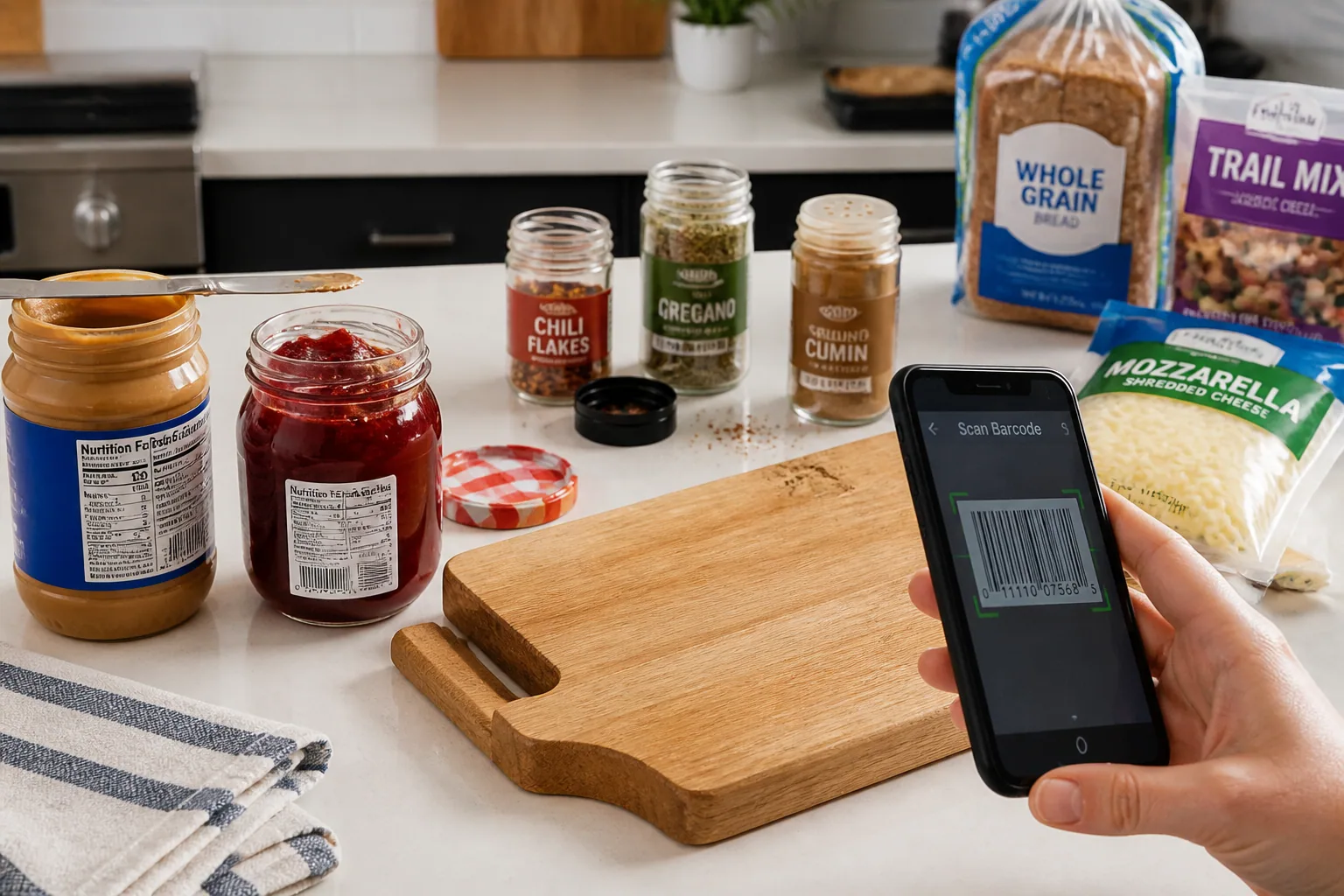
Home kitchens feel safe because they are familiar, but they are also one of the most common places for cross-contact to happen. Shared knives, cutting boards, toasters, baking sheets, condiment jars, and frying oil can all become sources of exposure if allergen-containing foods are prepared nearby.
Small habits make a big difference. A butter knife dipped into a jar after touching bread can spread crumbs. A wooden spoon used for a sauce can carry traces into the next meal. A toaster that once held wheat bread can retain enough residue to matter. Even a quick wipe-down with a cloth may not fully remove proteins if the surface is not properly cleaned and sanitized.
Hands also matter more than many people think. If someone handles an allergen and then touches a doorknob, a fridge handle, or a serving spoon, allergen transfer can continue long after the original meal is over. In family kitchens, this often becomes the hidden weak point, especially when people assume a quick rinse is enough.
The safest approach is to create clear boundaries. Dedicated utensils, separate storage, fresh sponges, labeled containers, and strict handwashing routines reduce the chance of transfer. For higher-risk allergens or severe allergies, some households even keep one shelf, one pan set, or one toaster reserved only for the allergen-free eater.
Overlooked Grocery and Packaged Food Dangers
Grocery shopping looks simple on the surface: read the label, choose the safe product, move on. But packaged foods can still create risk in less obvious ways. Shared manufacturing equipment, bulk bins, repackaged products, damaged packaging, and store handling can all introduce allergen exposure outside the ingredient list.
One major issue is that precautionary allergen labels are not always interpreted consistently. In a survey of allergic consumers and allergists, there was widespread confusion about what “may contain” actually means. About 49% believed it meant the allergen may or may not be present, while 29% thought it meant the allergen was unlikely. That uncertainty makes label-based decisions difficult: https://pmc.ncbi.nlm.nih.gov/articles/PMC12073677/
There is also the question of real contamination. Research summarized in AllergicLiving noted that among 186 products tested with precautionary peanut labels, about 9% actually contained peanut. The same discussion also reported that 12% to 40% of surveyed U.S. and Canadian food-allergic consumers bought foods made in facilities that process allergens, even while trying to avoid them: https://www.allergicliving.com/2016/03/08/precautionary-allergy-labels-cause-widespread-confusion/
In practice, that means the label is not just a legal note. It is a risk signal that must be interpreted with care, especially when the allergy is severe or the product has a history of inconsistent labeling.
What ‘May Contain’ and Trace Labels Really Mean
Precautionary allergen labeling, often called PAL, is meant to warn consumers about potential allergen presence from manufacturing or handling. But the wording is not standardized in a way that makes interpretation easy for shoppers. A phrase like “may contain traces of” may be taken more seriously than vague statements such as “made in a facility that also processes” or “good manufacturing practices used,” even though the real risk is not always obvious.
A study on PAL preferences found that 85.5% of stakeholders avoid products with “may contain traces of allergen” statements, while only 35% avoid “good manufacturing practices” labels. That difference shows how wording shapes behavior, even when the underlying risk is uncertain: https://www.sciencedirect.com/science/article/pii/S221321982031000X
The problem is that consumers often want PAL to function like a yes-or-no safety rule, but it does not. It is a warning about possible cross-contact, not a guarantee that contamination is present. Still, it is also not meaningless, because some PAL-labeled products do contain detectable allergens. The confusion is one reason many families end up developing their own risk thresholds for different foods.
Broader survey data suggests this concern is widespread. In a 2025 IFIC survey, about 25% of U.S. adults reported that either they or someone in their household has a food allergy, intolerance, or sensitivity, and unclear labeling remained one of the top concerns. Among people who know someone with a food allergy, intolerance, or sensitivity, 70% reported awareness of allergen information on foods they buy: https://ific.org/research/2025-ific-spotlight-survey-americans-perceptions-of-food-allergens-intolerance-sensitivities/
How Much Allergen Can Actually Trigger a Reaction?
This is the question everyone wants answered, but the honest answer is that it depends on the person and the allergen. Reactions can vary based on age, sensitivity, illness, medication, asthma, and other individual factors. Still, researchers have tried to estimate population thresholds to better understand what low-level exposures may mean in real life.
For peanut allergy, the ED05 threshold is estimated at around 1.5 mg of peanut protein, roughly equivalent to about 1/100th of a peanut kernel. That means a tiny amount can be enough to cause objective symptoms in 5% of peanut-allergic individuals. The Peanut Allergen Threshold Study and later reference dose proposals support that estimate: https://pmc.ncbi.nlm.nih.gov/articles/PMC3850217/
The same threshold research also matters because low-dose reactions can still be severe. A meta-analysis found that among those reacting to 5 mg or less of peanut protein, about 4.5% experienced anaphylaxis in response to that low level of exposure: https://pmc.ncbi.nlm.nih.gov/articles/PMC8168954/
More recent modeling has estimated reaction thresholds for several allergens, including peanut, cashew, egg, milk, shrimp, and sesame. In one meta-analysis, the discrete ED05 for peanut was about 2.1 mg, and for cashew about 0.8 mg, reinforcing the idea that very small amounts can matter for a meaningful share of allergic consumers: https://pmc.ncbi.nlm.nih.gov/articles/PMC11382767/
These data are not meant to scare people. They are meant to help families and manufacturers think more clearly about risk, especially when cross-contact is possible. They also help explain why precautionary labeling and careful routines matter so much in everyday settings.
Dining Out: The Small Mistakes That Matter Most
Restaurants are one of the most common places where confidence and risk collide. The menu may promise a safe option, but the kitchen workflow can still introduce allergens through shared fryers, grill space, utensils, gloves, sauces, or rushed communication between front-of-house and kitchen staff.
The small mistakes are usually the dangerous ones. A server forgets to mark the allergy ticket. A cook changes gloves but not the cutting board. Fries are cooked in the same oil as breaded food. A garnish is removed after the plate is already contaminated. Even when staff are well intentioned, the pace of restaurant service can make cross-contact easy to miss.
The best defense is direct communication. Clearly state the allergy, ask how the kitchen handles prep and cooking, and be willing to walk away if the answer sounds uncertain. It also helps to ask specific questions about shared fryers, grills, sauces, spice blends, dessert toppings, and final plating. General reassurance is not enough when the allergy is serious.
Dining out safely is less about perfection and more about reducing unknowns. If the restaurant cannot explain how it prevents allergen transfer, that itself is useful information.
Practical Ways to Reduce Risk Without Becoming Overwhelmed
Living with food allergy risk can become exhausting if every meal feels like an emergency. A more sustainable approach is to focus on the highest-impact habits first. The goal is not to control everything. It is to make the most important controls automatic.
Start with a few consistent rules. Wash hands before food prep and before eating. Clean surfaces with methods that remove residue, not just visible crumbs. Use separate utensils and storage for allergen-free foods. Avoid shared fryers and bulk bins. Read labels every time, because recipes and manufacturing can change. When in doubt, do not assume a product is safe just because it was safe last week.
It also helps to think in layers. Ingredient review is one layer. PAL review is another. Preparation environment is another. Restaurant communication is another. A layered system gives you more protection than relying on any single step.
And just as important, be realistic. No strategy eliminates every risk. The objective is to lower the chance of accidental exposure enough that daily life remains manageable. That is a much healthier mindset than trying to achieve perfect control.
How Barcode Scanners and Apps Like Bokha Can Help
One of the hardest parts of allergy management is speed. You are in the grocery aisle, standing in front of a shelf, trying to compare labels while remembering hidden ingredients, trace warnings, and product changes. This is where a barcode scanner can be genuinely helpful.
Tools like Bokha, a food allergy scanner app available on iOS and Android, let you scan a product barcode and discover allergens in less than a second. Bokha detects 13 allergens, including peanut, egg, gluten, soy, fish, shellfish, tree nuts, wheat, mustard, celery, mint, sulphites, and lactose, while also identifying traces and additives. For families making dozens of food decisions each week, that kind of support can save time and reduce stress: https://findthe.app/bokha
An app will not replace judgment, especially when cross-contact risk depends on preparation or restaurant handling. But it can make the first layer of screening faster and easier, which is often the difference between feeling overwhelmed and feeling in control.
A Smarter Daily Routine for Allergy Safety
The true cost of cross-contact is not just the reaction itself. It is the mental load of constantly trying to stay one step ahead of invisible risk. The good news is that safety does not have to mean panic. It means building a routine that matches the reality of how allergens move through the world.
A smarter daily routine starts with recognizing where risk actually comes from: shared surfaces, shared tools, shared oil, shared hands, unclear labels, and unclear communication. From there, you can make practical choices that fit your household and your level of risk tolerance. Some people need strict separation at home. Others need careful label checking plus a strong restaurant script. Most need a mix of both.
The science is clear that even tiny exposures can matter, especially for highly sensitive individuals. The surveys are clear that labeling remains confusing. And the everyday experience of families is clear that the hardest risks are often the ones nobody notices until it is too late. By treating cross-contact as a real, ordinary hazard, not a rare exception, you can make better decisions without living in constant fear.
That balance is the goal: informed, repeatable habits, less guesswork, and more confidence in the foods you choose every day.