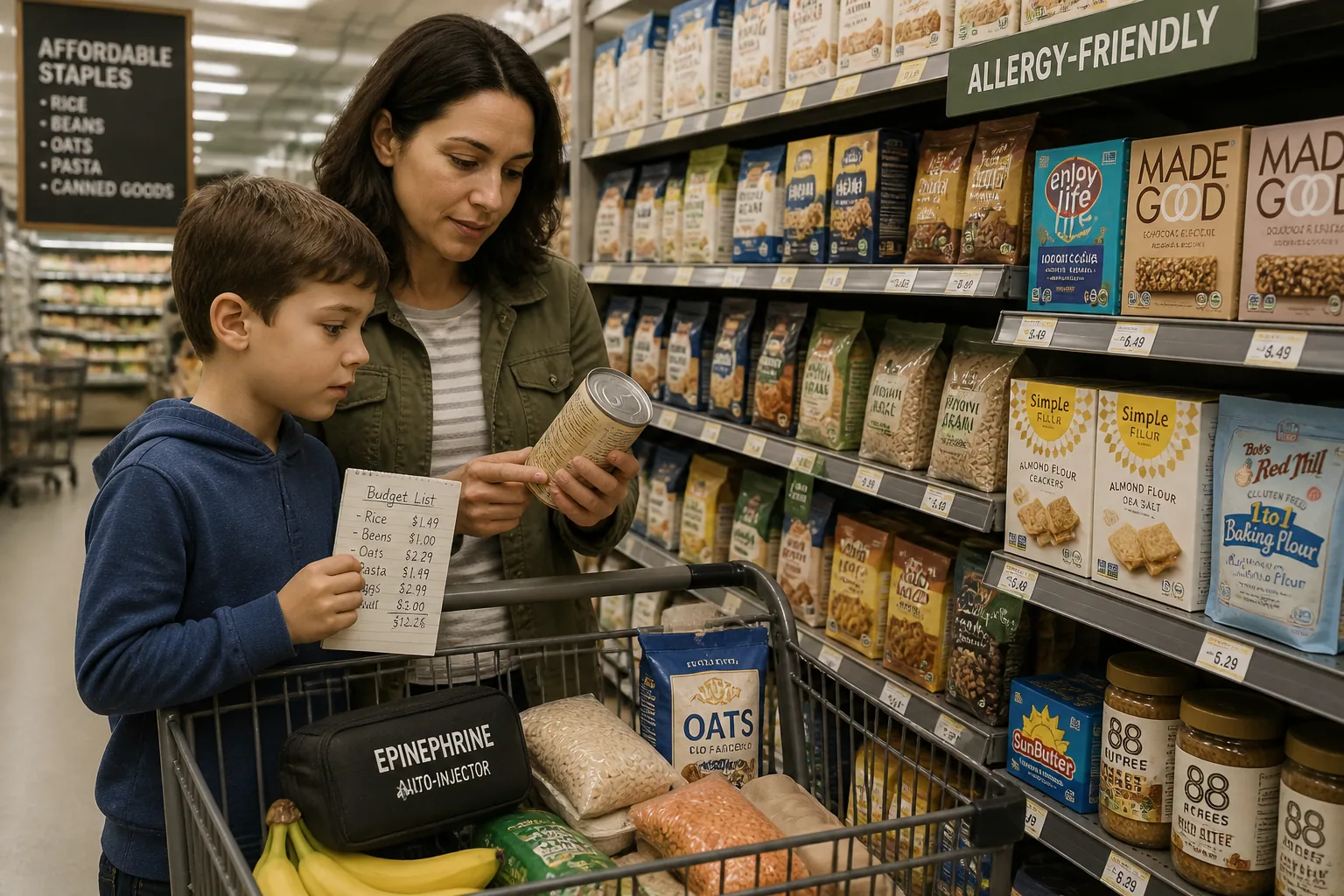
The Role of Socioeconomic Status in Food Allergy Management: Barriers, Solutions & Support
Food allergy management is often described as a matter of vigilance, but vigilance is not the same thing as equal access. For many families, staying safe means more than reading labels and carrying epinephrine. It also means having the money to see a specialist, the insurance coverage to pay for emergency medication, the transportation to get to appointments, and the neighborhood food options to keep meals both safe and affordable.
That is why socioeconomic status matters at every stage of food allergy care. Lower income, limited insurance, rural location, and food insecurity can all slow diagnosis, reduce access to allergists, make safe eating more expensive, and increase the chance that families rely on emergency care instead of prevention. In practice, the system can make the highest-risk patients the least supported.
Why Socioeconomic Status Matters in Food Allergy Care
Socioeconomic status shapes food allergy management in several connected ways. It affects whether symptoms are noticed early, whether a family can get referred to an allergist, whether an epinephrine prescription is filled, and whether a child can safely eat at school, at home, or away from home. It also affects the burden of daily decision-making, because every snack, restaurant meal, and grocery trip becomes a cost calculation.
Families with fewer financial resources are more likely to face structural barriers rather than individual ones. For example, if a parent cannot easily miss work, travel long distances, or pay specialist copays, diagnosis can be delayed. If a household is already stretched by rent, utilities, and transportation, the added cost of allergen-safe foods may push them toward cheaper products that are harder to verify. The result is not just stress. It is a real increase in health risk.
What the Data Shows About Diagnosis Delays and Emergency Outcomes
The research is clear that access is uneven. Patients in high-poverty areas are less likely to receive preventive food allergy services such as allergy testing or epinephrine prescriptions, and they are more likely to rely on emergency departments for treatment. One major reason is that many allergists do not accept Medicaid. According to Food Allergy Research and Education, only 55.5% of allergists in the U.S. accept Medicaid, with state rates ranging from about 13% to 90%: https://www.foodallergy.org/sites/default/files/2026-02/FARE_NIR_FINAL 1.pdf
When routine care is hard to obtain, problems tend to show up later and in more severe forms. Instead of preventive counseling, families may only encounter the healthcare system during a crisis. That pattern is especially concerning for food allergy because rapid response matters. Earlier diagnosis can mean earlier avoidance education, better action plans, and faster access to rescue medication.
The access gap is even more visible in rural areas. A study of allergist practices in the U.S. Midwest found that only about 74.1% accepted Medicaid, average wait times were more than two weeks, and the mean distance to the nearest allergist was 83.6 miles. Rural and publicly insured patients faced the greatest challenges: https://pubmed.ncbi.nlm.nih.gov/42285294/
That kind of travel burden is not minor. For a family juggling work schedules, school hours, and fuel costs, an 83.6-mile trip can easily become a barrier that turns a routine follow-up into a postponed appointment. And when appointments are delayed, so is guidance about diagnosis, management plans, and emergency preparedness.
The Hidden Cost of Staying Safe With Food Allergies
Food allergy care has a hidden price tag. Families often spend more on safe foods, label reading, kitchen equipment, school supplies, and restaurant avoidance. One study found that households managing food allergies spend about $2,500 more per year than households without food allergies, even before the COVID pandemic. During COVID-19, lower-income families dealing with staple-food allergies such as milk, eggs, and wheat saw especially large increases in food preparation costs: $244.58 versus -$20.28 for families without those allergies: https://www.frontiersin.org/journals/allergy/articles/10.3389/falgy.2022.915014/full
Those numbers matter because food allergies do not only affect the direct cost of groceries. They also change how families shop and cook. When safe packaged foods are limited, parents may have to buy more ingredients and prepare more meals from scratch. That increases time, labor, and planning demands. For caregivers working multiple jobs or managing unstable schedules, the burden can become overwhelming.
There is also an equity problem in how medically restricted diets are supported. Allergen-free foods can cost 2 to 4 times more than similar foods containing common allergens, yet food assistance programs like SNAP do not usually adjust for that higher cost. Food banks and pantries also often do not regularly offer allergen-friendly options: https://www.aaaai.org/Aaaai/media/Media-Library-PDFs/Allergist Resources/Statements and Practice Parameters/Shroba-et-al-JAIP.pdf
In other words, a family may be told to avoid certain foods, but given little structural help to replace them safely and affordably. That gap makes adherence harder and can create nutritional tradeoffs, especially for children.
Epinephrine, Insurance, and the Price of Emergency Preparedness
Epinephrine is the cornerstone of emergency food allergy preparedness, but it can be expensive. In one analysis, 2019 median two-pack prices were about $736 for Auvi-Q, $63 for branded EpiPen, and $10 for non-branded options for privately insured patients, though annual out-of-pocket costs still often exceeded $200. Another source notes that without insurance, brand-name EpiPen two-packs commonly fall between $650 and $750, while generic two-packs may cost $120 to $220 in some retail settings: https://www.goodrx.com/epinephrine-epipen/how-to-save-cost
For families already managing high food costs, those prices can be discouraging. Even when a clinician writes a prescription, cost can affect whether a medication is filled, whether it is replaced before expiration, and whether multiple doses are available for school, home, and travel. Emergency preparedness becomes less about best practice and more about affordability.
This is why coverage matters so much. When insurance is limited, high deductibles and formularies can create delays or force families to choose a cheaper option that may still be hard to sustain over time. Manufacturer coupons and patient assistance programs can help, but they are not a complete solution because they do not fix the underlying affordability problem.
Food Deserts, Geography, and Access to Safe Foods
Geography shapes food allergy management more than many people realize. In areas with few supermarkets, limited product variety, or weak transportation infrastructure, families may have to shop at convenience stores or small grocers where allergen-safe options are scarce. That can make even basic meal planning difficult.
Food deserts also interact with allergy management in a subtle way. A family may know exactly which foods are safe, but still be unable to find them locally at a reasonable price. If they must drive long distances, pay delivery fees, or rely on inconsistent stock, the total cost of safe eating rises again. This is especially hard for households that need staple alternatives like dairy-free milk, egg-free baking ingredients, gluten-free products, or peanut-free snacks.
The problem is not just convenience. Limited access to safe foods can reduce dietary quality. Research from the American Academy of Pediatrics found that children with food allergies in lower-income segments had lower diet quality, with less variety and adequacy in fruit, vegetables, fiber, and vitamin C intake compared with higher-SES children: https://publications.aap.org/pediatrics/article/154/Supplement 4/S32/200110/Socioeconomic-Status-and-Diet-Quality-in-Children
That means socioeconomic barriers can affect nutrition even when families are trying hard to follow medical advice. Safer choices are not always equally available, and when the options are narrower, diet quality may suffer.
Why Specialist Access Is Uneven: Allergists, Medicaid, and Rural Gaps
Allergists play a central role in confirming diagnosis, distinguishing food allergy from intolerance, prescribing epinephrine, and teaching avoidance strategies. But access to specialists is uneven. When many allergists do not accept Medicaid, publicly insured patients can be forced into long waits, out-of-pocket costs, or no specialist care at all.
This matters because primary care alone may not be enough for complex cases. Families may need help interpreting reactions, deciding which foods to avoid, understanding cross-contact risk, or updating emergency action plans. Without specialist support, mistakes become more likely, and anxiety tends to rise.
Rural patients face an additional challenge: distance. If the nearest allergist is dozens of miles away, every visit requires planning, transportation, and time off. That burden can discourage follow-up care, even for families who want to stay proactive. Over time, geographic isolation can become medical isolation.
Policy and Regulatory Barriers That Increase Risk
Many of the biggest barriers are not clinical. They are policy-related. Insurance networks may exclude specialists. Medicaid reimbursement may be too low to encourage participation. Food assistance rules may not account for the extra cost of medically necessary diets. Local food systems may not ensure reliable access to safe and affordable options.
These policy gaps widen disparities because they hit hardest where resources are already thin. A higher-income family may be able to self-fund specialist care, buy multiple epinephrine devices, and order specialty groceries online. A low-income family may have to choose which of those needs to prioritize, which means some form of safety is always compromised.
At the neighborhood level, disadvantage also clusters with other allergic conditions. Research using the Area Deprivation Index found that children with asthma had average ADIs of 43.3 versus 31.8 for children without asthma, showing how socioeconomic disadvantage often overlaps with comorbid allergic disease: https://publications.aap.org/pediatrics/article/152/Supplement 3/S42/195981/Assessing-Disparities-in-the-Prevalence-of-Atopic
This overlap matters because asthma can make allergic reactions more dangerous. So the same communities facing food allergy access barriers may also face higher respiratory risk, creating a compounded burden.
Programs and Community Models That Help Close the Gap
Even though the barriers are real, there are practical ways to reduce them. Community health centers, school nurses, nonprofit organizations, food pantries, and local advocacy groups can all play a role in making food allergy care more accessible.
Some communities support families by offering allergy-aware food pantry shelves, nutrition counseling, or connections to patient assistance programs. Others build partnerships between schools and healthcare providers so that children can get action plans, safe meal accommodations, and emergency training. These programs do not replace systemic reform, but they can reduce immediate risk.
Nonprofit education is especially important because it helps families understand how to prioritize safety when resources are limited. Guidance on label reading, cross-contact prevention, and school communication can prevent mistakes that are costly both medically and financially.
Affordable Safety Strategies for Individuals and Caregivers
For caregivers trying to manage food allergies on a budget, small systems can make a big difference. Start with a written allergy plan and keep it where everyone can see it. Make a list of safe staple foods, trusted brands, and backup meals so shopping is faster and less stressful. Buy in bulk when safe products are on sale, and compare unit prices before choosing specialty items.
It also helps to reduce decision fatigue in the store. A tool like Bokha: Food Allergy Scanner App can be useful because it scans product barcodes and identifies allergens in less than a second, which may save time when checking packaged foods: https://findthe.app/bokha
Other low-cost strategies include cooking more from scratch when possible, reusing safe recipes, batch-preparing meals, and building a small emergency pantry of shelf-stable safe foods. For cross-contact prevention, simple habits like separate utensils, clear storage bins, and label checks can lower risk without requiring a full kitchen redesign.
Caregivers can also ask pharmacies and clinicians about generic epinephrine options, manufacturer savings programs, or local assistance resources. If a family has trouble accessing an allergist, a primary care clinician may still be able to help with interim planning, prescriptions, and referrals.
What Advocates and Policymakers Can Do Next
If food allergy management is to become more equitable, the solution has to go beyond individual behavior. Policymakers can help by improving Medicaid participation, expanding reimbursement for allergy services, supporting rural specialty care, and making sure food assistance programs reflect the higher cost of medically restricted diets.
Public health systems can also invest in better food access infrastructure, especially in neighborhoods with limited grocery options. Schools and community programs should be supported in offering allergen-aware meals and training, because prevention is cheaper and safer than repeated emergency treatment.
For advocates, the priority is to keep the issue visible. Food allergy is not only a clinical condition. It is also a social and economic issue. When access to diagnosis, medication, and safe foods depends on where someone lives or how much they earn, the system is not protecting the people who need protection most.
The encouraging part is that many of the fixes are known already. Better insurance access, more allergist participation, stronger community food programs, affordable epinephrine, and practical support for caregivers can all reduce harm. The challenge is making those solutions available consistently, not just to families who can afford to navigate the system on their own.