The Hidden Environmental Triggers That Can Amplify Food Allergies, and How to Scan for Them
A safe ingredient label is important, but it is not the full story for people living with food allergies. In real life, reactions are not only shaped by what is written on a package. They can also be influenced by the environment around the food, the way it was prepared, the surfaces it touched, the products used on skin and lips, and even the season or air quality in the room. That is why allergy-aware decision making needs to go beyond a barcode check and into the context of where and how a product is used.
This matters even more for diagnosed allergy patients, new allergy parents, and anyone who shops with extra caution. A product may appear safe on paper, but still carry risk because of cross-contact, airborne exposure, hidden allergens in non-food items, or packaging and facility practices that are easy to overlook. The goal of this guide is to help you scan smarter, understand the triggers that can amplify risk, and build a more complete safety habit around everyday foods and products.
Why a Safe Ingredient Label Is Not Always the Full Story
Ingredient lists answer one question only: what was intentionally added. They do not always reveal what happened in the kitchen, on the factory line, or in the surrounding environment. In allergy management, that distinction matters. A product can be made without your allergen and still become risky if it was exposed to allergen residues through shared equipment, storage, transfer tools, or airborne particles during processing.
The FDA defines cross-contact as the inadvertent introduction of an allergen into a product that does not intentionally contain it. That can happen during manufacturing, packaging, or handling, and it is one reason precautionary labels deserve close attention. In other words, a clean ingredient panel is reassuring, but it is not the same as a fully controlled allergy environment.
You also need to think beyond food itself. Hidden allergen exposure can happen through lotion, lip balm, skincare, candle fragrance, or even a household cream that touches the skin every day. For people with eczema or a compromised skin barrier, that extra layer of exposure can be especially important because sensitization does not always happen by ingestion alone.
How Environmental Triggers Can Amplify Food Allergy Risk
Environmental triggers can intensify food allergy risk by priming the immune system or making the body more reactive at the wrong moment. Research suggests that household dust, fungal spores, pollen, and other environmental exposures can act like adjuvants, meaning they may help promote sensitization to food proteins. In animal models, co-exposure to peanut protein and indoor dust led to peanut-specific IgE and full allergic reactions, showing how the environment can shape immune response even without direct eating exposure: https://pmc.ncbi.nlm.nih.gov/articles/PMC8100692/
This helps explain why two people can respond differently to what looks like the same food. The food may be the same, but the setting is not. A child with eczema, for example, may be more vulnerable to sensitization through skin exposure. In infants, applying creams containing peanut oil increased the risk of peanut allergy through transcutaneous exposure, not ingestion. That is a powerful reminder that the route of exposure matters as much as the allergen itself.
Context can also change how the body reacts over time. If someone is already irritated by pollen, dust, or skin barrier damage, the immune system may be more alert and less forgiving. This does not mean every exposure causes a reaction, but it does mean the allergy threshold can feel lower in real-world conditions than it does in a simple label scan.
Airborne Allergens: Dust, Pollen, and Particles in Shared Spaces
Airborne allergens are easy to underestimate because they are invisible. Dust in a home, particles in a café, and pollen in the air can all influence allergy sensitivity, especially when food proteins are present nearby. Research has linked pollen exposure during pregnancy or early infancy with higher rates of food sensitization. One example is grass pollen exposure during defined periods increasing the risk of challenge-confirmed peanut allergy in 12-month-olds with maternal food allergy history.
There is also a meaningful overlap between inhalant allergens and food allergens. According to research on cross-reactivity, up to 60% of food allergies in older children, adolescents, and adults are related to inhalant allergens such as pollen that share molecular structures with food proteins: https://onlinelibrary.wiley.com/doi/10.1111/all.12666. That means the air around you can matter not just as an irritant, but as part of the allergy picture itself.
This is why shared spaces deserve a closer look. A bakery, salad bar, cafeteria, or family kitchen may feel safe if the food item itself is labeled correctly, but airborne particles from flour, nuts, spice mixes, shellfish, or dust can still create a higher-risk environment. Even if a reaction is not caused by airborne exposure alone, the combination of factors can make the situation more uncertain.
Cross-Contact in Kitchens, Cafes, and Food Prep Areas
Cross-contact is one of the most common hidden risks in food allergy management. It happens when allergen residues move from one food or surface to another through shared equipment, utensils, gloves, spills, aerosols, or insufficient cleaning. In manufacturing, this can happen on a shared line. In daily life, it can happen on a cutting board, toaster, blender, fryer, or countertop.
The same logic applies in cafes and restaurants. A drink may not contain milk, but a shared milk frother may have left residue behind. A sandwich may be made without nuts, but the prep area may still contain nut dust. A salad may be made from safe ingredients, but if it is handled with a spoon that also touched another item, the risk changes. This is why environment and process are just as important as the recipe.
Manufacturing practices can add another layer of uncertainty. The FDA notes that allergen cross-contact can occur through re-work, damaged packaging, storage of allergen materials near non-allergen items, and shared transfer equipment. Those details are not always visible to shoppers, which is why precautionary statements and facility clues should be treated as part of the scan, not as fine print to ignore.
Shared Utensils, Surfaces, and Packaging Risks to Watch
Shared utensils are a classic source of accidental exposure, but surfaces and packaging can be just as important. A knife used for peanut butter and then used for jam may leave enough residue to matter. A spoon resting on a shared counter can pick up traces from another product. A serving tray, scoop, or tong may carry allergens from one dish to another without anyone noticing.
Packaging also deserves attention. Damaged packaging can expose contents to contamination during storage or transport. Boxes stored near allergen-containing items can collect residues. In a plant, transfer equipment and re-work practices can move allergen particles into products that were not intended to contain them. Even at home, putting allergen and non-allergen foods in the same drawer or bin can create avoidable risk.
If you are making a decision on the spot, look for clues beyond the ingredient list. Is the package sealed well? Is the outer box crushed or torn? Is there a precautionary note about shared equipment, shared lines, or may contain statements? These are not perfect answers, but they help you build a more realistic picture of the product’s safety.
Hidden Allergens in Non-Food Products Like Lip Balm and Lotion
Many allergy families focus on food labels and forget that daily care products can also carry exposure risk. Lip balm is a good example because it sits close to the mouth and can be unintentionally ingested. A case report described a lip balm with beeswax, also called cera alba, triggering a contact allergy reaction even in a person with a nut allergy and no previous reaction to beeswax. That kind of scenario shows how a product can be unrelated to the main food allergen and still create a problem.
Skincare products can be tricky for another reason: fragrance. Fragrance mixes, including Balsam of Peru, limonene, and linalool, are among the most common allergens in cosmetics and non-food products. Even products labeled unscented may contain masking fragrances, botanicals, or other ingredients that are not obvious at first glance. Cleveland Clinic and DermNet both note that cosmetic reactions often come from these hidden fragrance components: https://health.clevelandclinic.org/allergic-reaction-to-skin-care and https://www.dermnetnz.org/topics/contact-reactions-to-cosmetics
There is also a broader developmental angle. Frequent use of moisturizers and emollients in infancy has shown a dose-dependent association with the development of food allergy in study data. That does not mean moisturizers are inherently dangerous, but it does reinforce the idea that skin exposure is part of the allergy conversation, especially for babies and children with eczema or fragile skin barriers.
How to Scan Smarter: Labels, Warnings, and Context Clues
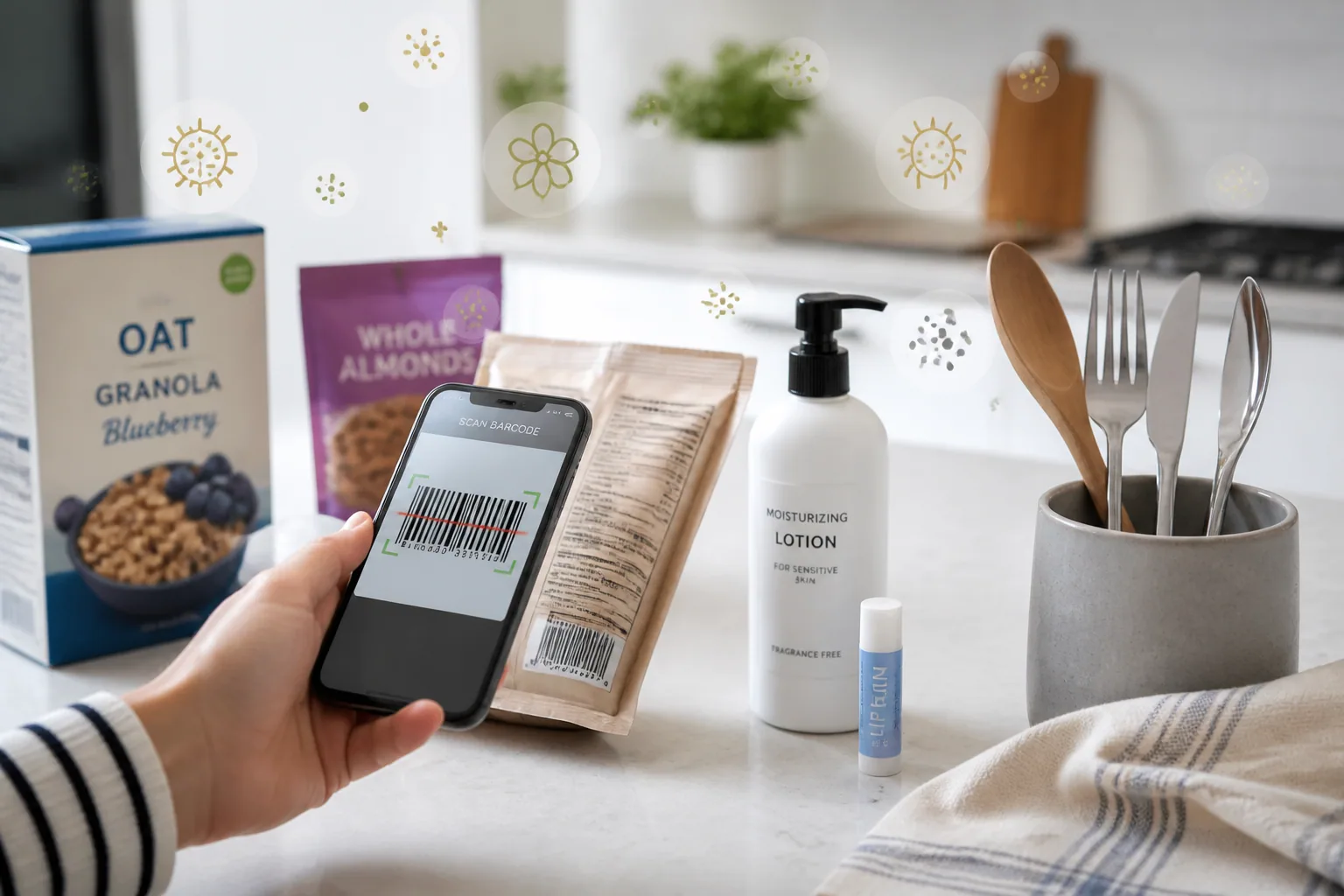
Scanning smarter means checking more than a barcode. A fast allergen scan is helpful, but it should be paired with a quick human review of the environment and the packaging cues. Start with the ingredient list, then look for precautionary allergen statements, shared-equipment warnings, and notes about facility practices. If the product is a food, consider whether it was produced in a plant that also handles your allergen. If it is a non-food item, check for fragrance, botanicals, oils, and waxes that may not be obvious from the front label.
The next step is reading context. Where will the item be used? At home, in a shared kitchen, at school, in a café, or on the go? Has the packaging been damaged? Is the product near open bins or bulk storage? Was it handled by shared tongs or scoops? These questions may feel small, but they are exactly where hidden risk often lives.
It also helps to remember that labels and warnings are not the whole environment. A product can be technically compliant and still be a poor choice in a high-risk setting. The best safety habit is to combine scan results with practical observations: fresh packaging, clean tools, clear prep areas, and a trustworthy handling process.
When Environment Matters More Than the Barcode
There are moments when the environment matters more than the barcode because the barcode only tells you what the product claims to be. It does not tell you whether the package was stored correctly, whether a counter was wiped with the same towel used for another dish, or whether someone used a shared spoon right before serving your food. In real life, these details can be more important than the label itself.
This is especially true for people whose reactions seem inconsistent. A food may be tolerated one week and trigger symptoms another week when the setting is different. That variation does not necessarily mean the label was wrong. It may mean the exposure context changed. Airborne allergens, skin contact, pollen season, dust levels, and prep habits can all shift the odds.
That is why allergy safety works best as a layered system. Scan the product, yes, but also scan the room, the tools, the hands, the storage, and the instructions. The more layers you check, the more likely you are to catch the hidden triggers that a simple ingredients list would never reveal.
How Bokha’s Scanner Helps Users Catch Hidden Risks
This is exactly where Bokha’s Food Allergy Scanner App can help. Bokha lets you scan product barcodes and discover allergens in less than a second, which is useful when you are standing in a supermarket aisle or checking a product before a meal. It detects 13 allergens, plus traces and additives, so you can move faster while staying more informed. You can learn more here: https://findthe.app/bokha
The value of a tool like this is not just speed. It is confidence. When you are deciding between products, the app can help you compare options quickly, spot potential issues, and reduce the chance of overlooking an allergen hidden in plain sight. That can be especially helpful for parents shopping for a child with allergies, or for anyone who is managing multiple sensitivities at once.
Used well, a scanner becomes part of a broader safety routine. It supports the first pass, while your eyes and judgment handle the rest: packaging condition, precautionary notes, and the reality of the environment around you. In other words, the app helps you scan the product, but you still scan the context.
Future Allergy-Safety Features: Community Reports and Cross-Contact Alerts
Looking ahead, allergy safety tools could become even more useful if they include community reporting and cross-contact alerts. Imagine being able to see whether other users have flagged a product, a store, or a facility for repeated concerns. Imagine a system that helps surface patterns such as shared equipment, seasonal risk, or recurring packaging issues. That kind of information would add a real-world layer that ingredient lists alone cannot provide.
Community alerts could also help people make quicker decisions in uncertain settings. A parent could check whether a school snack has been reported as risky. A shopper could see whether a batch had packaging damage or a possible cross-contact issue. A person with severe allergies could use those signals to choose the safer option before exposure happens.
These features are still future-facing, but they point in the right direction. Allergy management is moving toward context-aware safety, where the product, the process, and the environment all matter. The more information users can see, the better they can protect themselves and their families.
A Practical Safety Checklist for Everyday Shopping and Eating
A practical allergy checklist should be short enough to use in real life and thorough enough to catch the hidden stuff. Start with the label. Confirm ingredients, then check precautionary statements, traces, and facility warnings. Next, check the packaging itself. Look for damage, tampering, or signs of poor storage. Then consider the environment: shared prep areas, open bins, pollen season, dusty spaces, or a kitchen where multiple allergens are handled at once.
If the item is not food, do not lower your guard. Lip balms, lotions, candles, and cosmetics can contain fragrance compounds, waxes, oils, and botanical ingredients that matter just as much as food labels do. For children and infants, especially those with eczema or dry skin, keep in mind that skin exposure can be a meaningful route of sensitization.
The simplest rule is this: do not scan only the barcode, scan the situation. Look at the package, the place, the tools, the season, and the surrounding products. Then use a tool like Bokha to quickly check the allergen profile of the item itself, so you can make safer choices with more confidence and less guesswork.