The Hidden Cost of Food Allergy Scanning Apps: What Happens Behind the Scenes?
Food allergy scanning apps can feel like a lifeline. If you are managing an allergy yourself, or helping a child stay safe, the promise is simple: point your phone at a barcode, get an answer fast, and make a better decision in the aisle. That convenience matters a lot when you are tired, rushed, or standing in front of a product with a long ingredient list.
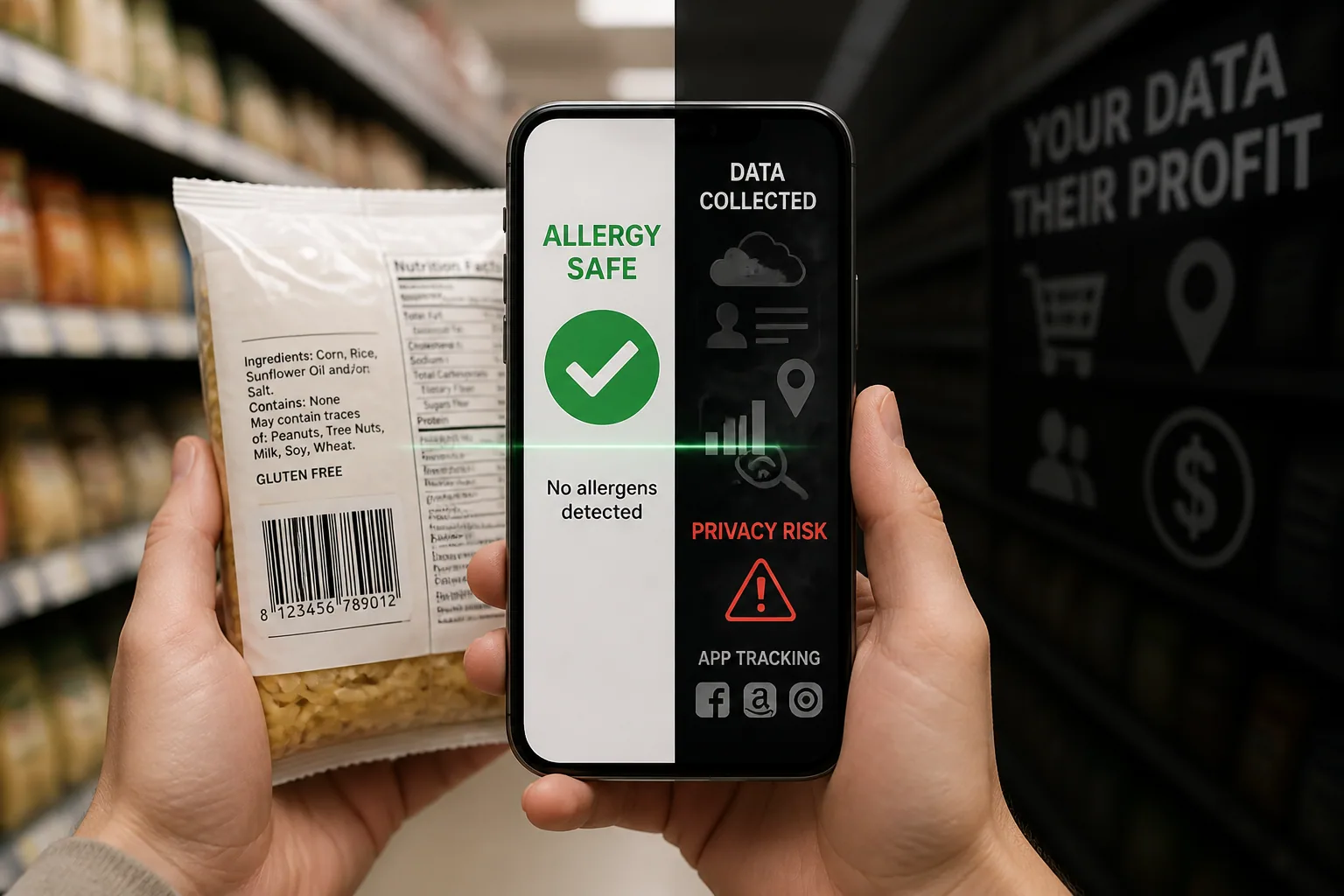
But behind that simple scan is a lot more happening than most people realize. These apps can collect sensitive health-related information, behavioral patterns, location signals, device identifiers, search history, and product preferences. In other words, the same tool that helps you avoid an allergen may also be learning a great deal about your habits and your family’s health profile.
This is where the hidden cost appears. The app may be useful, but its business model, privacy practices, and data quality can all affect how safe and trustworthy it really is. And in allergy management, trust is not a bonus feature. It is the whole point.
Why Food Allergy Scanning Apps Feel Essential
Food allergy scanning apps solve a real problem: they reduce friction in situations where speed and confidence matter. Instead of reading a label line by line, a user can scan a barcode and get an immediate indication of whether a product contains one of their allergens. For families shopping with young children, or for people juggling multiple sensitivities, that can feel indispensable.
The appeal is even stronger because many apps present themselves as health tools, not just convenience tools. They may promise safer shopping, personalized allergen filters, and quick interpretation of ingredients that are hard to decode. In practice, this can create a strong sense of reassurance, sometimes stronger than the underlying evidence deserves.
That gap matters. A 2021 review of 48 food allergy apps in the Apple App Store found that the average app quality score was 3.31 out of 5, but subjective quality and perceived impact were much lower, at 2.14 and 2.77 respectively. In other words, apps may look polished and useful, yet still fall short on the details that matter most for health decisions. The same review also noted that user ratings do not reliably reflect information quality or safety quality, even when barcode scanning is a central feature. Source: https://pmc.ncbi.nlm.nih.gov/articles/PMC9753233/
What Data Allergy Scanner Apps Actually Collect
When you use a food allergy scanning app, you are often sharing much more than the barcode itself. Depending on the app, it may log what you scanned, when you scanned it, how often you scan, which allergens you selected, what products you searched for, and whether you saved or rejected certain items.
Some apps also collect device and interaction data. In a study of top Android health and wellness apps, 89 percent collected data from general UI views, 76 percent from button presses, and 63 percent from text fields. That means the app may not just know what you scanned, but also how you navigated, what you typed, and which screens you lingered on. Source: https://arxiv.org/abs/2306.11447
This matters because allergy data is not ordinary shopping data. If an app knows that you repeatedly search for peanut-free snacks, dairy-free snacks, or sesame-safe products, it can infer personal health information about you or your child. Combined with location signals, timestamps, and product patterns, that can build a surprisingly detailed profile of daily routines, school shopping habits, travel, and dietary constraints.
The Surprising Ways Your Scan Data Can Be Used
Once scan data is collected, it can be used in ways many users never expect. The most obvious use is product recommendations. The app can suggest items similar to the ones you scan or flag products that match your preferences. That can be helpful, but it also turns your allergy profile into a behavioral signal that is valuable for analytics and marketing.
Some apps monetize through third-party analytics, advertising, or data sharing. In those cases, your usage patterns can be combined with other app or device data to create audience segments such as frequent shoppers, parents, health-conscious users, or users with specific dietary restrictions. Even if your name is not directly attached, the profile can still be quite revealing.
This is one reason privacy language matters. If an app says it collects data to “improve experience” or “personalize content,” that can cover a wide range of tracking. It may include internal product improvement, but it may also include sharing with SDKs, analytics vendors, attribution platforms, or ad networks. The more layers involved, the harder it becomes to know who sees what.
Privacy-First Apps vs Data-Hungry Business Models
Not all allergy apps are built the same way. A privacy-first approach usually tries to keep sensitive decisions close to the device. That can mean on-device barcode processing, minimal account creation, limited data retention, clear consent, and no sale or sharing of health-related data for advertising purposes.
A data-hungry model works differently. It may rely on free access to attract users, then monetize through ads, tracking, cross-app profiling, or data partnerships. In that model, the app’s value is not only in helping you avoid allergens. It is also in collecting information about what you search for, what you buy, and how your preferences change over time.
The difference is not just philosophical. It can change how much you are tracked, how long data is kept, whether the app can be used anonymously, and whether your sensitive health-related behavior is exposed to third parties. For a parent managing a child’s allergy, that is a serious tradeoff.
What Privacy Policies Reveal and What They Hide
A privacy policy is one of the few places where an app has to explain itself, but it is not always easy to read, and it is not always complete in the way users expect. You may learn that the app collects identifiers, usage data, approximate location, diagnostics, and contact information. You may also see broad language about analytics, service providers, or business transfers.
What is often harder to see is the full chain of data flow. A policy may disclose categories of data without making it obvious which third parties receive it, how long it is retained, whether it is linked to your identity, or whether it can be combined with other datasets. Mobile privacy research has repeatedly found that transparency and consent are difficult to implement well, especially when third-party software and tracking libraries are involved. Source: https://op.europa.eu/en/publication-detail/-/publication/5d1a8d45-0af0-11e8-966a-01aa75ed71a1
That is why vague phrases should make you pause. If an app says it may share data “with partners” or use it “for legitimate business purposes,” that can mean a lot of things. In a health-adjacent app, you want specificity: what data is collected, why it is collected, whether it is sold or shared, and whether sensitive allergy information can be used for advertising or profiling.
Does HIPAA Apply? Understanding the Rules That Really Matter
Many users assume that if an app handles health information, HIPAA must apply. Usually, that is not true for consumer apps. Under U.S. HIPAA rules, a consumer health app that is not offered by or on behalf of a covered entity such as a healthcare provider or insurer, and that is not acting as a business associate, is generally not subject to HIPAA privacy and security requirements, even if the user voluntarily enters health or allergy data. Source: https://www.ftc.gov/business-guidance/resources/mobile-health-apps-interactive-tool
That distinction is critical. A standalone food allergy scanning app downloaded from an app store is often outside HIPAA’s core framework. So the app may still collect and process sensitive data, but it may not have to follow the same protections users associate with medical records or clinical systems.
This does not mean the app is unregulated. It means the legal protections come from a different place, and users need to understand that difference before they trust the app with high-stakes decisions.
FTC, GDPR, and Consumer Protection for Health-Adjacent Apps
In the United States, the FTC can step in when a health-related app makes deceptive claims or engages in unfair practices. That includes misleading users about privacy, overstating safety, or suggesting a level of diagnostic accuracy the app cannot support. The FTC and related guidance also note that health apps may be subject to the Health Breach Notification Rule. Source: https://www.hhs.gov/hipaa/for-professionals/special-topics/hipaa-ftc-act/index.html
In the European Union, the picture is often stricter. Under GDPR, health data is treated as a special category and is subject to tighter requirements, including data minimization, clearer permitted purposes, and stronger safeguards such as anonymization or pseudonymization. The European Commission also notes that secondary reuse of health data may involve additional oversight bodies under emerging frameworks like the EHDS. Source: https://health.ec.europa.eu/ehealth-digital-health-and-care/reuse-health-data_en
So while the exact rules depend on where you live, the basic lesson is the same: an allergy app may not be a medical device in the legal sense, but it can still be handling highly sensitive data in ways that deserve close scrutiny.
The Real Safety Risks Beyond Privacy
Privacy is only part of the story. Even a perfectly private app can still be unsafe if its data is inaccurate. Food allergy scanning apps depend on databases, label parsing, product updates, and in some cases user-submitted information. If those inputs are wrong, out of date, or incomplete, the scan result can be misleading.
That risk is not hypothetical. A dietary tracking audit of five major consumer apps found that when food is entered manually, accuracy depends heavily on both correct user identification and database quality. Errors in database provenance or outdated entries can cause substantial misestimation of nutrient values. Source: https://www.dietaryassessmentinitiative.org/publications/manual-entry-database-quality-2026/
A separate large sample analysis of eight commercial nutrition apps found that two apps had calorie error rates below 1 percent versus USDA benchmarks, while others relying heavily on user-submitted data had error rates above 20 percent. Source: https://nutrition-research-review.com/articles/database-quality-nutrition-apps-2024/
For allergy management, the stakes are even higher than calorie tracking. If the data source is stale, incomplete, or weakly verified, a scanner might fail to catch a relevant ingredient or may flag a product incorrectly. Either mistake can affect trust, and in an allergy context, trust is safety.
Labeling Errors, Outdated Databases, and Algorithmic Blind Spots
One of the hardest realities here is that food labels themselves are not always sufficient. In a prospective study of 157 adults with physician-confirmed food allergy in the Netherlands, about 37 percent of tested food products contained one or more undeclared major allergens, sometimes at levels up to 5,000 mg protein per kg. The highest risk was seen for milk, peanut, and sesame. Source: https://pubmed.ncbi.nlm.nih.gov/29908992/
That finding helps explain why a scanner can never be treated as a perfect shield. If the underlying product data, label interpretation, or database record is wrong, the app may simply reproduce the error faster. It may even give a false sense of security by presenting a clean result in a situation where the product is actually risky.
Labeling rules can help, but they are not absolute. The FDA notes that sesame became the ninth major food allergen in the U.S. effective January 1, 2023, and also explains that terms like “spices,” “flavors,” or “colors” can still obscure non-major allergens or allergen sources under generic labeling. Source: https://www.fda.gov/food/conversations-experts-food-topics/current-food-allergen-landscape
That is where algorithmic blind spots come in. If an app is built around a fixed allergen list, or if it prioritizes common ingredients over trace warnings, or if it misses regional label differences, it may not fully reflect what a cautious user needs to know. The issue is not only whether the app scans quickly. It is whether it can deal with messy, incomplete, and changing food information.
How to Evaluate Whether an Allergy App Deserves Your Trust
A safer allergy app should be transparent about both privacy and data quality. Start with the basics. Does it explain what information it collects? Does it say whether allergy profiles, scans, or search history are stored locally or sent to a server? Can you use it without creating a detailed account? Can you delete your data?
Then look for evidence of trustworthiness. A strong app should clearly explain how it sources ingredient data, how often it updates product records, whether it uses on-device processing, and how it handles errors or corrections. It should also be careful with language. If the app suggests certainty where there is only probability, that is a red flag.
You can also pay attention to the broader reputation of the app, but do not rely on star ratings alone. As the app quality review showed, user ratings are not a reliable proxy for information quality or safety quality. A polished interface can hide weak data, and a popular app can still make serious mistakes.
If the app is privacy-first, you should be able to see that in its design. Minimal permissions, limited tracking, clear consent choices, and a straightforward privacy notice are all good signs. If it is asking for broad access to contacts, location, or advertising identifiers without a compelling reason, that should make you skeptical.
Questions to Ask Before You Rely on a Scanner for Safety
Before using any scanner as part of your allergy routine, it helps to ask a few direct questions. Where does the product data come from? How often is it updated? Does the app show the last verification date? What happens if the product database is missing an item or contains conflicting entries?
You should also ask what data the app collects about you. Does it track scan frequency, allergens searched, or location? Does it share data with analytics or advertising partners? Is the app usable without an account? Can you opt out of non-essential tracking and still use the core features?
And perhaps most importantly, what does the app say about its limits? A trustworthy tool should make it clear that it supports decision-making, but does not replace label reading, professional guidance, or emergency planning. In allergy care, the best apps are the ones that help you think more clearly, not the ones that encourage overconfidence.
A Smarter, Safer Way to Use Food Allergy Apps
The goal is not to avoid food allergy apps entirely. For many people, they are genuinely helpful, especially when used as a fast screening layer during shopping. But they work best when you treat them as one input among several, not as the final authority.
A smart approach is to choose an app that is transparent, data-minimizing, and honest about uncertainty. If you want a practical example of a scanner that focuses on speed and simplicity, Bokha: Food Allergy Scanner App offers barcode scanning on iOS and Android and is designed to identify allergens quickly while helping users save time in the supermarket. You can learn more here: https://findthe.app/bokha
Even then, the safest habit is to verify important decisions. Check the label yourself. Stay alert to updated formulations, generic ingredient terms, and country-specific labeling differences. Use the app to reduce effort, not to replace caution.
That is the real hidden cost behind food allergy scanning apps. The best ones save time, but the worst ones can quietly trade away privacy, accuracy, and confidence. The challenge is choosing tools that respect all three.