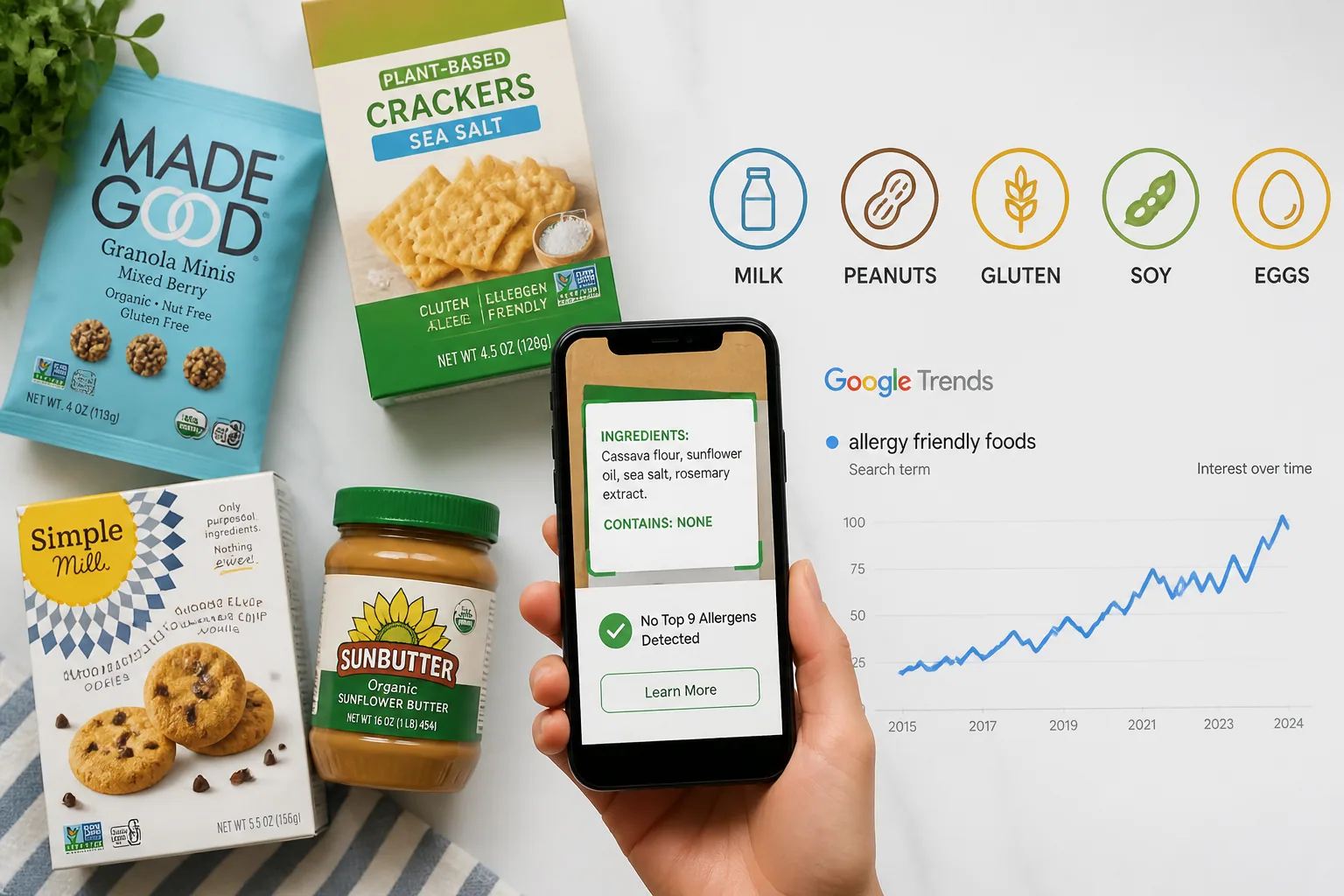
The Biggest Search Trends in Food Allergies Right Now - And What They Mean for You
Food allergies and intolerances are no longer niche topics people only think about after a bad reaction. They are part of everyday shopping, dining, travel, and app-based decision-making. In fact, the CDC reported that 6.7% of U.S. adults had a diagnosed food allergy in 2024, and the number is even higher in some groups, including 9.9% of Black non-Hispanic adults. At the same time, IFIC found in 2025 that over half of Americans either deal with food allergy, intolerance, or sensitivity in their household or know someone who does. That is a huge signal: people are actively searching for answers because these issues affect real choices, not just medical records.
Search behavior matters because it shows what people are worried about before they buy, order, or eat. The questions people ask online often reveal the gaps in labels, menus, and product pages. They also show where confusion is highest, whether that is gluten, milk, peanuts, cross-contact, airborne exposure, or the difference between a true allergy and a sensitivity. Looking at these trends helps explain what consumers need most right now and what brands should improve if they want to earn trust.
Why Food Allergy Search Trends Matter More Than Ever
Search trends are useful because they capture intent. Someone searching for a food allergy topic is usually trying to solve a concrete problem, not just learn a definition. They may be standing in a grocery aisle, scanning a menu, comparing packaged foods, or trying to figure out whether a symptom is a real allergy. That urgency is why search volume gives such a strong picture of consumer pain points.
The data also shows that food reaction concerns are widespread and often poorly distinguished. IFIC found that 25% of U.S. adults report that they or someone in their household has a food allergy, intolerance, or sensitivity, and another subgroup believes they have symptoms but never sought a clinical diagnosis. That means a lot of the online conversation is happening in the gray zone between medical certainty and personal experience. People are trying to manage risk before they have perfect clarity.
The Top Allergens People Are Searching Right Now
When you look at current search activity, a few terms consistently dominate the conversation. Gluten is one of the biggest. In an analysis of more than 136,000 online searches related to food allergies and dining decisions, gluten accounted for over 58% of allergen-related searches. That is far more than milk, peanuts, or tree nuts, and it tells us that gluten concerns are central to how many people decide where and what to eat.
Milk is another major topic, and for good reason. Across multiple countries, search interest in milk and dairy-related queries has risen sharply in recent years. That matches what IFIC found in the U.S., where dairy leads among intolerances and sensitivities. It also reflects the fact that dairy is everywhere, from sauces and breads to snacks and restaurant dishes, which makes ingredient checking more complicated than many consumers expect.
Peanuts and tree nuts continue to draw strong attention as well. IFIC reported that nuts are the most commonly reported food allergy in the U.S., which helps explain why these allergens remain high on the search list. For many people, a peanut or tree nut concern is not abstract. It changes how they shop, where they eat, and how much they trust a label or server answer.
Some searches are growing even faster because they represent newer or more specific concerns. Alpha-gal syndrome, for example, has seen dramatic growth in search interest. Since 2015, absolute searches for alpha gal allergy grew by more than 600%, compared with about 25% for general food allergy terms. That kind of spike shows how quickly a less familiar issue can move from medical curiosity to a major consumer search pattern.
Why Gluten, Milk, and Peanuts Keep Leading the Conversation
Gluten keeps leading because it sits at the intersection of allergy, celiac disease, and general digestive concern. People do not always know which category they belong to, and search engines become the first place they sort it out. That is one reason gluten-related queries stay so high: the term covers both strict medical necessity and broader lifestyle avoidance, which creates heavy, recurring interest.
Milk shows similar staying power because it is common, highly visible, and often misunderstood. Some people are dealing with lactose intolerance, some with milk allergy, and others with general sensitivity. Those are not the same issue, but in practice they can lead to the same question: is this safe for me to eat? Since dairy appears in so many processed and prepared foods, the search pressure stays high.
Peanuts remain a top concern because the consequences of exposure can be severe, and because peanut ingredients, traces, and cross-contact can be hard to interpret. When an allergen is both common and high risk, consumers become extremely vigilant. That vigilance shows up in search patterns, in label checking, and in the way people ask for reassurance before eating out or buying packaged foods.
The Most Common Questions People Ask Before Buying or Dining Out
Before buying packaged food or ordering from a restaurant, people usually search for practical questions rather than medical ones. They want to know if a product contains their allergen, whether a shared kitchen makes it unsafe, and whether a label can actually be trusted. IFIC found that 70% of people who know someone with food allergy, intolerance, or sensitivity are aware of allergen labeling on packaged foods, but only 16% always use that information. That gap says a lot. Awareness is high, but confidence and habit are still uneven.
Another common question is whether a term on a menu or package means what it seems to mean. For example, people may ask if a product marked gluten-free is also safe from cross-contact, or if a dairy-free dish is truly milk-free. They may also wonder whether an ingredient with a technical name hides an allergen. These searches are driven by uncertainty, and that uncertainty often comes from how food is described rather than from the food itself.
Trust also matters. IFIC reported that 67% of respondents who use allergen information on packaging trust it, while only about 11% distrust it. That suggests labeling is still an important decision tool, but it is not enough on its own. People want clearer ingredient disclosure, better context, and fewer ambiguities when they are deciding whether something is safe.
Where Searchers Still Find Confusing or Conflicting Information
One of the biggest problems in food allergy research online is inconsistency. Different sites, brands, and menus may describe the same ingredient or risk in different ways. That becomes especially frustrating when consumers are trying to compare products quickly. A term like natural flavors, modified starch, whey, casein, or barley can create confusion if the label does not make the allergen status obvious.
The confusion is even stronger when people move between medical language and everyday language. Searchers may use allergy, intolerance, and sensitivity interchangeably, even though those terms describe different mechanisms and different levels of risk. That is why search results often mix medical advice, personal stories, and product recommendations. For someone trying to make a safe choice fast, that mix can be helpful, but it can also be overwhelming.
The FDA has also recognized the need for better clarity. In January 2026, its MAHA Strategy proposed enhanced transparency around gluten-containing grains, including rye, barley, and oats because of cross-contact concerns. That move reflects what consumers have been saying in search behavior for years: ingredient disclosure is still not clear enough in many everyday situations.
Cross-Contact, Airborne Exposure, and Other High-Concern Gray Areas
Some of the most searched questions are about risks that do not fit neatly into a label. Cross-contact is one of the biggest examples. People want to know whether a product or meal was made on shared equipment, in a shared fryer, or in a mixed kitchen environment. Even when ingredients look safe on paper, cross-contact can make the food unsafe in practice, so searchers keep looking for more precise guidance.
Airborne exposure is another concern that gets a lot of attention because it is easy to misunderstand. People ask whether cooking fumes, flour dust, or nut particles in the air can trigger reactions. Those searches often come from real fear, especially among families managing severe allergies. The issue is not just ingredients, but proximity, preparation, and context.
These gray areas explain why so many users seek more than a simple yes or no answer. They want a risk assessment. They want to know whether a food is safe by ingredient, by production line, by handling, and by environment. That is a much harder question for brands and restaurants to answer, but it is exactly the kind of question consumers are asking.
Food Allergy vs Intolerance vs Sensitivity: Why Search Confusion Persists
The terms food allergy, intolerance, and sensitivity often get blended together in searches because symptoms can overlap. A person who feels sick after eating dairy may search for dairy allergy even if the issue is lactose intolerance. Someone with bloating after bread may search for gluten allergy when the concern might actually be celiac disease or a non-celiac sensitivity. Search engines reflect that confusion because people are trying to label a personal experience before they fully understand it.
This matters because the stakes are different. True food allergies can involve immune reactions and severe outcomes. Intolerances and sensitivities may not be life-threatening, but they can still be highly disruptive and painful. Search behavior shows that consumers often want one practical answer, even when the underlying causes differ. That is why educational content is so important. It helps people avoid using the wrong category when making decisions.
The 2025 IFIC survey makes this especially clear. It found that many Americans have some experience with food reaction issues, but understanding is uneven. Only 34% said they have a high level of understanding. That means a large share of people are navigating these decisions with partial knowledge, which makes simple, reliable explanations essential.
What These Trends Mean for Labels, Menus, and Food Apps
For labels, the message is straightforward: clarity wins. People want allergens called out early, consistently, and without ambiguity. They also want to know whether a product contains an ingredient, may contain traces, or was produced in a way that could create cross-contact. When labels do not separate those ideas clearly, users end up searching elsewhere for answers.
For menus, the opportunity is similar. Restaurants should make allergen information easy to find before the order is placed, not after the customer has already committed. Search trends suggest that diners are increasingly checking gluten, milk, nuts, and other risks in advance. If menus do not support that workflow, people will keep leaving to search on their phones instead of relying on the restaurant experience.
Food apps should prioritize speed and interpretability. Users do not want to read a long explanation every time they inspect a product. They want to know, instantly, what matters for their diet. That is especially true for people shopping with children, managing multiple allergens, or comparing several products at once. The best tools reduce cognitive load instead of adding to it.
How Consumers Can Use Search Trends to Make Safer Choices
Consumers can use search trends as a guide to what deserves extra attention. If gluten, dairy, peanuts, and cross-contact are among the most searched topics, that tells you these are recurring pain points for a reason. When a topic keeps appearing online, it often means people have had real trouble finding clear answers in stores, restaurants, or packages.
A practical approach is to search before you need to decide. Check ingredient terms in advance, learn which synonyms matter for your allergens, and pay attention to the difference between ingredient presence and production risk. If you have a condition like celiac disease, alpha-gal syndrome, or a severe nut allergy, do not assume the obvious answer is the safe answer. Search patterns show that the hidden details are often where the confusion begins.
It also helps to use tools that reduce the chance of human error. That is where a scanner can make a real difference, especially when you are comparing foods quickly or shopping under time pressure.
How Bokha Responds with Smarter Scanning and Better Allergy Content
Bokha: Food Allergy Scanner App fits naturally into this landscape because it is built around the exact behavior these trends reveal. The app lets users scan product barcodes and discover allergens in less than a second, which is especially useful when a shopper needs fast reassurance in the aisle. Bokha detects 13 allergens, including lactose, gluten, peanut, egg, soy, fish, shellfish, tree nuts, wheat, mustard, celery, mint, and sulphites, as well as traces and additives like colorants and preservatives. You can learn more here: https://findthe.app/bokha
That matters because search behavior shows users are not only looking for definition pages. They are looking for immediate, practical help. A scanner helps answer the question that sits underneath most food allergy searches: is this safe for me right now? Combined with educational content, that kind of tool can reduce uncertainty, save time, and make the decision process less stressful.
What Food Allergy Search Behavior Signals for the Future
The direction is clear. Food allergy search behavior is becoming more specific, more practical, and more tied to real-life purchase decisions. People are not just searching for broad allergy definitions anymore. They are searching for how to read labels, how to interpret ingredient lists, how to judge cross-contact risk, and how to eat more safely in everyday situations. That shift suggests consumers will keep demanding more transparency and better tools.
It also suggests that the future of food safety communication will be more personalized. One household may care most about gluten and dairy. Another may focus on nuts and sesame. Another may be managing a less common issue like alpha-gal syndrome. The more varied these concerns become, the more important it is for labels, apps, and educational resources to deliver fast, tailored answers instead of one-size-fits-all guidance.
In the end, search trends are not just digital noise. They are a map of what people fear, what they need to know, and where the food system still leaves them guessing. If brands, menus, and tools can respond to those questions with more clarity, people will make safer choices with more confidence.