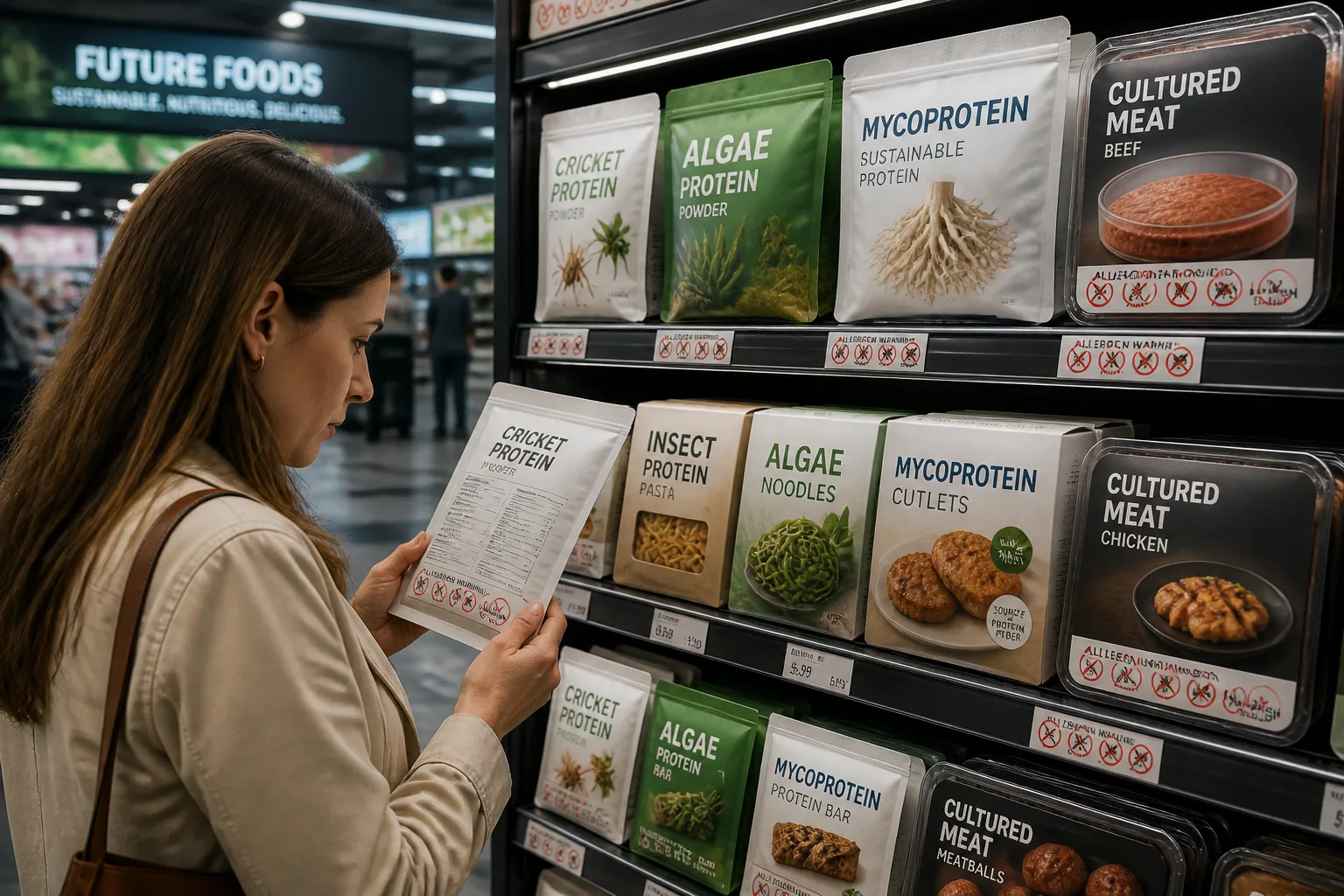
The Allergen Risk in 2026: Novel Foods, New Proteins, and How to Stay Safe
Food allergies have always required caution, but 2026 is bringing a new kind of complexity. The food system is changing fast, and with it comes a wider mix of proteins, production methods, and ingredient sources that many shoppers have never had to think about before. Insects, algae, fungi, cultured meat, precision-fermented dairy, and plant-based meat and cheese alternatives are no longer niche concepts. They are becoming mainstream options, and that means allergen risk is evolving too.
For people with food allergies or intolerances, the challenge is not only whether a product contains a known allergen. It is also whether a new ingredient may behave like an old allergen, whether processing changes protein structure, and whether labeling tells the full story. In this article, we will look at what counts as a novel food, where the biggest allergy risks are emerging, how scientists test new proteins, and what practical steps shoppers can take to stay safe.
Why Allergen Risk Is Changing in 2026
The allergy landscape is changing because the food supply itself is changing. Traditional allergen safety systems were built around familiar foods such as milk, egg, wheat, soy, peanuts, tree nuts, fish, shellfish, and sesame. But novel foods can introduce proteins with very different structures, new processing residues, or cross-reactive patterns that are not always obvious at first glance.
Research on novel food sources notes that plant-based alternatives, fungi, algae, insects, and cultured meat each bring distinct allergenic challenges because their proteins may carry unique epitopes, modified structures, or motifs not commonly seen in conventional foods. That matters because allergy risk is not just about the ingredient name. It is about how the immune system sees the protein itself. https://www.sciencedirect.com/science/article/pii/S0924224426000014
At the same time, regulators and manufacturers are under pressure to innovate quickly. That can be good for sustainability and food choice, but it also means consumers need better tools, clearer labels, and more transparency when evaluating unfamiliar products.
What Counts as a Novel Food or New Protein
A novel food is generally a food or ingredient that has not been consumed to a significant degree in a particular region before a certain regulatory cut-off, or that is produced through a new process that meaningfully changes its composition. A new protein can be a completely new source, like insect flour, or a familiar protein made in a new way, like precision-fermented dairy proteins produced by microbes rather than cows.
This distinction matters because the immune system does not care whether a protein came from a plant, animal, fungus, or fermentation tank. It reacts to molecular features. So a protein can be new to the market but still resemble a known allergen closely enough to cause a reaction. That is why protein source, processing method, and final formulation all matter.
Novel food categories now include insect-derived ingredients, algae and seaweed proteins, mycoprotein, cultured meat, fermentation-derived proteins, and a fast-growing range of plant-based analogs. Some are designed to mimic the taste and texture of meat or dairy, which means they may also mimic some of the same allergen-relevant proteins or rely on similar supporting ingredients such as soy, pea, wheat, or dairy-derived cultures.
The Biggest Emerging Allergy Risks: Insects, Algae, Fungi, and Cultured Foods
Among the most talked-about 2026 food trends, insect protein is one of the clearest allergen concerns. EFSA has noted that insect proteins can cross-react with allergens from crustaceans, molluscs, and house dust mites. Proteins such as tropomyosin, arginine kinase, enolase, and alpha-actin can act as pan-allergens across these groups, which means a person with shellfish allergy may also react to certain insect-derived products. EFSA also emphasized that although several insect products have been approved as novel foods in the EU, allergenicity data remain limited. https://efsa.onlinelibrary.wiley.com/doi/10.2903/j.efsa.2022.e200909
Algae ingredients are often perceived as gentle or automatically healthy, but that does not make them allergen-free. Algae and seaweed-based products can introduce unfamiliar proteins, and some may be processed in ways that leave behind residues or contaminants. The main issue is not that algae is a common allergen today, but that the data around cross-reactivity and long-term tolerance are still developing.
Fungi-based foods, including mycoprotein, are another area to watch. Fungal proteins can be unusual in structure and may present new risks for people with mold sensitivities or with allergies that overlap across fungal proteins. As with any highly processed ingredient, formulation also matters. A product may contain binding agents, flavor enhancers, or protein isolates that change the final allergen profile.
Cultured meat raises a different set of questions. Recent analysis highlights allergen concerns at multiple stages of production, including the cell source, the use of cell lines that may introduce non-native proteins, immortalization or genetic modifications, and culture media components that may not have a long history of food use. In other words, cultured meat is not just an animal tissue story. It is also a cell biology and manufacturing story. https://www.tandfonline.com/doi/abs/10.1080/10408398.2025.2497919
Why Plant-Based Meat and Cheese Alternatives Can Still Trigger Reactions
Plant-based products are often marketed as simple swaps, but they can still pose serious issues for allergy-aware shoppers. Many meat and cheese alternatives rely heavily on soy, pea, wheat gluten, cashew, almond, coconut, or other legume and nut proteins. That means a product designed to avoid animal allergens can still be problematic for someone avoiding soy or tree nuts.
There is also a less obvious risk: process-induced changes. Reviews of plant-based meat alternatives have reported anti-nutrients, allergens, and process-induced compounds, including thermally induced chemicals. They have also identified recurring concerns around bacterial contamination and residual allergenic soy or legume proteins. So even a product that looks safe on the front label may need a closer look at the ingredient list and manufacturing notes. https://pmc.ncbi.nlm.nih.gov/articles/PMC8230205/
Cheese alternatives can be especially tricky because they often use multiple protein systems together, such as starches, gums, oils, and plant proteins. A shopper avoiding one allergen may still encounter another in the same product. The lesson is simple: plant-based does not mean allergen-free.
How Scientists Assess Allergenic Potential in New Proteins
Assessing whether a new protein might cause allergies is now a multi-step process. Recent research supports a weight-of-evidence strategy that combines in silico screening of sequence homology, in vitro digestion assays, IgE-binding tests, cell-based activation assays, and in vivo models. No single test is enough on its own, because allergenicity is influenced by digestion stability, epitope similarity, dose, formulation, and immune response patterns. https://www.sciencedirect.com/science/article/pii/S0924224426000014
In practice, scientists compare a novel protein against known allergens to see whether it shares meaningful sequence or structural similarities. They also test how the protein behaves in digestion, because proteins that resist breakdown may be more likely to survive long enough to trigger an immune response in susceptible people.
Then come laboratory-based immune tests, which examine whether IgE antibodies from allergic individuals bind to the protein. If the signal is concerning, researchers may move into cell-based assays or animal models to understand whether the protein can activate allergic pathways more broadly. This layered approach is important because allergic potential is rarely obvious from the ingredient name alone.
The Role of AI, Machine Learning, and Organ-on-Chip Testing
One of the biggest shifts in 2026 is the use of advanced computational and biological tools to improve prediction. AI and machine learning models are being trained to identify allergen-like patterns, predict protein risk, and support faster screening. These tools are not replacing laboratory testing, but they are helping researchers prioritize which proteins need deeper review. https://www.sciencedirect.com/science/article/pii/S0924224426000014
Platforms like organoids and organ-on-chip systems are also gaining ground because they better mimic human physiology than simpler lab models. That matters when the question is not just whether a protein binds to antibodies, but how it behaves in a gut-like environment, how it interacts with tissue barriers, and whether it triggers immune activation in a more realistic setting.
Detection technology is advancing too. Research points to systems combining microfluidics, CRISPR-based multiplex screening, AI-driven readouts, and organ-on-chip evaluation as a route toward industrial-scale allergen sensing. For consumers, this may eventually mean safer products and better pre-market screening. For now, it mainly signals that the science is moving toward faster and more accurate risk assessment. https://www.sciencedirect.com/science/article/pii/S0924224426002712
Cross-Reactivity: When a New Food Resembles an Old Allergen
Cross-reactivity is one of the most important concepts for allergy-aware shoppers. It happens when your immune system mistakes a new protein for one it already recognizes. In the context of novel foods, this is especially relevant for insect proteins, some fungal proteins, and ingredients derived from organisms that share protein families with known allergens.
For example, someone allergic to shellfish may need to be cautious with insect protein because of shared pan-allergens. Likewise, people with existing sensitivities may react to proteins that are not identical to their known allergen but are close enough in structure to cause symptoms. This is one reason why a new food can feel unpredictable even if it is technically from a different category.
The safest mindset is to assume that novelty does not equal safety. If a product contains a protein source you have never seen before, it deserves the same scrutiny you would give a more familiar but high-risk ingredient.
Labeling Red Flags Every Allergy-Aware Shopper Should Know
Good label reading is still one of the best defenses, but 2026 brings new red flags to watch for. Start with the obvious: check the ingredient list for known allergens and for alternative names that may hide them, such as casein, whey, lecithin, albumin, or gluten-containing grains.
Next, look for vague terms like protein blend, natural flavor, fermentation-derived ingredient, modified starch, or textured protein. These phrases are not always dangerous, but they can signal that the product uses a complex formulation that deserves further scrutiny. If the food is novel, ask whether the protein source is listed clearly enough for someone with allergies to make an informed decision.
In the U.S., sesame is now required as a major food allergen under the FASTER Act, which became effective in 2023. That matters because sesame appears in many plant-based and global foods, and it is now easier to miss if you are not checking labels carefully. https://www.fda.gov/regulatory-information/search-fda-guidance-documents/guidance-industry-questions-and-answers-regarding-food-allergen-labeling-edition-5
For shoppers concerned about bioengineered ingredients, the USDA’s National Bioengineered Food Disclosure Standard has also been in flux. A Ninth Circuit decision in October 2025 invalidated the exemption for highly refined foods, which could expand labeling requirements and improve transparency for some ingredients. If you rely on label cues to avoid risk, this is a development worth following. https://www.cov.com/en/news-and-insights/insights/2025/11/ninth-circuit-invalidates-usdas-exemption-for-highly-refined-foods-under-the-national-bioengineered-food-disclosure-standard
GM, Gene-Edited, and New Plant Varieties: What Changes for Allergy Safety
Genetically modified and gene-edited foods often enter the allergy conversation because they can change a crop’s protein profile, either intentionally or as a side effect of breeding. In some cases, genetic engineering is used to reduce allergens. In others, it may introduce a new protein or alter expression levels in ways that matter to sensitive consumers.
The key point is that the technology itself is not the whole story. What matters is the final protein composition and whether it has been adequately assessed for similarity to known allergens, digestive stability, and immune activity. For consumers, the challenge is that these details are not always obvious on shelf labels.
This is why regulatory labeling, ingredient disclosure, and post-market surveillance are so important. Even if a food is technically approved, people with allergies still need practical information in plain language.
Regulatory Updates and What They Mean for Consumers
Regulation is trying to keep pace, but not always at the same speed as innovation. In the EU, novel food approvals are helping bring new products to market, yet EFSA has made clear that insect allergenicity data remain limited. That means approval does not equal zero risk, only that the available evidence supports marketing under certain conditions.
In the U.S., labeling rules continue to evolve around major allergens and bioengineered foods. The addition of sesame to the major allergen list improved transparency, and the ongoing legal and policy changes around refined bioengineered ingredients may affect how much information consumers see on packages.
For consumers, the practical takeaway is to stay alert to regulatory updates but not to assume that a product is safe just because it is approved or trendy. Approval is a threshold, not a personal allergy clearance.
How to Evaluate a Novel Food Before You Try It
If you are curious about a new product, start with your own allergy history. Ask whether the ingredient source overlaps with something you already avoid. If you have a shellfish allergy, insect protein deserves special caution. If you react to soy or peas, many plant-based meats and dairy alternatives may not be suitable. If you have multiple food allergies, even minor formulation changes can matter.
Then check the full label, including the allergen statement, advisory warnings, and any online product details. Look for the manufacturer name, because brands with transparent sourcing are more likely to provide usable information when contacted. If the product uses terms like fermentation-derived, precision-fermented, or cultured, confirm what the actual protein source is and whether any carrier, culture media residue, or processing aid may matter for you.
When in doubt, do not rely on the front of the package. A product marketed as high-protein, sustainable, or plant-powered can still contain hidden allergens or shared protein families. If you have a history of severe reactions, ask your allergist before trying a novel food category.
A 2026 Safety Checklist for Curious but Cautious Shoppers
Here is a simple way to approach novel foods in 2026 without turning every grocery trip into a guessing game. First, identify the protein source. Second, compare it to your known allergens and look for cross-reactivity risks. Third, read the full ingredient list and allergen statement every time, even if you have bought the product before. Fourth, check whether the brand explains sourcing, manufacturing, and contamination controls. Fifth, be extra careful with products that are new, imported, reformulated, or sold in limited batches.
It also helps to use tools that make label checks faster. For example, the Bokha: Food Allergy Scanner App can scan barcodes and identify allergens, traces, and additives in less than a second, which can save time when you are comparing unfamiliar products in the supermarket. You can learn more here: https://findthe.app/bokha
Above all, remember that the safest approach is not fear, but informed caution. Novel foods can be useful, sustainable, and exciting, but they also deserve the same level of scrutiny as any other high-risk ingredient. In 2026, the shoppers who stay safest will be the ones who combine label literacy, cross-reactivity awareness, and a healthy respect for anything that says new protein on the package.