That Midnight Munchie Panic: How to Navigate Allergens Late at Night Without Compromising Safety
Late-night hunger has a way of making everything feel more complicated. You are tired, the kitchen is dim, your phone battery may be low, and the easiest option is often the least carefully checked one. For people with food allergies, that combination can turn a simple snack decision into a genuine safety moment.
The good news is that midnight does not have to mean reckless choices. With a few routines, a safer snack stash, and the right tools, you can make late-night food decisions that are fast and still cautious. The key is to prepare for the moments when your brain is least interested in reading every label twice.
Why Late-Night Hunger Can Be Riskier for People With Food Allergies
Food allergies already demand constant attention, but late-night hunger adds a few extra layers of risk. When you are tired, it is easier to overlook small details, misread packaging, or decide that a questionable snack is probably fine. At night, people are also more likely to be isolated, which means fewer helpful eyes around if something seems off.
This matters because food allergy reactions can be severe even from very small amounts of an allergen. Mayo Clinic notes that food allergy affects about 10% of Americans overall, and that even small amounts of an allergen can trigger an immune response. That is why the midnight version of food safety needs the same seriousness as the daytime version, even if your energy is much lower. Source: https://www.mayoclinic.org/diseases-conditions/food-allergy/symptoms-causes/syc-20355095
Late-night hunger also increases the chance of making a rushed restaurant or delivery choice. That is worth taking seriously, because research shows restaurant reactions remain common even when people do the right thing and tell staff about their allergy. In one study, 53.9% of allergic reactions in U.S. restaurants occurred despite customers informing staff of the allergy, and 26.6% happened with menu allergen information available. Source: https://www.foodallergy.org/sites/default/files/2021-01/JACI In Practice_Restaurant Food Allergy-1 5 21.pdf
How Tiredness, Stress, and Low Light Affect Safe Food Decisions
Fatigue changes decision-making. Under stress, people are more likely to rely on shortcuts, assumptions, and familiarity. That can mean trusting a brand you have not checked recently, assuming a product is unchanged, or skipping a second look at an ingredient list because the room is dark and your patience is gone.
Low light makes label reading worse in a very literal sense. Tiny print, reflective packaging, and unfamiliar terms are already frustrating in good lighting. Add tired eyes and a desire to get back to bed, and it becomes easy to miss important information such as allergen declarations, shared-facility notices, or a formula change.
This is also where emotions matter. Midnight hunger can feel urgent, and urgency can create a kind of tunnel vision. Instead of asking, “Is this the safest option?” many people end up asking, “Is this the easiest option right now?” For allergy safety, those are not the same question.
When Labels and Trace Warnings Feel Hard to Trust After Hours
Packaged food labels are still your first line of defense, but they require careful reading. In the U.S., the FDA requires nine major allergens to be disclosed on packaged foods: milk, egg, fish, shellfish, tree nuts, peanuts, wheat, soybeans, and sesame. The FDA also explains that “contains” statements are required when major allergens are ingredients, while advisory statements like “may contain” or “made in a facility that also processes” are voluntary and not standardized. Source: https://www.fda.gov/consumers/consumer-updates/have-food-allergies-read-label
That matters because advisory labels can be confusing. Some people treat “may contain” as a hard stop, while others only avoid certain warnings depending on their allergy profile and advice from their clinician. There is no one-size-fits-all interpretation, which is why a late-night, half-awake reading session is not the best time to make a brand-new judgment call.
A safer habit is to pre-select brands and products you have already vetted during daytime hours. When possible, choose companies that publish clear allergen policies and shared-facility details openly. Brands that explain their peanut-free standards, for example, are often more trusted by allergy shoppers than vague “free from” claims without details about shared equipment or advisory warnings.
The Safest Late-Night Snacks to Keep at Home
The best midnight snack is the one you do not have to research at 1:00 a.m. A safe home setup reduces the number of decisions you must make when you are tired. Think in terms of shelf-stable, clearly labeled, easy-to-grab options that you have already checked when you were alert.
Good late-night options often include individual items you know well, such as simple crackers, allergy-safe granola bars, fruit cups, plain popcorn from a trusted brand, shelf-stable applesauce, or packaged snacks you have personally reviewed. The exact list depends on your allergies, but the principle stays the same: keep it boring, familiar, and verified.
It also helps to separate everyday snacks from emergency snacks. Everyday snacks may be what everyone in the house eats, while emergency snacks are your own protected backup supply. If you store them in a dedicated bin or marked shelf, you lower the odds of accidental sharing, contamination, or someone else “borrowing” the one thing you were saving for a late-night moment.
How to Build a Scan-Friendly Emergency Snack Stash
A scan-friendly stash is a small collection of packaged foods that are easy to check quickly with an allergy scanner app. The idea is not to replace human judgment, but to make it faster to confirm ingredients when your energy is low. This can be especially useful for products with barcodes that you buy repeatedly.
A smart stash should include items with simple packaging, legible labels, and brands you trust enough to buy again. Keep the quantity manageable. A huge pile of random products does not help at midnight. A curated set of safe options does.
This is also where a scanning app can reduce friction. Bokha: Food Allergy Scanner App, available at https://findthe.app/bokha, lets you scan product barcodes and identify allergens in less than a second. It detects 13 allergens, traces, and additives, which makes it a practical tool when you are tired and want a quick check before taking that first bite.
Still, the app should be part of a system, not your only defense. Research on food allergy apps has found that average quality can be acceptable, but restaurant and product-scanning apps often have lower engagement than meal-planner apps. A separate review also notes that many allergy apps lack strong clinical validation, so they are promising tools, not guarantees. Sources: https://mhealth.jmir.org/2020/9/e18339 and https://www.frontiersin.org/journals/allergy/articles/10.3389/falgy.2026.1760856/full
What to Look for at Convenience Stores, Gas Stations, and Vending Machines
Late-night shopping often means limited options. Convenience stores, gas stations, and vending machines can be useful in a pinch, but they require extra caution because product variety changes often and staff may not know much about ingredient details.
Start with packaged foods that have a full ingredient list and a visible allergen statement. Avoid loose bakery items, fountain drinks with shared equipment questions, and anything where you cannot easily confirm the manufacturer. If a product is unfamiliar, scan it if possible, but do not let the scanner override a label that clearly says a relevant allergen is present.
When in doubt, choose simpler items over highly processed ones. Fewer ingredients generally means fewer hidden risks, though not always. A plain snack with one or two ingredients that you already trust is usually a better midnight bet than a flashy new product with unclear sourcing.
How to Use Allergy Scanner Apps Quickly and Accurately at Night
Scanner apps are most helpful when you use them the same way every time. At night, that consistency matters even more. First, make sure your app data is updated and your phone brightness is high enough to read the result. Then scan the barcode and pause long enough to review the allergens and any trace or additive flags.
Do not scan in a rush and assume a green light means you are done. Check whether the app is identifying the product correctly, especially if the packaging has changed, the barcode is damaged, or you are scanning a similar-looking item. If the scan result does not match the label, trust the actual packaging and, if needed, skip the product.
Apps are especially useful for repetitive decisions. If you already know a certain snack is safe, the scanner can help you verify whether the current version is still the same. That kind of quick confirmation is often what you need when your brain is too tired for a long label audit.
What to Ask Restaurants Before Ordering Late-Night Delivery
Late-night delivery can feel convenient, but it is also one of the highest-risk ways to improvise food. Restaurant allergy handling is inconsistent, and the research backs that up. The CDC reports that about one in three people with food allergies say they have had a reaction at a restaurant. In another CDC study, fewer than half of restaurant managers had received food allergy training, and only 33.3% of servers had. Sources: https://www.cdc.gov/restaurant-food-safety/php/practices/food-allergy-reactions.html and https://www.cdc.gov/mmwr/volumes/66/wr/mm6615a2.htm
That means the late-night order should come with direct, specific questions. Ask whether the kitchen can prevent cross-contact, whether a separate prep surface or clean utensil can be used, and whether a manager or trained staff member can confirm the order before it goes out. If the restaurant seems uncertain, rushed, or annoyed, that is useful information. It is better to cancel than to gamble.
The risk is not only ingredient presence. A review of dining-establishment hazards highlights hidden allergens, cross-contamination during prep, and communication failures between staff and patrons. Even if a menu looks allergy-aware, the system behind the menu may still be fragile. Source: https://pubmed.ncbi.nlm.nih.gov/40431476/
How to Reduce Cross-Contact Risks With Takeout and Fast Food
Takeout safety starts before the food leaves the kitchen. Be very clear in the order notes, but do not rely on notes alone. Reconfirm the allergy by phone if needed, especially for complex meals or chains with mixed practices across locations.
When the food arrives, inspect the packaging for signs of tampering, mixing, or accidental ingredient changes. If multiple items are packed together, keep your own safe food separate from anyone else’s order. That sounds obvious, but at midnight, people are more likely to grab the wrong box or assume the “plain” item belongs to them.
A practical rule is this: if anything about the order is unclear, stop before eating. Late-night hunger is real, but so is the cost of an avoidable reaction. A short delay is usually far easier than managing symptoms after a rushed decision.
A Calm Safety Routine for Midnight Cravings
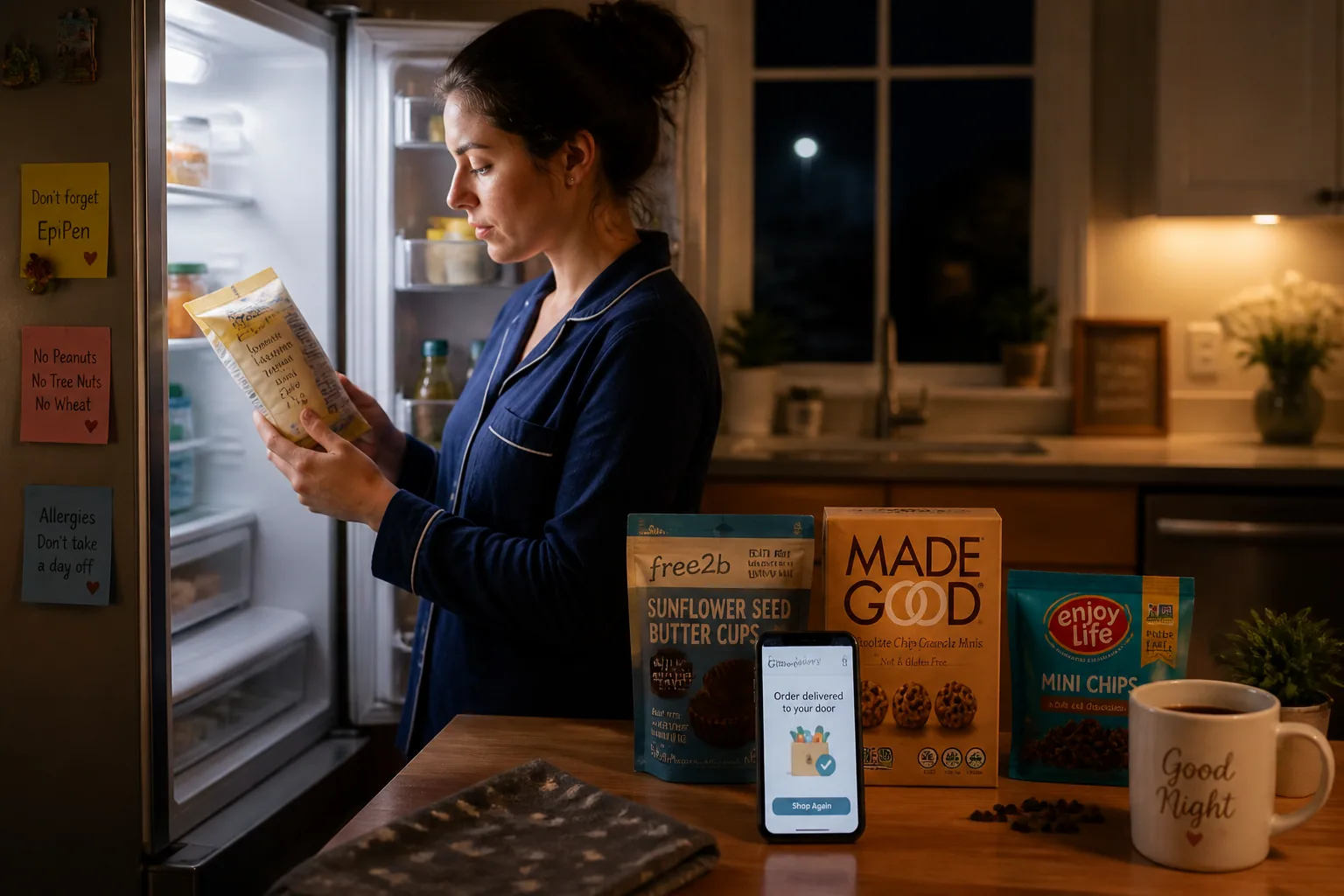
The calmer your routine, the easier it is to make good choices when you are sleepy. Start with a simple sequence: sit down, turn on the light, grab the snack you already pre-approved, and check the package once more. If it is a new product, scan it. If anything is unclear, do not keep going just because you are hungry.
It can help to create a personal rule, such as never trying a new packaged food after a certain hour unless it was already reviewed earlier in the day. Another useful rule is to avoid making allergy decisions while standing in the kitchen with the refrigerator open. That is often when impulse wins.
If you live with family, roommates, or a partner, ask them to respect your late-night safety setup. That means not moving your reserved snacks, not assuming they are shared, and not pressuring you to “just have a little bit” of something you have not checked.
Helping Kids, Teens, and Family Members Make Safer Nighttime Choices
Children and teens need the same safety logic, but simpler steps. Kids are often less patient with labels, and teens may be more likely to trust convenience and speed. A family plan can reduce the chances of a risky choice when adults are asleep or unavailable.
For younger children, keep approved snacks in a visible, separate place and teach them which items are always okay and which ones require an adult check. For teens, build a short decision tree: look at the label, scan if needed, avoid anything unfamiliar, and text or wake an adult if they are unsure. The goal is not to create fear. It is to make safe choices feel automatic.
This is especially important because food allergy is common enough that families cannot treat it like an edge case. With about 8% to 10% of children affected, nighttime routines should be built with allergy safety in mind from the start, not added as an afterthought. Source: https://www.mayoclinic.org/diseases-conditions/food-allergy/symptoms-causes/syc-20355095
Final Checklist: What to Do Before You Take That First Bite
Before you eat anything late at night, run through a fast mental check. Is this food one you already vetted? Does the label clearly avoid your allergens? Did you scan it if needed? Was it stored safely and kept separate from shared foods? If it came from a restaurant, did you clearly communicate your allergy and confirm cross-contact precautions?
If the answer to any of those questions is no or maybe, pause. Eat something safer instead, or wait until you can verify the item properly. Midnight cravings pass, but reactions can escalate fast.
The best allergy safety habit is not perfection. It is having a system that still works when you are tired, distracted, or half-asleep. With a trusted snack stash, clear label habits, realistic restaurant expectations, and a quick scanner tool like Bokha, late-night hunger does not have to turn into late-night panic.