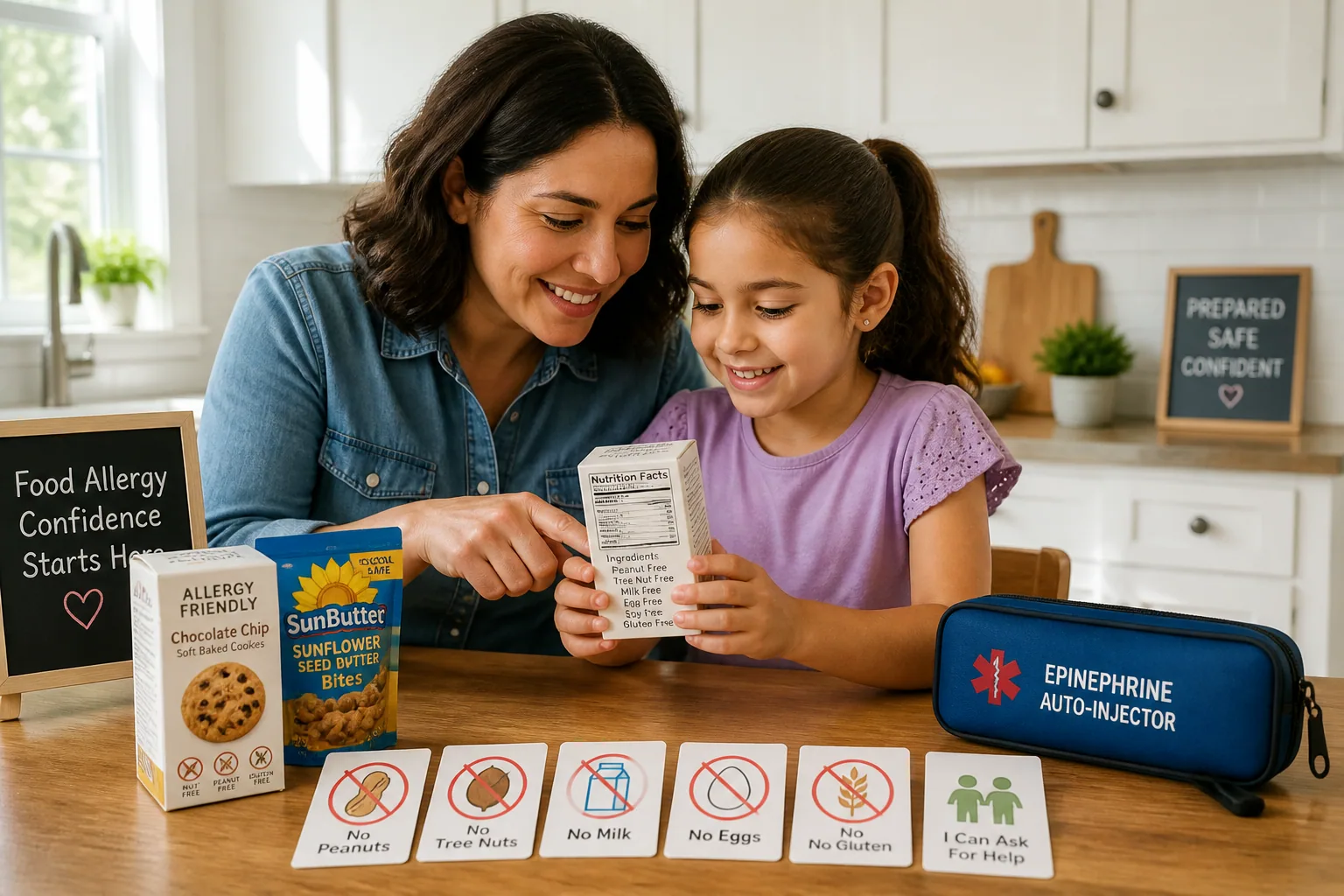
Talking to Children About Food Allergies: Building Trust, Safety & Understanding
Talking to a child about food allergies is not just about warning them what to avoid. It is about helping them understand their body, feel safe in everyday situations, and build habits that protect them without making food seem scary. That balance matters more than ever, especially when food allergies are common in childhood. According to the CDC, about 5.3% of U.S. children ages 0 to 17 had a physician-diagnosed food allergy in 2024, while earlier survey data from FARE suggested the number was closer to 8%, or about 1 in 13 children. Some children are allergic to more than one food, and reactions can happen in places parents do not always expect, including school. The goal of these conversations is not fear. It is confidence, clarity, and trust.
Why Early Conversations About Food Allergies Matter
The earlier children hear honest, simple information about their allergy, the more normal safety routines become. If a child only learns about allergies in a stressful moment, the message can feel overwhelming. But when the conversation starts calmly and early, children begin to see allergy care as part of daily life, like brushing teeth or buckling a seat belt. That makes it easier for them to remember rules, ask questions, and speak up when something does not feel right.
Early conversations also help children build a sense of self-protection. Kids with food allergies may eventually need to explain their needs to teachers, relatives, babysitters, coaches, and friends. That is a big skill, and it grows over time. The earlier you begin, the more chances they have to practice. It also gives caregivers a chance to notice what language works best for the child, what worries them, and which teaching tools make the biggest difference.
This matters in school settings too. FARE notes that more than 15% of children with food allergies have had an allergic reaction at school, and about 20% to 25% of epinephrine administrations in schools involve students whose allergy was unknown before the reaction. Those numbers show why conversations should include not only the child, but also the adults around them. Safety improves when everyone is informed.
Explaining What a Food Allergy Is Without Creating Fear
A food allergy happens when the immune system treats a certain food like a threat. That can cause symptoms ranging from mild to severe, and in some cases, a reaction can become anaphylaxis, which is a medical emergency. For children, the explanation should be simple and reassuring. You might say, “Your body is extra sensitive to some foods, so we help it stay safe by checking labels and asking questions.” That tells the truth without making the child feel broken or fragile.
It can help to explain that an allergy is not the same as being picky, and it is not the child’s fault. Some children feel embarrassed when they have to ask about ingredients or bring special food. Reassure them that many people live with food allergies and manage them successfully every day. A good conversation should make the allergy feel important, but not scary enough that the child starts to fear all food or avoid social situations entirely.
Visual aids can make this easier. Showing pictures of safe and unsafe foods, pointing out ingredients while grocery shopping, and using simple symptom illustrations can help children understand the topic in a concrete way. Healthline also recommends using visuals to explain food allergies without creating fear, since children often respond better to pictures and examples than to long explanations.
Age-Appropriate Ways to Talk to Toddlers, Kids, and Preteens
The best explanation depends on the child’s age and developmental stage. Toddlers do not need detailed immune-system lessons. They need short, repeatable rules. A toddler might hear, “This food is not safe for your body,” or “We only eat foods Mommy or Daddy says are safe.” The focus should stay on simple boundaries and routine, not on medical details.
For early grade school children, the conversation can become more active. AAAAI notes that children ages 5 to 8 can often be involved in allergy management with supervision, including simple tasks like reading labels and following safety rules. At this stage, many children can learn a basic sequence such as stop, look, ask, and go. That gives them a practical script they can use when food is offered by a friend, at a party, or in a classroom.
Preteens usually want more independence and more explanation. They can handle more detailed information about ingredients, cross-contact, and symptoms. They also begin to care more about fitting in, so the conversation should include how to speak up confidently without feeling awkward. You can explain what to do if they are unsure about a snack, how to recognize early symptoms, and why carrying emergency medication is part of being prepared, not different in a bad way.
Teaching Everyday Safety Skills Through Practice
Children learn best by doing. Safety skills are much easier to remember when they are practiced regularly in real-life situations instead of only talked about in theory. That means building tiny routines into everyday life. Before snack time, before a playdate, before a school event, or before a restaurant meal, you can pause and ask the child to help think through the safety steps.
One of the most helpful tools for young children is the STOP. LOOK. ASK. GO. method from FARE. The idea is simple: stop before eating, look at the food or label, ask an adult if it is safe, and then go if the food has been approved. Because it is short and action-based, it works well for children who are still learning how to pause before grabbing food automatically. It also creates a habit that can reduce impulsive mistakes.
Practice can include role-play. Pretend that a friend offers a cookie. Ask the child what they would say. Pretend you are at a birthday party and there is an unfamiliar dessert. Ask them what to check. Role-play is especially useful because it lets the child make mistakes in a safe setting and rehearse a better response the next time. The more often they practice, the more natural it becomes.
How to Help Kids Read Labels and Spot Risky Ingredients
Label reading is one of the most important safety skills, but it can be confusing at first. Children need to learn that packaging can change, recipes can change, and words on labels are not always obvious. The goal is not to turn a child into a detective overnight. It is to help them understand that checking labels is a normal habit whenever food is new or unfamiliar.
Start with the allergen they need to avoid, then show them how that ingredient may appear in different forms. For example, a child who avoids milk may need to recognize butter, whey, casein, and other dairy-related terms. A child with peanut or tree nut allergies can learn to look for direct mentions on the package and to ask an adult when the label is unclear. Sesame is also now one of the major allergens required to be listed on labels in the U.S. under the FASTER Act, which became effective in 2023, so families should teach children that newer labeling rules can help, but careful checking is still essential.
This is also where shopping trips become powerful teaching moments. You can stand in the aisle, compare packages, and point out where allergen information appears. Over time, children can take part in the process by finding the ingredient list, spotting the allergen statement, and learning what to do if the package says “may contain” or if the label is hard to understand. For parents who want a faster way to check packaged foods, a tool like Bokha: Food Allergy Scanner App can make shopping easier by scanning barcodes and identifying allergens in less than a second, which can be especially helpful when teaching kids how to make quick, informed choices.
Practicing What to Say at School, Parties, and Restaurants
Many children know the safety rules at home, but struggle when they need to say them out loud. That is why it helps to practice scripts. A child can learn phrases such as, “I have a food allergy. I need to check with my parent or teacher first,” or “I can only eat food from home,” or “Can you tell me the ingredients?” These are not just polite phrases. They are self-advocacy tools.
School is one of the most important places to rehearse. Children may be offered snacks during class, birthday treats, cafeteria food, or shared baking projects. Practicing ahead of time helps them avoid freezing or feeling pressured. It is also useful to teach them how to find a trusted adult if they start feeling symptoms or if they accidentally eat something unsafe. Because school reactions can happen even when the allergy was not previously known, clear routines and communication really matter.
At parties and restaurants, children benefit from short, confident language. Younger kids may simply need to know how to hand the situation to an adult. Older kids can ask about ingredients, cross-contact, and preparation methods. The key is to make speaking up feel normal. If children hear adults say, “Good question, let’s check,” they learn that asking is smart, not rude.
Making Epinephrine and Safety Tools Less Scary
Many children feel nervous about epinephrine because it looks medical or serious. But avoiding the topic does not help. The better approach is to explain the tool in calm, positive language. You can say that epinephrine is a medicine that helps in emergencies and that carrying it is part of staying prepared, like having a fire extinguisher in the kitchen. The message is not, “Something terrible will happen.” The message is, “We are ready if it does.”
It can also help to show the child where the medication is kept, who is responsible for it, and what happens in an emergency. Some families use practice devices or walkthroughs so the child becomes familiar with the process. This matters because real reactions can move quickly. Research cited in allergy literature shows that some children who experience anaphylaxis need more than one dose of epinephrine, which is one reason adults should always know the full emergency plan and when to call for help.
Children do not need every medical detail, but they do need confidence. If they understand that the medication is there to help them breathe, feel better, and stay safe while waiting for medical care, it becomes less intimidating. The goal is not to make the child depend on fear. It is to make safety tools feel normal and familiar.
Working With Schools, Family Members, and Other Caregivers
Food allergy education works best when it extends beyond the child’s immediate household. Schools, grandparents, babysitters, after-school staff, sports coaches, and family friends all need to know the basics. A child may understand their allergy perfectly at home, but still be at risk if other caregivers do not follow the same plan.
Keep the message simple and consistent. Everyone should know the allergens, symptoms, where emergency medication is kept, and what to do in an emergency. Written instructions are helpful, but they work best when paired with conversation. Adults should know not only what the child cannot eat, but also how to prevent cross-contact, what snacks are safe, and what phrases to use if the child asks questions.
This is also a chance to reduce the child’s emotional burden. When adults around them are informed and prepared, the child does not have to do all the explaining alone. That can make social settings feel less stressful and help the child participate more fully in everyday life.
Using Cooking, Shopping, and Dining Out as Teaching Moments
Everyday activities are some of the best teachers. In the kitchen, children can learn which ingredients are safe, how recipes can change, and why clean tools matter. They can help wash produce, measure ingredients, and check labels on packaged items. This turns allergy management into an ordinary part of cooking instead of a separate, stressful task.
At the grocery store, you can compare two versions of the same product and ask the child what is different. You can look at ingredient lists, allergen statements, and packaging warnings together. Over time, children begin to recognize patterns and understand that not every item with a similar name is safe. That real-world repetition is more memorable than a lecture at home.
Restaurants can also become learning spaces. Children can watch how parents ask questions, request ingredient lists, and confirm safe preparation. They can learn that it is okay to be specific and to double-check even if a menu looks friendly. The goal is not to make dining out stressful. It is to show children that safe eating is possible with planning and communication.
Books, Visuals, Apps, and Other Resources That Help
Some children learn best through stories, pictures, and interactive tools. Books can help normalize allergy routines by showing characters who ask questions, carry medication, and solve problems confidently. Visual charts can make safety steps easier to remember, especially for younger children. A simple checklist near the door or in a lunch bag can become a reassuring routine before school or outings.
Digital tools can also support learning when used thoughtfully. The Friends, Family and Food app was designed with input from children with food allergies and caregivers, and research in PMC reports that users rated it highly for acceptability and educational usefulness. Another option, Alan - Food Allergy Guide, offers symptom tracking, allergy-friendly recipes, multilingual allergy cards, and a community forum. Tools like these can reinforce lessons, provide reminders, and help families stay organized.
No app replaces adult guidance, but the right resource can make the child feel included and capable. If the tool feels simple, visual, and age-appropriate, it can reinforce what they already hear from parents and caregivers. The best resources are the ones that help the child practice, not just read.
Building Confidence and Self-Advocacy Over Time
Confidence grows when children experience success. Every time they check a label correctly, ask a question at a party, or remind an adult about their allergy, they build a sense of competence. That is why the tone of these conversations matters so much. The child should feel proud of being careful, not ashamed of needing special steps.
As children get older, their responsibilities can slowly increase. A younger child may only identify their allergen and ask for help. An older child may begin checking labels with supervision, managing a snack stash, or explaining the allergy to a trusted adult. A preteen may practice ordering safely at a restaurant or keeping track of their emergency plan with more independence. Growth should be gradual and matched to maturity, not rushed.
It also helps to celebrate progress. If a child speaks up even when they are nervous, notice it. If they remember to stop and ask before eating, praise the habit. These moments show them that self-advocacy is a skill they can learn. Over time, that skill becomes part of how they move through the world with more confidence.
Common Mistakes to Avoid When Talking About Allergies
One common mistake is using fear as the main teaching tool. Scaring a child into compliance may work briefly, but it can also create anxiety, secrecy, or food avoidance. The better approach is calm repetition and practical steps. Children should understand the seriousness of the allergy without feeling panicked every time food is nearby.
Another mistake is giving too much information too fast. A toddler does not need a long explanation of immune responses and emergency treatment. A preteen may need more detail, but still benefits from clear, manageable chunks. Matching the message to the child’s age helps the information stick.
It is also important not to assume one conversation is enough. Food allergy education is ongoing. Children forget, grow, and face new situations. Repetition is not failure. It is how habits are built. The more often you weave safety into normal life, the more natural it becomes.
Finally, avoid making the child feel alone in the responsibility. A child can learn self-advocacy, but adults still need to manage the bigger safety system. The most effective food allergy conversations say, in effect, “We will do this together.” That message builds trust, and trust is what helps children feel informed, included, and capable.