Smart Swaps for Unlikely Allergen Crossovers: Surprising Foods to Watch Out For
Even careful shoppers can get caught off guard by allergens hiding in places that do not seem risky at first glance. A label may look simple, a product may seem familiar, and yet a hidden crossover can still happen through ingredients, flavor systems, shared equipment, or even the way food is prepared and served. That is why allergen awareness is not only about the major ingredients you already know to avoid, but also about the less obvious places they can appear.
This is especially important because some of the most common problem foods are not the obvious ones. Coffee creamers, spice blends, flavored waters, sauces, snack seasonings, and bulk-bin items can all bring unexpected exposure. In some cases, the issue is an undeclared ingredient. In others, it is cross-contact from manufacturing or restaurant prep. The good news is that with a few smart swaps and better label habits, it becomes much easier to stay ahead of surprise exposures.
Why Hidden Allergen Crossovers Catch Even Careful Shoppers Off Guard
One reason hidden allergen crossovers are so tricky is that the food industry uses a lot of flexible wording. A product can appear safe because it does not obviously name a major allergen, but the actual source of a flavor, spice, or additive may be less transparent. That makes it easy for consumers to miss risk when they rely only on the front label or on familiarity with a brand.
Another issue is that cross-contact does not always leave a visible trace. A product can look clean, smell normal, and still carry tiny amounts of another allergen from shared machinery, storage bins, utensils, or packaging lines. In practical terms, this means that a shopper can do everything right and still face risk if the product was handled in a facility that processes allergens without strong controls.
Research shows this is not a rare edge case. In Canadian surveys, about 23 to 34 percent of herb and spice products tested had at least one undeclared allergen, often gluten, soy, milk proteins, sesame, peanut, hazelnut, or egg. That is a big reminder that even small pantry staples deserve serious attention. https://inspection.canada.ca/en/food-safety-industry/food-chemistry-and-microbiology/food-safety-testing-reports-and-journal-articles/gluten-0
Everyday Foods That May Hide Unexpected Allergens
The everyday foods most likely to surprise people are often the ones that are heavily processed, blended, or flavored. Think instant mixes, powders, coatings, sauces, creamers, seasoning packets, and convenience snacks. These products often contain multiple components, and each component introduces another chance for an allergen to slip in.
Spice jars are a good example. Even if a product is labeled as a single ingredient, testing in Canada found undeclared peanut in 12 ground single-ingredient spice or herb products, and undeclared soy in 9 single and 7 mixed spice or herb products. The levels detected were low, but the cause was manufacturing cross-contact. That means the problem was not necessarily intentional formulation, but the way the product was made. https://inspection.canada.ca/sites/default/files/documents/2025-03/2020-2021-undeclared-allergens-gluten-in-ground-spices-herbs-eng.pdf
Mixed flavor packets are another place to watch. In one CFIA survey of flavor packets such as sauce mixes, seasoning mixes, and spice mixes, 25 of 100 samples had detectable levels of undeclared allergens or gluten, and three products required recall. Soy, milk, and gluten were the most common undeclared allergens. https://www.canada.ca/en/news/archive/2012/06/cfia-tests-food-samples-undeclared-allergens-flavour-packets.html
That is why the safer habit is to treat convenience foods as higher-risk than their packaging suggests. If a food is designed to be flavorful, shelf-stable, or ultra-convenient, it often depends on complex processing, and complexity is exactly where hidden allergens tend to appear.
Coffee, Drinks, and Flavor Add-Ins: The Sneaky Risk Zone
Coffee drinks and flavored beverages can seem harmless because they do not always look like allergen-heavy products. But creamers, syrups, whipped toppings, powder blends, and ready-to-drink coffee mixes often use broad ingredient categories or shared production lines. Even a simple morning beverage can become a risk if the add-in contains milk derivatives, soy-based ingredients, or flavor compounds sourced from an allergen.
Flavored waters, powdered drink mixes, and coffee enhancers can also carry vague labeling. If a product lists only general terms such as natural flavors, flavoring, or spices, it may be impossible to tell from the package alone whether a sensitive ingredient is involved. That is why drinks deserve the same caution as snacks or meals, especially when they are pre-mixed or heavily processed.
For people who want to reduce the guessing game, this is a smart place to compare products carefully and choose simpler formulas when possible. A plain coffee with a single-ingredient milk alternative or an unsweetened beverage with clearly named ingredients is usually easier to evaluate than a flavored blend with a long ingredient list.
Spice Mixes, Seasonings, and Sauces That Deserve a Second Look
Spices are one of the biggest hidden-risk categories because they look so basic. In reality, they can be highly complex. A seasoning blend may contain anti-caking agents, flavor enhancers, starches, dehydrated dairy, soy-derived ingredients, mustard, celery, or traces from equipment used for other products. Even something as routine as a taco mix or curry blend can be a cross-contact hotspot.
CFIA testing found that spice blends can contain very significant amounts of allergens in some cases. For example, a mansaf spice mix contained 9,400 ppm gluten and 270 ppm sesame, while mixed seasoning items in surveys contained 190 to 850 ppm of milk proteins. Those are not tiny marketing footnotes, and they show why spice labels should never be treated casually. https://inspection.canada.ca/en/food-safety-industry/food-chemistry-and-microbiology/food-safety-testing-reports-and-journal-articles/gluten-0
Sauces deserve the same level of scrutiny. Marinades, stir-fry sauces, salad dressings, dipping sauces, and instant gravy packets often rely on hidden flavor systems. A sauce may be gluten-free in one version and contain soy, sesame, or milk in another. If you have ever had a reaction to a dish that seemed identical to one you tolerated before, a changed sauce formula may be the reason.
There is also a broader point here: spice botanicals themselves can cross-react with common allergens. Research has shown measurable cross-reactivity in a multiplex assay involving items such as black pepper, allspice, cardamom, sesame seed, and poppy seed, even if the levels were often very low. That does not mean every person will react, but it does show why botanically similar ingredients can still matter in allergy management. https://pubmed.ncbi.nlm.nih.gov/29916095/
How Manufacturing and Shared Equipment Create Cross-Contact
A major source of hidden exposure is shared equipment. A factory may make multiple products on the same line, or store ingredients in the same facility, and tiny residues can move from one product to another if controls are weak. This is why allergen management is not just about ingredient selection, but also about production scheduling, segregation, and cleaning.
The FDA’s current good manufacturing practice guidance emphasizes controls such as scheduling allergen-containing products at the end of production cycles, segregating allergens, and cleaning equipment properly to prevent cross-contact. In other words, a safe label is only part of the story. The manufacturing process matters just as much. https://www.hhs.gov/guidance/sites/default/files/hhs-guidance-documents/FDA/DRAFT-CPG-Sec555.250-AllergensLabelingCrossContact-05122023.pdf
This also helps explain why precautionary allergen labeling can be so confusing. A product may say it may contain traces of an allergen, but not every PAL statement means the same thing in practice. In Canadian testing, among about 870 peanut-labeled samples, 4 percent actually contained peanuts, and among about 860 hazelnut-labeled samples, 9 percent contained hazelnut. The fact that some labeled products truly did contain the allergen shows why consumers should not dismiss PAL language as meaningless. https://open-science.canada.ca/handle/123456789/1247
What Vague Label Terms Like Natural Flavors and Spices Can Really Mean
Vague label terms are one of the biggest reasons allergens stay hidden. According to the U.S. FDA, manufacturers are allowed to list natural flavors without disclosing the specific source. Current rules also allow some non-major allergens, such as sesame in certain cases, to appear under broad terms like spices, color, or flavoring without naming the actual food source. https://www.fda.gov/food/conversations-experts-food-topics/current-food-allergen-landscape
That creates a practical problem for allergic consumers. If you see natural flavors, spices, or proprietary blend, you often do not know whether the product includes an ingredient that is relevant to you. The safest response is not to assume the worst, but to treat the term as a cue to investigate further. That can mean checking the manufacturer’s site, contacting customer support, or choosing a product with a shorter, clearer ingredient list.
It is also worth remembering that a vague term can hide more than one ingredient. A seasoning blend may use a general spice declaration while also containing flavor carriers or processing aids that are not obvious at first glance. When the label is unclear, the smaller the ingredient list and the simpler the recipe, the better.
Smart Swaps for Common High-Risk Pantry and Snack Items
The easiest way to reduce risk is to replace the foods that tend to cause uncertainty with simpler alternatives. For flavored creamers, try plain milk or a clearly labeled allergy-friendly alternative with a short ingredient list. For seasoning packets, build your own blend from single spices that you have already checked individually. For sauces, use basic pantry ingredients such as oil, vinegar, citrus, salt, and fresh herbs when appropriate.
For snacks, avoid products that depend on mystery coatings or seasoning dusts if you are unsure about the source. Plain roasted nuts, simple popcorn, unsalted crackers, rice cakes, or single-ingredient snacks are often easier to assess than flavored chips or mixed snack packs. The goal is not to eliminate convenience, but to choose convenience that is transparent.
This is also where buying smarter can save time. If a product has a history of changing formulations, or if the brand is known for multiple shared lines, it may be worth switching to a more predictable option. The best swap is usually the one that gives you fewer questions at the shelf and fewer surprises at home.
How to Use Scanning Apps and Brand Tools Before You Buy
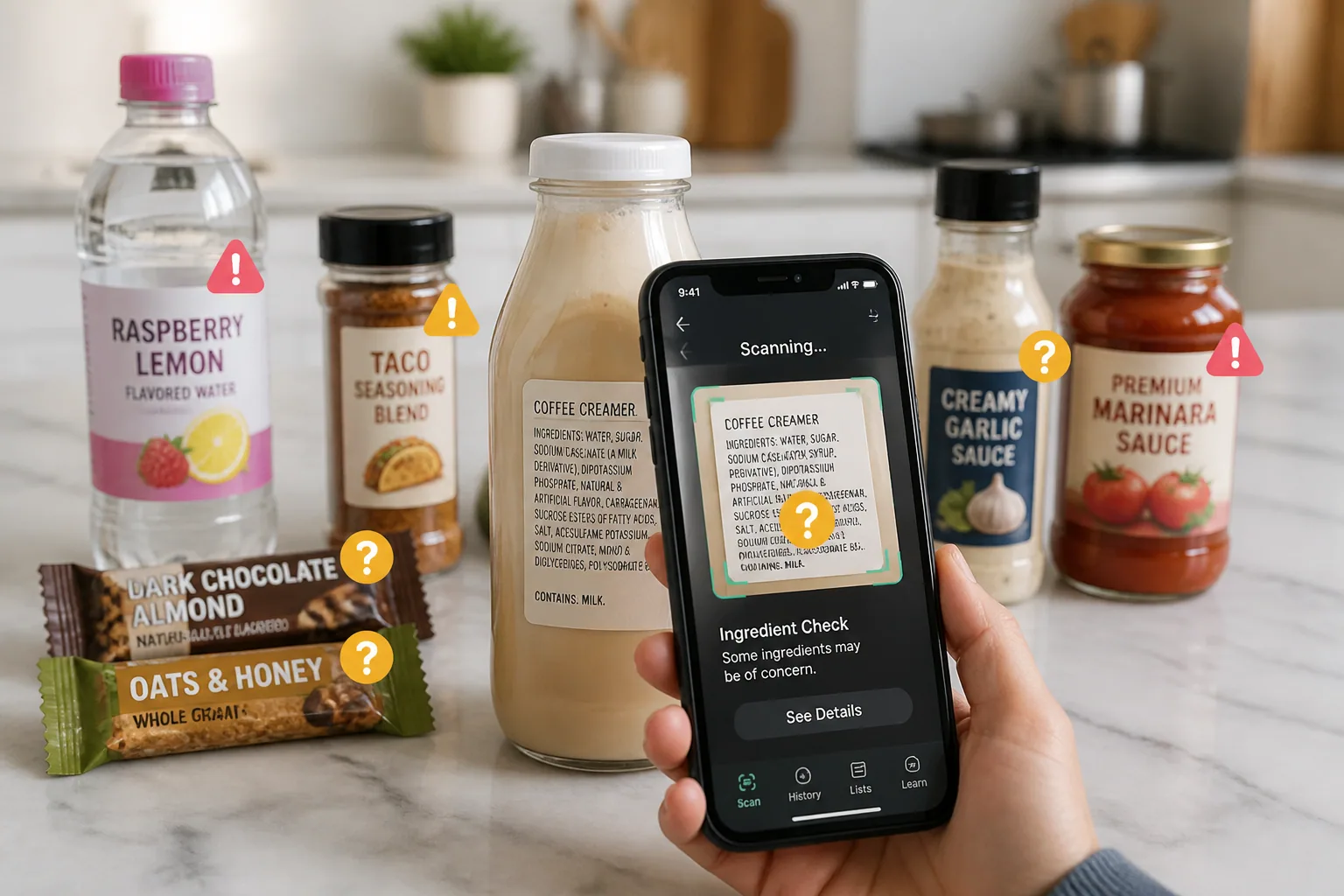
Digital tools can make label-checking much faster, especially when you are comparing several products in a store aisle. Barcode scanning apps can help you identify allergens quickly, flag traces, and reduce the time spent reading every label line by line. They are not a substitute for judgment, but they are a strong first filter.
One useful option is Bokha: Food Allergy Scanner App, which lets you scan a product barcode and discover its allergens in less than a second. It detects 13 allergens, traces, and additives, and it is designed to help people with food allergies and intolerances save time in the supermarket. You can learn more here: https://findthe.app/bokha
Brand allergen policies are another valuable tool. Many manufacturers publish allergen statements, facility information, or customer service contacts on their websites. If a product seems ambiguous, a quick check of the brand’s allergy page can clarify whether they use shared equipment, whether a formula has changed, or whether they have dedicated allergen controls in place.
The most effective approach is to combine technology with a habit of double-checking. Scan first, confirm second, and treat any inconsistency between the app, the package, and the brand site as a reason to pause.
Simple Habits for Staying Ahead of Surprise Allergen Exposure
A few simple habits can make a big difference. First, read the full ingredient list every time, even on products you have bought before. Second, check for formulation changes, because manufacturers do update recipes and production sites. Third, pay attention to precautionary allergen statements, especially when the product is a spice blend, sauce mix, or snack seasoning.
It also helps to be cautious in restaurants and bulk food settings. In one study, 22 percent of allergic reactions reported by customers were due to cross-contact from shared kitchens or serving utensils. That means the risk can come from the scoop, the cutting board, the fryer, or the tongs, not only from the recipe itself. When eating out, asking specific questions about preparation is often more useful than asking only whether an allergen is present in the dish. https://pmc.ncbi.nlm.nih.gov/articles/PMC6324195/
Finally, build a short personal routine that you repeat every time you shop or eat away from home. Check the label, verify the source, confirm the setting, and choose the simpler option if anything feels uncertain. Hidden allergen crossovers are common enough to deserve respect, but they are manageable when you combine awareness, smart swaps, and consistent checking habits.