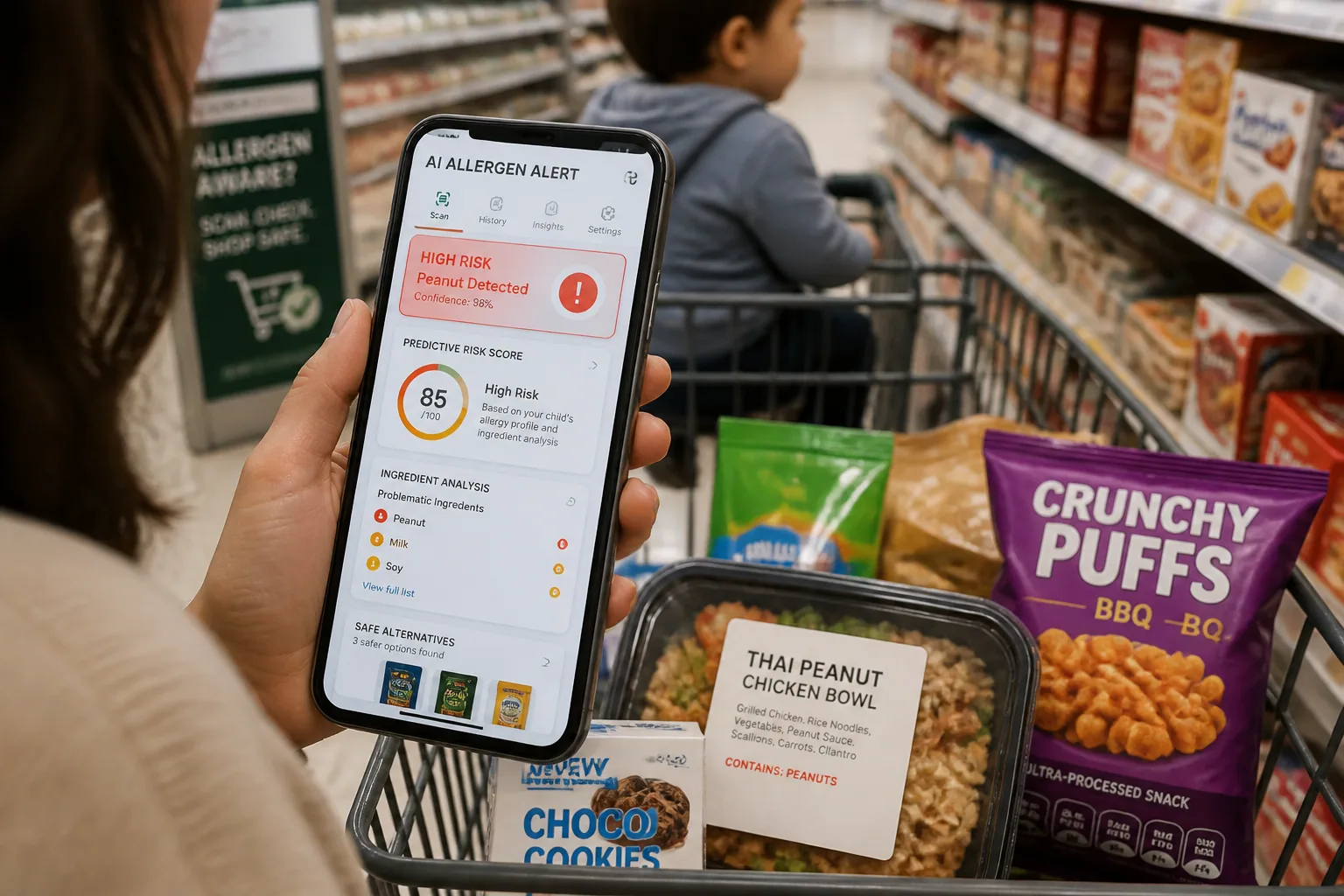
Smart Shopping Tech Beyond the Barcode: How AI Is Powering Predictive Allergen Warnings
Barcode scanners changed allergy shopping in a big way. For many families, they made the supermarket faster, less stressful, and a lot safer. But they still have a hard limit: they can only warn you after you have found a packaged product, scanned it, and matched it against a database. That works well for straightforward label checks, but it is not enough for the messy reality of food allergies. Restaurants change recipes. Fast-food orders are assembled by hand. Ingredient lists can be incomplete, vague, or updated without much notice. Cross-contact can happen long before a barcode is ever involved.
That is where artificial intelligence is starting to matter. The next wave of allergy tech is moving beyond simple barcode lookup and toward predictive warnings. Instead of only saying what is on the label, future systems may estimate risk from ingredient patterns, product processing level, menu structures, purchase history, and even known cross-reactivity. The result could be a much smarter safety net for people managing food allergies, intolerances, and multiple sensitivities.
Why Barcode Scanning Is No Longer Enough for Allergy Safety
Barcode scanning is useful because it gives an instant answer, but it is only as good as the data behind it. If a manufacturer changes a recipe, if a restaurant adds a new sauce, or if a product uses a confusing precautionary label, a scanner may not catch the nuance. It can tell you that a product contains milk or peanut, but it cannot reliably predict whether a new product is likely to share manufacturing equipment, whether an ingredient is a hidden source of soy, or whether a menu item has a high cross-contact risk in a busy kitchen.
This is especially important because real-world allergy risk is not only about obvious allergens. It is also about the processing environment, ingredient substitutions, and patterns that humans may overlook. A barcode-based app can help you avoid known problems, but it usually cannot forecast the unknown ones. Predictive AI tries to fill that gap.
How AI Is Improving Food Allergy Diagnostics and Prediction
Recent research shows that AI-driven allergen prediction methods, especially machine learning and deep learning models, are getting very strong results in sequence-based allergenicity assessment. One review found that these models can reach over 90% predictive accuracy in some settings, outperforming traditional similarity-based techniques. At the same time, the authors warn that dataset bias, weak interpretability, and poor generalization across different food matrices remain major limitations. Source: https://pubmed.ncbi.nlm.nih.gov/42262265/
That matters because allergen prediction is not just about identifying known allergens. It is about recognizing patterns in proteins, structures, and molecular features that may trigger immune responses. Tools such as AllerCatPro 2.0 use amino acid sequence data and predicted 3-D structure to assess allergenicity and possible cross-reactivity, drawing from nearly 5,000 known protein allergens and over 160 low-allergenic proteins. Source: https://pmc.ncbi.nlm.nih.gov/articles/PMC9252832/
Even more recently, Applm, or Allergen Prediction with Protein Language Models, uses the large xTrimoPGLM model to outperform seven state-of-the-art methods on difficult generalization tasks, including cases with no close homologs in the training set. That is important because real-world food innovation often introduces proteins and modifications that are not simple copies of known allergens. Source: https://arxiv.org/abs/2508.10541
In plain terms, AI is becoming better at answering a question that matters a lot for food safety: if a protein looks unfamiliar, how likely is it to behave like something already known to cause reactions?
From Ingredient Lists to Risk Forecasts: What Predictive Allergen Warnings Could Look Like
A predictive allergen warning does more than highlight ingredients. It would combine several signals at once. Ingredient databases could be matched against known allergen families. Product processing data could be used to estimate cross-contact risk. Purchase history could help an app learn which allergens matter to a specific user. Threshold science could then help separate low-risk from high-risk exposure scenarios instead of treating every trace the same way.
This is where the future looks very different from the current generation of scanners. Instead of a binary safe or unsafe label, a system could say something like: this product contains no declared peanut, but it has a high likelihood of hidden milk derivatives, and the manufacturing profile suggests meaningful cross-contact risk for users sensitive to trace amounts. That is more useful, because it reflects real-life decision making rather than simple ingredient matching.
Some tools are already moving in this direction. AllergyPred, for example, predicts both protein- and chemical-based allergens using multiple models that incorporate sequence similarity, structural modeling, epitope mapping, and physicochemical features. It also offers separate endpoints for food, plant, animal, and nut allergens, along with confidence scores. Source: https://pmc.ncbi.nlm.nih.gov/articles/PMC12230706/
How AI Could Flag Hidden Allergens in Fast Food, Restaurants, and Ultra-Processed Foods
Restaurants and fast-food chains are perfect examples of why predictive systems are needed. Menu descriptions are often incomplete, staff training varies, and shared fryers, utensils, or preparation surfaces create risk that is not visible to the customer. A predictive app could flag likely cross-contact hazards before an order is placed, especially when a menu item contains layered sauces, composite ingredients, or highly processed components.
That challenge is even bigger with ultra-processed foods. Machine learning can already classify ultra-processed foods from nutrient panels with roughly 80% to 85% accuracy in one recent study using Open Food Facts data, and gluten and milk appear particularly common in higher NOVA classes. Source: https://arxiv.org/abs/2512.17169
There is also broader evidence that AI can infer patterns in the food supply that matter to allergy risk. A NIH-led study used machine learning to build poly-metabolite scores from blood and urine data, showing that many metabolites are associated with ultra-processed food intake. Some of those compounds are formed when sugars react with proteins, which is one more reminder that processing can change the food environment in ways a simple label check may not capture. Source: https://www.nih.gov/news-events/nih-research-matters/measuring-ultra-processed-foods-diet
For allergy sufferers, the practical takeaway is simple: the more processed the food, the more useful a predictive layer becomes. Ingredients may be hidden, renamed, or embedded in a complex formulation, and AI may be able to spot the patterns humans miss.
Can Purchase History and Personal Profiles Make Allergy Apps Smarter?
Yes, and this may be one of the most promising directions. A personalized app could combine your safe-product history, your known allergens, your tolerance to traces, and your family preferences to tailor warnings more intelligently. If a user consistently avoids milk, egg, and mustard, the system should not waste attention on irrelevant alerts. It should prioritize what actually matters to that household.
This is especially important for caregivers managing children with multiple allergies. One-size-fits-all warning systems can become noisy very quickly. If an app learns that a family is most concerned about peanut cross-contact in snacks but less concerned about low-risk cosmetic trace warnings, it can reduce alert fatigue and improve trust. The core idea is not just detection, but personalization.
That said, personalization also creates a responsibility problem. If an app learns from past behavior, it can accidentally reinforce blind spots. A good system should support informed decisions, not quietly guess on behalf of the user. Personal profiles can make warnings smarter, but only if they are transparent about why a product was flagged.
The Role of Generative AI in Predicting Cross-Reactivity and Ingredient Risk
Generative AI is interesting here because it can go beyond static classification. Instead of only matching ingredients against known allergens, it can help summarize likely risks, explain why a component may matter, and surface patterns across large ingredient sets. In research settings, protein language models are becoming powerful at generalizing to unfamiliar cases, which is exactly what cross-reactivity analysis needs.
Cross-reactivity is one of the hardest problems in allergy prediction because the immune system does not always react to a food the way a simple ingredient list suggests. Proteins with similar structural features can trigger reactions even if the exact food has never been seen before. That is why tools like AllerCatPro 2.0 and Applm are so important: they reflect a shift from exact matching toward biological inference.
For consumers, generative AI could eventually explain risk in plain language. It might say that a sauce contains ingredients that are commonly associated with milk derivatives, that the product includes proteins with structural similarity to a known allergen family, or that the restaurant’s menu has a repeated pattern of shared equipment warnings. That kind of explanation is much easier to act on than a generic caution screen.
Where Apps Like Bokha Could Evolve Next
Apps like Bokha already solve a very practical problem: they scan barcodes and quickly reveal allergens, traces, and additives in less than a second. For many shoppers, that is already a huge time saver. But the next step is obvious. Barcode scanning can become one layer in a broader risk engine rather than the whole product.
In the future, a smart allergy app could scan a barcode, read a label with OCR, compare ingredients against allergen knowledge graphs, estimate trace exposure, and then combine that result with a user profile and product history. That would make it much more than a lookup tool. It would become a decision assistant.
If you are looking for a simple and fast current tool while that future develops, Bokha is one practical option to keep in your pocket: https://findthe.app/bokha
How Allergen Threshold Science Could Shape Future AI Warnings
Threshold science is central to making predictive warnings useful. Not every sensitive person reacts at the same level, and not every trace amount carries the same risk. A future AI system that ignores thresholds may over-warn and frustrate users, while one that understands approximate risk levels can be far more helpful.
This does not mean thresholds are simple. They vary by allergen, individual sensitivity, food matrix, and exposure route. But the principle is important: an AI warning should ideally reflect dose, context, and confidence, not just presence or absence. That is how the system avoids turning every shopping trip into a wall of red alerts.
The challenge is that threshold science still has gaps, and regulatory standards do not always align across countries or manufacturers. That means future systems will need to be careful about presenting estimates as estimates, not certainties. The best tools will explain uncertainty rather than hide it.
The Biggest Challenges: Data Quality, Transparency, and Trust
The main obstacles are not flashy. They are data quality, transparency, and trust. AI systems are only as good as the information they learn from, and food allergy data is often incomplete, inconsistent, or biased toward certain foods and populations. The 2026 review by Li et al. highlights dataset bias and limited interpretability as major concerns, especially when models are asked to generalize beyond the training set. Source: https://pubmed.ncbi.nlm.nih.gov/42262265/
In the real world, labeling standards are also inconsistent. Terms like may contain or processed in a facility are not always standardized, and that makes it hard for any algorithm to translate them into a reliable risk score. If the underlying labels are vague, the app will be vague too.
Restaurant data is even harder. A 2025 briefing from Toronto found that only 16% of 1,000 sampled non-chain restaurants had allergen statements on their online menus, and only 10% used allergen symbols. That is a serious visibility problem for any predictive tool. Source: https://iafns.org/wp-content/uploads/2025/06/IAFNS-Food-Safety-Science-Briefs-May-2025.pdf
And beyond the data, there is the human issue of trust. If an app gives too many warnings, people ignore it. If it gives too few, people lose confidence immediately. Predictive allergy tech must earn trust carefully, with explainable logic and conservative defaults.
False Positives, False Negatives, and the Risk of Overreliance
Every predictive system has failure modes. A false positive can create unnecessary fear, wasted money, or a reduced diet. A false negative can be much more serious, because it may give someone a false sense of security. In allergy safety, both errors matter, but they do not matter equally.
That is why predictive apps should be treated as decision support tools, not replacements for medical advice, label reading, or direct communication with restaurants and manufacturers. Even the most advanced models cannot fully understand hidden kitchen practices, undocumented recipe changes, or the full variability of human immune response.
The safest mindset is to use AI as one more layer of evidence. If it confirms a product is low risk, good. If it warns of uncertainty, even better. But the final call still needs human judgment.
What Families and Caregivers Should Look for in Next-Generation Allergy Tech
For families and caregivers, the best allergy technology should be fast, understandable, and conservative. It should explain why something was flagged, show which allergens were detected or inferred, and make it clear when the evidence is weak. It should also update often, because food data changes constantly.
Look for tools that combine more than one method: barcode scanning, label OCR, ingredient recognition, restaurant menu analysis, and some form of confidence scoring. More importantly, look for systems that let you set your own risk preferences. A child with severe anaphylaxis risk needs different warnings from an adult with a mild intolerance.
Point-of-use sensors may also keep an important role, especially for specific allergens. For example, gluten sensors like Nima have been used to detect gluten residues at threshold levels in restaurant foods, showing that physical testing can complement software-based prediction. Digital and sensor-based tools are likely to work best together.
The Future of Predictive Food Safety: Helpful Assistant or Risky Guess?
The most realistic answer is that it can be both, depending on how it is built and used. Predictive AI has real promise. It is already helping researchers model allergenicity, detect cross-reactivity, and identify hidden patterns in processed foods. It may soon help consumers anticipate risks before they ever hold a product in their hand.
But that future only works if the systems are transparent about uncertainty, careful with user trust, and grounded in good data. Without that, they could become just another source of confusing alerts. With it, they could become one of the most useful safety tools in modern allergy management.
So yes, the barcode scanner still matters. But it is likely becoming the starting point, not the destination. The next generation of allergy tech will not just read labels. It will try to understand risk.