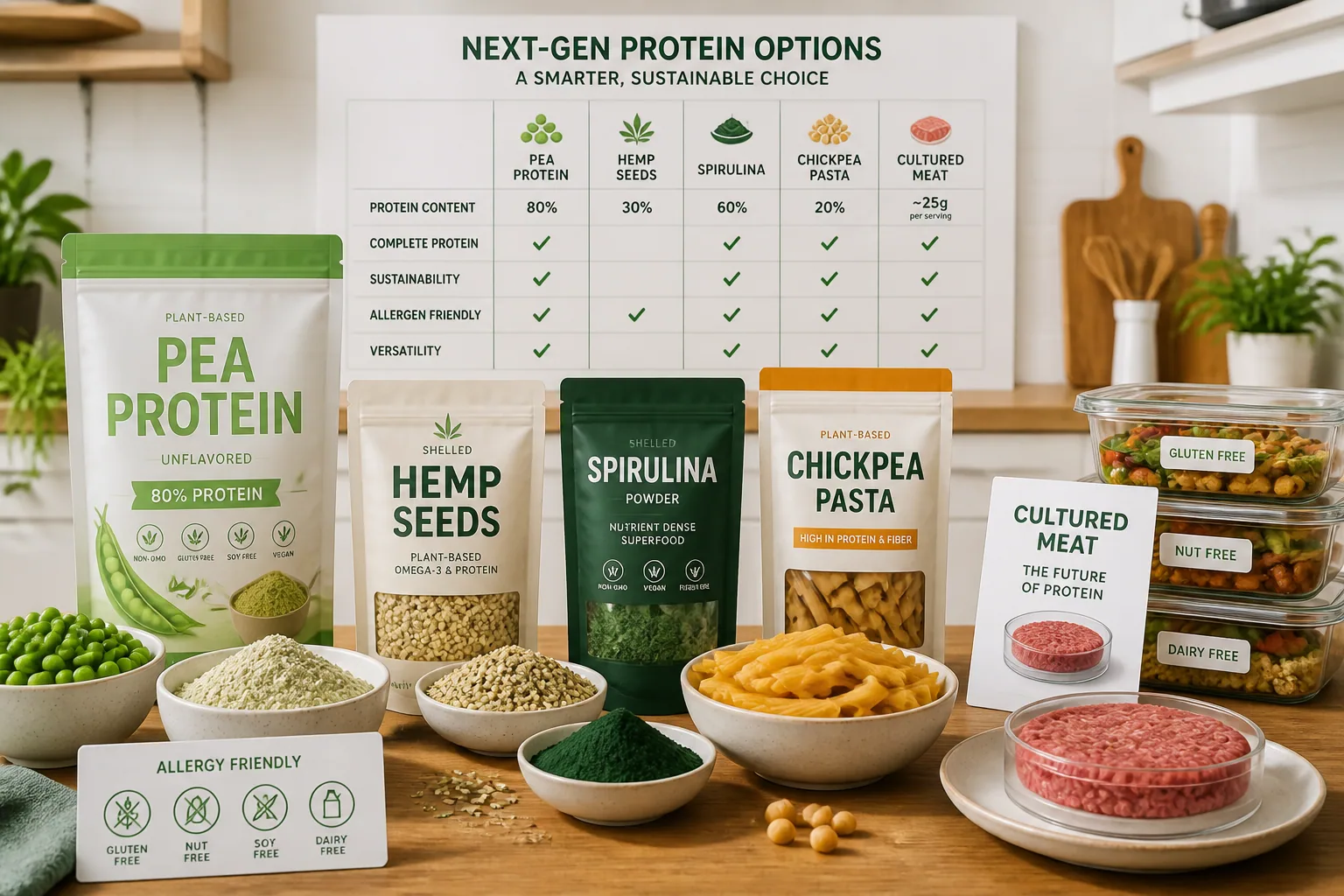
Smart Protein Alternatives: Allergen-Free Options Beyond Meat and Dairy
For anyone avoiding milk, eggs, soy, shellfish, or other common triggers, protein planning can feel harder than it should. Many traditional high-protein foods are also among the most frequent allergens, which makes everyday choices like breakfast shakes, snack bars, and ready meals more complicated than they used to be. At the same time, the market for alternative proteins is expanding quickly, and that gives allergy-conscious shoppers more options than ever before.
The challenge is that not every protein alternative is equally useful. Some are excellent nutritionally but can be hard to digest, expensive, or awkward in flavor. Others are convenient but have cross-reactivity concerns, manufacturing contamination risks, or vague label claims that make them difficult to trust. In this guide, we will look at the smartest allergen-conscious protein options beyond meat and dairy, including pea, hemp, algae, insect-derived proteins, and cultured meat, then compare how they perform in real life for taste, safety, cost, and access.
Why Allergen-Free Protein Matters More Than Ever
Allergen-free protein is not just a niche dietary preference. For many people, it is a daily health requirement. Food allergies and intolerances can affect school lunches, work snacks, restaurant meals, sports nutrition, and even the simplest grocery trip. When protein staples like whey, casein, egg, soy, or shellfish are off the table, the number of safe, convenient options can shrink fast.
That matters because protein is not optional. It supports muscle maintenance, immune function, enzyme production, hormone signaling, and satiety. If someone removes a major protein source for safety reasons, they need replacements that are not only free from the trigger ingredient but also nutritionally solid enough to sustain long-term use. The best alternatives should bring enough amino acids, reasonable digestibility, and practical versatility.
Which Allergens People Are Trying to Avoid and Why
The most common reasons people turn to alternative proteins include allergies to milk, eggs, soy, peanuts, tree nuts, wheat, fish, and shellfish, along with intolerances such as lactose sensitivity or gluten avoidance. In the United States, the Big 9 allergens are milk, eggs, fish, shellfish, tree nuts, peanuts, wheat, soy, and sesame, and any of those must be declared on labels when present. That makes label literacy a crucial survival skill for anyone managing food reactions.
Some allergies are straightforward, while others are more complicated because of cross-reactivity. For example, pea protein is in the legume family, so people with peanut or soy allergy may occasionally react to it, even though pea protein is generally considered low allergenicity. Insect proteins can also pose risk because of shared proteins such as tropomyosin, which may overlap with crustacean or dust mite sensitization. In other words, a product can be free of one allergen and still be unsafe for someone with a different but related sensitivity.
What Makes a Protein Alternative Nutritionally Smart
A smart protein alternative is more than just a high number on the nutrition panel. The real questions are: does it contain all essential amino acids, how well is it digested, what micronutrients does it bring, and how easy is it to use in everyday meals? Protein quality depends on more than grams alone.
Amino acid profile matters because the body needs all nine essential amino acids from food. Digestibility matters because a protein can look strong on paper but deliver less usable nutrition if it is poorly absorbed or bound up in fiber, processing, or cell walls. Micronutrients matter because some alternatives contribute iron, magnesium, zinc, omega-3s, or B vitamins, while others are relatively nutrient narrow. And finally, taste and texture matter because the best protein is the one you will actually eat consistently.
Research on pea protein shows this clearly. Pea protein contains all nine essential amino acids, so it is technically a complete protein, but it is relatively low in sulfur-containing amino acids like methionine and cysteine, and it is modest in tryptophan. That means its efficiency scores such as DIAAS or PDCAAS are lower than animal proteins like whey. At the same time, wet-fractionated pea protein isolates can exceed FAO/WHO daily essential amino acid recommendations, while dry-fractionated versions may lose some sulfur amino acids during processing. Sources: https://biologyinsights.com/is-pea-protein-a-complete-protein-what-to-know/ and https://pmc.ncbi.nlm.nih.gov/articles/PMC10648759/
Pea Protein: The Mainstream Allergy-Friendly Standout
Pea protein has become the mainstream choice for people who want a dairy-free, egg-free, and often soy-free protein source that performs well in shakes, bars, meat alternatives, and baked goods. It is popular because it is relatively neutral in flavor, easy to formulate, and widely available in powder and packaged food form. For many shoppers, it is the first alternative protein they encounter that feels close to an everyday staple rather than a specialty ingredient.
Nutritionally, pea protein is a strong all-rounder. It is not perfect, but it is useful. Because it contains all essential amino acids, it can contribute meaningfully to daily protein intake. Its weak spots are the sulfur amino acids and, to a lesser extent, tryptophan. That means it is often even better when paired with other plant proteins, grains, or legumes over the course of the day. In practical terms, pea protein works best as part of a balanced diet rather than as a one-ingredient miracle.
The main safety caveat is legume cross-reactivity. Most people with peanut or soy allergy do not automatically react to pea protein, but some do. This is why a product marketed as allergy-friendly should still be checked carefully by people with a history of legume allergies. If you are unsure, it is wise to test any new product with caution and, when appropriate, with medical guidance.
Hemp Protein: Fiber, Minerals, and Everyday Uses
Hemp protein offers a different profile from pea. It is less focused on pure protein density and more of a whole-food style ingredient that brings protein, fiber, and minerals together. It is made from hemp seeds, not from the psychoactive parts of the plant, so it is widely used in nutrition powders, cereals, snack mixes, and baking blends.
Hemp protein is nearly complete because it contains all nine essential amino acids, though lysine is usually the first limiting amino acid. Much of its protein comes from edestin and albumin, both known for good digestibility. Research suggests that digestibility for defatted hemp hearts and hemp protein concentrates ranges roughly from 88% to 95% in various tests, while PDCAAS values are moderate, about 0.60 to 0.75, mainly because of lysine limitations and processing effects. Sources: https://www.healthline.com/nutrition/hemp-protein-powder and https://pmc.ncbi.nlm.nih.gov/articles/PMC10630821/
That makes hemp especially attractive for people who want a more whole-food, less ultra-processed protein option. It is useful in oatmeal, smoothies, yogurt alternatives, and homemade energy balls. The flavor is nutty and earthy, which some people enjoy and others need to balance with fruit, cocoa, cinnamon, or vanilla. Hemp also adds fiber and minerals, which can be valuable if your diet is limited by multiple allergies and you need more from each serving.
Algae and Microalgae Proteins: Tiny Sources, Big Potential
Algae is one of the most interesting emerging protein categories because it can be highly nutrient dense and less dependent on traditional agricultural systems. Microalgae and macroalgae can provide proteins with favorable essential amino acid profiles, often meeting or exceeding FAO guidelines, particularly for branched-chain amino acids such as leucine, isoleucine, and valine. That makes them appealing for athletes and for anyone trying to maintain lean mass with limited allergen exposure.
The biggest issue is not protein quality on paper. It is bioavailability. Algal proteins can be hard to digest unless the cell walls are disrupted through mechanical, enzymatic, or other processing methods. Digestibility varies widely by species and processing method, with some seaweeds testing much lower than others. For example, in vitro digestibility can range from around 40% to 90%, with red algae such as Palmaria palmata performing better than some brown algae like Undaria pinnatifida. Sources: https://pmc.ncbi.nlm.nih.gov/articles/PMC10613476/ and https://pmc.ncbi.nlm.nih.gov/articles/PMC12985022/
This means algae proteins are promising, but not always easy. They may appear in powders, bars, specialty smoothies, and health products rather than in mainstream weeknight meals. They can also carry a strong marine flavor, depending on the format. If you like the idea of a compact, nutrient-rich protein source and do not mind a premium price tag, algae could be worth exploring. If you need a low-cost household staple, it may still be too early for everyday dependence.
Insect-Derived Protein: Nutrition Benefits and Allergy Caveats
Insect protein is one of the most efficient and environmentally interesting novel proteins, but it is also one of the most complicated for allergy-conscious consumers. Insects can offer high-quality protein and useful micronutrients, and they are being developed in powders, flours, snacks, and blended products in some markets. For flexible eaters who are not avoiding animal-derived foods, the idea can be appealing from a sustainability perspective.
The concern is allergy risk. EFSA notes that insect proteins can cross-react with proteins associated with crustaceans and dust mites, especially tropomyosin and related compounds. That makes insect protein a poor fit for anyone with shellfish allergy or related sensitivities. In the EU, insect-based foods are treated as Novel Foods under Regulation (EU) 2015/2283 and must undergo EFSA evaluation before authorization. Sources: https://www.efsa.europa.eu/en/efsajournal/pub/e170907 and https://www.europarl.europa.eu/doceo/document/E-10-2025-000663_EN.html
There are also practical barriers. Insect protein still faces consumer hesitation, higher costs, and uneven availability. In some regions, the products are mostly experimental or limited to specialty shops. For people trying to avoid allergens, the safety question often outweighs the novelty. In other words, insect protein may be nutritionally interesting, but it is not automatically a safer choice.
Cultured Meat and Novel Proteins: What’s Emerging Now
Cultured meat, sometimes called cell-cultivated or cultivated meat, is one of the most discussed emerging proteins because it aims to deliver familiar animal protein without traditional livestock farming. For people avoiding dairy or egg allergens, it is not a direct replacement, but it could eventually become another protein option in the broader market. The key issue is that being novel does not automatically mean being hypoallergenic.
A 2026 ACS report found that cultured beef differed from conventional steak in allergy-related hazards. It contained fewer traditional allergen proteins overall, but it also triggered strong IgE binding in some alpha-gal-sensitive individuals. That suggests cultured cells may introduce altered proteins or glycosylation patterns that change the allergy picture rather than simplifying it. Source: https://www.acs.org/pressroom/presspacs/2026/february/cultured-beef-differs-from-conventional-beef-in-allergy-related-hazards.html
In the United States, FDA oversees cell collection and growth, while USDA-FSIS handles processing, packaging, and labeling for cultivated meat products. Labels must clearly distinguish the product from conventional meat, and any allergens introduced through growth media or inputs must be disclosed. That means cultured meat is still governed by conventional allergen logic, even if the technology is brand new. Source: https://www.fsis.usda.gov/inspection/compliance-guidance/labeling/labeling-policies/human-food-made-cultured-animal-cells
Comparing Protein Quality, Taste, Cost, and Convenience
If you compare these alternatives side by side, the best choice depends on your priorities. Pea protein is usually the most practical all-purpose option because it is accessible, relatively affordable, and easy to blend into many foods. Hemp protein is less refined and often better for people who want fiber and a more whole-food profile, but it can be grittier and lower in protein density. Algae proteins can be nutritionally impressive, but they are often more expensive and less familiar. Insect proteins may be efficient and nutrient-rich, yet they come with strong allergy concerns and limited mainstream acceptance. Cultured meat is still emerging and, for most shoppers, not yet a daily staple.
Taste also matters more than people expect. A technically excellent protein is not useful if it makes every smoothie chalky or every baked good dry. Pea protein can be formulated well but sometimes has a “beany” aftertaste. Hemp is earthy and nutty. Algae can taste marine or grassy. Insect flour may be neutral in blended products but hard to love on its own. Cultured meat may mimic conventional meat closely, but availability and price remain obstacles.
Convenience and cost often decide what actually gets purchased. The mainstream shelf still favors pea protein and, in some settings, hemp blends. Algae and insect proteins remain more niche, while cultivated meat is just beginning to appear in select markets. For most households, the smartest strategy is usually not to chase the most futuristic protein, but to choose the one that fits the allergy profile, budget, and meal routine you can repeat every week.
Cross-Reactivity, Contamination, and Other Safety Concerns
Food safety for allergen-conscious shoppers goes beyond ingredient lists. Cross-reactivity is one issue, but contamination is another. A product can be made from a non-trigger protein and still pick up traces of milk, egg, soy, wheat, or shellfish during processing, transport, or shared equipment use. That is why some people react to products labeled as “free from” even when the main ingredient should have been safe.
Novel protein sources can also carry non-allergen hazards. A review on safety of novel protein sources noted risks such as heavy metals, mycotoxins, pesticide residues, and microbiological hazards depending on the substrate, rearing, and processing conditions. This matters for algae, insects, duckweed, and similar ingredients because the production system itself affects the final food’s safety profile. Source: https://pubmed.ncbi.nlm.nih.gov/33412718/
For consumers, the takeaway is simple: ingredient source is important, but manufacturing control is just as important. If you have a severe allergy, prioritize brands with strong allergen controls, transparent labeling, and clear facility practices. If possible, contact the manufacturer when you are dealing with a high-risk product or one that is made in a shared line.
How Novel Proteins Are Regulated and Labeled
Regulation varies by market, but the direction is consistent: novel proteins are under increasing scrutiny. In the EU, insects fall under Novel Food rules and require safety evaluation before market authorization. In the U.S., cultivated meat has a shared oversight model between FDA and USDA-FSIS, and labels must be clear enough not to mislead consumers about what they are buying. That transparency is especially important when the product is trying to look like a familiar food while using a very different process.
For allergen-conscious shoppers, label clarity is not a luxury. It is the difference between a safe meal and a reaction. When labels mention “cell-cultivated,” “fermented,” “protein isolate,” or “plant-based,” the real question is what else is inside the formula and whether the supply chain introduces any hidden triggers. Under U.S. law, the Big 9 allergens must be declared when present, including if they come from growth media or other inputs used in making novel foods. Source: https://legalclarity.org/does-lab-grown-meat-have-to-be-labeled/
How to Read Labels and Spot Hidden Allergen Ingredients
The fastest way to protect yourself is to read the full ingredient panel and the allergen statement, not just the front-of-pack claims. Phrases like “vegan,” “allergen-free,” or “high-protein” can be useful, but they are not enough on their own. A vegan product may still contain pea protein, coconut, or sesame. A high-protein product may use milk-derived additives or be processed on shared lines. An allergen-free claim may only refer to one or two allergens, not all of them.
Watch for hidden names and technical ingredients that may signal an allergen source. Protein isolates, concentrates, hydrolysates, flavor systems, enzyme blends, lecithin, natural flavors, and fortifying ingredients can all matter. If you react to legumes, look carefully at pea, lentil, chickpea, soybean, and bean-derived ingredients. If you react to dairy, watch for casein, whey, milk solids, lactose, butterfat, and curds. If you react to shellfish, be cautious with insect-derived products and foods that mention crustacean-related ingredients or sourcing.
This is where practical tools help. A scanner app like Bokha: Food Allergy Scanner App can make the process much faster in the supermarket by scanning barcodes and identifying allergens, traces, and additives in seconds. You can learn more here: https://findthe.app/bokha
Best Uses for Plant-Based, Omnivorous, and Flexible Diets
For plant-based eaters, pea and hemp are usually the easiest starting points because they fit vegan diets and are relatively easy to source. They work well in shakes, breakfasts, baked snacks, soups, and meatless meal prep. Algae can be a more specialized add-on for those seeking a more nutrient-dense, functional ingredient. Insect protein is generally not plant-based, so it is only relevant for omnivores and some flexitarians.
For omnivores trying to reduce allergen exposure without abandoning animal foods, cultured meat may eventually offer a more familiar texture and cooking behavior than plant proteins, but it is still a developing category. In the meantime, blended strategies often work best. That might mean using pea protein at breakfast, hemp in snacks, and traditional animal protein at meals that do not trigger your specific allergies. There is no rule that says every meal has to come from the same protein source.
Easy Meal Ideas Using Allergen-Conscious Protein Swaps
You can build a full day of eating around allergen-conscious protein without feeling restricted. For breakfast, try a smoothie with pea protein, frozen berries, oats, and a seed butter if tolerated. Or make overnight oats with hemp protein mixed into chia, cinnamon, and plant milk. For lunch, use a pea-protein-based spread in a wrap with vegetables and avocado, or add hemp hearts to a grain bowl for extra texture and minerals.
For dinner, think about protein as an ingredient rather than a centerpiece. Hemp can be stirred into pesto-style sauces, blended into veggie burgers, or sprinkled over roasted vegetables. Algae-based ingredients can appear in specialty noodles, powders, or nutrition blends. If you eat meat, a carefully labeled cultivated option may eventually fit into the same place on the plate as conventional chicken or beef, but for now it is more of a watch-this-space category than a household staple.
For snacks, protein bars, roasted seed mixes, allergen-aware shakes, and homemade energy bites can all work well. The smartest routine is often the simplest one: choose one safe protein at breakfast, one at lunch, and one at dinner, then keep two or three emergency snacks on hand for travel or busy days.
How to Choose the Right Alternative for Your Needs
The right protein alternative depends on what you are avoiding, what you need nutritionally, and how much friction you can tolerate in daily life. If you want the most practical mainstream option, pea protein is usually the best place to start, especially if you do not have legume cross-reactivity. If you want a more whole-food style ingredient with fiber and minerals, hemp is a strong choice. If you are exploring high-potential niche ingredients and do not mind variability, algae may be worth a look. If you are allergic to shellfish or dust mites, insect protein is probably not the right option. If you follow food innovation closely and want a meat-like product with new regulatory safeguards, cultivated meat is emerging, but it still needs careful label review.
The bigger lesson is that “allergen-free” should never be read as a blanket promise. It is a starting point for investigation, not the final answer. The best approach is to combine a strong protein source with careful label reading, awareness of cross-reactivity, and a few reliable backup foods that you know are safe. That way, you can build meals that are both nutritionally smart and realistically livable.