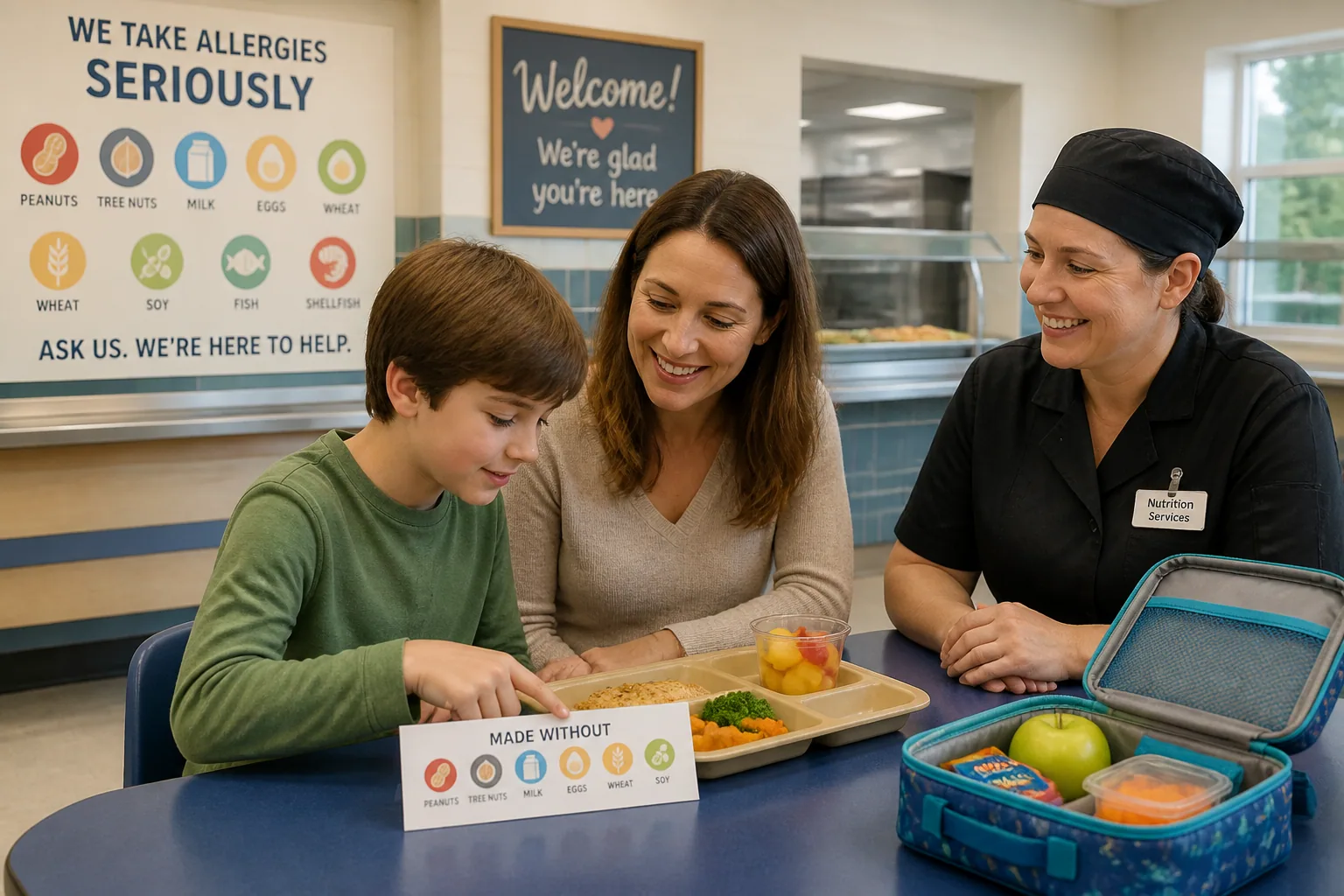
Safe School Lunches: How Students with Food Allergies Can Navigate Cafeteria Life Confidently
School lunch should be a normal part of the day, but for students with food allergies, it can feel like a constant risk assessment. Every tray, label, shared spoon, and table surface can matter. For families, that means deciding when a cafeteria meal is truly safe enough and when packing lunch is still the better choice. For schools, it means building systems that reduce guesswork and prevent accidental exposure. The stakes are real: about 8% of U.S. children, or roughly 1 in 13, have at least one diagnosed food allergy, and more than 15% of school-aged children with food allergies have had an allergic reaction while at school. Sources: CDC and FoodAllergy.org https://www.cdc.gov/school-health-conditions/food-allergies/index.html and https://www.foodallergy.org/resources/facts-and-statistics
That risk is not only medical. It is also emotional. Students who have to question every meal can feel different from their peers, and that pressure can grow when the school cafeteria is unclear, inconsistent, or dismissive. The good news is that safer school lunch routines are possible. With better communication, clearer ingredient information, and stronger staff training, students with allergies can participate more confidently in school life.
Why School Lunch Feels Risky for Students With Food Allergies
Food allergies make the cafeteria feel unpredictable because so many variables are outside a student’s control. A meal may be safe one day and less clear the next if ingredients change, if a food is prepared differently, or if a shared serving area introduces cross-contact. Even when schools mean well, a lack of transparency can make families hesitate. This hesitation is common, not exaggerated. In 2024, an estimated 5.3% of children aged 0 to 17 were diagnosed with a food allergy, according to the National Center for Health Statistics, showing that food allergy management is a mainstream school-health issue, not a rare exception. Source: https://www.cdc.gov/nchs/products/databriefs/db546.htm
The cafeteria risk becomes even more serious when schools rely on vague menu language. Terms like sauce, seasoning, dressing, batter, or spice blend can hide allergens or cross-contact concerns. For families, that means a menu may look simple on the surface while still offering little real safety information. Students with celiac disease or multiple food allergies often become skilled at scanning menus for clues, but even then, uncertainty can be exhausting.
Pack or Buy? Deciding When School Meals Are Safe Enough
There is no universal answer to whether a student should pack lunch or buy school food. The decision depends on the specific allergy, the school’s procedures, the student’s age and independence, and the quality of communication with the food service team. For some families, school meals are a workable option. For others, packing lunch is still the most dependable way to reduce risk and stress.
A helpful way to think about it is to ask a few practical questions. Does the school publish ingredient lists that are detailed enough to evaluate risk? Can the cafeteria explain how food is prepared, served, and kept separate from allergens? Are substitutions available without confusion or delay? Is there a clear process for handling special meals, and does the student know what to do if a menu item changes unexpectedly? If the answers are inconsistent, packing lunch may be the safer and calmer choice for now.
For students with celiac disease, the challenge can be even more pronounced. In the CeliacKIDS study, only about 12% of students with celiac disease said their school offered gluten-free food options, and 78% brought their own gluten-free food to school. That tells us something important: even when schools are trying to be inclusive, many families still feel the safest option is to control the food themselves. Source: https://pmc.ncbi.nlm.nih.gov/articles/PMC12078044/
When families do consider school meals, trust matters just as much as availability. In a Boston Children’s Hospital survey, more than half of children with celiac disease did not participate in school lunch programs because caregivers were concerned about safe gluten-free preparation, especially cross-contact. About 25% of parents reported having not very much or no trust at all in the cafeteria’s ability to prevent cross-contact with gluten. Source: https://pmc.ncbi.nlm.nih.gov/articles/PMC11600365/
How to Read School Menus and Spot Hidden or Vague Allergens
Menu reading is one of the most valuable skills for families managing school food allergies. The goal is not only to identify obvious allergens like milk, egg, peanut, or wheat. It is also to notice where the menu is incomplete. If a school meal says chicken strips, gravy, pasta salad, or breakfast bake without more detail, that may be a sign to ask follow-up questions before assuming the item is safe.
Watch for ingredients that often carry hidden allergen risk. Cheese sauces may contain milk or wheat. Marinades and seasonings can include soy, mustard, celery, or sulphites. Gluten-free labels still deserve a second look, because cross-contact can happen during preparation, storage, or serving. Students with multiple allergies need especially careful review, because a meal that avoids one allergen may still be unsafe for another.
It helps to request menu information in a consistent format, ideally with ingredient lists and clear allergen statements. If a school cannot provide that level of detail, the uncertainty itself is useful information. The issue is not just what is listed, but what is missing. A vague menu often signals a system that is not yet built for reliable allergen management.
Families who want to verify packaged foods can also use tools that speed up label checking. For example, Bokha: Food Allergy Scanner App can scan product barcodes and identify allergens in less than a second, including gluten, peanut, egg, soy, tree nuts, wheat, and more. For school-age children who bring packaged snacks or lunch components, that kind of quick check can reduce stress at home and on busy mornings. You can learn more here: https://findthe.app/bokha
Talking With Cafeteria and Nutrition Staff the Right Way
Good communication with cafeteria staff should feel practical, respectful, and specific. The most useful conversations are not vague requests like “please be careful.” Instead, families should ask about procedures: how ingredients are verified, how meals are separated, who is trained on food allergy protocols, and what happens if a substitution is made at the last minute.
It can help to introduce the student’s needs early, before the first day of school or at the start of a new semester. Share the exact allergens, the severity of the reaction, and whether cross-contact is a concern. If the student has a formal accommodation plan, such as a 504 Plan or IEP, bring that into the discussion so everyone understands the school’s responsibility. In the Boston Children’s Hospital study, approximately one in six students with celiac disease did not have a formal accommodations plan, even though federal law requires schools to accommodate medically necessary dietary needs at no extra cost. Source: https://pmc.ncbi.nlm.nih.gov/articles/PMC11600365/
For staff, the key is consistency. A parent should not need to repeat the same safety explanation to every teacher, aide, and cafeteria worker. Schools can reduce confusion by documenting safe foods, approved substitutions, emergency steps, and contact people for menu questions. Clear notes prevent small misunderstandings from becoming safety incidents.
The Extra Challenge of Gluten-Free and Multiple Allergen Needs
Students with gluten-free needs face a distinct set of barriers at school because the issue is not only ingredient avoidance. It is also cross-contact prevention, menu variety, and social inclusion. A strict gluten-free diet is currently the only treatment for celiac disease, so the consequences of a mistake are not minor. School food quality, hand hygiene, and staff support all affect adherence and day-to-day quality of life. Source: https://pmc.ncbi.nlm.nih.gov/articles/PMC12078044/
The problem is compounded for students who need to avoid several allergens at once. A school might offer a gluten-free item, but it may not also be free from dairy, soy, egg, or tree nuts. That leaves families with a narrow set of options and often very little confidence in what is actually safe. In the Boston Children’s Hospital survey, 45% of parents described gluten-free food as having very limited variety or not being very appealing, and about 27% said the options were not appealing for their child. Even when food is technically safe, it still has to be realistic enough for students to eat it. Source: https://pmc.ncbi.nlm.nih.gov/articles/PMC11600365/
This is why multiple-allergen support needs to be broader than a single special tray. Schools should think about ingredient transparency, batch preparation, storage practices, and whether the student can participate without feeling singled out. Food safety and dignity need to move together.
Why Some Families Avoid Free School Lunch Programs
Many families do not avoid school lunch programs because they are unwilling to participate. They avoid them because the risk-reward balance does not feel fair. If a program offers limited gluten-free choices, poor labeling, or inconsistent preparation, families often conclude that packing lunch is more reliable than trying to navigate a system they do not trust.
That decision can also be shaped by perception. Some caregivers see free school meals as nutritionally limited or not appealing, especially when the special diet version is even less varied than the standard menu. In the Boston Children’s Hospital survey, concerns about limited variety, appeal, and cross-contact all contributed to lower participation in school lunch programs. Source: https://pmc.ncbi.nlm.nih.gov/articles/PMC11600365/
The result is a fairness issue. If a school meal program exists, but only some students can safely and comfortably use it, then access is not truly equal. Better transparency and better procedures can help close that gap, but until then many families will continue choosing the path that feels most predictable.
The Emotional Toll: Anxiety, Exclusion, and Bullying at Mealtime
Food allergy management at school is never only about ingredients. It is also about how a student feels while eating with peers. Some children become anxious before lunch even starts, worrying that they will accidentally choose the wrong item or be pressured to share food. Others feel excluded when they must sit separately, bring different food, or decline class treats that everyone else enjoys.
Bullying risk should not be ignored either. Children can be teased for bringing special meals, asking questions, or refusing food. When classmates do not understand allergies, the student with dietary restrictions may be seen as difficult rather than protected. That social pressure can make students less likely to advocate for themselves, which increases risk.
Schools can help by normalizing food allergy needs, not treating them as a source of embarrassment. That means age-appropriate education for classmates, clear adult supervision, and cafeteria routines that make safety feel routine rather than exceptional. A student should never feel punished for being careful.
What Schools Can Do Better: Training, Labels, and Safer Systems
Safer school lunch systems are built, not improvised. The CDC’s Voluntary Guidelines for Managing Food Allergies in Schools and ECE programs recommend procedures to prevent cross-contact, training for relevant staff, proper cleaning and sanitizing of shared surfaces, and food-free or allergen-safe zones in settings such as cafeterias, kitchens, and classrooms. Source: https://www.cdc.gov/school-health-conditions/media/pdfs/20_316712-a_fa_guide_508tag.pdf
That guidance points to a practical truth: safety improves when the whole environment is designed for it. Schools can post clear allergen labels, keep ingredient lists updated, train food service and classroom staff together, and establish routines for safe serving and cleaning. If a school has separate prep tools, clearly identified safe storage, and a consistent response plan, families are much more likely to trust the system.
Training matters because knowledge gaps create hidden risk. A worker may know a meal is gluten-free but not realize that a shared utensil, crumb tray, or cutting board can still cause cross-contact. Better systems reduce the chance that one well-meaning mistake becomes a medical emergency.
A Practical Allergy-Safe Lunch Checklist for Families and Staff
Before the school year starts, families can use a simple checklist to evaluate whether lunch is safe enough. Ask for a current menu with full ingredient details. Confirm whether the cafeteria can prevent cross-contact during preparation and serving. Find out who prepares special meals, how they are labeled, and where they are stored. Make sure the student knows what to do if food looks different from what was planned. And if there is any uncertainty, do not assume safety just because a dish is on the menu.
For staff, the checklist is just as important. Review allergy lists regularly, document accommodations, train substitutes and aides, and communicate any menu change before lunchtime, not after. Keep cleaning procedures consistent and visible. If a school serves students with celiac disease, make gluten-free options more than a token offering. They should be dependable, appealing, and prepared with cross-contact prevention in mind.
The simplest test is this: can a student eat lunch without needing to guess, worry, or defend their needs every day? If the answer is no, the system still needs work.
Building a Cafeteria Culture Where Every Student Feels Safe
A safe cafeteria is not just one that avoids allergens. It is one where students can participate without fear, where parents feel informed instead of left in the dark, and where staff understand that food safety and student dignity belong together. That culture takes planning, but it is absolutely achievable.
When schools improve labeling, train staff, reduce cross-contact, and communicate clearly, they do more than prevent reactions. They reduce anxiety, improve trust, and help students with food allergies feel like full members of the school community. That is what school lunch should be: nourishing, inclusive, and safe enough to stop being a daily source of stress.