Safe Levels, Not Just Avoidance: How Food Allergen Thresholds Can Change Daily Decisions
For a long time, food allergy management has been framed as a simple rule: avoid the allergen completely. That advice is still important, but it is not the whole story anymore. In real life, people with food allergies are constantly making choices in situations that are not black and white. A label says “may contain.” A product lists “trace amounts.” A factory uses shared equipment. A restaurant cannot guarantee separation. This is where the idea of food allergen thresholds becomes useful.
Thresholds do not mean that allergens are safe in general. They mean that risk can sometimes be understood more precisely than by using a blanket assumption of zero exposure. That shift matters because it helps consumers, manufacturers, and regulators move from fear-based guessing to more informed decisions. It also opens the door to smarter labeling, better manufacturing controls, and more personalized allergy management.
Why ‘Zero Risk’ Isn’t the Only Conversation Anymore
The concept of zero risk sounds reassuring, but it is rarely achievable in food production. Cross-contact can happen during harvesting, processing, packaging, transport, and food service. Even when a company tries to eliminate allergens, tiny unintended residues can still appear. That is why the conversation has moved toward understanding what level of allergen exposure can be tolerated by different people, and what level should trigger warnings or control measures.
This does not weaken allergy safety. In many ways, it strengthens it. When the conversation is only about avoidance, labels can become vague and overly cautious, which may make consumers ignore warnings over time. Threshold-based thinking tries to distinguish between meaningful risk and background uncertainty. It is a more practical way to think about safety, especially in complex food systems.
What Food Allergen Thresholds Actually Mean
A food allergen threshold is the amount of allergenic protein that may be present before a reaction is likely to occur. In practice, the word threshold can refer to different things depending on whether you are talking about one person or a whole allergic population. The FDA explains that an individual threshold is the amount needed to trigger a reaction in a specific person, while population thresholds such as ED01 and ED05 describe levels below which only a small percentage of allergic individuals react. Source: FDA https://www.fda.gov/food/conversations-experts-food-topics/current-food-allergen-landscape
This distinction is essential. Two people with the same allergy can react very differently. One person may tolerate tiny amounts without symptoms, while another may react to a much smaller dose. Threshold science does not erase that variability. Instead, it gives us a framework for discussing risk in a measurable way.
The practical value of thresholds is that they let risk managers ask better questions. How much allergen could realistically be present? How likely is that amount to cause harm? Does the evidence support a warning, a reformulation, or a different control strategy? Those questions are much more useful than a vague “avoid everything” approach when decisions need to be made in the real world.
Individual Thresholds vs Population Thresholds
Individual thresholds are personal. They are based on the smallest dose that causes a reaction in one specific allergic person. These can vary widely, and they can even vary from day to day. Population thresholds are statistical. They are based on challenge studies and models that estimate how much allergen would cause reactions in a certain percentage of allergic people. ED01 means 1% of allergic individuals would react. ED05 means 5% would react.
That difference matters because a product can be below a population threshold and still be unsafe for a highly sensitive individual. For example, peanut threshold research shows broad variation. In one challenge study, 50% of peanut-allergic patients reacted to as little as 3 mg of peanut protein, while threshold doses ranged from about 0.1 mg up to 1 g. Source: PubMed https://pubmed.ncbi.nlm.nih.gov/12464959/
More recent analyses also show meaningful variation. A systematic review and individual-participant meta-analysis found that about 4.5% of peanut-allergic individuals experience anaphylaxis when exposed to 5 mg or less of peanut protein. Source: PubMed https://pubmed.ncbi.nlm.nih.gov/33571537/
Cow’s milk shows a similar pattern. An individual-participant meta-analysis found a cumulative ED01 of about 0.3 mg and an ED05 of about 2.9 mg of cow’s milk protein. Source: ScienceDirect https://www.sciencedirect.com/science/article/pii/S0091674922007643
The takeaway is simple: thresholds are useful, but they are not one-size-fits-all. They describe distributions, not guarantees.
What WHO/FAO and FDA Are Saying About Threshold Science
Threshold science is no longer just an academic idea. The FAO and WHO have published work on food allergen risk assessment and reference doses. Their “In brief: Risk Assessment of Food Allergens - Food Allergen Reference Doses” describes global reference doses as risk-based values intended to define exposure without appreciable health risk for unintended allergen presence in foods. Source: WHO/FAO https://www.who.int/publications/i/item/B09029
That is a major shift. Instead of asking only whether a food contains an allergen, regulators and risk assessors can ask whether the amount present is likely to be harmful at a population level. This does not mean everyone is protected equally, but it does create a more evidence-based foundation for policy.
The FDA, meanwhile, has been careful about how far to go. It recognizes threshold science and uses it in discussions about risk assessment and labeling, but it has not established official threshold levels for major food allergens under U.S. law. Source: FDA https://www.fda.gov/food/nutrition-food-labeling-and-critical-foods/food-allergies?lv=true
At the legal level, the U.S. still relies heavily on allergen disclosure rules rather than threshold-based limits. FALCPA requires foods containing one of the major allergens to list it by name, and the FASTER Act added sesame as the ninth major allergen. But these laws do not set a numerical threshold for unintended allergen presence. Source: FDA https://www.fda.gov/food/nutrition-food-labeling-and-critical-foods/food-allergies?lv=true
Why Thresholds Matter for Real-World Food Safety
Thresholds matter because food safety is not just about whether a contaminant exists. It is about how much of it exists, how likely exposure is, and who is being exposed. In a factory, for example, a tiny amount of peanut protein on shared equipment might be a serious issue for one consumer but below the level of concern for most peanut-allergic individuals. That distinction helps companies prioritize where to spend resources on cleaning, segregation, testing, and supplier controls.
Threshold thinking also matters because the food supply is huge and highly interconnected. A company can control its own process, but it cannot always control every grain, every shipment, or every shared line. Risk-based reference doses help manufacturers make decisions that are more consistent and scientifically grounded than blanket caution alone.
For consumers, the benefit is clarity. If you know the threshold concepts behind a warning or a production practice, you can better judge whether a product fits your own risk tolerance. That is especially important when the label is ambiguous and the stakes are personal.
How Precautionary Allergen Labeling Could Evolve
Precautionary allergen labeling, often called PAL, covers phrases like “may contain,” “made in a facility with,” or similar warnings. Today, these labels are widely used but not always consistent. Some companies use them very cautiously, while others use them frequently, sometimes in ways that are more about legal protection than actual risk.
That is exactly why threshold science is being discussed in relation to PAL. Codex and FAO/WHO discussions are moving toward action levels derived from reference doses. Under a proposed approach, PAL would be used only if unintended allergen presence cannot be reduced below the action level derived from reference doses per food and per eating occasion. Source: Codex summary proposal, October 2024 https://www.fao.org/fao-who-codexalimentarius/sh-proxy/en/?lnk=1&url=https%253A%252F%252Fworkspace.fao.org%252Fsites%252Fcodex%252FMeetings%252FCX-714-48%252FLinks%252FAllergen_labelling_CL_summary_for_VWG.pdf
If this direction continues, PAL could become more meaningful. Instead of being a catch-all warning, it could reflect a documented level of risk. That would help consumers trust the label more, and it would encourage manufacturers to reduce unnecessary warnings by improving actual control measures.
What ‘May Contain’ and ‘Trace Amounts’ Really Tell You
The problem with “may contain” and “trace amounts” is that they sound precise without actually being precise. They do not tell you how much allergen is present. They do not tell you whether the allergen is likely to be in every batch or only occasionally. And they do not tell you how much of the food would need to be eaten before risk becomes relevant.
In practice, these phrases usually mean that the manufacturer has identified some possibility of cross-contact but cannot guarantee complete absence. That possibility might be based on shared machinery, shared ingredients, or supply chain uncertainty. But the label itself rarely reveals the underlying evidence.
Threshold-based thinking helps decode those warnings. If a product is likely to contain allergen residue, the key question is whether the likely exposure is above or below a level of concern. Of course, that still depends on the individual, the food matrix, the size of the serving, and the current health state of the person eating it.
That is why these labels should be treated as risk signals, not absolute verdicts. They tell you to pay attention, not necessarily to panic.
How Food Manufacturers Use Threshold Thinking
Manufacturers use threshold thinking to build better allergen control programs. That can include dedicated production lines, validated cleaning, ingredient verification, supplier audits, environmental monitoring, and product testing. The goal is not only to avoid contamination, but to understand when contamination levels are likely to be meaningful from a health perspective.
This matters for product development too. If a company can show that a cross-contact risk is below a relevant reference dose, it may be able to avoid unnecessary PAL statements on some products. That can improve label credibility and reduce the confusion caused by over-warning consumers.
Threshold thinking also supports smarter manufacturing standards. Instead of treating all potential contamination as equally dangerous, companies can identify which allergens and which processes create the greatest risk. That makes food safety more targeted and more efficient.
Practical Ways Consumers Can Use Threshold Information
For consumers, threshold information is most useful when it becomes part of a broader decision process. The first step is to know your allergen and understand that sensitivity can vary. The second is to pay attention to the exact wording on labels. The third is to compare the product’s warning level with your own history of reactions.
It also helps to think in terms of serving size and eating occasion. A tiny amount of cross-contact in a single bite is different from repeated exposure across a whole meal or several snacks. That is why food safety decisions should not be based on the presence of a warning alone, but on the combination of warning, dose, and personal history.
Another useful habit is to track patterns. If you have tolerated certain “may contain” products repeatedly without symptoms, that does not mean they are universally safe. But it may help you understand your own comfort level when paired with medical guidance. If you have reacted to very small amounts in the past, then even low-level contamination may remain unacceptable.
How to Match Threshold Guidance to Your Personal Risk Tolerance
Personal risk tolerance is not just about medical sensitivity. It also includes context. Are you choosing food for yourself at home, where you can control the environment? Are you buying snacks for a child, where uncertainty may feel less acceptable? Are you traveling, where emergency care is harder to access? Those factors change the practical meaning of threshold data.
FARE notes that 95% of peanut-allergic individuals tolerate at least 2 mg of peanut protein, while 50% tolerate up to 165 mg without symptoms, showing how broad the range of individual sensitivity can be. Source: FARE https://www.foodallergy.org/sites/default/files/2026-02/IR Executive Summary_FINAL (1).pdf
The same report also highlights that illness, exercise, stress, NSAID use, and menstrual cycles can temporarily lower an individual’s threshold, which makes real-world risk assessment more complicated. Source: FARE https://www.foodallergy.org/sites/default/files/2026-02/IR Executive Summary_FINAL (1).pdf
That means a product decision can change depending on the day. A food that feels acceptable in one context may feel too risky in another. Threshold-based thinking is not about replacing caution. It is about making caution more intelligent and more situational.
What a Food Allergy Scanner Like Bokha Could Do With This Data
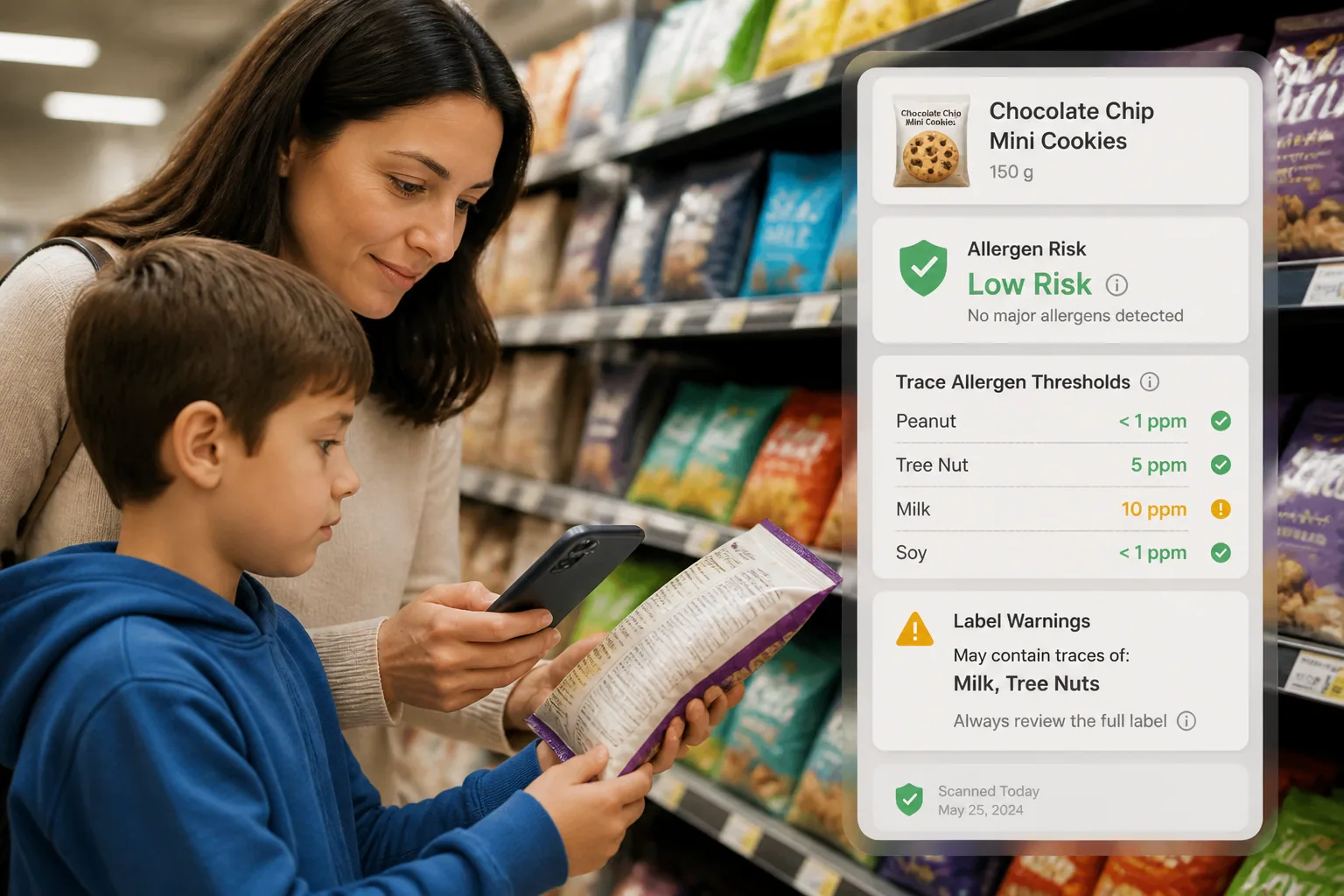
This is where technology can make threshold science more usable in everyday life. A food allergy scanner like Bokha could take label data, allergen declarations, and trace information and translate it into something easier to act on while you are standing in the supermarket aisle. Bokha can scan barcodes in less than a second and detect 13 allergens, traces, and additives, helping users save time and make faster decisions. https://findthe.app/bokha
In a threshold-aware version of that experience, a scanner could do even more. It could flag whether a product contains a major allergen, whether the label uses precautionary wording, and whether the available information suggests a lower or higher cross-contact concern. It could also help users store personal preferences, so the app could reflect each person’s own risk tolerance rather than a generic rule.
That kind of tool would not replace medical advice or emergency planning. But it could turn abstract threshold science into a practical shopping aid. For many families, that would mean less second-guessing and faster decisions in daily life.
The Future of Smarter, More Personalized Allergy Decisions
The future of allergy management is likely to be more nuanced than the old avoidance model. Threshold science is pushing the field toward decisions based on evidence, dose, and context. Regulators are looking at reference doses. Researchers are refining population models. Manufacturers are revisiting how they label products. And consumers are becoming more informed about what warnings really mean.
That does not remove the seriousness of food allergies. If anything, it makes the issue more real. A person with food allergy does not need abstract reassurance. They need better information. Thresholds offer a way to move from fear of unknowns to judgment based on measurable risk.
In the end, the goal is not to make people less careful. It is to make daily decisions more precise. When you understand thresholds, you can interpret labels more confidently, ask better questions, and choose foods in a way that reflects both science and your own lived reality.