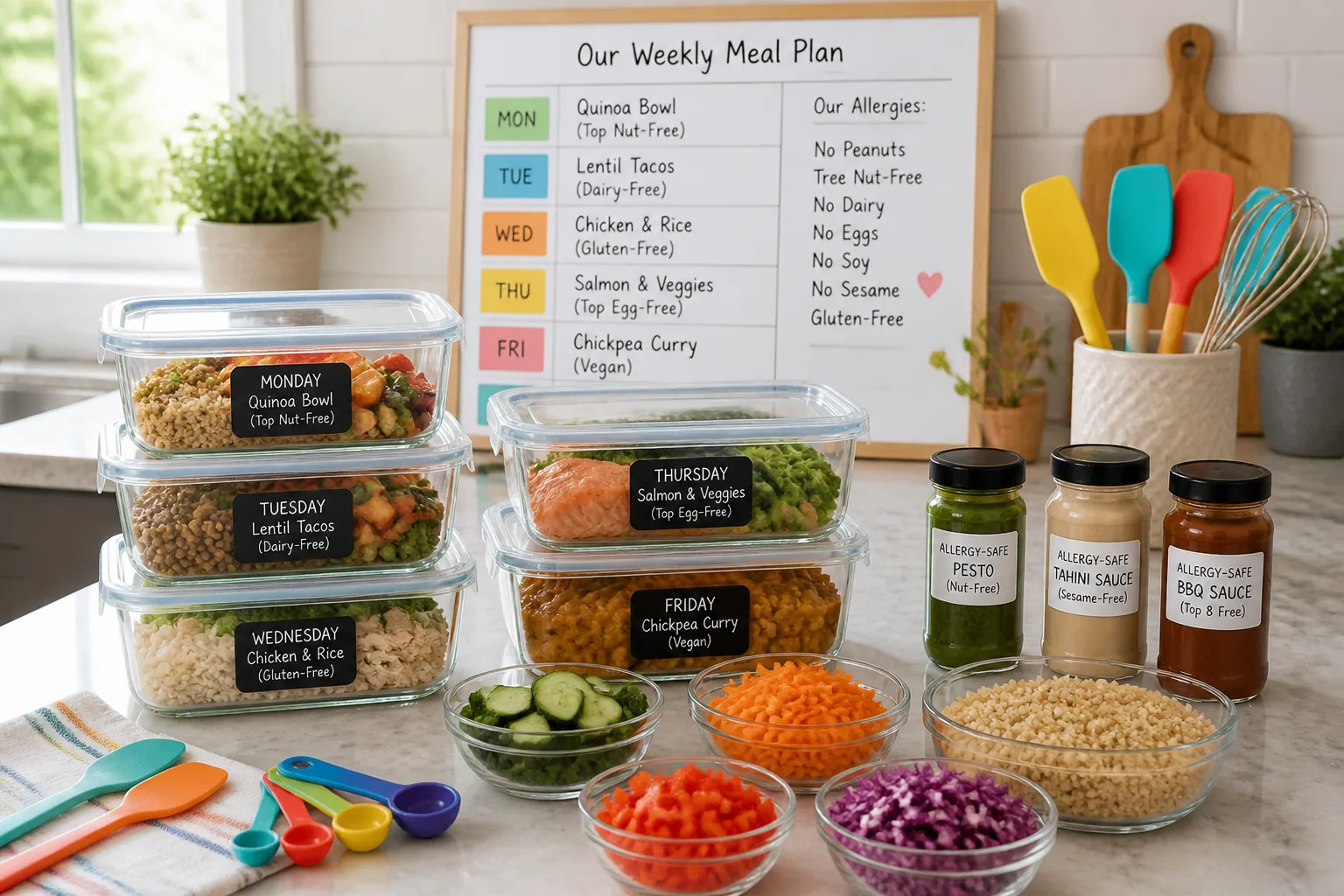
Safe Allergy-Friendly Meal Prep: A Real-Life Game Plan for Everyday Eating
Allergy-friendly meal prep is not just about being organized. It is about making everyday eating safer, calmer, and more repeatable in a kitchen where one small mistake can matter. That is especially true when you consider how common food allergies are: the CDC estimates that about 6.7% of U.S. adults and 5.3% of children ages 0 to 17 have a diagnosed food allergy. And while more than 170 different foods have been reported to trigger reactions in the U.S., the Big 9 allergens account for at least 90% of serious food allergy incidents, including milk, egg, peanut, tree nuts, soy, wheat, fish, shellfish, and sesame. https://www.cdc.gov/nchs/fastats/allergies.htm https://www.foodallergy.org/resources/facts-and-statistics
The best meal prep system for allergies is not the one with the prettiest containers or the longest shopping list. It is the one that reduces decision fatigue, lowers cross-contact risk, and can actually survive a busy week. That means building around a few safe base ingredients, using smart storage and labeling habits, and involving the whole household so the burden does not fall on one person alone.
Why Everyday Allergy-Safe Meal Prep Needs a Different Approach
A holiday menu can be carefully managed for one day. Everyday meal prep has to work on Monday, Wednesday, and the nights when everyone is tired, rushed, and tempted to grab whatever is easiest. That is why allergy-safe meal prep should be treated as a routine system rather than a special project.
The main goal is not perfection. It is consistency. When you repeat a small number of safe ingredients and prep methods, you reduce the number of times you need to check labels, sanitize surfaces, and worry about whether a utensil touched something risky. That simplicity matters because cross-contact often happens in ordinary places. In a USDA/FSIS survey, 34% of kitchen sinks tested after meal prep were contaminated post-use, and 26% of fruit salad pieces were found contaminated, showing how easily allergen transfer can happen during normal cooking. https://www.fsis.usda.gov/news-events/news-press-releases/kitchen-sink-overlooked-place-food-safety
So instead of aiming for a different dinner every night, aim for a structure that can flex. A safe grain, a roasted vegetable, a protein, and one or two flavor directions can create multiple meals without requiring a full restart each day.
Start With a Simple Weekly Plan, Not a Perfect Menu
A good allergy-friendly week starts with a short planning session. You do not need a complicated calendar or a meal prep spreadsheet with twenty columns. Start by choosing the meals you truly need help with, usually lunches, three or four dinners, and a few emergency backup options.
Then build the week around repeatable templates. For example, one template could be rice bowl, another could be soup and bread, and another could be pasta with vegetables and a safe sauce. If you know the format, you can swap ingredients based on what is safe for your household without reinventing the menu each time.
This approach also makes shopping easier. You can create a short list of safe staples and focus your energy on checking labels carefully rather than trying to design a brand new menu every week. In allergy prep, fewer decisions usually means fewer mistakes.
Choose Interchangeable Base Ingredients for Safer Faster Meals
Interchangeable ingredients are the backbone of a sustainable meal prep system. They are the foods that can be cooked once and used in multiple meals without becoming boring or unsafe. Think of a few dependable anchors: a safe grain, a cooked protein, a roasted vegetable, and a sauce or seasoning blend that works across dishes.
A batch of rice can become a lunch bowl, a dinner side, or a fried rice style meal with safe add-ins. Roasted carrots or broccoli can support a grain bowl one day and a soup the next. Chicken, tofu, beans, or lentils can be portioned into different containers depending on the meal plan. The idea is to make each component useful in more than one way.
This is especially helpful in homes where not everyone shares the same restrictions. When you keep the allergy-safe base separate and clearly labeled, other household members can still add their own toppings or sauces later without contaminating the shared prep.
How to Batch Cook Without Increasing Cross-Contact Risk
Batch cooking is useful, but only if it is done carefully. The more food you handle at once, the more chances there are for allergen transfer. That means your prep process matters just as much as the recipe.
Best practice is to dedicate tools and cookware clearly, ideally by color or another easy visual system. Food Allergy Research and Education recommends using dedicated utensils and cookware, washing them thoroughly with hot soapy water and sanitizer, drying them properly, and using non-latex gloves when needed. https://www.foodallergy.org/media/5054/download
It also helps to work in zones. Use one area for clean ingredients, another for prep, and another for finished containers. If you need to handle allergens for other family members, do that last and with separate tools, so you do not accidentally move residue back into the safe prep area.
Be extra cautious with sinks, sponges, dish racks, and dish towels. These are common transfer points, and they are easy to overlook when the kitchen gets busy. If something may have touched an allergen, treat it as contaminated until it has been washed and fully dried.
Freezer Strategies That Save Time on Busy Weeknights
The freezer is one of the most valuable tools in allergy-friendly meal prep, but it works best when you understand its limits. Freezing food does not destroy allergens, and shared packaging or surfaces can still create risk. The good news is that foods stored at 0° F, or minus 18° C, stay safe indefinitely, with quality being the main thing that declines over time. https://www.fsis.usda.gov/food-safety/safe-food-handling-and-preparation/food-safety-basics/freezing-and-food-safety
That means freezer meals should be treated as part of your safety plan, not a shortcut around it. Freeze only food that was prepared in a clean, allergy-aware environment, and package it in a way that prevents mix-ups later. Flat freezer bags, stackable containers, and pre-portioned meals can all make weeknights easier.
A smart strategy is to freeze components instead of full meals. For example, freeze cooked rice in meal-size portions, soup base in individual containers, or seasoned protein in single-use bags. This gives you flexibility and helps prevent waste when plans change.
Safe Storage, Labeling, and Fridge Organization Tips
Labeling is not a nice extra. It is one of the most important safety habits in an allergy-friendly kitchen. When freezing food, include the name of the product, the date packaged, the number of servings, added ingredients, and the form, such as sliced or chopped. Freezer tape, gummed labels, and a clear marking pen all help reduce mix-ups. https://nchfp.uga.edu/how/freeze/freeze-general-information/packaging-and-labeling-foods/
The same logic applies to the fridge. Keep allergy-safe meals on a designated shelf when possible, and place them where they will not be dripped on by other foods. Store leftovers in sealed containers, and use a simple system that makes older items easy to identify. If everyone in the home can recognize the labels, the system is much more likely to hold up.
If you live with others, make it obvious which food is safe for which person. Color coding helps, but only if everyone understands it. A label that says safe for lunch, peanut-free, or dairy-free is often more useful than assuming people will remember.
Flavor Without Fear: Seasoning and Sauce Ideas for Common Allergies
One of the biggest complaints about restrictive eating is that it can feel bland. It does not have to. Flavor is where allergy-friendly meal prep can become much more enjoyable, because herbs, spices, acids, and aromatics can do a lot of the work without relying on common allergens.
Think in layers. Start with garlic, onion, ginger, citrus, vinegar, herbs, and spice blends that are verified safe. Then build from there with toasted seeds, safe oils, or a simple tomato base if those ingredients fit your needs. Even a basic rice bowl can taste completely different with a lemon-herb profile versus a cumin-lime profile.
Sauces are especially useful because they turn repetitive prep into varied meals. A simple olive oil and herb dressing, a tahini-style sauce if sesame is safe, or a coconut-based curry sauce can change the character of the same ingredients. The key is checking each ingredient carefully, especially blends and condiments where hidden allergens can appear.
Sesame deserves special attention. The FDA now requires sesame to be listed as a major allergen under the FASTER Act, bringing it in line with the other Big 9 allergens in U.S. labeling. That helps, but it also means you still need to read labels closely because sesame can show up in bread, seasonings, sauces, and snack foods. https://www.fda.gov/food/nutrition-food-labeling-and-critical-foods/food-allergies?lv=true
Easy Allergen-Friendly Swaps That Still Taste Good
Good substitutions are less about imitation and more about function. If a recipe depends on a creamy texture, a crunchy topping, or a savory depth, look for a swap that performs the same job in a safe way.
For creaminess, try blended white beans, potato, coconut milk, or a safe dairy-free alternative. For crunch, use toasted seeds or safe vegetables instead of nuts if tree nuts are an issue. For umami, lean on mushrooms, caramelized onions, roasted tomatoes, tamari alternatives that fit your needs, or slow-cooked vegetables. The goal is to keep the same satisfaction, not necessarily the same exact ingredient list.
This is also where you can simplify your pantry. You do not need ten substitutes for every ingredient. You need a few reliable ones that your household actually likes and will eat regularly.
How to Share Kitchen Safety Tasks Across the Household
Allergy safety works better when it is shared. If one person has to plan, shop, cook, clean, label, and double-check every step, burnout is almost guaranteed. That is why household routines should be divided into small, repeatable jobs.
A partner can be responsible for washing and drying dedicated utensils. Kids can help label containers, set out safe ingredients, or check off items on a shopping list. Another adult can handle fridge organization or be the person who double-checks that the correct lunch boxes were packed. The point is not to hand off the most critical judgment calls, but to create support around them.
When everyone participates, food safety becomes part of the household culture instead of a private burden. That also helps children and partners understand why certain steps matter, which makes them more likely to follow the system consistently.
A 7-Day Sample Allergy-Friendly Meal Prep Framework
Here is a simple framework that can be adapted to many households. It is not a rigid menu, just a model for how a week can flow without requiring constant reinvention.
Day 1: Grain bowl with roasted vegetables and seasoned protein. Day 2: Leftover grain bowl remixed with a different sauce. Day 3: Soup made from the same cooked vegetables and protein, with a side of safe bread or crackers. Day 4: Pasta or noodle dish using the same flavor base in a different form. Day 5: Lunchbox plate with grain, protein, and raw veggies. Day 6: Freezer backup meal, such as a pre-portioned soup or casserole. Day 7: Flexible reset meal, using whatever is left in the safe system.
The beauty of this model is that it reduces both food waste and safety stress. You are not starting from zero each day, and you are not trying to manage too many ingredients at once.
Common Meal Prep Mistakes That Can Undermine Safety
The biggest mistake is assuming that a food is safe because it looks safe. Cross-contact is often invisible. A spoon, cutting board, sink, towel, or storage container can all transfer allergens even when a recipe itself seems simple.
Another common mistake is making too many recipes at once. More recipes usually mean more utensils, more labels, more chances to forget a step, and more cleaning. In allergy meal prep, complexity is often the enemy.
People also underestimate the importance of checking labels every time. Ingredients and formulations change, and allergens can appear in products that were previously safe. This is one reason tools that help scan products quickly can be useful. Bokha: Food Allergy Scanner App can help by scanning barcodes and identifying allergens in less than a second, which can be especially handy during grocery shopping. https://findthe.app/bokha
Finally, do not forget storage mistakes. A well-cooked safe meal can become risky if it is stored in a contaminated container or placed under food that might drip onto it.
Building a Routine You Can Actually Maintain
A sustainable allergy-friendly meal prep routine should feel boring in the best possible way. It should be predictable enough to trust and flexible enough to survive real life. That usually means choosing a small set of safe staples, repeating a few meal formats, labeling everything clearly, and making shared responsibility part of the plan.
The more you practice the same safe habits, the less mental energy they require. Over time, meal prep stops feeling like a crisis response and starts feeling like a normal rhythm. That is the real win: not perfection, but a routine that makes everyday eating safer, easier, and more livable for the whole household.