Safe & Savvy: How to Read Food Labels Like a Food-Allergy Pro
If you live with a food allergy, or shop for someone who does, reading a food label is never just a quick glance at the front of the package. The real story is usually in the ingredient list, the allergen statement, the warning phrases, and sometimes even in the way ingredients are named. A product can look simple and safe on the shelf while still hiding a risk in plain sight.
The good news is that label reading is a skill you can learn. Once you know where allergens hide, which terms deserve extra attention, and how labeling rules differ by country, grocery shopping becomes a lot less stressful and a lot more predictable.
Why the Allergen Statement Isn’t the Whole Story
Many shoppers are taught to go straight to the bold “Contains:” statement, and that is a smart first step. In the U.S., FALCPA requires packaged foods to clearly disclose the major allergens, and the FASTER Act added sesame as the ninth major allergen, effective January 1, 2023. Under U.S. rules, allergens may appear either inside the ingredient list or in a separate “Contains:” statement near it. That helps, but it does not mean the label tells you everything you need to know. Source: https://pmc.ncbi.nlm.nih.gov/articles/PMC11250542/ and https://www.fda.gov/food/food-labeling-nutrition/food-allergies
Why not? Because food labels can still use unfamiliar ingredient names, voluntary precautionary warnings, or marketing language that sounds safer than it really is. In other words, the allergen statement is important, but it is only one part of the safety check.
The First 5 Places to Check on Any Food Package
A reliable label-reading routine keeps you from missing something important when you are tired, rushed, or distracted. Start with these five spots on every package:
The front of pack. This is where brands love to use terms like “natural,” “free-from,” “allergy-friendly,” or “dairy-free.” Those claims can be helpful, but they are not a substitute for the ingredient list.
The ingredient list. This is the main place to look for hidden allergen names, especially when an ingredient sounds technical or unfamiliar.
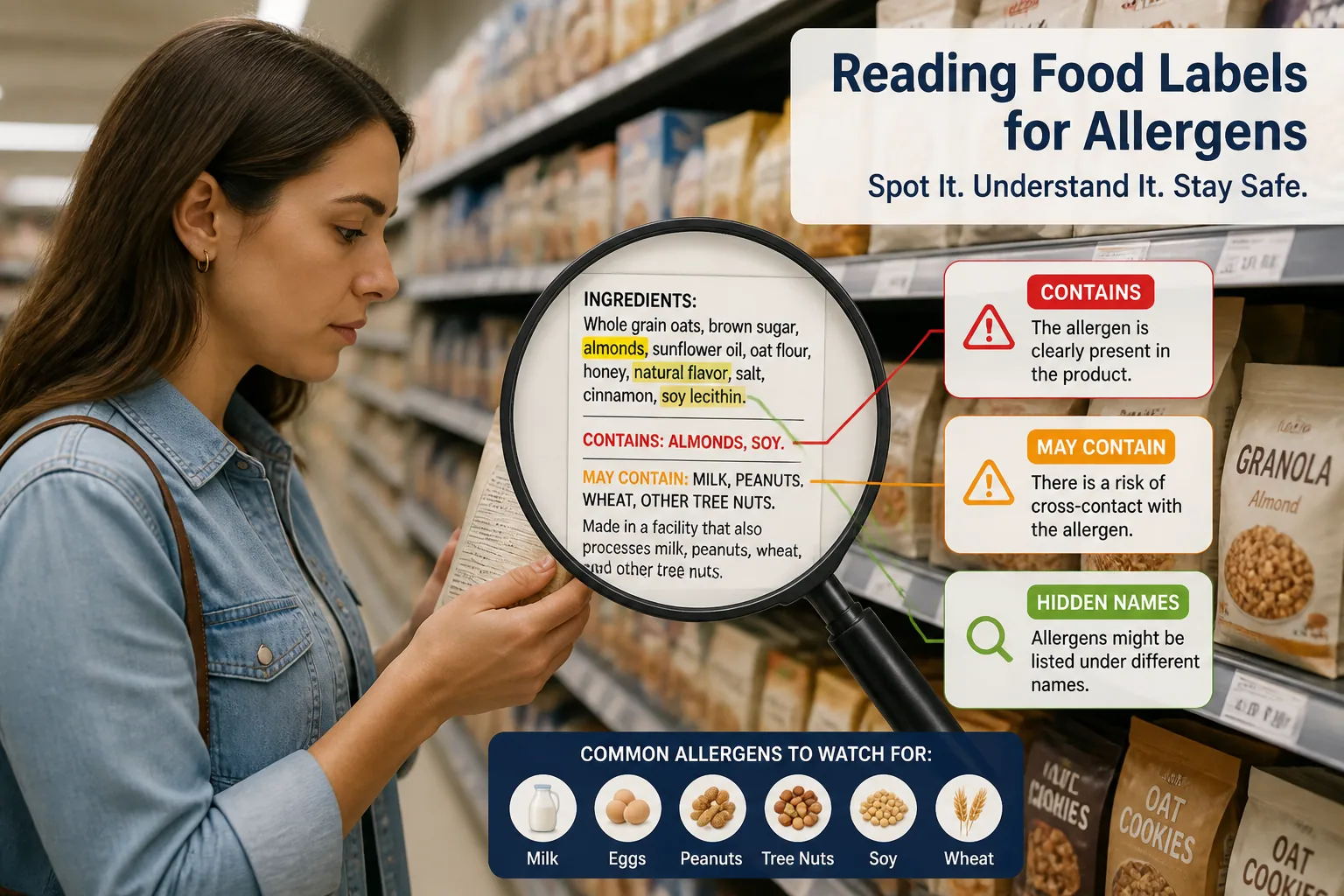
The allergen statement. In the U.S., this may say “Contains: milk, soy, wheat,” and similar wording. In the UK and EU, allergens are often highlighted in bold, italics, underlining, color, or another clear visual distinction inside the ingredient list. Source: https://www.food.gov.uk/business-guidance/allergen-labelling-for-food-manufacturers and https://manubolu.de/blog/allergen-labelling-eu-regulation.html
Precautionary allergen labeling. Phrases such as “may contain” or “produced in a facility with…” can signal cross-contact risk, but they are not the same as a regulated ingredient declaration.
The manufacturer’s contact details. If the label is unclear, calling or emailing the company can be the final step before buying.
Hidden Allergen Names: Ingredients That Don’t Sound Obvious
One of the biggest label-reading mistakes is assuming an allergen will always be named in plain language. It often won’t be. Food ingredients may appear under scientific, processing, or industry names that are easy to overlook if you are new to allergy shopping.
For example, milk can appear as casein, whey, lactose, or albumin. Egg may hide in albumin or egg white solids. Soy can show up as lecithin, soybean oil, or soy protein. Wheat may appear as flour, semolina, durum, or modified food starch. Gelatin, natural flavors, and food starch can also deserve a second look depending on the product and the country. Source: https://www.bestallergysites.com/how-to-read-ingredient-lists-for-food-allergens/
This is why label reading is more than memorizing a list of allergens. It is about recognizing the many ways those allergens can be written. A good rule is simple: when an ingredient sounds unfamiliar, do not assume it is safe until you verify what it is.
Additives, Flavorings, and Processing Terms That Can Raise Red Flags
Some ingredients are not allergens themselves, but they can still matter if they are derived from allergenic sources or processed in ways that create concern. “Natural flavors” is a classic example because the term is broad and can cover many formulations. “Spices” can also be vague, depending on the market and the product category.
Processing language matters too. In the U.S., the FDA notes that the law does not require allergen labeling for processing aids or incidental amounts naturally present, unless they contain allergenic proteins. That means the label may still leave room for interpretation, especially when ingredients are highly modified or combined in a complex manufacturing process. Source: https://www.fda.gov/food/food-labeling-nutrition/food-allergies
This is where experience helps. If a product has a long ingredient list with multiple flavor systems, emulsifiers, or starches, it is worth slowing down and checking each item carefully rather than relying on the front label.
What ‘May Contain’ and Shared-Facility Warnings Really Mean
Precautionary allergen labeling, often called PAL, includes statements like “may contain peanuts,” “may contain traces of milk,” or “made in a shared facility.” These warnings can be useful, but they are not standardized in the way ingredient declarations are.
In the U.S., PAL phrases are voluntary. There is no legal requirement for companies to use them, and there is no regulated threshold that makes one warning more or less meaningful than another. The FDA also notes that these statements do not reliably predict whether an allergen is present or at what level. Source: https://www.fda.gov/food/conversations-experts-food-topics/current-food-allergen-landscape
That means two important things. First, the absence of a warning does not automatically mean a product is safe. Second, the presence of a warning does not tell you exactly how much risk exists. In practical terms, the warning is a signal to pause, not a precise safety rating.
The UK takes a slightly different approach: precautionary statements are not strictly mandatory and should only be used after a risk assessment where cross-contamination cannot be prevented. Australia and New Zealand also treat “may contain” and similar advisory statements as voluntary under the Food Standards Code. Source: https://www.food.gov.uk/business-guidance/allergen-labelling-for-food-manufacturers and https://www.foodstandards.gov.au/business/labelling/allergen-labelling
How Allergen Labeling Laws Differ by Country
Allergen labels can look familiar from one country to the next, but the rules behind them are not identical. That matters if you travel, buy imported foods, or shop online from international sellers.
In the U.S., the Big Eight allergens were long the core standard, and sesame was added as the ninth major allergen under the FASTER Act. The law requires clear disclosure in the ingredient list or in a nearby “Contains:” statement. Source: https://www.fda.gov/food/food-labeling-nutrition/food-allergies
In the UK, prepacked foods must highlight allergens inside the ingredient list using a different font, style, or background color. The UK also recognizes 14 allergens, including celery, cereals containing gluten, crustaceans, eggs, fish, lupin, milk, molluscs, mustard, nuts, peanuts, sesame, soya, and sulphur dioxide/sulphites above 10 mg/kg. Source: https://www.food.gov.uk/business-guidance/allergen-labelling-for-food-manufacturers
The EU’s Regulation (EU) No 1169/2011 requires the same 14 major allergens to be clearly identified in ingredient lists for prepacked foods, loose foods, and catering settings. The core idea is similar to the UK system: allergen information must be prominent and easy to find. Source: https://manubolu.de/blog/allergen-labelling-eu-regulation.html
One detail that is easy to miss: sulphur dioxide and sulphites have a specific threshold in both the UK and EU. They must be declared only when present above 10 mg/kg or per liter. Source: https://www.gov.uk/food-labelling-and-packaging/ingredients-list
Australia and New Zealand updated their allergen labeling rules in 2024, requiring more specific naming for items like tree nuts, molluscs, and individual cereals containing gluten. That makes the label more precise, but it also means travelers need to read carefully instead of assuming all countries name allergens the same way. Source: https://www.foodstandards.gov.au/business/labelling/allergen-labelling
Misleading Packaging Claims: ‘Allergen-Free,’ ‘Dairy-Free,’ and More
Front-of-pack claims can be useful, but they can also create a false sense of security. A product marked “allergen-free” may be free from one allergen but not another. “Dairy-free” does not automatically mean safe for someone avoiding egg, soy, or tree nuts. “Gluten-free” is not the same as “wheat-free” in every context, and “natural” tells you almost nothing about allergen risk.
UK guidance notes that claims like “free-from” must be truthful and based on specific controls, but labels like “natural” or “allergy-friendly” without supporting detail can still mislead consumers. Source: https://www.food.gov.uk/business-guidance/allergen-labelling-for-food-manufacturers
The safest mindset is this: treat marketing claims as bonus information, never as your final decision point.
Real-World Label Comparisons: Safe-Looking vs. Actually Safe
This is where label reading becomes very practical. A package can look “clean” and safe at first glance, but the ingredient list may reveal a hidden risk. For example, a cereal bar labeled “simple ingredients” may still contain soy lecithin. A sauce labeled “dairy-free” may still include whey-derived flavoring or be produced in a shared facility. A bakery snack may have no obvious allergen on the front, yet list wheat flour, albumin, or sesame in the ingredients.
The lesson is not to become suspicious of every product. It is to compare what the packaging promises with what the actual label says. If the front and the back do not match, trust the back.
When you shop, it can help to take photos of products you have already verified at home. That way, when you see the same brand or same packaging in another store, you have a reference point. Over time, this creates your own personal safe-product library.
A Smart Grocery-Store Checklist for Allergy-Safe Shopping
A strong grocery habit can reduce stress and help you make decisions faster. Here is a practical checklist you can use in the store:
First, slow down and check the entire label, not just the front. Second, look for both the ingredient list and the allergen statement. Third, scan for hidden names and technical terms that could represent your allergen. Fourth, read any precautionary warnings carefully, but do not treat them as a guarantee either way. Fifth, if the product is new or uncertain, choose a simpler alternative or confirm directly with the manufacturer.
If you shop frequently, it can also help to keep a short note on your phone with your main allergens, common aliases, and a list of trusted brands. That turns label reading from a guessing game into a repeatable process.
And if you want to speed things up even more, a scanner tool can help. Bokha: Food Allergy Scanner App lets you scan a barcode and check allergens quickly in the supermarket, which can be especially helpful when you are comparing several products at once: https://findthe.app/bokha
When in Doubt: Best Practices Before You Buy or Eat
When a label feels ambiguous, the safest move is to pause. If the ingredient list is unclear, if the package has changed, if the warning language is new, or if the product is imported from a country with different labeling rules, do not guess.
A few best practices go a long way: save photos of labels you have already checked, keep a list of safe staples, avoid products with vague ingredient language when you are unsure, and contact the manufacturer for confirmation when necessary. If someone has had severe reactions in the past, that extra step is not overcautious; it is smart risk management.
Food label reading gets easier with repetition. Once you know where allergens hide, how warnings work, and how labeling laws differ across regions, you can shop with much more confidence. That confidence is powerful, because it turns every grocery trip into a more informed decision rather than a stressful search for hidden danger.