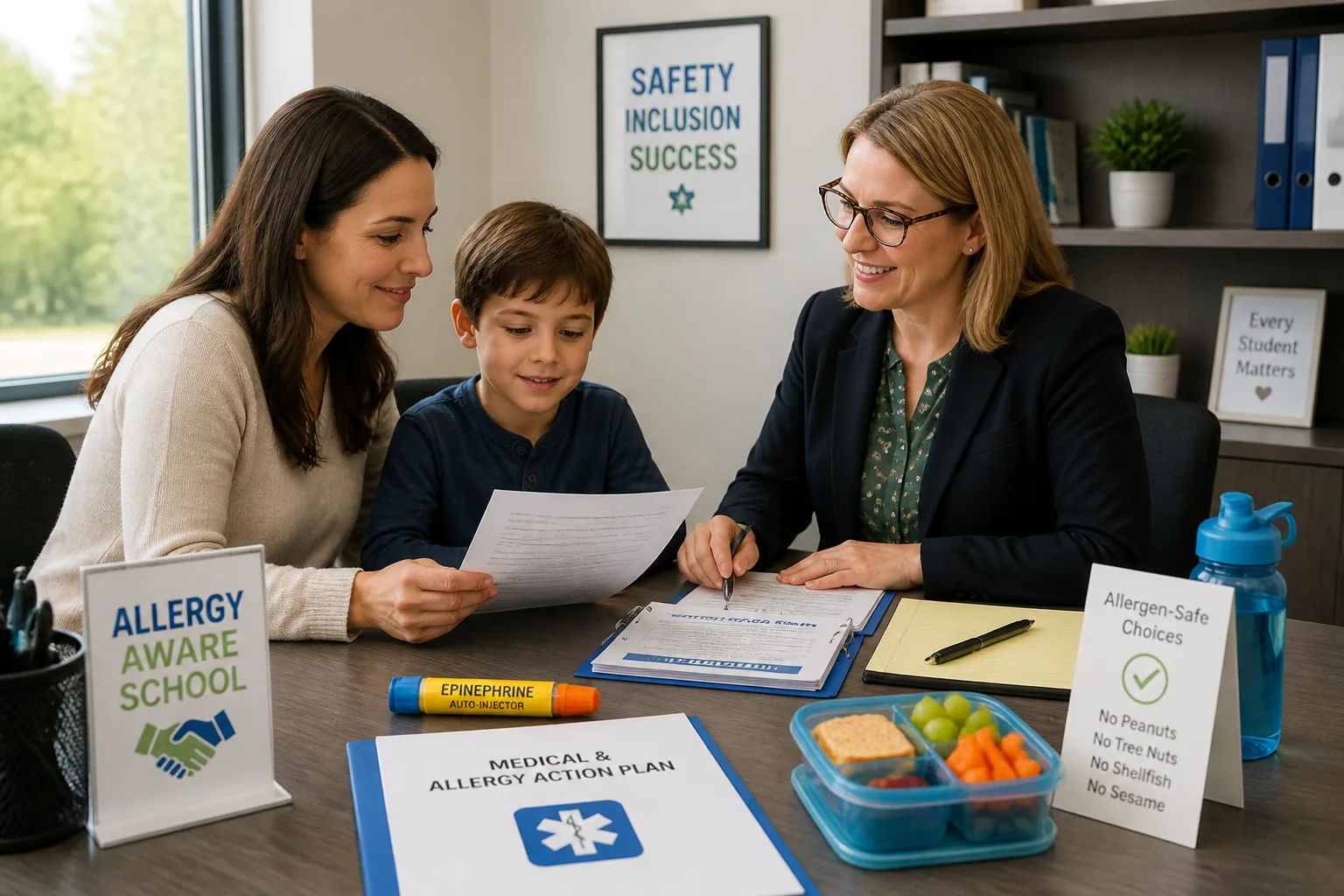
Legal Rights and Food Allergies: Navigating Accommodations and Protections
Food allergies are not just a medical issue. In many settings, they can also be a legal issue. When an allergy substantially limits a major life activity like breathing, eating, or the functioning of the immune or gastrointestinal systems, it may qualify as a disability and trigger legal protections under federal law. That matters for students, employees, parents, caregivers, and anyone who needs safer access to school, work, housing, restaurants, camps, childcare, and community spaces.
The good news is that the law already offers several pathways for protection. Section 504 of the Rehabilitation Act can apply in schools. The Americans with Disabilities Act can apply in workplaces, public services, and many public accommodations. State laws can add extra protections, especially around allergen awareness, menu labeling, and stocked epinephrine. Knowing how these rules work can help you ask for accommodations with more confidence and respond effectively if a school, employer, or business pushes back.
Why Food Allergies Can Qualify for Legal Protection
Under federal disability law, the key question is not whether a food allergy is common or manageable. The key question is whether it substantially limits one or more major life activities. The U.S. Department of Education explains that, for Section 504 purposes, a student with a food allergy is protected from disability-based discrimination if the allergy substantially limits activities such as breathing, eating, or functioning of the immune or gastrointestinal systems. That framing is important because it moves food allergy from a private inconvenience into a recognized access issue.
The ADA uses a similar standard after the 2008 Amendments. A disability is a physical or mental impairment that substantially limits one or more major life activities, and severe food allergies can meet that standard when they significantly affect daily living. In practice, that means the person does not need to prove that the allergy is constant or visible. It is enough that the condition creates a real and substantial limitation when exposed to allergens or when normal food access is restricted.
This legal recognition matters because it opens the door to accommodations. A student may need a safe lunchroom plan. An employee may need a modified meal arrangement or a way to avoid mandatory food exposure. A restaurant or campus may need to adjust its policies or train staff. The central idea is simple: equal access sometimes requires different treatment, and disability law is built around that principle.
Understanding Section 504 in K-12 Schools
Section 504 is one of the most important protections for students with food allergies. It applies to schools that receive federal funding, which includes most K-12 public schools. If a student’s food allergy substantially limits a major life activity, the school must provide equal access and may need to put written protections in place.
The process usually begins with the school’s 504 Coordinator. Parents or guardians request a review, and the 504 Team considers medical documentation and the student’s daily needs. If the student qualifies, the team develops a 504 Plan outlining accommodations. FoodAllergy.org notes that this process often includes an Individual Healthcare Plan and an Emergency Care Plan, which can help clarify both day-to-day prevention and emergency response. Source: https://www.foodallergy.org/resources/section-504-and-written-management-plans
A well-written school plan can include many practical supports. These may involve allergen-aware seating, handwashing procedures, classroom food restrictions, substitute meal safeguards, field trip planning, anti-bullying protections, staff training, emergency medication access, and clear communication with substitute teachers and cafeteria staff. The point is not to isolate the student. The point is to reduce preventable risk while preserving full participation in school life.
Families should also remember that a 504 Plan is not a favor from the school. It is a civil rights tool. If the school refuses to assess the student, delays the process unreasonably, or offers only informal assurances without clear implementation, parents can ask for written responses and begin documenting the concern.
How the ADA Applies to Food Allergies in Public Life and Work
Outside school, the ADA is often the main federal law people rely on. Title I covers employment. Title II covers state and local government services. Title III covers public accommodations such as restaurants, hotels, theaters, retail spaces, and many private businesses open to the public. If a food allergy qualifies as a disability, these entities may need to provide reasonable accommodations unless doing so would create an undue burden or fundamentally alter the service.
In the workplace, that can mean adjusting meeting snacks, allowing an employee to avoid shared food preparation tasks, creating safer break-area practices, or modifying office food rules when needed. In public settings, accommodations may involve ingredient information, staff communication, allergen-safe preparation methods, or reasonable modifications to standard policies. The exact accommodation depends on the setting and the risk involved, but the legal question is the same: can the person access the benefit or service safely and equally?
Legal and enforcement examples show that institutions sometimes must change rigid policies. A notable Rider University settlement reflected the principle that a school can be required to modify a mandatory meal plan policy for students with food allergy disabilities when a standard plan does not work safely. Source: https://archive.ada.gov/rider_sa.html
The ADA does not guarantee a perfect environment. It does require a meaningful one. That means people with food allergies should not be excluded simply because a policy is convenient, traditional, or expensive to change. If a business or employer treats all requests as impossible, it may be worth asking whether the refusal is based on actual hardship or just habit.
Federal Rights vs. State-Level Protections: What Changes by Location
Federal law creates the baseline, but state law often determines how much practical protection people actually receive. This is especially true in schools, food service, and public venues. Some states require or allow schools to stock epinephrine. Others authorize public places like arenas, malls, and parks to keep epinephrine auto-injectors on hand. As of March 2025, 36 U.S. states had enacted entity epinephrine laws, and many states also have rules for K-12 schools. Source: https://www.foodallergy.org/sites/default/files/2026-02/FARE_NIR_FINAL 1.pdf
State law can also affect food labeling and local safety practices. At the federal level, the Food Allergen Labeling and Consumer Protection Act requires packaged foods to identify major allergens, and the FASTER Act added sesame as the ninth major allergen, effective January 1, 2023. Source: https://www.fda.gov/food/nutrition-food-labeling-and-critical-foods/food-allergies?lv=true
However, restaurant allergen disclosure is not automatically required nationwide. Federal menu labeling rules for chain restaurants focus on nutrition information like calories, not allergen disclosure. Source: https://www.fda.gov/food/nutrition-food-labeling-and-critical-foods/menu-labeling-requirements
That means the protections a family, employee, or student can rely on may vary by state and by type of setting. In one state, a school may have robust stock-epinephrine requirements. In another, the local school board may need stronger advocacy before adopting similar practices. The safest approach is to know both the federal floor and the state-specific rules where you live or travel.
How to Request School Accommodations and 504 Plans
A strong accommodation request usually starts with a clear written letter. Parents or guardians should contact the school’s 504 Coordinator and explain the diagnosis, the risks, and the supports being requested. The school can then review the student’s medical documentation and decide whether the child qualifies for a 504 Plan. If eligible, the plan should spell out specific actions, not vague promises.
Good requests are concrete. Instead of asking for general help, describe the actual situations that create risk: cafeteria exposure, classroom snacks, birthday treats, science projects, field trips, bus rides, or after-school programs. Then connect each risk to a specific accommodation. For example, safe seating, food-free classroom rules, handwashing, emergency medication access, and adult supervision during meals can all be reasonable depending on the student’s needs.
It also helps to ask how the school will train staff and communicate the plan. A written accommodation is only useful if the people who supervise the student know it exists. Parents should request copies of the finalized plan, ask when it will be reviewed, and keep records of any incidents or failures to follow the plan.
If the school seems hesitant, keep the conversation focused on access and safety rather than debate. The goal is not to prove that the child is fragile. The goal is to make sure the child can participate in school without facing avoidable discrimination or danger.
Workplace Accommodations: What Employees Can Ask For
Employees with food allergies can ask for reasonable accommodations under the ADA when the condition qualifies as a disability. The request should be tied to the specific workplace issue. Common examples include a safer workspace policy, fragrance and food handling limits in some environments, break-room adjustments, permission to store safe food separately, flexible scheduling for allergy management, or advance notice of catered meetings.
Employers do not have to grant every request exactly as written, but they do need to engage in an interactive process and consider effective alternatives. That means the employer should discuss the limitation, ask for relevant documentation if needed, and work toward a practical solution. A short, respectful written request usually works better than a broad complaint. Explain the allergy, the risk, and what would help reduce that risk while still allowing you to do the job.
Employees should also think about emergency preparedness. If epinephrine is part of the medical plan, ask whether workplace policy allows you to keep it nearby, whether coworkers should know where it is, and whether first aid procedures are clear. A good accommodation plan should not just address prevention. It should also address what happens if exposure occurs.
If your workplace has mandatory meal events or team lunches, you can ask for safer alternatives or the ability to opt out without penalty. The ADA does not require a perfect social environment, but it does protect the employee’s right to participate in work life on an equal basis.
Restaurant, Childcare, and Campus Safety Protections to Know
Restaurants, childcare centers, and college campuses each create different legal questions, but the underlying concern is the same: can the person access the service safely? Under Title III of the ADA, public accommodations may need to make reasonable modifications. For restaurants, that might mean ingredient information, safer communication with kitchen staff, or reasonable changes to a standard practice when possible.
For childcare and early learning settings, state licensing rules and disability law can both matter. Families should ask whether the center has allergen policies, cleaning procedures, training on avoiding cross-contact, and a plan for emergency response. Because young children cannot always advocate for themselves, the center’s procedures become even more important.
College and university settings can be especially important because students may live with dining plans, roommates, and shared food spaces. Schools that require meal plans may need to provide meaningful modifications if a student’s allergy makes standard dining unsafe. That is why the Rider University example is so useful: it shows that meal-plan policies are not automatically immune from disability law.
In every setting, the best approach is to ask about the written policy before there is a crisis. Once you know the rules, you can compare them with actual practice. If the policy looks strong on paper but staff are not following it, that gap may matter just as much as the wording itself.
What Documentation Strengthens an Accommodation Request
Medical documentation is often the difference between a vague concern and a strong accommodation request. A letter from an allergist, physician, or other qualified provider should ideally identify the allergy, describe the severity of reactions, explain the major life activities affected, and state why the requested accommodations are medically necessary. The more specific the letter, the easier it is for a school or employer to understand the need.
Useful documentation can also include emergency action plans, medication instructions, prior reaction history, and notes about known triggers or exposure risks. For children, it may help to include school-related examples, such as reactions to shared snacks, lunchroom contact, or hidden ingredients. For employees, documentation can focus on the work environment and why exposure is a safety issue, not just a preference issue.
At the same time, documentation should be practical. You do not need to submit every medical record in your file. The question is whether the material you provide is enough to show a disability-related need and a connection between the condition and the accommodation requested. Keep copies of everything you send, and send important documents in writing whenever possible.
How to Handle Denials, Retaliation, or Unsafe Policies
If a request is denied, the first step is to ask why. Was the request rejected because the decision-maker thinks the allergy is not serious enough, because they believe the accommodation is unavailable, or because they are offering an alternative you have not yet reviewed? A denial should not end the process. It should begin a more detailed conversation.
Retaliation is also a concern. A child should not be punished for needing an accommodation, and an employee should not be disciplined for requesting one. If the school or workplace responds with hostility, reduced opportunities, exclusion, or threats after a request is made, document the timeline carefully. Retaliation claims often depend on those details.
Unsafe policies can sometimes be challenged by showing that the policy is overly broad or not actually effective. For example, a no-accommodation stance that ignores documented risk may be harder to defend than a policy built around individualized assessment. Ask whether the institution has considered alternatives, staff training, or a temporary trial period. The law generally expects a real interactive process, not a one-word refusal.
When and How to File a Complaint
If direct communication does not solve the problem, a formal complaint may be the next step. In schools, that can mean contacting the district’s Section 504 coordinator, superintendent, or grievance officer, depending on local procedure. In federal settings, complaints may be filed with the U.S. Department of Education’s Office for Civil Rights when disability discrimination is involved. In employment, the Equal Employment Opportunity Commission may be involved. In public accommodations, the appropriate channel may depend on the issue and location.
Before filing, organize your records. Save letters, emails, doctor notes, incident reports, and any photos or written witness accounts. Create a timeline of what happened, who was informed, what response you received, and why the response was inadequate. Clear records make it much easier to explain the issue and prove a pattern if there is one.
Complaints are not only about winning a dispute. They also create a formal record. In some cases, that is enough to prompt a resolution. In others, it helps establish that the school, employer, or business was put on notice and failed to act. Either way, it is often a useful escalation tool when informal requests have gone nowhere.
Advocacy Strategies for Parents, Educators, and Caregivers
Effective advocacy usually starts long before there is a crisis. Parents and caregivers can build relationships with teachers, nurses, coaches, and administrators early in the year. Educators can make allergy safety part of routine planning, not an afterthought. Caregivers can ask for written instructions, emergency contacts, and clear handoff procedures. When everyone knows the plan in advance, fewer emergencies happen later.
It also helps to frame food allergy support as inclusion, not special treatment. The student is not asking for a separate life. The student is asking for equal access with reasonable safety measures. That message is often easier for schools and communities to understand, and it can reduce the social stigma that sometimes surrounds accommodations.
Educators and caregivers can advocate for staff training, better label reading, cross-contact awareness, and consistent emergency response. These changes benefit more than one child. They create a safer culture for students with allergies, diabetes, celiac disease, or other medical needs that intersect with food.
Families can also empower children, when age-appropriate, to know their allergy, recognize unsafe situations, and speak up for themselves. Self-advocacy is not a substitute for legal protection, but it can strengthen safety and confidence over time.
How to Push for Better Food Allergy Policies in Your Community
Community advocacy can be surprisingly effective when it is specific. Instead of asking a school, camp, restaurant, or recreation center to become “more allergy friendly,” propose a concrete change: stock epinephrine, post emergency steps, train staff, improve label visibility, or create a designated allergy-aware procedure for events. Specific requests are easier to adopt and easier to measure.
You can also use local policy channels. Attend school board meetings, speak with parent groups, ask public venues about their epinephrine policies, and encourage local businesses to adopt clearer allergen procedures. State and local rules often evolve because families and advocates keep showing up with practical solutions rather than only complaints.
Technology can help with day-to-day management too. For example, the Bokha: Food Allergy Scanner App lets users scan product barcodes and identify allergens in less than a second, which can be useful while shopping and checking packaged foods. It is not a substitute for legal rights or medical guidance, but it can support safer, faster decisions in everyday life. You can learn more here: https://findthe.app/bokha
At the end of the day, food allergy advocacy works best when it combines law, documentation, communication, and persistence. Federal protections like Section 504 and the ADA provide the framework. State laws can add extra safeguards. But the real progress often comes from people asking the right questions, demanding written answers, and refusing to treat safety as optional.