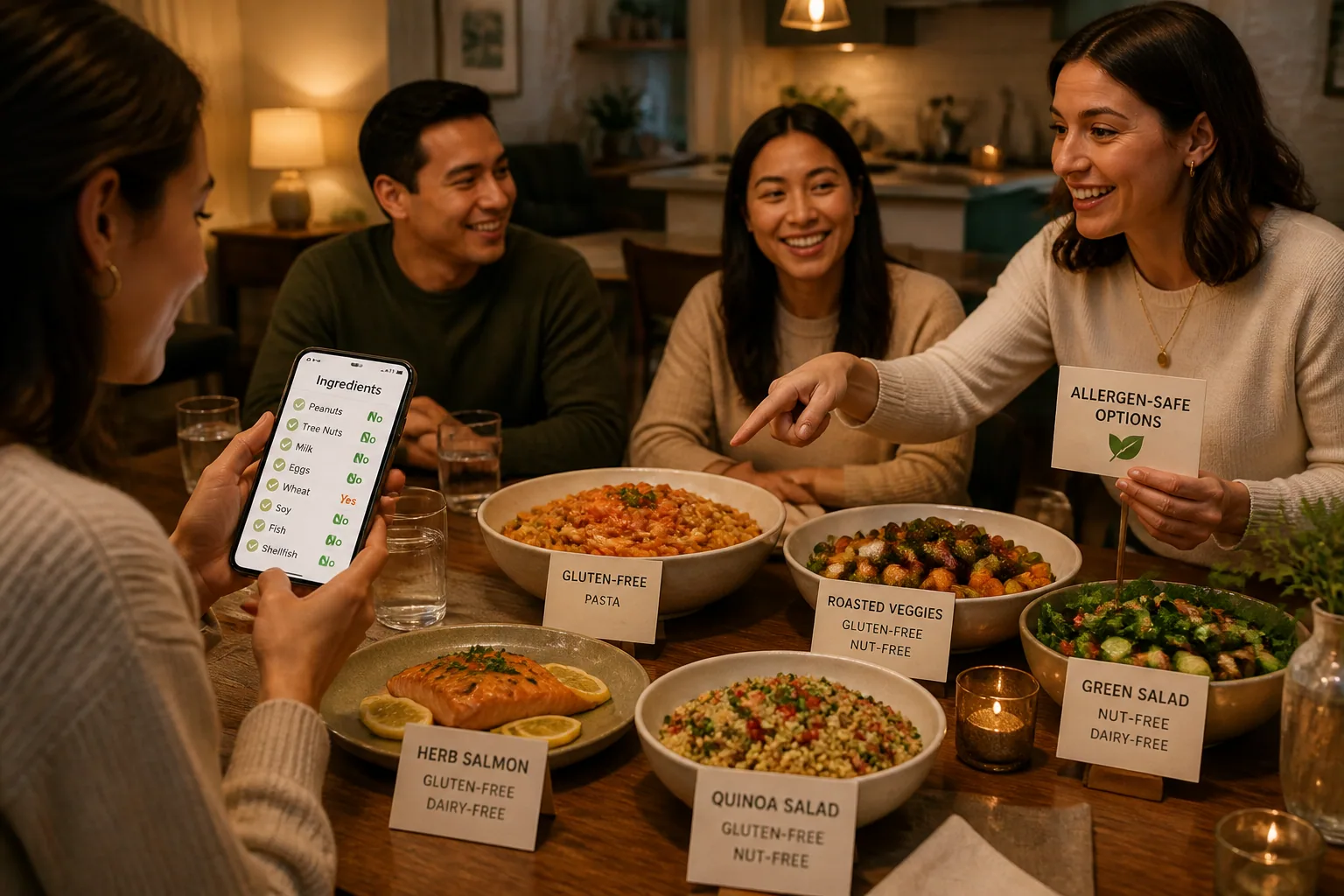
How to Manage Food Allergies When Eating Food Prepared by Others: Hosting, Attending, and Everything In Between
Food allergies are not just a restaurant issue. They show up at birthday dinners, office potlucks, school fundraisers, holiday meals, and casual nights at a friend’s house. In fact, accidental allergic reactions happen most often at home, where about 44 percent of reactions occur in both children and adults, according to a review of U.S. reaction settings. That means the informal meals people often think of as “low risk” can actually be some of the hardest to navigate safely.
This matters for a lot of families. In 2024, 6.7 percent of U.S. adults and 5.3 percent of children were diagnosed with a food allergy, according to CDC/NCHS data. Among adults, about 10.8 percent have a convincing food allergy, and nearly half of those adults developed at least one allergy later in life. Shellfish, milk, peanut, tree nut, and fin fish are among the most common triggers. So when you are planning or attending a home meal, you are probably not dealing with an edge case. You are dealing with a real and common safety need.
The good news is that safer informal eating is absolutely possible. It usually comes down to three things: clear communication, careful kitchen habits, and a plan for what to do when the menu is not fully under your control. If you are a host, that means learning how to ask the right questions and avoid cross-contact. If you are a guest, it means sharing your needs early and deciding when to bring backup food, eat beforehand, or politely skip a dish that feels uncertain.
Why Informal Meals Can Feel Riskier Than Restaurants
Restaurants may seem more dangerous because the environment feels unfamiliar, but informal meals often create a different kind of risk. At home, people tend to rely on memory instead of written ingredient lists. Someone may say, “It’s just a little sauce,” or “I made it the same way as last time,” without realizing that a spice blend, marinade, broth, or garnish contains a problem ingredient.
There is also less routine. In a restaurant, allergen protocols may be imperfect, but there is at least a process. At a friend’s house, the process can be entirely ad hoc. A cook may use the same spoon in two dishes, wipe a counter with the same towel, or reuse oil, cutting boards, and pans. The Academy of Nutrition and Dietetics notes that cross-contact in shared utensils, cookware, and prep surfaces is a major risk in home kitchens, even when the cook is careful. That is why “I did not put the allergen directly in it” is not always enough.
There is also a social layer. People with food allergies often report discomfort asking hosts for ingredient details or feeling their concerns are minimized. That emotional pressure can lead guests to stay quiet, and silence is where many preventable mistakes happen. The goal is not to make every meal feel clinical. The goal is to make communication normal enough that safety does not depend on guesswork.
The Biggest Food Allergy Risks at Home Gatherings
The biggest risks at informal gatherings usually fall into a few predictable categories. First is hidden ingredients. Sauces, fillings, baked goods, dips, spice mixes, salad dressings, and desserts often contain allergens that are not obvious from appearance alone.
Second is cross-contact. Shared knives, butter dishes, serving spoons, and baking sheets can transfer enough allergen to trigger a reaction. Home kitchens are especially tricky because people often do not think of a crumb, a splash, or a reused utensil as meaningful contamination, even though it can be.
Third is uncertainty around labels. If a host uses packaged ingredients, they may assume “may contain” or “processed in the same facility as” warnings are either meaningless or automatically unsafe. In reality, precautionary allergen statements are not standardized in a way that makes them easy to interpret universally, so the guest still has to assess risk carefully.
Fourth is crowd behavior. At buffets and potlucks, serving spoons get swapped, kids dip crackers into shared bowls, and plates get placed next to one another. That makes the food itself only part of the issue. The way people serve, refill, and sample food matters just as much.
Finally, there is the temptation to minimize. A host may say, “A little bit won’t hurt,” or “It is easier if you just pick around it.” That kind of response can be frustrating, but it is also a signal that the situation is not safe enough to rely on trust alone. When in doubt, simplify the menu or bring separate food.
What Hosts Should Ask Before Planning the Menu
If you are hosting, the most helpful thing you can do is ask early. Do not wait until the day of the event, when the shopping is done and the menu is fixed. A simple message like, “I want to make sure everyone can eat safely. Are there any allergies or ingredients I should avoid?” gives guests permission to speak up without feeling dramatic.
Once you know the allergens, ask follow-up questions. Is it an allergy, an intolerance, or a preference? If it is an allergy, how severe is the reaction? Does contact matter, or only ingestion? Does the person need to avoid all forms of the ingredient, including oils, extracts, or baked-in versions? These details help you decide whether you can safely cook for them or whether the best plan is to serve separately packaged food.
It also helps to ask about the guest’s comfort level. Some people are fine with a menu that is completely free of their allergen. Others only feel safe eating food they brought themselves or food prepared in a kitchen they know well. Neither position is rude. The right answer is the one that keeps the guest healthy and keeps the host from having to improvise.
If you want a practical menu rule, choose simple over elaborate. Meals built from fewer ingredients are easier to vet. Grilled chicken, roasted vegetables, plain rice, fresh fruit, and a straightforward salad with a known dressing are easier to manage than casseroles, mixed sauces, and baked dishes with multiple hidden components.
How to Prevent Cross-Contact in a Home Kitchen
Preventing cross-contact starts before cooking begins. Clean counters thoroughly, wash hands with soap and water, and use fresh sponges, towels, and dishcloths if possible. Then separate allergen-free ingredients from the rest of the kitchen workspace. The goal is to make contamination less likely at every step, not just at the final plate.
Use dedicated utensils and cookware when possible. If that is not possible, wash items carefully with hot soapy water or run them through a dishwasher cycle before use. Shared toaster slots, baking sheets, cutting boards, strainers, and condiment jars are common trouble spots. A knife that touched peanut butter and then touches a butter dish is enough to create a problem.
Keep ingredients in their original containers until you have checked them. This matters because people may decant flour, breadcrumbs, or baking mix into unlabelled jars, making it hard to verify safety later. It also helps to keep allergen-containing foods sealed and away from the prep area while the allergen-free meal is being made.
When preparing multiple dishes, cook the safest item first and keep it covered. If you are preparing an allergen-free portion and a regular portion of the same meal, make the safe one first, with clean hands and tools, then move on. Do not use the same serving spoon or tongs across both dishes.
If the allergy is serious and the kitchen is busy, consider simplifying even more. A one-pan meal, individually plated portions, or completely separate prep spaces can be safer than trying to juggle multiple dishes at once. In many homes, the safest strategy is not perfection. It is reducing the number of chances for a mistake.
What Guests With Food Allergies Should Share Ahead of Time
As a guest, your best protection is early communication. Tell the host about your allergy before the event, not at the front door. This gives them time to plan, ask questions, and decide whether they can accommodate you safely. It also avoids the awkward situation where everyone is standing around hungry while a conversation about ingredients unfolds.
Be specific. Instead of saying, “I have food restrictions,” say, “I have a peanut allergy,” or “I cannot eat dairy or foods cooked in shared butter.” Specific wording helps hosts understand the level of care required. If you react to trace contact, say so clearly. If you only need to avoid ingestion, that distinction matters too.
It can also help to state what you do need, not only what you cannot eat. For example, “I am happy with simple food like plain chicken, rice, and vegetables, as long as the ingredients are confirmed,” or “If it is easier, I can bring my own meal so I can still come.” This turns the conversation into problem-solving instead of a pass-fail test.
If you have a backup meal plan, mention that early. Hosts often feel less pressure when they know you are not expecting them to build a custom menu from scratch. In practice, that can make them more willing to include you in other parts of the meal, even if your main food comes from elsewhere.
Questions to Ask Before You Say Yes to the Invitation
Before you accept, it is worth asking a few practical questions. What is being served? Will the food be homemade, catered, or a mix of both? Are there any dishes that contain your allergen? Will there be a separate serving area? Who will be cooking, and are they comfortable following the precautions you need?
You may also want to ask whether the host is open to keeping one or two dishes completely free of your allergen. Sometimes the answer is yes, and a simple plan is enough. Other times, the host is kind but unsure, and that is useful information too. It lets you decide whether the safest choice is to attend with your own food or to eat first.
A useful rule is this: if you have to spend the entire evening guessing, the situation is not ready. If you can identify what is safe, who prepared it, and how it was handled, the event is much more manageable.
Sample Phrases for Texts, Calls, and In-Person Conversations
Sometimes the hardest part is saying it out loud. Here are a few simple scripts that can make the conversation easier:
Text to a host: “Thank you for inviting me. I have a [allergen] allergy, and I just wanted to check what food you were planning so I can figure out the safest way to join.”
Text offering to help: “I would love to come. If it is easier, I can bring a dish that is safe for me and share the rest of the meal with everyone.”
In a phone call: “I want to be upfront because I really appreciate the invitation. My allergy is serious, so I need to know exactly what ingredients are in the food and whether anything was prepared with shared utensils.”
In person if someone minimizes it: “I know it may seem small, but for me this is a real safety issue. I am not trying to be difficult. I just need to avoid a reaction.”
If you have to decline a dish: “That looks amazing, but I am going to pass because I cannot confirm the ingredients. I appreciate you understanding.”
How to Handle Potlucks, Buffets, and Shared Serving Utensils
Potlucks are especially tricky because every dish comes with a story, but not always with full ingredient details. If you are hosting a potluck, ask people to label dishes with ingredients and common allergens. You can also ask them to note whether they used shared kitchen tools or if the food contains a top allergen such as milk, egg, peanut, tree nut, wheat, soy, fish, shellfish, or sesame.
For guests, the safest approach is often to assume that unlabeled food is not safe until proven otherwise. That does not mean you have to ask awkward questions about every casserole. It just means you should not feel pressured to “take a chance.” Shared serving utensils can transfer allergens quickly, so even if a dish itself is safe, the serving setup may not be.
A buffet line can be made safer by separating allergen-containing dishes from the rest, using dedicated utensils, and placing safe items first in the line so there is less chance of spoon switching or accidental drips. If that is not possible, it may be better to rely on foods that were plated separately rather than shared from a central tray.
One practical tactic is to serve the person with food allergies first, using fresh utensils and a clean plate. Another is to designate a single person to handle serving for the most sensitive dishes. Small choices like these reduce chaos and make the event more inclusive without turning it into a burden.
Navigating Family Pressure and Social Awkwardness
Family events can be the most emotionally difficult, because the people around you may know your allergy and still treat it casually. You may hear comments like, “But you ate this before,” or “Your cousin made it specially,” or “Can’t you just scrape off the top?” This can be exhausting, especially when you are trying to avoid embarrassing anyone.
The key is to keep your boundary simple and repeat it without overexplaining. You do not owe a long defense. “I am not able to eat that safely” is enough. So is “I am going to stick with the food I brought.” The more you explain, the more room some people feel to debate you.
It can also help to assign meaning to the choice. You are not rejecting family, hospitality, or tradition. You are protecting your health so you can stay at the table. In many cases, people calm down once they realize you are not criticizing their cooking. You are making a medical decision.
If one family member tends to be more understanding, enlist them ahead of time. A supportive ally can help redirect conversations, answer questions, or quietly make sure your safe food stays separate. That kind of backup can lower the social stress enough to make the event feel possible.
When to Bring Your Own Food or Eat Before You Go
Bringing your own food is not a failure. It is a smart strategy when the host is unsure, the menu is complex, or cross-contact is hard to control. It can also be the right choice when the event matters socially but not gastronomically, such as a work gathering where your real goal is to see colleagues, not sample every dish.
Eating before you go is another valid option, especially for events where food is secondary. That way, you can focus on the company and still enjoy a drink, snack, or dessert if something is clearly safe. It is much easier to relax when hunger is not forcing you into bad decisions.
If you do bring food, pack enough that you are not left with only a tiny portion. Label it if needed, keep it closed until you are ready to eat, and make sure you know whether it needs a separate plate or utensil. The point is not to draw attention. The point is to give yourself a reliable option.
Useful Tools: Ingredient Apps, Labels, and Emergency Prep
Technology can help reduce uncertainty, especially when you are checking packaged ingredients before bringing food to an event. Apps that scan ingredient labels are becoming more common. For example, Allerwise and Labelz are both designed to help people identify allergens more quickly from packaged products and ingredient lists.
For a fast, practical option, Bokha: Food Allergy Scanner App lets you scan product barcodes and discover allergens in less than a second. It detects 13 allergens, traces, and additives, which can be especially helpful when you are verifying snacks, sauces, or convenience foods before heading to someone else’s home. You can learn more here: https://findthe.app/bokha
Labels still matter, but they are only one part of the plan. Keep emergency medication accessible if it has been prescribed to you, know your personal action plan, and make sure someone around you understands what to do if a reaction begins. Even the most careful event planning should include a backup response.
It is also worth remembering that more than 170 different foods have been reported to cause allergic reactions in the U.S., and the Big 8 major allergens account for more than 90 percent of serious reactions, with sesame now included as a ninth major allergen in the U.S. That is a reminder that allergy safety is broader than one ingredient list or one kitchen habit. It is an ongoing process of checking, asking, and preparing.
Real-Life Scenarios and What You Can Learn From Them
Scenario one: A friend invites you to dinner and says they are making pasta with homemade sauce. You ask about ingredients and learn the sauce includes cheese and is cooked in a pan that also held butter. Even though the host meant well, the dish is not safe for a dairy allergy. The lesson: kindness does not replace ingredient clarity.
Scenario two: A workplace potluck includes several labeled dishes, but one dessert has no ingredient card and sits next to a tray of nut bars. You choose the labeled fruit salad and skip dessert. The lesson: when shared serving spaces are uncertain, defaulting to known-safe food is often the smartest move.
Scenario three: A grandparent says, “I made your favorite cookie recipe without the nuts.” When you ask about the flour, chocolate chips, and baking sheet, it turns out the kitchen also bakes other treats on the same trays. The lesson: removing one ingredient is not always enough if cross-contact remains.
Scenario four: You are going to a holiday dinner, and the host is happy to make one separate main dish but nervous about the rest of the menu. You bring a safe side and dessert, and everyone enjoys the meal without stress. The lesson: inclusive gatherings often work best when responsibility is shared instead of placed on one person alone.
A Simple Safety Checklist for Hosts and Guests
For hosts: ask about allergies early, keep the menu simple, use clean tools and surfaces, separate allergen-free food from the rest, label dishes clearly, and be honest if you cannot safely accommodate every need.
For guests: share your allergy in advance, be specific about severity and cross-contact concerns, ask what ingredients are in each dish, decide whether you need to bring food or eat beforehand, and carry your emergency plan with you.
For both: treat food allergy safety as normal hospitality. The more routine these conversations become, the less awkward they feel and the safer everyone is.
Building More Inclusive Gatherings for Everyone
The best food-centered gatherings are not the ones where nobody has to think about allergies. They are the ones where people think about them early enough that no one has to panic later. That is what inclusion really looks like in practice. It means asking before planning, checking before serving, and respecting boundaries without making them a big performance.
Because food allergies are so common, inclusive habits benefit more than one guest. They help children who are newly diagnosed, adults who develop allergies later in life, and families trying to participate in everyday social life without fear. They also make hosts more confident, because a clear process is easier than a last-minute scramble.
If you remember only one thing, make it this: safety works best when it is shared. Hosts can ask and plan. Guests can explain and prepare. Together, they can turn informal meals from a source of anxiety into something much closer to what they are meant to be: a way to connect.