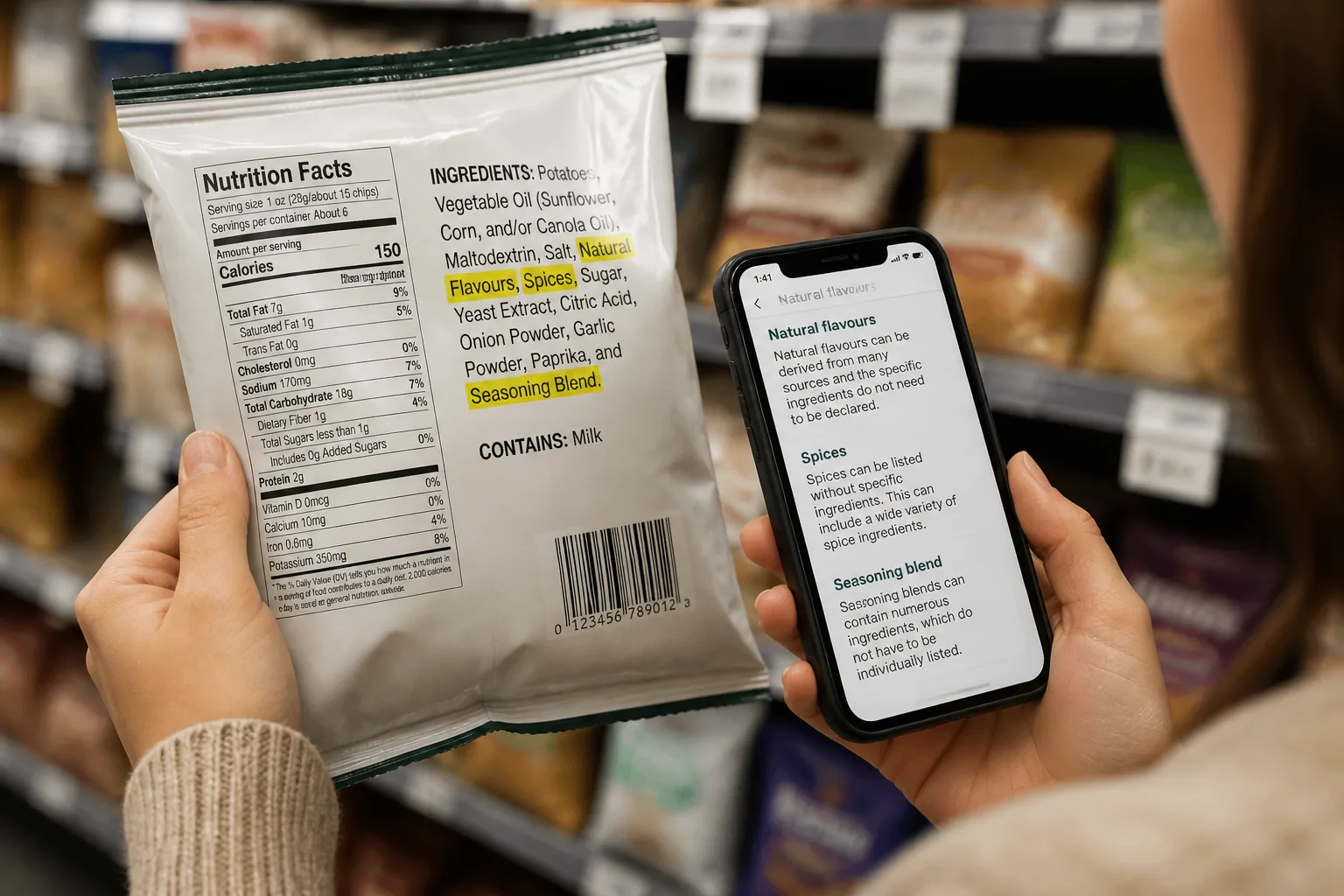
How to Decode Allergen Labelling Words Like a Pro: “Natural Flavours,” “Spices,” and the Fine Print
If you live with food allergies or intolerances, ingredient lists can feel like they were written to be helpful and confusing at the same time. Most of the time, the problem is not that labels are totally hiding information. It is that some ingredient names are broad enough to cover a lot of possible formulations, and that can make it hard to know what is actually inside a product. Words like “natural flavours,” “spices,” “seasoning blend,” “flavouring,” and “modified starch” often look harmless, but they can sometimes hide ingredients that matter a lot when you are trying to avoid allergens.
The goal here is not to turn every vague term into panic. It is to help you understand what these labels can legally mean, where allergen risk still exists, and when you should slow down and investigate a little further. In some cases, these terms are low risk. In others, they deserve extra caution, especially when the product also has a cross-contact warning or comes from a manufacturer that is not very transparent.
Why Vague Ingredient Labels Matter for Allergy Safety
Ingredient labels are supposed to help you make safe decisions, but in practice, some terms are intentionally broad. In the United States, the FD&C Act requires packaged foods to list ingredients by their common or usual name, yet FDA rules allow certain ingredients such as spices and flavorings to be grouped under umbrella terms instead of being named one by one. That means the label can be legally correct and still leave you with a question mark when you are trying to avoid a specific allergen. The FDA explains this in its allergen labeling guidance, including the way spices, flavorings, and some colorings may be declared collectively rather than individually. Source: https://www.fda.gov/regulatory-information/search-fda-guidance-documents/guidance-industry-questions-and-answers-regarding-food-allergen-labeling-edition-5
For shoppers managing allergies, the challenge is simple: you are often reading for hidden risk, not just for names. A product can look safe at a glance because it does not list milk, egg, or nuts in plain sight, but one vague term can still leave room for uncertainty. That is why learning to recognize these catch-all ingredients is such an important part of safer label reading.
What “Natural Flavours” Can Actually Mean
“Natural flavor” sounds reassuring, but legally it is much broader than many people think. Under U.S. regulation, natural flavor may include essential oils, oleoresins, extracts, protein hydrolysates, distillates, or products of roasting, heating, or enzymolysis, as long as they are derived from plant or animal sources and their primary purpose is flavor rather than nutrition. In other words, the word natural does not mean allergen-free, and it does not mean simple. It describes the source and function of the ingredient, not whether it contains a major allergen. Source: https://www.law.cornell.edu/cfr/text/9/317.2
This is where a lot of shoppers get tripped up. A natural flavour might be plant-based, but it might also be made from something you need to avoid, or it may contain a carrier or subcomponent that matters for your allergy. The point is not that every natural flavour is dangerous. It is that the term can legally cover many different inputs, so you should not assume the word natural tells you anything useful about allergen safety on its own.
That is why it is smart to treat natural flavours as a prompt to keep reading, especially if you are avoiding milk, egg, soy, wheat, sesame, peanuts, tree nuts, fish, shellfish, or another ingredient that can show up unexpectedly in processed foods. If the label includes a separate “Contains” statement or specifies the allergen source in parentheses, that is far more useful than the flavour term itself.
When “Spices” and “Seasoning Blends” Become a Red Flag
“Spices” is another term that can look more precise than it really is. By regulation, spice means whole, broken, or ground aromatic vegetable substances used mainly for seasoning, and manufacturers can often declare them collectively without listing each spice by name. That is convenient for brands, but it can be frustrating for consumers who want to know exactly what is in the product. Source: https://www.law.cornell.edu/cfr/text/9/317.2
Seasoning blends are even more complicated. They often contain true spices, but they may also include salt, sugar, dextrose, onion or garlic powder, monosodium glutamate, anti-caking agents, or flavoring compounds. Some of those ingredients must be named individually if they are not covered by a collective term. If any component is a major allergen, it must be disclosed using the allergen source name. The FDA has also noted that seasonings can be labeled under broad seasoning terminology when appropriate, but allergen disclosure rules still apply. Source: https://www.fda.gov/regulatory-information/search-fda-guidance-documents/cpg-sec-525650-labeling-seasonings
This is one of those places where the word blend should make you slow down. A blend is not inherently unsafe, but it tells you that the product may contain many sub-ingredients, and some of those may be carried over from an allergen-containing processing line or used as part of a flavor system. If the product is something you have reacted to before, or if it is a food category with frequent hidden ingredients such as soups, chips, sauces, or instant meals, it is worth checking the manufacturer’s allergen statement before buying.
Other Confusing Terms: Flavouring, Modified Starch, Extracts, and More
“Flavouring” by itself is another broad umbrella term. It may hide a complex formulation used to create a specific taste profile, and that formulation can sometimes include allergenic ingredients or derivatives. The same general caution applies to “extracts,” which can be plant-based, animal-derived, or processed with solvents and carriers that are not obvious from the front of the package.
“Modified food starch” is a particularly important term for people avoiding gluten or wheat. Modified starch can come from corn, potato, tapioca, or other sources, but it may also originate from wheat or other gluten-containing grains. If the modified starch is derived from wheat, the label must disclose wheat under U.S. allergen rules, either in the ingredient list or in a “Contains” statement. For gluten-free claims, the product must meet the FDA’s standard of 20 ppm or less gluten, and the source of the starch still matters. Source: https://www.hhs.gov/guidance/sites/default/files/hhs-guidance-documents/FDA/FDA-Guidance-Jan2025-AllergenLabelingQA-12292024.pdf
A useful rule of thumb is that the more technical and generic the ingredient name sounds, the more likely it is to require context. That does not mean it is automatically unsafe. It means you should pay attention to whether the package gives you a source, a “Contains” statement, or a more detailed manufacturer explanation.
Legal Definitions vs. What Shoppers Think They Mean
One of the biggest label-reading traps is assuming that words mean what they sound like in everyday language. In ordinary shopping, natural may seem like a promise of purity, spice may sound like a simple kitchen ingredient, and modified starch may look like a plain texture helper. In regulatory language, those terms are functional categories, not consumer reassurance statements.
The law is trying to balance practicality and disclosure. Regulators allow broad terms because listing every single component of a flavor or seasoning system would make labels hard to read and, in some cases, reveal proprietary formulas. At the same time, allergen rules require that major allergens such as milk, eggs, fish, shellfish, tree nuts, peanuts, wheat, soy, and sesame be disclosed when present. Sesame was added as the 9th major allergen under the FASTER Act, effective January 1, 2023. Source: https://www.fda.gov/food/nutrition-food-labeling-and-critical-foods/food-allergies
So the legal standard is not full transparency. It is targeted transparency for major allergens. That means a vague term can be perfectly compliant while still being unhelpful if you are trying to avoid a non-top-9 ingredient, or if you are worried about cross-contact rather than deliberate inclusion.
Where Allergen Rules Help and Where the Gaps Still Are
Allergen labeling laws do a lot of the heavy lifting, but they are not a complete safety system. If a major allergen is intentionally used in a flavoring, spice mix, incidental additive, or processing aid, it must be declared using the allergen source name. That disclosure can appear in the ingredient list or in a separate “Contains” statement. FDA guidance makes clear that incidental additives are generally exempt from listing, but not if they contain a major allergen. Source: https://www.fda.gov/media/117410/download?attachment=&os=0
The gaps start where the rules stop. Advisory statements like “may contain milk” or “produced in a facility that also handles peanuts” are voluntary, not mandatory. They are not the same as an ingredient declaration, and they do not mean the product definitely contains the allergen. They do, however, signal a possible cross-contact risk that some shoppers will want to avoid. The FDA notes that these warnings are not required by FALCPA, even though manufacturers are expected to follow good manufacturing practices to reduce contamination risks. Source: https://www.fda.gov/food/nutrition-food-labeling-and-critical-foods/food-allergies
This is why two products with nearly identical ingredient panels can still deserve very different levels of caution. One may have a clear “Contains” statement and no advisory warning, while the other may hide behind generic terms and add a facility warning on top. The label is giving you information, but you still need to interpret how much confidence that information actually provides.
How Bokha Flags Vague Terms and Supports Better Decisions
This is exactly the kind of situation where a scanner app can save time. Bokha: Food Allergy Scanner App helps you scan product barcodes and see allergen information in less than a second. It can detect 13 allergens, traces, and additives, which makes it useful when ingredient labels use broad terms that are hard to decode at a glance. You can learn more here: https://findthe.app/bokha
The value of a tool like Bokha is not that it replaces your judgment. It is that it helps flag products with ingredients or traces that deserve a second look, especially when terms like flavouring, spices, or modified starch appear on the label. For busy shopping trips, that kind of fast screening can be a practical way to reduce mistakes and save time in the supermarket.
If you already know your personal risk profile, a scanner can be a helpful filter. It can point you toward products that look compatible with your restrictions and help you focus your energy on the borderline cases instead of re-reading every single package from scratch.
When to Contact the Manufacturer Before You Buy
Sometimes the label gives you enough to make a decision. Sometimes it does not. If a product uses several vague terms, has an advisory warning, or is made by a brand that does not clearly disclose allergen sourcing, contacting the manufacturer is a smart next step. This is especially true if you have a severe allergy, react to trace amounts, or are buying a product for a child or someone with a history of serious reactions.
When you reach out, ask direct questions. Does the “natural flavour” contain or derive from my allergen? Is the modified starch sourced from wheat? Are the spices processed on shared equipment with my allergen? Do you use a dedicated line or cleaning validation between batches? Clear questions usually get clearer answers than broad ones.
It also helps to ask whether the formula has changed recently. Even brands with good habits can reformulate without making the change obvious on older packaging images or third-party listings. Manufacturer confirmation is often the best way to close the gap between what a label legally says and what you personally need to know.
Why “Free-From” and Allergy-Friendly Claims Still Need a Second Look
Claims like “free-from,” “allergy-friendly,” or “made for sensitive eaters” can be reassuring, but they do not automatically guarantee safety for every allergen. A product may be free from one ingredient and still contain another one you need to avoid. It may also be produced in a facility that handles your allergen, even if the brand has taken steps to minimize risk.
The important distinction is between marketing and disclosure. Front-of-pack claims are designed to grab your attention. The ingredient list, allergen statement, and advisory notes are where the real details usually live. If a product sounds safe because of its marketing but still contains broad terms like spice blend or flavouring, you should read the full label before trusting the claim.
In practice, “free-from” labels are best treated as a starting point, not the final answer. They can be genuinely helpful, but they are only as reliable as the brand’s formulation, sourcing, and manufacturing controls. If the product is new to you, or if your allergy is severe, you should still verify the full ingredient and warning information every time.
A Practical Checklist for Safer Label Reading Every Time
A good label-reading routine can make shopping much less stressful. Start by scanning the ingredient list for broad terms such as natural flavours, spices, flavouring, seasoning blend, extract, and modified starch. Then look for a separate “Contains” statement and any advisory warning about shared equipment or facility handling. If a major allergen appears anywhere, make sure the source name is clearly identified. Sesame, in particular, now falls under the same disclosure rules as the other major allergens in the United States.
Next, ask yourself whether the product category is one where hidden ingredients are common. Sauces, soups, snacks, candies, seasoning mixes, and processed meats are often more complicated than they first appear. If the label feels incomplete, do not guess. Check the brand website, contact the manufacturer, or use a scanner app like Bokha to quickly flag suspicious ingredients before you buy. When you combine label reading with a simple verification habit, you give yourself a much better chance of avoiding surprises at the table.
The bottom line is that vague ingredient words are not automatically dangerous, but they are never worth ignoring. Once you understand what these terms legally cover, you can read labels more calmly and more accurately. That is the real skill: not panic, not blind trust, but informed caution.