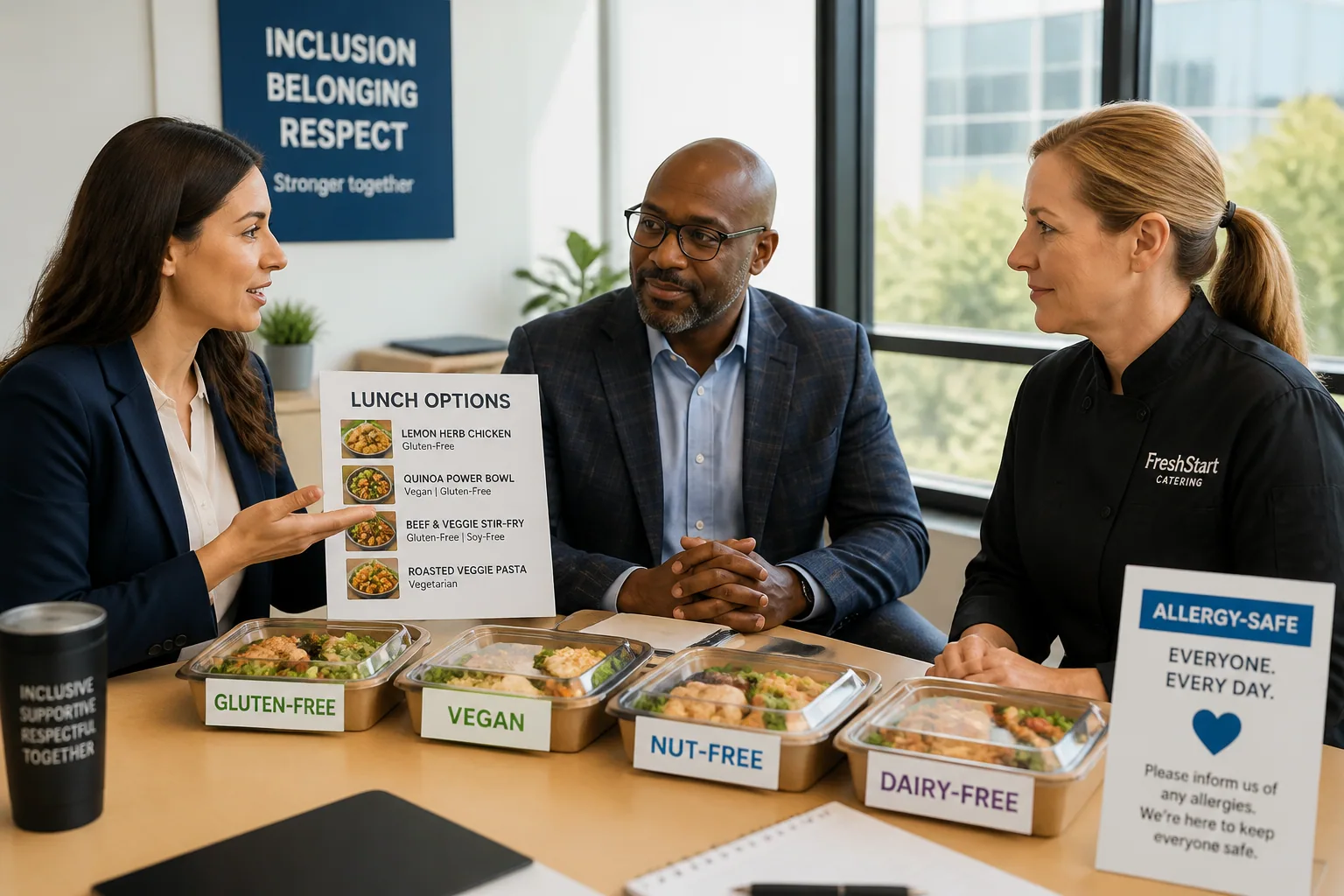
How to Advocate for Your Food Allergy Needs at Work: Empowerment, Accommodation & Inclusion
Having a food allergy at work is not just about what you eat at lunch. It can affect meetings, celebrations, travel, shared kitchens, catered events, and even how safe you feel walking into the office each day. For many professionals, the hardest part is not only avoiding allergens, but also having to explain, remind, and negotiate those needs over and over again. That constant planning can be exhausting.
This is why food allergy advocacy at work matters. It is about safety, yes, but also dignity. It is about being able to do your job without feeling like a problem to manage. And it is about creating a workplace where inclusion is practical, not performative.
Food allergies are common enough that most workplaces already have employees who are affected. The CDC estimates that about 6.7% of U.S. adults have a diagnosed food allergy, and 31.7% have at least one allergic condition. Food allergies are also diagnosed more frequently in Black non-Hispanic adults, which is one more reason why workplace policies should be thoughtful, equitable, and not based on assumptions about who needs support. Source: https://www.cdc.gov/nchs/products/databriefs/db545.htm
Why Food Allergy Advocacy at Work Matters
At work, food is everywhere. It appears in onboarding lunches, birthday cakes, client dinners, conference buffets, and casual team celebrations. If you live with a food allergy, each of those moments can carry a hidden checklist: What is being served? Who touched it? Was it labeled correctly? Is there a safe alternative? Can I eat here without drawing attention to myself?
That mental load is real. It can create anxiety, reduce participation, and make employees feel isolated from team culture. And because food is often treated as a social glue, people with allergies can end up feeling as if saying no to food means saying no to belonging. In practice, advocacy helps shift that dynamic. Instead of one employee bearing all the responsibility, the workplace begins to share responsibility for safety and inclusion.
There is also a public health reality behind this. A survey of approximately 40,000 U.S. adults found that 11% report a convincing food allergy, nearly half developed at least one allergy during adulthood, and more than half have experienced a severe reaction. Yet fewer than 25% currently own epinephrine auto-injectors. Source: https://www.foodallergy.org/resources/adults-food-allergies
That makes awareness at work especially important. A colleague’s allergy is not a minor preference, and it is not something they are being difficult about. For some people, exposure can be medically serious very quickly.
When Food Allergies May Be Protected Under the ADA
In the United States, severe food allergies may qualify as a disability under federal law, including Title I of the Americans with Disabilities Act, the ADA Amendments Act of 2008, and Section 504 of the Rehabilitation Act. Source: https://www.foodallergy.org/resources/information-employers
That does not mean every food allergy automatically qualifies. The key question is whether the condition substantially limits a major life activity such as breathing or eating. Documentation from a medical professional can help establish that a food allergy meets the legal standard and support a request for accommodation. Source: https://www.eeoc.gov/laws/guidance/ada-questions-and-answers
If your allergy qualifies, your employer has an obligation to consider reasonable accommodations unless doing so would create an undue hardship. The Equal Employment Opportunity Commission notes that accommodations can include changes to workplace policies, schedules, or the physical environment, as well as reassignment to a vacant position when appropriate. Source: https://www.eeoc.gov/laws/guidance/enforcement-guidance-reasonable-accommodation-and-undue-hardship-under-ada
One important part of this process is the interactive dialogue. Once an employee requests an accommodation, the employer must engage in a discussion to clarify the need and explore possible solutions. In other words, the process is meant to be collaborative, not adversarial. Source: https://www.eeoc.gov/laws/guidance/enforcement-guidance-reasonable-accommodation-and-undue-hardship-under-ada
What Reasonable Workplace Accommodations Can Look Like
Reasonable accommodations for food allergies are often simple, practical changes that reduce risk without disrupting business operations. These are not usually dramatic interventions. More often, they are small systems that make safety easier and more consistent.
Examples can include designated cups, plates, utensils, or serving tools for shared spaces. Employers can also create separate storage areas in refrigerators or cabinets, post signage in kitchens, and provide education for staff about cross-contact and reaction response. Source: https://www.foodallergy.org/resources/information-employers
Other useful accommodations may include permission to store safe food at your desk or in a designated area, advance notice of catered meals, the option to attend meetings virtually when food is heavily involved, or a private eating space when that lowers exposure risk. For some workers, the accommodation may be as simple as not requiring food-based team bonding to count as participation.
The best accommodations are specific to the person and the workplace. A warehouse worker, teacher, office manager, and traveling sales representative may all need different support. That is why the interactive process matters so much. It helps translate a general need for safety into a workable plan.
How to Talk to HR, Managers, and Coworkers About Your Needs
The most effective advocacy is clear, calm, and specific. You do not need to overexplain your diagnosis to every person you meet. But it helps to decide in advance who needs to know what, and what kind of support you are actually asking for.
For HR, the conversation can be more formal. If you need an accommodation, ask for an interactive process conversation and be ready to share documentation if appropriate. Keep the focus on the workplace barrier and the solution. For example: I have a food allergy that can cause a serious reaction. I am requesting separate storage and advance notice of catered meals so I can participate safely.
For managers, it often helps to connect the request to productivity and participation. You might say that when meetings include food without notice, you spend extra time trying to verify ingredients and that it makes it harder to focus. The goal is not to make anyone feel guilty. The goal is to make the issue understandable and actionable.
For coworkers, shorter is often better. You can say: I have a food allergy, so I can’t share utensils or eat food that may have had cross-contact. If we are doing a potluck, I may need a labeled ingredient list or to bring my own meal. Thank you for understanding.
You do not owe everyone a medical lecture. A simple boundary is enough. Repeating the same script can also reduce emotional strain because it gives you a reliable way to answer questions without improvising every time.
Explaining Cross-Contact and Why ‘Ingredient-Free’ Is Not Always Safe
One of the most important things to communicate at work is that an ingredient-free label does not automatically mean safe. Cross-contact can happen during cooking, plating, transport, or serving. A dish can be made without your allergen and still become risky if it was prepared on the same surface, with the same utensil, or next to foods that contain your trigger.
This is especially relevant in office kitchens, catered lunches, and potlucks, where people may mean well but use shared spoons, buffet lines, or unwashed serving tools. Even trace exposure can matter for some people. That is why policy-level support is better than relying on individual vigilance alone.
FoodAllergy.org’s Aware Workplace framework emphasizes exactly this point: employees should not be left to repeatedly educate coworkers or manage cross-contact risks on their own. Safer systems need to be built into the workplace culture and policy, not improvised event by event. Source: https://www.foodallergy.org/sites/default/files/2025-04/Food Allergy-Aware Workplace 1.pdf
If you are explaining this to a team, a useful line is: I need more than ingredient awareness. I also need cross-contact precautions, because a food can be made without my allergen and still not be safe for me.
How to Request Safer Catered Meetings, Office Parties, and Potlucks
Catered events can be one of the highest-risk parts of workplace culture because they combine food, time pressure, and limited information. The easiest way to improve safety is to ask for advance notice. If you know what is being served, you can decide whether to attend, what to eat, and what questions to ask before the food arrives.
When requesting accommodation for a meeting or event, be specific about what would help. For example: Please share the menu at least 48 hours in advance, label dishes clearly, and keep allergen-containing foods separated from safer options. If possible, could there be a plated meal or a separate serving area?
For office parties, ask whether there can be a safe alternative meal or whether you can contribute a dish that you know is safe for you. If the event is casual and food is central, sometimes the safest option is to attend for the social part and not the meal itself. That is not being antisocial. It is self-protection.
Potlucks deserve special caution because many people assume homemade food is safer than catered food. In reality, the opposite can be true if ingredients are unclear and serving methods are shared. A better setup is to require labels with key allergens, ask contributors to use clean utensils, and avoid double-dipping or shared tongs. Even then, you may still choose not to eat.
Employers who want to do better can treat these gatherings like accessibility issues, not just social events. Planning for safety in advance is much easier than trying to fix a problem after someone has already been exposed.
Practical Strategies for Participating Safely Without Feeling Isolated
The goal is not only to survive workplace food events. It is to stay connected without constantly feeling on guard. That often means making a few strategic choices that help you participate on your own terms.
Some people bring their own meal or snack and still join the table. Others ask to eat before the event so they are not pressured to take risks. Some keep trusted shelf-stable foods at work for unexpected meetings. Others choose to focus on the conversation rather than the buffet. There is no single correct way to participate.
It can also help to identify one ally, such as a manager, teammate, or event organizer who understands your needs and can quietly reinforce them. Having one person who remembers to check labels or speak up about utensils can reduce the burden on you.
If travel is part of your job, planning becomes even more important. Carrying safe snacks, knowing how to ask hotel or conference staff about ingredients, and keeping emergency medication accessible can make business trips less stressful. The more predictable your system is, the less energy you spend in each new setting.
For quick grocery planning before a trip or a long office day, a tool like Bokha: Food Allergy Scanner App can also help by scanning barcodes and identifying allergens in less than a second. You can learn more here: https://findthe.app/bokha
Scripts for Speaking Up Without Feeling Like a Burden
Many people with food allergies struggle not with knowing what they need, but with saying it out loud. It can feel awkward to ask for special handling, especially in a culture that praises being easygoing. Having scripts ready can make it easier.
Here are a few examples:
For HR: I have a medically significant food allergy and would like to discuss reasonable accommodations that reduce exposure risk in shared food spaces and catered events.
For a manager: To participate safely in team meals, I need advance notice of menus and clear labeling. If that is not possible, I may need an alternative way to join the meeting.
For a coworker: I appreciate the invite. Because of my allergy, I can’t eat food with cross-contact risk, so I’ll bring my own meal. I’m still happy to join the conversation.
For an event organizer: Could you let me know what ingredients are in the menu and whether serving utensils will be separate? That will help me decide how to participate safely.
The main idea is to speak as if your need is normal, because it is. Clear does not mean rude. Direct does not mean difficult.
Managing Anxiety, Exclusion, and the Emotional Labor of Self-Advocacy
Food allergy advocacy is not only logistical. It is emotional. A lot of people are carrying fear in the background: fear of a reaction, fear of being embarrassed, fear of being excluded, and fear of becoming the person who always has to ask for something different.
That emotional labor can be heavy. You may find yourself scanning every event for risk, anticipating awkward questions, and deciding how much to disclose. You may also worry that speaking up will label you as demanding. These feelings are valid, and they are common.
One helpful reframing is that you are not creating inconvenience. You are identifying a real accessibility need. In the same way a wheelchair ramp is not a luxury, allergen-aware planning is not a favor. It is part of making the workplace usable for everyone who works there.
It can also help to give yourself permission to opt out when an event is not worth the stress. Not every team lunch needs to become a test of bravery. Protecting your well-being is not the same as refusing to be part of the team. Sometimes it is the only sustainable way to remain part of it.
If anxiety is high, support from a clinician, therapist, or allergy specialist can help. Some people benefit from written plans, while others benefit from practicing scripts or rehearsing how to respond when someone minimizes the allergy. The right support can make advocacy feel less like a battle and more like a skill.
How Employers and Team Leads Can Build Food-Inclusive Workplace Culture
Food-inclusive workplaces do not rely on the most outspoken employee to keep everyone safe. They use policy, communication, and routine practices that make inclusion the default. That is the spirit of an Aware Workplace. Source: https://www.foodallergy.org/sites/default/files/2025-04/Food Allergy-Aware Workplace 1.pdf
Leaders can start by normalizing label checks, separate utensils, and advance notice for food-based events. They can encourage staff to ask before bringing allergen-containing foods to shared meetings, and they can make it acceptable for employees to bring their own safe food without comment.
Training matters too. If staff understand cross-contact and know how to respond to a reaction, they are less likely to make harmful assumptions. A supportive workplace also makes it clear that allergies are health issues, not personality quirks.
Managers can also help by thinking beyond the event itself. Is there a non-food way to celebrate? Can team bonding include activities that are not centered on eating? Can the company avoid treating food as the only reward or social glue? Small shifts like these can make the culture feel much more inclusive.
Examples, Tools, Checklists, and Food Allergy Advocacy Resources
A strong advocacy plan is easier to maintain when you have a few tools ready. Here is a simple framework you can adapt:
Know your triggers and level of risk. Be clear about which allergens matter, what symptoms you experience, and what situations are most likely to create exposure.
Decide who needs to know. HR may need more detail than coworkers. Event organizers may only need the practical instructions.
Prepare a short script. Repeating the same language helps reduce stress and inconsistency.
Request specific accommodations. Examples include advance menu notice, separate utensils, labeled dishes, or safe storage space.
Keep emergency information accessible. Make sure you know your own action plan and that the people around you know how to respond in an emergency.
Review travel and event plans early. The earlier you ask, the more options you usually have.
Helpful resources include the CDC’s adult food allergy data, EEOC guidance on reasonable accommodation, and FoodAllergy.org’s employer-focused information and workplace framework. These are useful not only for employees, but also for HR teams and managers who want to do the right thing and need practical direction.
When possible, keep a written record of accommodation requests and responses. That can help you stay organized and can make future conversations easier if your needs change or if leadership changes.
Creating a Personal Workplace Allergy Action Plan
A personal workplace allergy action plan can reduce stress because it turns a vague worry into a concrete process. Start by writing down your allergens, typical symptoms, emergency steps, key contacts, and the accommodations that would make the biggest difference.
Then map out the moments that create the most risk: onboarding lunches, standing meetings, conferences, office celebrations, travel days, and shared kitchen use. For each one, decide what you need in order to participate safely or whether you would rather opt out.
You can also prepare a brief accommodation request, a coworker script, and an emergency contact card. If you are traveling, add a list of safe snacks, restaurant questions, and any app or tool you rely on for checking products and ingredients.
The purpose of the plan is not to make you feel hypervigilant. It is to make safety more automatic so you can focus more of your attention on your work, your colleagues, and your actual life. Advocacy should support your participation, not consume it.
When workplaces understand food allergies as a real access issue, everyone benefits. Employees feel safer. Managers handle fewer misunderstandings. Teams become more inclusive. And the burden of safety shifts from one anxious person to a shared standard of care.