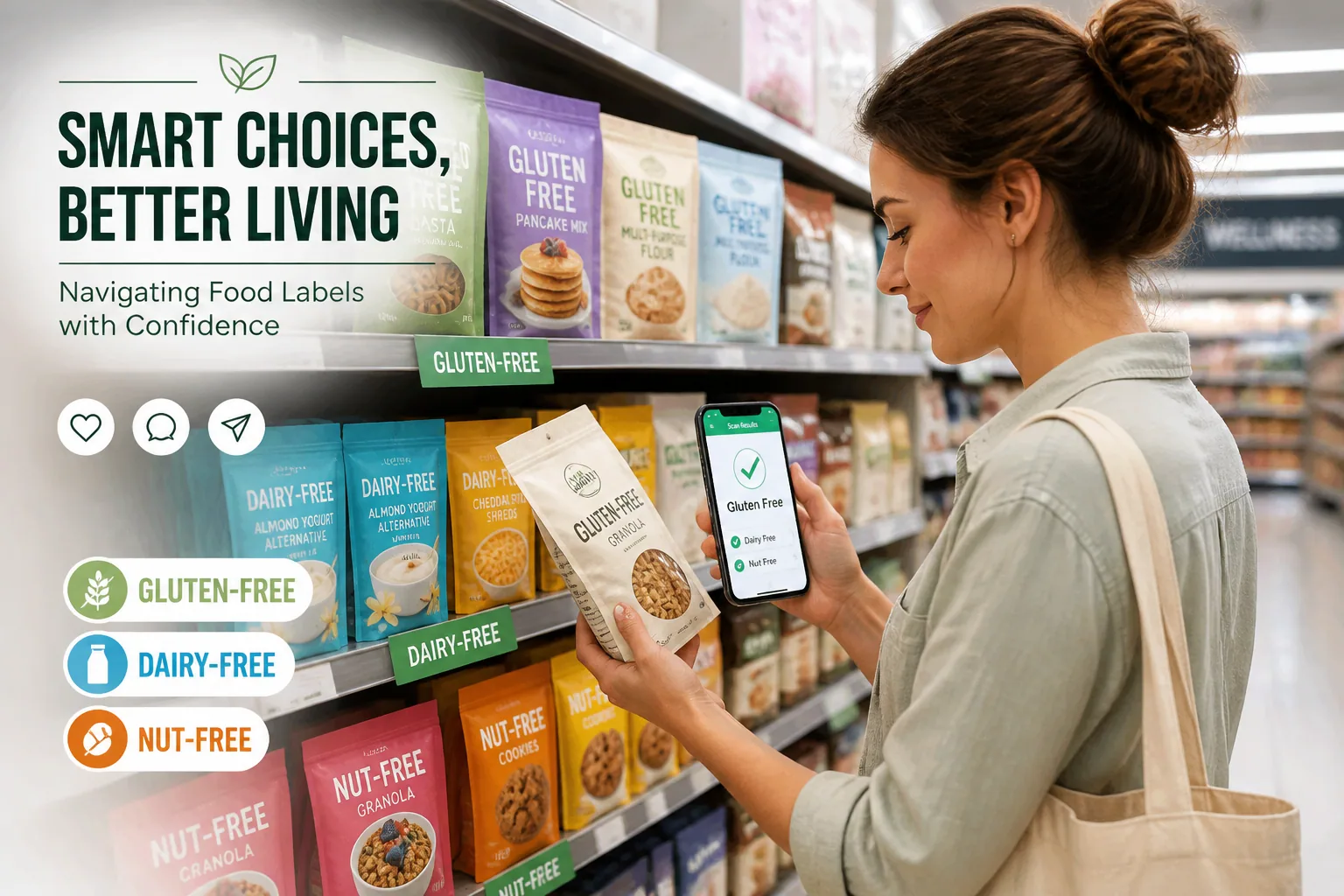
How the “Free-From” Lifestyle Became a Movement and What It Means for Food Allergy Wellness
What started as a practical way to avoid trigger ingredients has turned into one of the most visible food movements of the decade. “Free-from” now shows up everywhere, from supermarket shelves to social feeds, and it is no longer limited to people managing diagnosed allergies or intolerances. It has become part of a broader wellness mindset built around cleaner labels, fewer surprises, and more control over what goes into the body.
That shift matters because food allergy and intolerance are not niche concerns. In 2024, about 3 in 10 U.S. adults and children reported having a seasonal allergy, eczema, or food allergy, and roughly 6.7% of adults and 5.3% of children have a diagnosed food allergy, according to the CDC: https://www.cdc.gov/nchs/pressroom/releases/20260108.html
At the same time, the market itself is expanding quickly. The global free-from food market is projected to grow at about 6.5% CAGR from 2025 to 2033, which shows that this is more than a passing trend. It is becoming a permanent part of how people shop, eat, and evaluate trust in food brands: https://www.imarcgroup.com/free-from-food-market
The Rise of “Free-From” From Niche Need to Mainstream Movement
For a long time, free-from products were mostly found in specialty aisles and health food stores. They were designed for a relatively small audience, often people with celiac disease, lactose intolerance, or a specific food allergy. Today, that audience is much wider. Many consumers are looking for gluten-free, dairy-free, nut-free, or additive-conscious products not only because they need them, but because they want simpler ingredient lists and a greater sense of safety.
This is one reason the category has moved into mainstream retail. In 2024, supermarkets and hypermarkets accounted for nearly 48.34% of global free-from food market share, while online retail is projected to grow quickly, with a CAGR of about 15.76% through 2030: https://www.mordorintelligence.com/market-analysis/free-from-food
The rise of free-from also reflects a cultural shift. Food is increasingly treated as an extension of identity, health, and self-management. People want products that match their bodies, beliefs, and routines, and brands have responded by making “free-from” claims more visible on packaging, menus, and advertising.
How Social Media and Gen Z Wellness Culture Accelerated the Trend
Social media has done a lot of work in normalizing the free-from lifestyle. What used to feel medical or restrictive is now often framed as empowering, aesthetic, and modern. TikTok, Instagram, and creator-led wellness content have helped turn label reading into a habit and ingredient avoidance into a form of self-care.
Gen Z has played a major role in this. Younger consumers are especially likely to value transparency, ethical sourcing, and “cleaner” products. Even when they do not have a diagnosed allergy, many still look for free-from options because they associate them with better quality, less processing, and more control.
That cultural momentum can be positive, but it can also blur the line between preference and medical necessity. A person who avoids gluten because of a trend is in a very different situation from someone with celiac disease or a severe wheat allergy. The first can experiment. The second cannot afford confusion.
What “Free-From” Really Means and What It Does Not
Free-from claims sound simple, but they are not all equivalent. A product labeled gluten-free is not just a product that contains no obvious wheat flour. In the U.S., gluten-free labeling has been regulated since 2014, and the label must correspond to food that contains less than 20 parts per million of gluten: https://www.fda.gov/food/nutrition-education-resources-materials/gluten-and-food-labeling
That matters because gluten can appear in unexpected forms, through ingredients, processing, or cross-contact. The standard gives consumers a meaningful threshold, but it still does not guarantee that every product will be safe for every person in every circumstance. Sensitivity levels vary, and so do manufacturing environments.
The same principle applies to other free-from terms. Dairy-free does not always mean free of every milk-derived processing aid. Nut-free does not always mean the entire supply chain is free of nut exposure. Free-from is a claim, not a universal safety guarantee.
There is also an important difference between allergy and intolerance. Lactose-free products may help people with lactose intolerance, but they are not the same as milk-free products for someone with a milk allergy. A consumer needs to know exactly which ingredient or allergen is being excluded, and why.
Regulations, Certifications, and the Labeling Rules That Matter
In the U.S., food allergy labeling is built around clear legal requirements. The Food Allergen Labeling and Consumer Protection Act, or FALCPA, defines eight major allergens that must be clearly labeled: milk, eggs, fish, shellfish, tree nuts, peanuts, wheat, and soy. Sesame became the ninth major allergen through the FASTER Act, effective January 1, 2023: https://www.fda.gov/food/food-allergies and https://www.fda.gov/food/food-allergensgluten-free-guidance-documents-regulatory-information/food-allergen-labeling-and-consumer-protection-act-2004-falcpa
Those rules help a lot, but they do not remove all risk. Advisory labels such as “may contain” or “produced in a facility that also processes [allergen]” are voluntary, not required by law. The FDA notes that these statements must be truthful and not misleading, but they are not a substitute for good manufacturing practices: https://www.fda.gov/food/food-allergies
That means consumers often need to interpret several signals at once. Ingredient statements matter. Allergen disclosures matter. Facility statements matter. Certifications can help too, especially when they come from reputable third-party programs with defined testing or production standards. But even certifications should be understood as support, not magic.
The main takeaway is simple: regulation creates a baseline, not a guarantee of personal safety. For someone with food allergy risk, label reading remains a skill, not just a habit.
Common Pitfalls: Misleading Claims and Hidden Allergen Risks
One of the biggest dangers in the free-from world is assuming that a front-of-pack claim tells the whole story. It usually does not. A product can highlight one favorable attribute while still containing another ingredient that matters to you. It can be vegan, but not nut-free. It can be gluten-free, but made in a facility with significant cross-contact risk. It can be dairy-free, but still contain additives or processing aids that some consumers prefer to avoid.
The U.S. legal framework also reminds us that “free-of” claims must not be misleading. Under 16 CFR § 260.9, claims like “free of dairy,” “nut-free,” or “gluten-free” must be truthful and not deceptive in context: https://www.law.cornell.edu/cfr/text/16/260.9
Another pitfall is overreliance on the word “natural” or on wellness language that sounds safer than it is. A product marketed as clean, simple, or wholesome may still contain allergens, traces, or additives that matter to a sensitive shopper. Marketing language is not the same thing as safety data.
Cross-contact is especially important. Even when an ingredient is excluded from the recipe, exposure can still happen during sourcing, transport, manufacturing, or packaging. That is why the same label can mean one thing on paper and another thing in practice if the production environment is not tightly managed.
How Food Brands Are Adapting With Allergen-Friendly Innovation
Brands have clearly noticed that free-from is no longer a fringe category. They are reformulating recipes, simplifying ingredient lists, and developing products that better serve people with allergies and intolerances. In many cases, the innovation is not just about removal. It is about replacement, texture, taste, and trust.
One example is the growing strength of lactose-free dairy. Sales of lactose-free and lactose-reduced dairy milk grew about 14% in the year leading up to May 2025, and lactose-free dairy is outpacing many plant-based milks in market growth: https://www.axios.com/2025/05/06/lactose-free-fairlife-milk-popular
That is a useful reminder that the market is not simply moving away from dairy. In many cases, it is moving toward modified or more digestible versions of familiar foods. Consumers often want the comfort of a product they already know, with fewer consequences for their bodies.
Across categories, brands are also paying more attention to additive transparency. Shoppers increasingly want to know not just whether a product contains milk or peanuts, but whether it contains colors, preservatives, or other ingredients they would rather avoid. That broader demand has pushed free-from beyond allergen management into the wider conversation about food processing and label trust.
Why Label Transparency and Additive Awareness Matter More Than Ever
For people with food allergies, transparency is not a luxury. It is a safety issue. For people with intolerances, it is often a comfort and quality-of-life issue. And for many other consumers, it has become part of how they judge a brand’s honesty.
This is why additive awareness is now part of the free-from conversation. Colorants, preservatives, and other additives may not be allergens in the strict sense, but they still affect purchasing decisions. Some shoppers want fewer ingredients. Others are trying to avoid specific compounds because of sensitivities or dietary goals. Either way, the clearer the label, the better the decision.
The challenge is that transparency is not always standardized. Brands may disclose different details on different packaging formats, in different markets, or across product lines. That makes it hard to rely on memory alone. If a product changes recipe, supplier, or production site, a previously safe item may not remain safe forever.
How Consumers Can Shop Smarter and Verify Safety
The best way to shop in a free-from world is to treat every purchase as a quick verification process. First, check the ingredient list carefully, not just the front label. Then look for the major allergens in plain language. Next, review any advisory statements and think about your own risk tolerance and medical needs.
If you have a diagnosed allergy, especially a severe one, you should be more conservative than someone avoiding an ingredient by preference. Multiple food allergies are common too. Roughly 45.3% of food-allergic U.S. adults report being allergic to multiple foods, according to published research: https://pmc.ncbi.nlm.nih.gov/articles/PMC6324316/
That same research found that among U.S. adults, 10.8% are estimated to have one or more convincing food allergies, though 19.0% believe they do. The most common allergens included shellfish, milk, peanuts, tree nuts, and fin fish. This gap between perceived and confirmed allergy is another reason that consumer education matters so much: https://pmc.ncbi.nlm.nih.gov/articles/PMC6324316/
It is also worth remembering that documented food allergies and intolerances show up frequently in health records. In U.S. electronic health record data for 2.7 million patients, 3.6% had one or more documented food allergies or intolerances, with shellfish, fruits and vegetables, dairy, peanuts, and tree nuts among the most commonly recorded: https://pmc.ncbi.nlm.nih.gov/articles/PMC7059078/
Practical shopping habits can reduce risk a lot. Buy from brands that update labels consistently. Re-check products after packaging redesigns. When in doubt, contact the manufacturer. And if a product is for a child, a guest, or anyone with a severe reaction history, be even more careful than usual.
Using Apps and Tools Like Bokha to Scan for Allergens and Additives
Digital tools can make free-from shopping easier, especially when you are standing in a store aisle trying to compare products quickly. A barcode scanner can help turn a confusing label into a fast answer, which is exactly where tools like Bokha can be useful. Bokha is a mobile app for iOS and Android that scans product barcodes and identifies allergens in less than a second: https://findthe.app/bokha
The app detects 13 allergens, including lactose, gluten, peanut, egg, soy, fish, shellfish, tree nuts, wheat, mustard, celery, mint, and sulphites, along with traces and additives such as colorants and preservatives. For people trying to save time while reducing risk, that kind of support can make everyday shopping much easier.
Of course, an app should complement label reading, not replace it. Product formulas change. Regional versions differ. And the safest habit is still to verify the package in hand. But as a decision aid, a scanner can reduce friction, lower stress, and help people compare alternatives faster.
What the “Free-From” Movement Means for the Future of Food Allergy Wellness
The free-from movement is doing more than changing grocery shelves. It is reshaping expectations. Consumers now expect clearer labels, better allergen disclosure, more thoughtful sourcing, and more transparency about additives and processing. That pressure is pushing brands and regulators in the same direction: toward clearer information and fewer surprises.
For food allergy wellness, that is encouraging. A market that takes allergens seriously is one where people can participate more fully in daily life, whether they are shopping for themselves, their children, or their households. It also creates more room for innovation, since better labeling and safer formulation can open up access to millions of shoppers who were previously underserved.
The big lesson is that “free-from” is no longer just about what is missing from a recipe. It is about trust. And in food allergy wellness, trust is everything. The more informed consumers become, and the more transparent brands are willing to be, the safer and more usable this movement becomes for everyone.