How Much Allergen Is Too Much? Understanding Thresholds, Trace Exposure, and Food Allergy Safety
For someone newly living with a food allergy, one of the hardest questions is also one of the most important: how much allergen is too much? The uncomfortable truth is that there is no single number that is safe for everyone. A tiny amount may be harmless for one person and dangerous for another. That is why understanding allergen thresholds, trace exposure, and labeling language can make such a difference in day-to-day safety.
This matters because allergens are not just a problem at obvious doses. They can appear through cross-contact during manufacturing, during cooking, or even through residue left on shared equipment. So when a label says “may contain,” or when a package is described as “trace” something, those words can carry real meaning, but not always a standardized one. Knowing what they do and do not promise is essential for making safer choices.
Why Tiny Amounts of Allergens Matter
Food allergy reactions can happen at very low doses. Research has shown that for milk, egg, and peanut allergies, about 1% of allergic people may react to around 1 mg of natural food, which is only a few hundred micrograms of protein. In other words, what looks like an invisible amount can still matter medically. Source: https://pubmed.ncbi.nlm.nih.gov/15126945/
Peanut allergy is a good example of how much individual sensitivity can vary. One study found that among peanut-allergic individuals, about 50% showed objective symptoms after ingesting 3 mg of peanut protein, but thresholds ranged widely from 100 micrograms all the way up to 1 gram of protein. Another analysis estimated that roughly 4.5% of peanut-allergic individuals reacting to 5 mg or less of peanut protein may experience anaphylaxis. Source: https://pubmed.ncbi.nlm.nih.gov/12464959/ and https://pmc.ncbi.nlm.nih.gov/articles/PMC8168954/
This is why food allergy safety is not only about avoiding obvious ingredients. It is also about understanding that tiny exposures can still be enough to trigger symptoms in sensitive individuals, especially when the allergy is severe or the person has reacted to very small amounts in the past.
What Scientists Mean by an Allergen Threshold
In allergy science, a threshold is the smallest dose of an allergen that triggers a reaction in a person or in a group of people. It is not a fixed universal number. Instead, it is usually discussed as a distribution across allergic populations, because some people react at much lower doses than others.
Researchers often use terms like LOAEL, which means lowest observed adverse effect level, and ED values, which describe the dose expected to affect a certain percentage of allergic individuals. For example, an ED01 is the dose estimated to trigger reactions in 1% of allergic people, while an ED05 would affect 5%.
This is where the science becomes practical. If a product contains only a tiny amount of allergen, it may still be too much for a highly sensitive person even if it would not trigger a reaction in most other allergic consumers. Thresholds help researchers estimate risk, but they do not create a blanket “safe” level for every person.
How Thresholds Are Determined in Research
Thresholds are usually estimated through oral food challenge data, where carefully measured doses are given under medical supervision. Researchers pool results from many patients to identify patterns and estimate population response levels. That is how scientists can approximate figures like ED01 or ED05 for specific allergens.
For cow’s milk allergy, one analysis found a cumulative ED01 of about 0.3 mg protein and an ED05 of about 2.9 mg. Another pooled estimate reported ED05 values of roughly 2.1 mg for peanut, 2.3 mg for egg, 2.4 mg for milk, 0.8 mg for cashew, and 2.7 mg for sesame protein. Source: https://www.sciencedirect.com/science/article/pii/S0091674922007643 and https://pmc.ncbi.nlm.nih.gov/articles/PMC11382767/
These numbers are useful because they give public health experts a way to think about risk management. But they are still estimates based on study populations, challenge methods, and statistical modeling. They do not tell you exactly what any one person will tolerate on a given day. Factors like recent illness, exercise, asthma control, medication, and individual biology can all influence how a reaction unfolds.
Why There Is No One-Size-Fits-All Safe Exposure Level
A major reason allergen management is so difficult is that sensitivity varies dramatically from person to person. Two people with the same allergy can have very different thresholds. One may tolerate trace amounts in a processed product, while another reacts to a smaller amount than standard testing can reliably detect.
That means there is no universally “safe” level of allergen for all allergic consumers. Even if a reference dose exists for policy discussion, it is not a guarantee of safety for every individual. It is better understood as a risk-management tool used by scientists, manufacturers, and regulators to reduce overall harm.
For caregivers, this is an important mindset shift. The goal is not to find the magic number that makes all risk disappear. The goal is to reduce exposure as much as reasonably possible, recognize that risk can never be reduced to zero in every setting, and make decisions based on the most sensitive person in the household.
Zero Allergens vs Below a Threshold: A Crucial Difference
When people see labels or marketing claims, it is easy to assume that “safe” means allergen-free. But there is a real difference between true allergen-free products and products that merely contain an amount below a proposed threshold. Those are not the same thing.
A product can be manufactured without intentionally using an allergen and still contain tiny traces due to cross-contact. A threshold-based approach may say that the amount present is low enough for a population-level decision, but that does not mean the food is truly allergen-free. For highly sensitive people, “below threshold” may still be enough to trigger symptoms.
This distinction is especially important for parents managing a child’s first allergy diagnosis. A label or product description may sound reassuring, but the real question is whether the food is genuinely free from the allergen or only likely to contain less than a measured amount.
What “Trace,” “Cross-Contact,” and “May Contain” Really Mean
In everyday language, “trace” sounds like a tiny amount, but not necessarily a dangerous one. In food allergy settings, though, it usually signals the possibility that an allergen may be present because of cross-contact. Cross-contact happens when a food picks up an allergen during growing, transport, storage, preparation, or packaging.
“May contain” statements are one of the most common examples of precautionary allergen labeling. In the United States, these statements are voluntary, not required by law, and they are not standardized. The FDA notes that these precautionary statements are used in response to possible cross-contact, but they do not follow a single mandatory format. Source: https://www.fda.gov/food/nutrition-food-labeling-and-critical-foods/food-allergies
So when a package says “may contain peanuts,” it is warning you about a possible risk, not telling you exactly how much is there. When it says “trace,” it is often a marketing or labeling term rather than a verified safety statement. In practice, these words should usually be treated as caution flags, especially for people with a history of severe reactions.
How Advisory Labeling Works and Where It Falls Short
Advisory labeling exists because food manufacturing is messy in the real world. Shared lines, airborne dust, ingredient storage, and cleaning limitations can all create cross-contact risk. Manufacturers often use “may contain” statements to reduce liability and communicate possible contamination concerns.
The problem is that these warnings are not always consistent or predictive. Some products with advisory labels may have negligible allergen presence, while others without such statements may still carry risk if cross-contact controls are weak. That inconsistency makes label interpretation frustrating for allergic consumers.
The FDA has acknowledged these issues in guidance and enforcement policy documents. Its draft Compliance Policy Guide Sec. 555.250, issued in May 2023, addresses labeling and prevention of cross-contact of major food allergens. It is important to note that this is guidance for enforcement policy, not a new law. Source: https://www.fda.gov/regulatory-information/search-fda-guidance-documents/cpg-sec-555250-statement-policy-labeling-and-preventing-cross-contact-common-food-allergens
The bigger takeaway is simple: advisory labels can help you identify higher-risk products, but they cannot guarantee a product is safe or unsafe on their own. They are one piece of a larger decision-making process.
Recent FDA and Regulatory Developments to Watch
Allergen threshold science is getting more attention from regulators. In February 2026, the FDA held Virtual Listening Sessions focused on “food allergen threshold concepts” and reference doses for major food allergens. That is a strong signal that public health agencies are actively exploring how threshold data might support better risk communication and labeling policy. Source: https://www.fda.gov/media/190635/download
Why does this matter for families? Because clearer reference points could eventually improve how manufacturers communicate risk. Better policy could reduce confusing labels, help standardize precautionary statements, and support more transparent decisions about when a product should be considered acceptable for allergic consumers.
Still, any regulatory move toward thresholds has to balance science, practicality, and safety. A reference dose is not the same thing as a personal tolerance level. For now, consumers should continue to treat labels conservatively and watch for updates from the FDA and other health authorities.
Can Sensors, Test Kits, and Scanners Detect Dangerous Traces?
Technology can help, but it is not a perfect solution. Traditional allergen detection methods such as ELISA are widely used, yet they can struggle in real-world food processing. Heat, hydrolysis, and protein modification can make allergens harder to detect accurately. Source: https://pubmed.ncbi.nlm.nih.gov/33260424/
Portable and digital allergen detection tools have also been developed, including systems such as Nima Sensor, Allergy Amulet, and iEAT-style prototypes. Research suggests these tools are promising for point-of-use testing, but they still face important limits: sensitivity varies, performance across food matrices is inconsistent, cost can be high, and regulatory approval remains a hurdle. Source: https://pmc.ncbi.nlm.nih.gov/articles/PMC12113666/
That means a sensor can be helpful as a second layer of protection, especially when eating packaged or prepared foods. But it should not replace careful label reading, ingredient verification, or medical advice from an allergist. No handheld device can fully eliminate uncertainty in a complex food environment.
How Barcode-Scanning Apps Can Help You Make Safer Choices
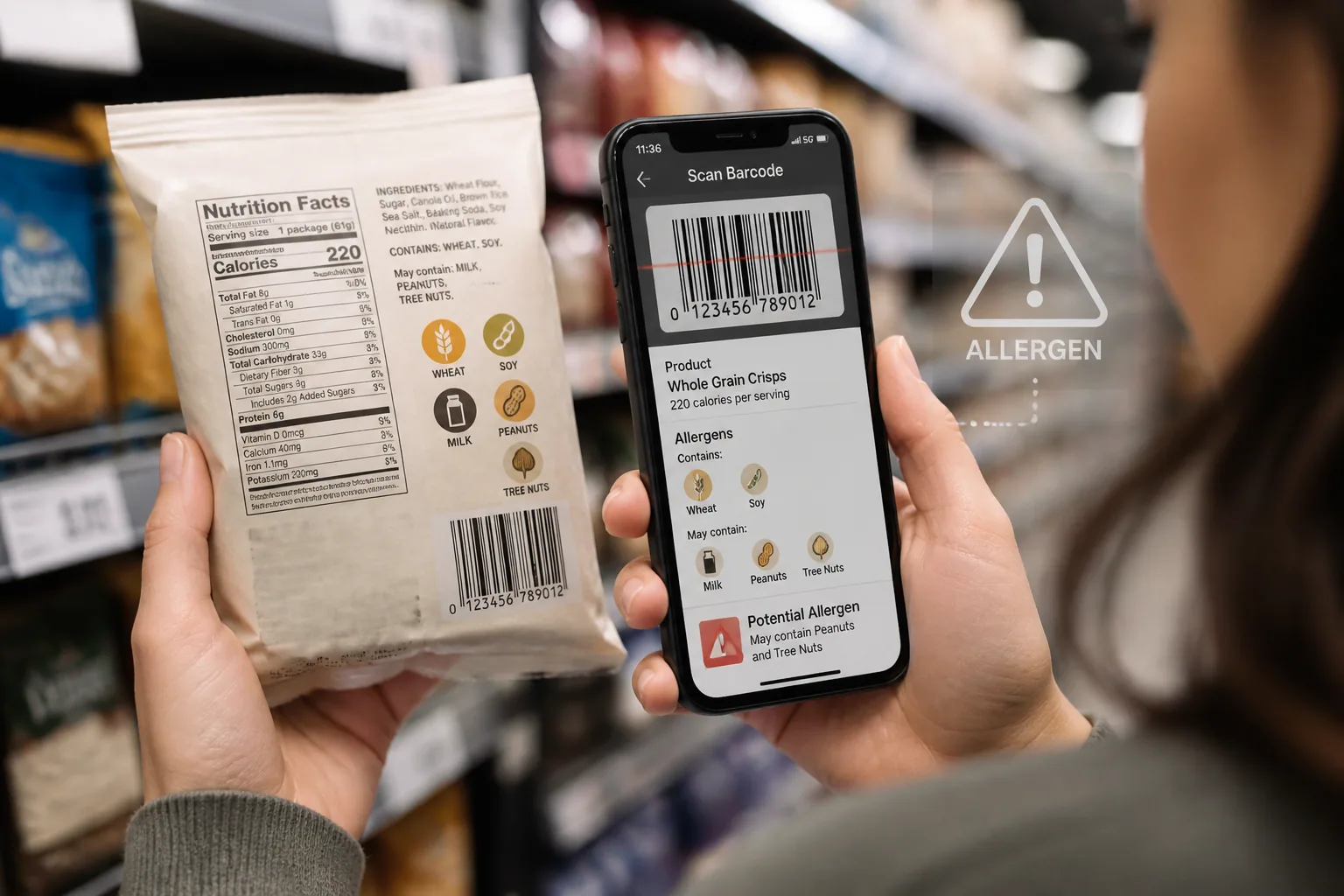
Barcode-scanning apps are useful because they save time and simplify the first step of checking a packaged food. Instead of reading every ingredient panel from scratch, you can scan a product and quickly identify listed allergens, traces, or additives that may matter to you.
That is especially helpful when shopping with children, comparing multiple brands, or checking items that you buy repeatedly. A good app can reduce decision fatigue and help you catch obvious risks before putting a product in your cart.
One example is Bokha: Food Allergy Scanner App, which lets users scan barcodes and discover allergens in less than a second. It detects 13 allergens, traces, and additives, making it a practical tool for faster shopping decisions: https://findthe.app/bokha
The key is to use these tools as support, not as a replacement for judgment. Databases can be incomplete, recipes can change, and scanning results are only as good as the data behind them. Always double-check if a product is newly reformulated, imported, or produced by a manufacturer with frequent ingredient changes.
Practical Tips for Navigating Low-Level Exposure Risk
If you are managing food allergies, the safest approach is usually the simplest: read every label every time, even on familiar products. Ingredients and manufacturing processes can change without much warning. A product you bought safely last month may not be identical today.
Also pay attention to how the food is made, not just what is printed on the front. Shared equipment, bakery cases, bulk bins, and restaurant kitchens are common cross-contact points. If a product has a precautionary label and you know the allergic person has reacted to tiny doses before, skipping it is often the most cautious choice.
When in doubt, choose products with clear ingredient lists and stronger allergen controls. Keep rescue medication accessible, especially for children or for anyone with a history of severe reactions. And remember that exercise, illness, stress, and asthma can all make reactions feel more intense or harder to manage.
If a product seems ambiguous, contact the manufacturer directly. Ask about shared lines, cleaning protocols, and whether they test for specific allergens. That will not guarantee safety, but it can give you more context than a vague “may contain” statement alone.
When to Trust the Label and When to Skip the Product
Trust the label when it is clear, current, and consistent with your or your child’s allergy plan. If the allergen is not present, no advisory warning applies, and the manufacturer’s allergen controls are solid, the product may be reasonable to consider. Even then, first exposures to a new product should be approached thoughtfully.
Skip the product when the label is unclear, when advisory statements mention your specific allergen, or when you know the person involved is highly sensitive to trace exposure. For some families, any precautionary label is enough reason to avoid a food altogether. That is not overreacting. It is risk management based on real threshold uncertainty.
The bottom line is that allergen thresholds are useful science, but they do not erase individual risk. Trace exposure can matter. “May contain” is not standardized. And the most practical protection still comes from a combination of careful label reading, smart shopping habits, and guidance from a qualified clinician.