How Fermented Foods Fit into a Food-Allergy-Safe Diet: Benefits, Risks & Smart Choices
Fermented foods have a confusing reputation for people with food allergies. On one hand, fermentation can break down proteins and sometimes make a food less reactive. On the other hand, fermented products can still contain the original allergen, hidden ingredients, or traces from cross-contact, which means “fermented” does not automatically mean “safe.” For allergy-aware shoppers, parents, and home cooks, the real question is not whether a food was fermented, but how it was made, what it contains, and how much the proteins were changed along the way.
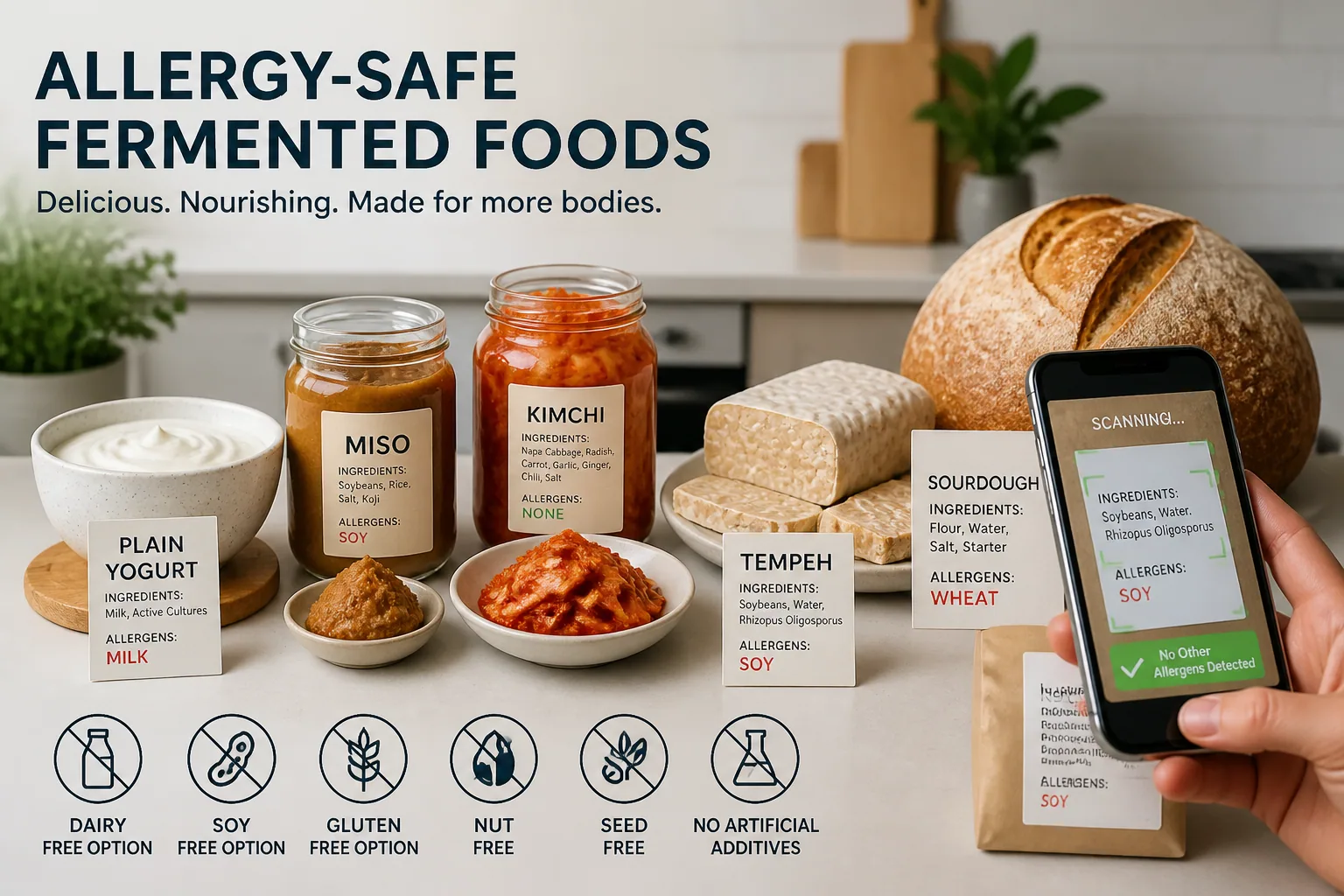
That is why fermented foods are suddenly on the radar for allergy-safe eating. Yogurt, kefir, soy sauce, miso, tempeh, kimchi, and sourdough can all look like smart choices in certain situations, but each one comes with its own allergy profile. The good news is that research increasingly shows that fermentation can reduce allergenicity in some foods. The caution is that the science is still inconsistent, and product labels can hide ingredients that matter a lot if you are avoiding milk, soy, wheat, or other allergens.
What Fermentation Actually Does to Food Proteins
At its simplest, fermentation is the work of microbes, usually bacteria, yeast, or mold, that transform food over time. Those microbes do not just change flavor and texture. They can also cut large proteins into smaller pieces through a process often called protein hydrolysis. For allergy management, that matters because many allergic reactions are triggered when the immune system recognizes certain protein structures, or epitopes, on a food protein.
If fermentation chops up a protein enough, the immune system may have a harder time recognizing it. In theory, that can lower allergenicity. But the key word is “may.” A protein can be partially degraded and still keep enough allergenic structure to trigger symptoms. That is why a food that looks “pre-digested” on paper is not automatically safe for a person with a true food allergy.
This protein-breaking effect is one reason fermented foods are being studied so closely. Researchers have observed that fermentation can reduce the allergenic activity of milk, soy, wheat, and even some plant proteins. Yet the exact outcome depends on the microbe, the fermentation time, the temperature, the starting ingredient, and whether the process is carefully controlled or more traditional and variable.
Can Fermentation Reduce Allergenicity? What the Science Says
The short answer is yes, sometimes. A recent systematic review reported that fermentation-mediated hydrolysis of allergenic proteins from gluten or soy often reduced allergenicity in fermented foods, but the authors also stressed that many studies had major methodological limitations. Importantly, in one case soy fermentation actually worsened allergic responses, which is a useful reminder that fermentation is not a guaranteed win for allergy safety. Source: https://pmc.ncbi.nlm.nih.gov/articles/PMC12812536/
There are also more specific examples that look promising. In one study, pea proteins Pis s 1 and Pis s 2 were first enzymatically hydrolyzed and then fermented by Lactobacillus plantarum, leading to a large drop in molecular weight and significantly reduced antibody binding in ELISA tests. That suggests lower immunogenicity, at least in the lab. Source: https://pmc.ncbi.nlm.nih.gov/articles/PMC8750503/
Milk proteins show a similar pattern in some studies. Fermenting milk with Lactobacillus helveticus and Streptococcus thermophilus reduced the antigenicity of whey proteins very strongly, including about 87% for alpha-lactalbumin and about 95% for beta-lactoglobulin in certain conditions. Research on sourdough has also found that Pediococcus acidilactici XZ31 had strong proteolytic activity and reduced wheat protein allergenicity. Source: https://pmc.ncbi.nlm.nih.gov/articles/PMC3634986/ and https://pubmed.ncbi.nlm.nih.gov/32517155/
Soy is another major example. Traditional soy proteins beta-conglycinin and glycinin were degraded by about 70% and 42% respectively through solid-state fermentation with Bacillus subtilis, depending on strain and duration. In another soy fermentation method that combined Lactococcus lactis, Aspergillus oryzae, and Bacillus subtilis, the resulting soybean protein fragments were under 10 kDa and soybean antigenicity became undetectable by immunoblot using serum from soy-allergic patients. Source: https://pmc.ncbi.nlm.nih.gov/articles/PMC11276117/ and https://www.sciencedirect.com/science/article/pii/S0091674904003252
Plant proteins can also become less reactive after more targeted processing. For example, a review of plant protein allergenicity reductions reported soy protein isolate IgE-binding reductions of about 83.8% to 94.8% after Lactobacillus plantarum fermentation, but the results depended strongly on strain selection, fermentation time, and treatment sequence. In other words, the microbiology matters a lot. Source: https://pmc.ncbi.nlm.nih.gov/articles/PMC11276117/
Why Fermented Foods Can Still Trigger Allergic Reactions
Even when proteins are partially hydrolyzed, an allergic person may still react. A 2005 study found that although lactobacilli degraded beta-lactoglobulin, IgE binding in human sera was not significantly decreased. That is a critical point: lower protein size or partial breakdown does not always translate into lower reaction risk in real life. Source: https://pubs.acs.org/doi/10.1021/jf048121w
There are several reasons for this. First, not all epitopes are destroyed by fermentation. Some remain intact, or enough of them remain intact to trigger the immune system. Second, fermentation can create a very mixed final product, where some proteins are degraded while others persist. Third, reactions can also happen because of ingredients added after fermentation, such as milk solids, wheat, soy sauce blends, flavorings, or stabilizers.
Another issue is that fermentation can change the food matrix without removing the allergen entirely. A smaller fragment may still be recognized by IgE antibodies. Or a product may be less likely to trigger a reaction in laboratory testing, yet still not be safe for someone with a history of severe allergy. That is why fermented food should be viewed as “potentially modified,” not “automatically hypoallergenic.”
Understanding Starter Cultures: Bacteria, Yeast, and Mold Differences
The starter culture used in fermentation can strongly influence the final allergen profile. Lactic acid bacteria such as Lactobacillus, Pediococcus, and Streptococcus often help break proteins down through proteolytic activity. Some strains do this much more effectively than others, which is why one yogurt or sourdough can behave very differently from another.
Yeasts can help ferment sugars and influence texture and flavor, while molds like Aspergillus oryzae are often used in soy- and grain-based fermentations such as miso and some traditional soy products. Mold-based fermentation can be useful, but it also adds complexity. The process may involve multiple steps, variable enzymes, and ingredient mixes that make allergen prediction harder for consumers.
This is one reason carefully controlled industrial fermentation tends to be more predictable than homemade or artisanal batches. A product made with a known starter culture and a standardized process is easier to assess than a traditionally fermented food that varies by region, recipe, and producer. For anyone with a serious allergy, “unknown culture, unknown process, unknown traces” is usually not a good combination.
Safer Picks for Some Allergy-Aware Shoppers
For some people, certain fermented foods may be easier to tolerate than their non-fermented equivalents, especially when the allergen protein is known to be substantially broken down during processing. Yogurt and kefir are often discussed in the context of milk protein changes, because fermentation can reduce the antigenicity of whey proteins in some conditions. But this does not make them safe for milk-allergic people in general. It simply means some proteins may be less reactive after fermentation.
Similarly, some sourdough breads may be better tolerated by some people with wheat sensitivity or digestive discomfort because fermentation can reduce certain protein fractions. Still, sourdough is not a safe gluten-free food unless it is specifically made and certified gluten-free, since wheat flour is often still present. If you have celiac disease or a wheat allergy, label scrutiny matters more than the word “sourdough.”
Tempeh and other carefully produced soy fermentations may also be of interest because fermentation can lower soy allergenicity in some studies. Yet soy remains a major allergen, and people with soy allergy should not assume tempeh is safe without expert guidance. In allergy care, “reduced allergenicity” is not the same as “non-allergenic.”
Fermented Foods That Deserve Extra Caution
Some fermented foods deserve a higher level of caution because their ingredient lists are variable or because the processing can be inconsistent. Miso is a good example. It is traditionally made from fermented soybeans, salt, and kōji, usually Aspergillus oryzae, but it can also include barley, wheat, rice, or other grains. That means it can pose a risk for soy allergy, wheat allergy, or gluten avoidance depending on the recipe. Source: https://en.wikipedia.org/wiki/Miso
Soy sauce is another classic example. Tamari can be wheat-free, but many soy sauces are made from both soy and wheat. Some products also use hydrolyzed proteins, which are not the same thing as traditional fermentation and can complicate allergen labeling. In older testing, hydrolyzed soy protein sauces were also linked to unexpected contaminants such as 3-MCPD. Source: https://en.wikipedia.org/wiki/Soy_sauce
Kimchi can look simple, but it often contains hidden issues for allergy-aware shoppers. Depending on the recipe, it may include fish sauce, shrimp paste, gluten-containing seasonings, or other flavor ingredients that are easy to miss. Homemade and restaurant versions can vary widely, so the label or ingredient disclosure matters more than the dish name.
Hidden Allergens, Cross-Contact, and Label Red Flags
The biggest day-to-day risk with fermented foods is often not the fermentation itself. It is the surrounding manufacturing environment. Cross-contact can happen when the same equipment handles milk, soy, wheat, nuts, or shellfish, especially in small-batch or shared-facility production. If you are highly sensitive, even a product with a seemingly safe ingredient list may still be risky if the factory processes major allergens.
Label red flags include vague terms like “natural flavors,” “seasoning,” “protein extract,” or “culture blend” when the product is not fully transparent. For soy-based products, watch for wheat, barley, or malt. For dairy-based products, look for milk solids, whey, casein, or cream added after fermentation. For kimchi, check for anchovy, shrimp, fish sauce, or wheat-containing gochujang or seasoning pastes.
Another important issue is inconsistency between batches. Traditional fermentation can vary more than people expect. A product might be safe one month and slightly different the next if the starter culture, fermentation length, or ingredient sourcing changes. For a food-allergic household, consistency is a safety feature, not just a quality preference.
How to Read Soy Sauce, Miso, Yogurt, and Kimchi Labels Smarter
Start by looking at the full ingredient list, not the front-of-pack marketing. If you are avoiding wheat, soy sauce and miso deserve extra attention because they can contain wheat even when the product name sounds simple. If you are avoiding soy, do not assume fermentation removes it. If you are avoiding milk, yogurt and kefir remain dairy products even when they are cultured.
For soy sauce, check whether it says tamari, wheat-free, or gluten-free, but still verify the allergen statement and manufacturer guidance. For miso, look for the base grain and whether barley or wheat is present. For yogurt and kefir, check for added flavorings, cookies, cereal, or nut-containing mix-ins, since the primary cultured base may not be the only issue. For kimchi, confirm whether fish, shellfish, wheat, or soy-based seasonings are used.
If a label is unclear, contact the manufacturer. This is especially useful for fermented foods because ingredient and process differences can be hidden behind generic product names. In allergy management, the safest assumption is not the one with the most tradition behind it, but the one you can verify.
What Studies Show and What Researchers Still Don’t Know
The research trend is encouraging, but it is not definitive. Studies repeatedly show that fermentation can reduce antigenicity in certain foods, including milk, soy, wheat, and peas. At the same time, many studies are laboratory-based, use small sample sizes, or measure changes in antibody binding rather than real-world clinical reactions. That means they may show a reduction in allergenicity without proving the food is safe for an allergic person to eat.
Researchers still do not fully know which fermentation conditions reliably produce a safe product for a specific allergy. The same food can behave differently depending on the starter strain, time, pH, salt, temperature, and added ingredients. Even more importantly, a lab result showing reduced IgE binding does not guarantee that every patient will tolerate the food without symptoms.
So the most practical conclusion is this: fermentation may improve the odds that a food is less allergenic, but it does not replace individualized allergy advice. If you have a diagnosed allergy, especially one involving anaphylaxis, fermented versions of allergenic foods should still be treated cautiously unless your allergist specifically advises otherwise.
How an App Can Help You Scan and Interpret Fermented Food Labels
This is where a tool like Bokha: Food Allergy Scanner App can be genuinely helpful. Bokha is a mobile app for iOS and Android that lets you scan product barcodes and discover allergens in less than a second. It can detect 13 allergens, including gluten, wheat, soy, milk-derived lactose, mustard, celery, mint, sulfites, and others, plus traces and additives. You can learn more here: https://findthe.app/bokha
For fermented foods, speed is only part of the value. The bigger benefit is that an app can help you notice hidden risks that are easy to miss when reading small print in a grocery aisle. It can flag soy, wheat, or milk ingredients in fermented products, help you compare similar items, and save time when ingredients vary across brands. That is especially useful when you are checking yogurt, miso, sauces, dips, marinades, or packaged kimchi where the allergen risk is often in the details.
Used well, an app is not a replacement for clinical judgment, but it can make the shopping process less stressful and more consistent. For families managing multiple allergies, that can be a meaningful advantage.
Smart Shopping and Home-Cooking Tips for an Allergy-Safer Approach
A safer approach to fermented foods starts with choosing simplicity over novelty. Short ingredient lists are easier to verify. Standardized brands are easier to trust than unknown bulk containers. Products that clearly list their starter cultures and allergen statements are easier to assess than foods with vague or changing labels. When possible, pick items made in dedicated facilities or under clear allergen-control policies.
At home, use separate utensils, cutting boards, fermentation jars, and storage containers if you are preparing allergy-sensitive foods. Avoid reusing brines, sauces, or starter cultures unless you are certain there has been no cross-contact. If you make kimchi, sourdough, or fermented soy products yourself, keep careful track of every ingredient, especially spice blends, condiments, and flour additions that can introduce hidden allergens.
The safest mindset is to treat fermentation as a tool, not a guarantee. It can improve flavor, preserve food, and sometimes lower allergenicity. But for people with food allergies, the decision still comes down to ingredients, processing, and individual tolerance. When in doubt, verify the label, check the source, and choose the most transparent option available.