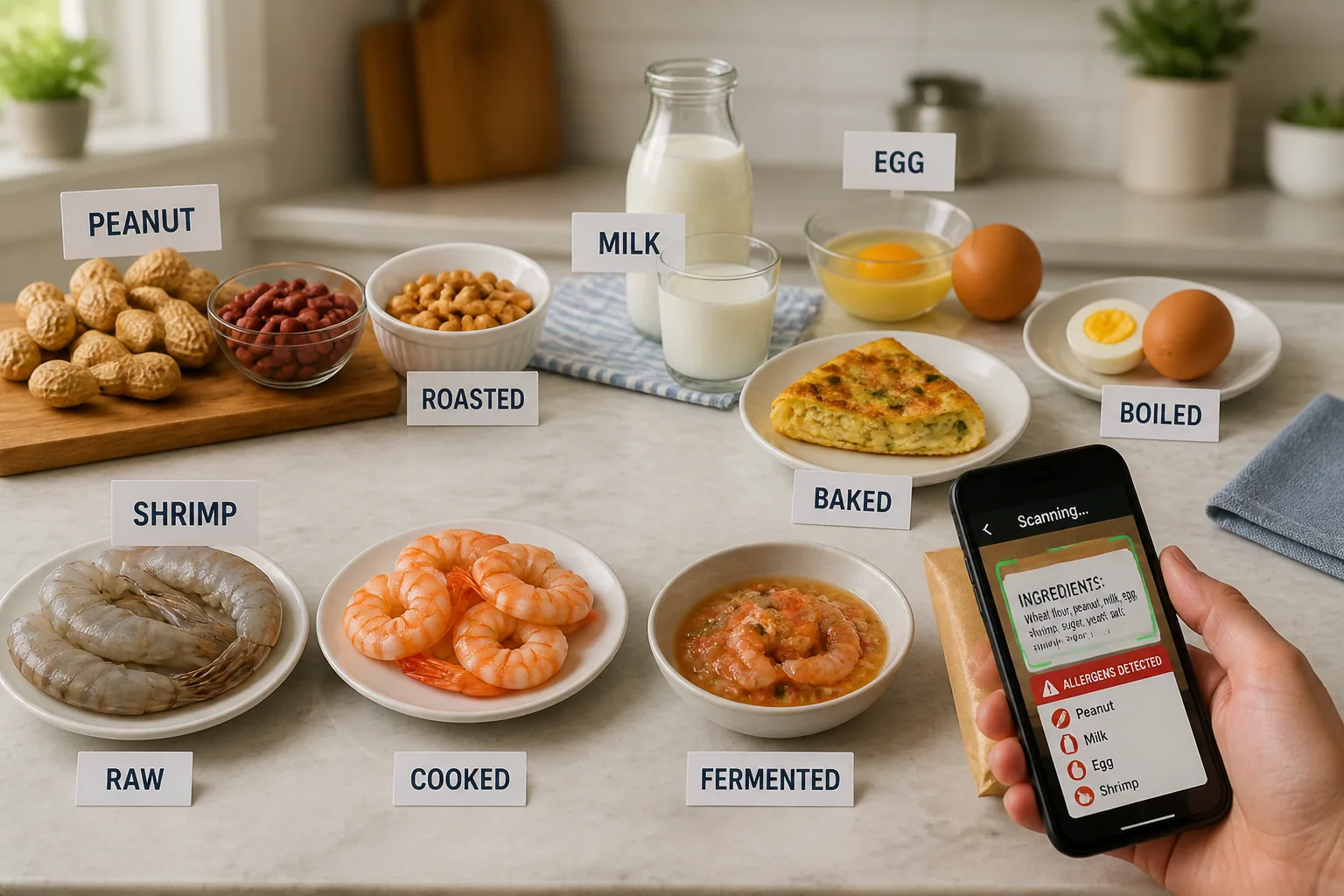
How Cooking & Processing Change the Real Risk of Allergen Foods
When people think about food allergies, they usually think in simple terms: peanut is dangerous, milk is dangerous, egg is dangerous. But the real story is more nuanced. The way a food is cooked or processed can change the shape, stability, and digestibility of its allergen proteins, which can make the same ingredient more or less likely to trigger a reaction. In other words, the risk is not only about what the food is, but also about how it was treated before it reached the plate.
That is why one person may react to roasted peanuts but tolerate boiled peanuts, or why a child with milk allergy may react to fresh milk but safely eat a muffin made with baked milk. Heat, moisture, pressure, fermentation, peeling, and industrial processing all influence allergen structure in different ways. Understanding those differences can help families, patients, and nutrition professionals make more informed decisions, especially when labels and scanner apps only tell part of the story.
Why the Same Allergen Can Behave Differently After Processing
Allergens are usually proteins, and proteins are not fixed objects. Their allergenic potential depends on how they fold, how they survive digestion, and whether immune cells can still recognize them. A raw peanut protein, a roasted peanut protein, and a boiled peanut protein may all come from the same food, but they can behave very differently in the body.
This is because processing can expose hidden protein regions, destroy sensitive ones, or even create tougher protein structures that survive digestion better. Some treatments reduce IgE binding, which may lower risk for some patients. Other treatments, especially dry high heat, can make certain proteins more resistant and sometimes more allergenic. So a label that says simply peanut, milk, egg, or fish does not tell the full risk story.
What Makes a Food Allergenic in the First Place
A food becomes allergenic when the immune system mistakenly identifies one of its proteins as a threat. In many food allergies, IgE antibodies bind to specific protein shapes called epitopes. Some epitopes depend on the protein’s 3D shape, while others depend on the amino acid sequence itself. That difference matters a lot when food is heated or processed.
If a protein loses its folded shape, conformational epitopes may disappear and the food can become less reactive. But if processing makes the protein more compact, more cross-linked, or more resistant to enzymes in the stomach, then the allergen may persist longer and interact more strongly with the immune system. This is why two foods with the same ingredient list can have very different clinical effects.
How Heat Changes Allergen Proteins
Heat can denature proteins, meaning it changes their structure. But not all heat is equal. Dry heat, moist heat, pressure, time, and the presence of other ingredients all influence what happens. A short pasteurization step is very different from a long bake inside a wheat matrix or a pressure-based cooking method like autoclaving.
In practical terms, heat can either reduce allergenicity or increase it. It may reduce allergenicity by unfolding proteins and making them easier to digest, or by destroying heat-sensitive epitopes. But it may increase allergenicity if it promotes Maillard reactions, protein aggregation, or structural changes that make proteins more resistant to digestion. The final outcome depends heavily on the food and the processing method.
Roasted vs Boiled Peanuts: Why Preparation Matters
Peanuts are a classic example of how preparation changes risk. Research shows that roasting peanuts at about 170 to 200 °C with dry heat can increase allergenicity. Roasting has been linked to increased resistance to gastric digestion, stronger IgE and cytokine responses, and structural changes in Ara h 2, including more beta-sheet and less alpha-helix content. In simple terms, roasting can make some peanut allergens more stable and more likely to survive digestion. See the studies on peanut processing and digestion-resistant peptides here: https://pmc.ncbi.nlm.nih.gov/articles/PMC6186550/ and https://pmc.ncbi.nlm.nih.gov/articles/PMC11497363/
Boiling tells a different story. Several studies have found that boiling reduces IgE binding to major peanut allergens such as Ara h 1, Ara h 2, and Ara h 3, likely because soluble proteins leach into the cooking water and because the protein structure becomes more open. Frying may still be hot, but in some assays it was less allergenic than roasting. That is a useful reminder that temperature alone does not tell you everything. Moisture and method matter too.
Pressure plus heat may reduce allergenicity even more. USDA research found that autoclaving peanuts under moist, high-pressure conditions significantly reduced antibody-binding capacity, likely because proteins became more unfolded and digestible. That kind of result matters because it shows that industrial or laboratory-style processing can change allergen behavior in ways that ordinary home cooking may not.
Egg and Milk Allergies: Why Some People Tolerate Baked Forms
Egg and milk allergies are among the clearest examples of baked tolerance. Many children who react to raw or lightly cooked egg can tolerate egg that has been baked into a wheat-based matrix like a muffin or cake. The same idea applies to milk: studies suggest that around 75% of children with cow’s milk allergy can tolerate extensively heated baked milk products. Baking destroys conformational IgE epitopes and makes the proteins less recognizable to the immune system.
This does not mean baked milk or baked egg are automatically safe for everyone. It means that in carefully selected patients, the processed form may be tolerated even when the fresh form is not. In milk allergy, baked milk has even been associated with faster development of tolerance to less heated milk compared with strict avoidance. You can read more in the studies on heated milk tolerance and baked milk acceleration here: https://pubmed.ncbi.nlm.nih.gov/18620743/ and https://pmc.ncbi.nlm.nih.gov/articles/PMC3151608/
The immune profile also seems to shift over time in some baked-milk-tolerant children. Researchers have observed smaller skin prick test wheals, lower casein-specific and milk-specific IgE, higher casein-specific IgG4, and reduced basophil reactivity. That pattern suggests that baked exposure, when medically appropriate, may be part of a structured pathway toward broader tolerance rather than a simple yes or no food rule.
Egg works in a similar way. Baking can denature egg white proteins and disrupt the conformational epitopes that IgE antibodies recognize. Many children tolerate baked egg but still react to soft-cooked or raw egg. For this reason, the exact cooking method is an essential part of any allergy conversation, not an afterthought.
What Happens During Fermentation, Pasteurization and Peeling
Not all processing is about heat. Fermentation can alter allergen proteins through microbial activity, acidification, and enzymatic breakdown. Depending on the food and the organism involved, fermentation may lower allergenicity by partially degrading proteins or changing how the proteins are presented in the food matrix. In some foods, this can make the final product more tolerable, although the effect is not uniform across all allergens.
Pasteurization is a good example of a process that sounds powerful but may not fully solve the allergy problem. For milk, standard pasteurization temperatures are usually not enough to reliably alter the allergen proteins on their own. The evidence suggests that baked milk, especially when embedded in a food matrix and exposed to higher heat for longer, is much more effective at reducing allergenicity than simple pasteurization.
Peeling can also matter, especially with produce and some nuts or fruits where allergenic compounds may be concentrated in the skin. Removing outer layers can reduce exposure to certain proteins or contaminants, although it does not eliminate the risk if the core still contains the relevant allergen. This is why processing context is always more important than a generic ingredient name.
How Industrial Processing Can Raise or Lower Risk
Industrial processing can change food allergenicity in both directions. Roasting, extrusion, spray drying, and pressure treatments can all modify protein structures and digestion patterns. In some cases, these methods create more stable allergen complexes. In others, they break proteins down or reduce immune recognition.
Tree nuts show this complexity well. One study on roasted hazelnuts found that roasting at 140 °C for 40 minutes reduced allergenic activity in birch pollen allergic patients, including lower skin prick test responses, histamine release, and specific IgE, although many participants still reacted in food challenge testing. So even when processing lowers risk, it does not necessarily make the food safe for everyone. See the hazelnut study here: https://pubmed.ncbi.nlm.nih.gov/12622744/
Seafood is another example. Fish allergen parvalbumin can be heat sensitive, but it is also relatively persistent. Some studies report that heating fish to 90 to 140 °C through boiling, roasting, or smoking reduces IgE binding or allergenicity, yet the matrix can protect the protein and slow the loss of allergenicity. So again, the cooking method and food environment matter just as much as the ingredient itself.
Why Food Labels and Allergy Scanners Miss Processing Context
Current food labels usually tell you whether a major allergen is present, but not whether that allergen is baked, boiled, roasted, fermented, or pressure-treated. That is a real limitation for people who may tolerate one form but not another. The same issue affects many ingredient scanners and allergy apps. They are useful for speed, but they usually flag any presence of the allergen without distinguishing the processing level or the food matrix.
Regulatory and scientific documents also acknowledge that cooked and raw foods can behave differently, but that nuance rarely appears in consumer-facing tools. As a result, scanning technology can be excellent for identifying a likely exposure, yet still fall short when the question is more specific: is this the same risk as the form I reacted to before? The answer is often no, but the app may not know that.
That is why tools should be seen as a first filter, not a full risk assessment. For example, Bokha: Food Allergy Scanner App can quickly scan barcodes and identify allergens, traces, and additives in seconds, which is helpful for everyday shopping. You can learn more here: https://findthe.app/bokha
What Scanner Users and Shoppers Should Watch For
If you rely on a scanner or a label, pay attention to several details beyond the allergen alert. First, look at whether the food is baked, boiled, roasted, fried, pasteurized, fermented, or raw. Second, check the ingredient context. Peanut flour in a bar is not the same as boiled peanuts. Baked milk in a muffin is not the same as a glass of milk. Third, consider cross-contact risk, because a processed product may still be made in a facility that handles the unprocessed allergen.
It is also wise to watch for vague terms like natural flavoring, spice blend, protein concentrate, or modified starch when you have a known allergy. These do not always indicate the same risk, but they can be harder to interpret than a plain ingredient list. The safest strategy is to combine scanner data with the product description, allergy history, and when needed, guidance from an allergist or dietitian.
How to Explore Tolerance Safely With Medical Guidance
If a person has previously reacted to an allergen, they should not test a baked or processed version on their own. Even if the literature suggests that baked milk, baked egg, or boiled peanut may be tolerated by some patients, individual risk varies a lot. Medical supervision matters because reactions can still happen, and the severity can be unpredictable.
In clinical practice, tolerance is usually explored through a careful history, IgE testing, skin prick testing, and when appropriate, a medically supervised oral food challenge. That challenge is the only reliable way to confirm whether a specific processed form is tolerated. It is especially important for children, because the diet may broaden over time, but only after proper evaluation.
The goal is not to encourage experimentation at home. The goal is to avoid unnecessary dietary restriction while also avoiding dangerous guesswork. If a clinician recommends trying a baked version, they will usually give exact preparation instructions, serving amounts, and a safety plan.
Lower-Risk Cooking and Buying Strategies for Everyday Life
For families living with food allergy, the best day-to-day strategy is to reduce uncertainty. Choose products with clear ingredient lists, prefer brands that state processing methods when relevant, and avoid assuming that all forms of the same food carry the same risk. When buying prepared foods, ask whether the allergen was baked, boiled, roasted, or used in a sauce or filling, because the final method can matter as much as the recipe name.
In the kitchen, keep equipment separate if cross-contact is an issue, and remember that changing the cooking method does not remove allergy risk unless tolerance has already been established. A roasted nut may be more allergenic than a boiled one, but a boiled nut is still a peanut. Likewise, baked milk is not safe for everyone with milk allergy, even if many children can tolerate it.
When shopping, a fast scanner can save time, especially for comparing packaged products, but it should be paired with practical checks. Look at the product type, the processing method, and any allergy advisory statement. If the answer is still unclear, choosing a simpler product with fewer ingredients is often the safer move.
Key Takeaways for Families, Patients and Nutrition Professionals
The main lesson is that allergen risk is not fixed. Processing can increase it, reduce it, or shift it into a different form that some people tolerate and others do not. Roasting often intensifies peanut allergenicity, while boiling and pressure-based moist heat can reduce it. Baked milk and baked egg may be tolerated by many patients who still react to less processed forms. Seafood, tree nuts, fermentation, and pasteurization all show their own processing effects, with important exceptions and limits.
For families and patients, the safest approach is to treat processing as clinically meaningful, not as a minor detail. For nutrition professionals, it means asking not only what food is being eaten, but how it was made. And for consumers using allergy tech, it means remembering that a scanner can identify an allergen, but not always the real risk behind the label.
Used thoughtfully, technology can help. But the best decisions still come from combining label reading, food processing awareness, and medical guidance when tolerance is being evaluated. In a world where the same ingredient can act very differently depending on how it is cooked, that context is everything.