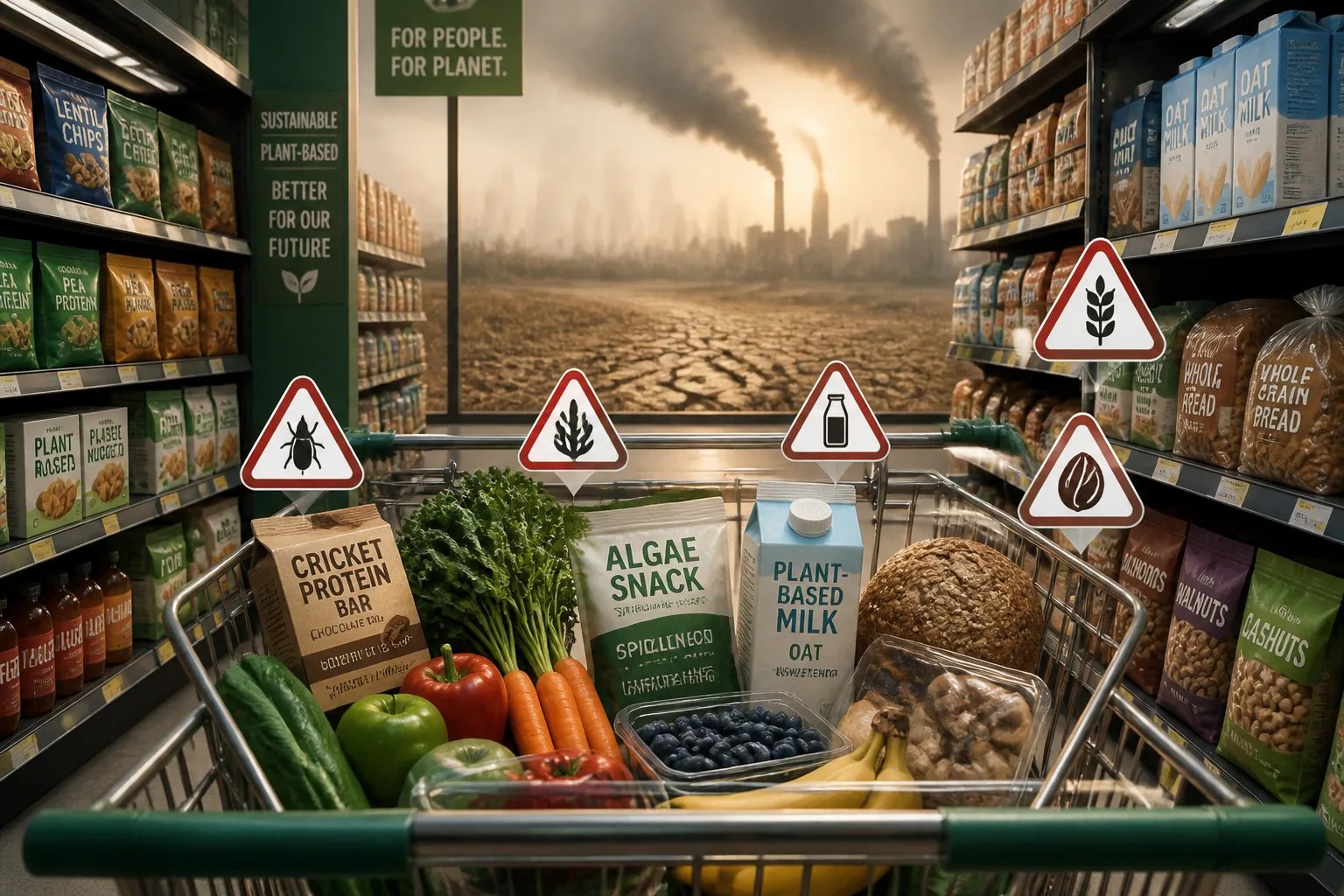
How Climate Change Is Changing What We’re Allergic To: New Risks in Your Grocery Cart
Climate change is not only changing the weather outside. It is also quietly changing what can end up triggering reactions inside the body. For many families, allergies have long been associated with the usual suspects like peanuts, milk, eggs, wheat, soy, shellfish, and tree nuts. But the reality is becoming more complicated. Rising carbon dioxide, heat stress, changing rainfall patterns, pollution, and new food technologies are reshaping crops and introducing novel proteins into the food supply. That means the allergy picture in your grocery cart is no longer as stable as it once seemed.
This matters because food allergy risk is not just about whether an ingredient is present. It is also about how that ingredient was grown, processed, concentrated, and combined with other proteins. Climate stress can change protein expression in familiar crops, while sustainable innovations like insect protein, algae ingredients, fungi-based foods, and cultured proteins may introduce unfamiliar allergenic properties that current systems are still learning how to assess. In other words, the grocery store is becoming a place where climate science, food safety, and allergy management increasingly overlap.
Why Climate Change Is Becoming a Food Allergy Issue
The link between climate change and allergies is often discussed in relation to pollen and respiratory symptoms, but the same forces can affect food allergy risk too. When plants are exposed to more carbon dioxide, heat, drought, or pollution, they may change the proteins they produce as part of their stress response. Some of those proteins are precisely the kinds that can matter for allergic people because they are stable, abundant, and resistant to digestion.
A report from AESAN, the Spanish food safety agency, notes that elevated CO₂ and rising temperatures can activate pathogenesis-related proteins in crops, which are defense proteins associated with increased allergenic potential in foods. That means climate stress can influence not just yield and nutrition, but the actual immune relevance of what ends up on the plate. Source: https://www.aesan.gob.es/AECOSAN/docs/documentos/seguridad_alimentaria/evaluacion_riesgos/informes_cc_ingles/ALLERGY_CLIMATE_CHANGE_.pdf
This is part of a bigger shift. Food systems are being forced to adapt to climate pressure, and that adaptation often includes changing crop varieties, expanding novel ingredients, and reformulating products to maintain supply. Each of those changes can alter allergen exposure in subtle ways, especially for consumers who already manage asthma, eczema, oral allergy syndrome, food intolerance, or diagnosed food allergies.
How Rising CO₂, Heat, and Pollution May Intensify Food Allergen Risks
One of the clearest climate signals is elevated atmospheric CO₂. In ragweed, a major aeroallergen, a doubling of CO₂ from about 350 to 700 ppm increased pollen production by roughly 61%. That finding is about airborne allergy, but it reveals something important: elevated CO₂ can amplify the biological output of allergenic organisms. Source: https://www.sciencedirect.com/science/article/pii/S1081120610620091
The same principle may affect food crops. More CO₂ does not simply mean more plant growth. It can also alter the balance of proteins, carbohydrates, and defensive compounds. In spring wheat, elevated CO₂ reduced grain protein content and storage protein levels, while heat stress increased some proteins, and the combination of elevated CO₂ plus heat weakened glutenin polymer content. That kind of shift can change how wheat behaves in baking, but it may also influence allergenic and immune-relevant properties. Source: https://www.sciencedirect.com/science/article/pii/S0308814618319423
Pollution adds another layer. When plants are exposed to environmental stress, they may produce more defense-related proteins. Some of these proteins are known to be relatively resistant to digestion and heat, which can make them more allergenic or at least more likely to survive processing. A recent review of allergen-related physicochemical traits highlights that resistance to proteases, thermal stability, structural persistence, and abundance are all associated with higher allergenic potency. Source: https://pmc.ncbi.nlm.nih.gov/articles/PMC11481639/
For consumers, this does not mean every climate-stressed crop becomes dangerous. It does mean the allergenicity of familiar foods is not fixed. As climate pressures increase, the same ingredient may behave differently from season to season, region to region, or even batch to batch.
When Familiar Foods Change: Crop Allergenicity and Environmental Stress
The uncomfortable truth is that your standard shopping list may contain foods whose protein profiles are already shifting. Wheat is a good example because its proteins are highly relevant to both food quality and allergy. If heat stress and elevated CO₂ can change glutenin polymer content and storage proteins, then a bag of flour from one growing season may not be biologically identical to one from another. That does not automatically create a new allergen, but it can alter potency, digestibility, and the way the immune system encounters the protein.
Other crops may respond by increasing defense-related proteins such as nonspecific lipid transfer proteins. These proteins are often discussed in the context of plant allergy because they are compact, stable, and can survive processing. In stress conditions, plants may ramp them up as a survival mechanism. From a food allergy perspective, that is exactly the type of response that deserves attention.
This is why allergen risk assessment cannot rely only on old assumptions like “this crop was always safe before.” Climate change is pushing the food system into an era where environmental context matters. The same fruit, grain, or legume may now come with a different protein signature depending on how it was grown, harvested, and processed.
Novel Proteins on the Shelf: Insects, Algae, and Cultured Food Ingredients
Climate adaptation is not only changing existing foods. It is also accelerating the introduction of novel foods designed to reduce land use, emissions, and dependence on traditional livestock. That includes edible insects, algae ingredients, fungi-derived proteins, plant-based alternatives, and cultured meat. These products can be promising from a sustainability standpoint, but they also create a new allergenicity challenge.
A 2026 review on future-proof frameworks for allergenicity assessment explains that as these novel foods become more common, their allergenic potential becomes more complex too. New proteins may introduce novel epitopes, structural changes, or cross-reactivity motifs that current standards do not fully capture. The review also highlights emerging tools such as AI and machine learning predictions, organ-on-a-chip systems, and microfluidic bioassays as part of next-generation safety assessment. Source: https://www.sciencedirect.com/science/article/pii/S0924224426000014
Insect protein is a particularly important example. A case study on black soldier fly larva proteins found that modern safety evaluation under EU regulation needs in silico, in vitro, and in vivo analyses to assess both cross-reactivity with known allergens and the risk of de novo sensitization. In plain terms, regulators and manufacturers cannot assume that because an ingredient is novel and sustainable, it is automatically low risk for allergic consumers. Source: https://pmc.ncbi.nlm.nih.gov/articles/PMC9749447/
This is especially relevant because many consumers do not expect insect-derived or algae-derived ingredients to appear in everyday products such as protein bars, pasta, snacks, supplements, bakery mixes, and meat analogs. When the ingredient source is unfamiliar, the chance of misunderstanding or incomplete label review increases.
What Recent Research Says About Emerging Allergenicity Frameworks
A major theme in the research is that allergenicity testing for novel foods is becoming more structured and layered. EFSA’s updated framework uses a tiered approach for evaluating novel proteins or foods. Tier I covers literature and phylogenetic relations. Tier II uses bioinformatics to search for cross-allergenicity. Tier III involves human serum IgE binding assays. Tier IV includes human challenge or exposure-based studies. Source: https://www.sciencedirect.com/science/article/pii/S0378427425019538
That tiered system matters because allergenicity is not a single test. It is a chain of evidence. The food’s source, sequence, structure, processing behavior, and biological activity all contribute to the final risk picture. For novel foods, especially those developed quickly to meet sustainability goals, this framework helps prevent a dangerous shortcut where only nutritional or environmental benefits are considered.
The direction of travel is clear: food safety is moving toward predictive and integrated methods. AI-based sequence analysis may flag likely cross-reactors before a product reaches market. Microfluidic models can simulate immune interactions more efficiently. Organ-on-a-chip systems may help bridge the gap between lab assays and human biology. But these methods complement, rather than replace, careful labeling and post-market vigilance.
Hidden Exposure Risks in Additives, Processing Aids, and Trace Proteins
A lot of allergy risk does not come from the headline ingredient alone. It comes from what is hiding around it. Additives, processing aids, flavor carriers, enzymes, emulsifiers, and trace proteins can all introduce exposure that is easy to miss if you only glance at the front of the package.
This is especially important with alternative proteins. A plant-based burger may be marketed as meat-free, but it can still contain soy, wheat, pea protein, or other cross-reactive components. An algae snack may look simple, yet algae cultivation, extraction, and blending steps can introduce residual proteins or shared processing equipment issues. Insect-based foods may also raise cross-reactivity concerns for people with shellfish allergy because of protein similarities that need to be evaluated carefully.
The practical takeaway is that allergy management now requires reading for sources, not just names. A product may be “dairy free” and still include caseinate-derived processing aids, or it may be free of the main allergen but made on shared lines with trace exposure. That is why robust formulation review matters for food brands and why consumers need tools that can flag more than just the obvious big eight or top fourteen allergens.
How to Read Labels for Unfamiliar Sources and Precautionary Warnings
When ingredients get unfamiliar, labels become the first line of defense. Start by scanning the full ingredient statement, not just the marketing claims on the front of the package. Look for terms like protein isolate, hydrolysate, concentrate, flour, flavoring, binder, culture, fiber blend, or texturized protein, because these may hide the real source of a potentially allergenic ingredient.
Also pay attention to precautionary allergen labeling, often written as may contain, produced in a facility with, or made on shared equipment with. These warnings are imperfect and inconsistent, but they are still important risk signals. In the United States, the FASTER Act updated the major allergen list to include sesame, reflecting the reality that regulatory systems do change as allergy science and exposure patterns evolve. Source: https://www.fda.gov/regulatory-information/search-fda-guidance-documents/guidance-industry-questions-and-answers-regarding-food-allergen-labeling-edition-5
For parents and highly sensitive shoppers, a good rule is to identify the source of every protein and every added functional ingredient. If a label says “pea protein” or “insect flour” or “algae extract,” treat it as a new decision point, not as a marketing detail. The same goes for allergy warnings on imported or reformulated foods, where naming conventions can differ by region.
How Apps and Ingredient-Checking Tools Like Bokha Can Help
Because modern labels can be dense and because ingredient sources are getting more complex, scanning tools can save time and reduce guesswork. Bokha is a free food-allergy scanner app that connects to the Open Food Facts database and lets users scan barcodes to detect allergens, traces, additives, and preservatives in less than a second. You can learn more here: https://findthe.app/bokha
That kind of tool is useful because it helps users move from manually decoding every label to getting a faster first-pass risk check. Bokha can detect 13 allergens, including lactose, gluten, peanut, egg, soy, fish, shellfish, tree nuts, wheat, mustard, celery, mint, and sulphites, along with trace warnings and ingredient additives. For someone navigating a climate-changed and innovation-heavy food supply, that kind of speed and clarity can make shopping less stressful.
No app replaces personal judgment or medical advice, of course. But when a package contains unfamiliar proteins, a scanner can help people catch ingredients they might otherwise miss, especially during rushed grocery trips, school lunch planning, or travel shopping.
What Parents, Allergy-Sensitive Shoppers, and Intolerant Consumers Should Do Now
For families managing allergies, the best strategy is to stay both cautious and practical. First, keep a current list of known allergens and cross-reactive foods for your household. Second, check every reformulated product, even ones you have purchased for years. Climate-driven supply changes and sustainability reformulations can affect the ingredient list without much fanfare.
Third, watch for new protein sources in snacks, supplements, cereals, baked goods, and frozen meals. Children are especially likely to encounter these products at school, in sports settings, and during social events where labels may not be easy to review. Fourth, use barcode scanning, manufacturer websites, and when necessary direct contact with the company to confirm sourcing and shared equipment risks.
For intolerance rather than true allergy, the approach is similar but the threshold may differ. Lactose, gluten, sulphites, and other sensitivity triggers still deserve careful attention, especially when new formulations blur the line between convenience and safety.
What Food Brands and Manufacturers Need to Review in Formulation and Compliance
Manufacturers should assume that climate pressure and novel food innovation will increase scrutiny, not reduce it. That means rechecking supplier declarations, allergen mapping, cleaning validation, and label accuracy whenever a formula, origin, or process changes. If a crop’s protein profile is altered by environmental stress, or a novel protein is introduced for sustainability reasons, the risk assessment should be revisited from the beginning.
Food companies should also invest in stronger cross-functional review between R&D, regulatory, quality, procurement, and legal teams. A formulation that is nutritionally excellent but poorly documented from an allergen perspective can create recall risk, consumer harm, and compliance failures. The emerging research on AI, organ-on-chip, and tiered assessment methods suggests that brands will eventually need more sophisticated evidence packages, especially for novel proteins and alternative ingredients.
At the same time, clear consumer communication matters. Better naming, more consistent precautionary warnings, and more transparent ingredient sourcing can reduce confusion. This is not just a labeling issue. It is a trust issue.
Regulatory Changes to Watch: Codex PAL Reform and Ingredient Restrictions
Regulation is moving, but not always fast enough for the pace of change in the market. In the United States, sesame was added to the list of major allergens through the FASTER Act, showing that allergen policy can and does expand when evidence and public pressure converge. That same logic is likely to shape future ingredient oversight as new proteins become more common. Source: https://www.fda.gov/regulatory-information/search-fda-guidance-documents/guidance-industry-questions-and-answers-regarding-food-allergen-labeling-edition-5
Internationally, one of the key issues is precautionary allergen labeling, or PAL. Standardizing PAL language would make life easier for consumers who currently face inconsistent phrases with varying meanings. For allergy-sensitive shoppers, a warning only helps if it is specific, meaningful, and applied consistently. Regulatory reform in this area could significantly improve risk communication in a marketplace where novel ingredients are multiplying.
Restaurant disclosures are also tightening in some places. For example, California’s SB 68, effective July 1, 2026, requires chain restaurants with 20 or more locations to provide written allergen disclosures for every menu item, with digital menus or QR codes allowed. That signals a broader trend toward more structured allergen communication beyond packaged goods. Source: https://www.shevafood.com/blog/restaurant-allergen-regulation-2026-us-states/
The Future of Allergy Safety in a Climate-Changed Food System
The future of food allergy safety will depend on recognizing that the food system is no longer static. Climate change is altering crops, stress responses, protein expression, and supply chains. At the same time, sustainability goals are accelerating the arrival of foods whose allergenic behavior is not yet fully understood. That combination creates a moving target for consumers, regulators, and manufacturers alike.
The good news is that the field is responding. Better allergenicity frameworks, more predictive bioengineering tools, improved labeling expectations, and practical consumer apps are making it easier to manage risk. But the burden will still fall on all parts of the system to stay vigilant. For shoppers, that means reading labels with fresh attention. For brands, that means revalidating formulations and assumptions. For regulators, it means updating rules before confusion becomes harm.
Climate change may not create every allergy risk, but it is amplifying enough of them to change how we shop, how we label, and how we think about food safety. In that sense, the grocery cart is becoming one of the first places where the health impacts of climate change become visible in daily life.