Hidden Allergen Risks in Everyday Medications and Supplements: What to Scan Before You Take Them
When people think about allergy risks, they usually think about food labels first. But medications, vitamins, herbal remedies, and dietary supplements can also hide ingredients that matter a lot if you live with food allergies or intolerances. The tricky part is that the risk is often not in the active drug itself, but in the inactive ingredients around it: coatings, fillers, colorants, flavorings, binders, oils, and capsule materials. Those components can sometimes include soy, milk-derived ingredients, gluten-related excipients, gelatin, latex-related materials, or dyes that may trigger sensitive individuals.
This is why checking a medicine or supplement is not as simple as checking a snack. Labeling rules are different, ingredient names can be vague, and the same medication may have a safer formulation in one brand or country and a different one in another. For anyone who manages food allergies, a quick scan before taking a new product can prevent a lot of stress, and in some cases, a serious reaction.
Why Medications and Supplements Can Be a Hidden Allergen Source
Most medicines are built from more than one ingredient. The active ingredient is the part meant to treat the condition, but the rest of the formula helps the product stay stable, dissolve properly, taste better, look appealing, or fit into a tablet or capsule. These excipients are essential from a manufacturing point of view, but they are also where hidden allergens tend to show up.
A large study on oral medications found that nearly all oral solid-form medications, 92.8%, contained at least one inactive ingredient with known allergenic potential. Even more striking, only about 28% of active ingredients had at least one formulation that avoided all of those allergenic excipients, and only 12% were free of any reported allergenic inactive ingredients. That means the problem is not rare or theoretical. It is built into the way many products are made. Source: https://pmc.ncbi.nlm.nih.gov/articles/PMC7122736/
Supplements can be even less predictable. They may contain botanical extracts, flavor systems, capsule shells, and manufacturing aids that are not always presented in a very clear way. If you have a strict allergy profile, it is reasonable to treat supplements as products that need a careful ingredient review, not a casual one.
Where Allergens Hide: Excipients, Coatings, Fillers, and Flavorings
The most common hiding places are the inactive ingredients. Tablet coatings can contain starches or colorants. Capsules may be made with gelatin. Chewable products often use flavorings and sweeteners. Liquids can use emulsifiers or oils to keep ingredients suspended. Even the wording on a label can be indirect, with terms like modified starch, natural flavor, or proprietary blend.
This matters because allergen source is not always obvious from the ingredient name alone. For example, lactose is a sugar from milk, but not every lactose-containing drug will contain enough milk protein to cause a reaction. Soy lecithin may be present in small amounts, while a soybean oil excipient may be highly refined and less likely to contain protein. Still, for highly sensitive individuals, these distinctions are worth checking with a pharmacist or manufacturer rather than guessing.
The FDA notes that the Inactive Ingredient Database lists excipients in approved products, but it does not provide allergen thresholds or always specify the exact origin of an ingredient. That means a label may tell you what is present, yet still leave open questions about whether it came from wheat, corn, soy, or another source. Source: https://www.fda.gov/drugs/drug-approvals-and-databases/inactive-ingredient-search-approved-drug-products-frequently-asked-questions
Common Food Allergens Found in Non-Food Products
Several familiar allergens can appear in medicines and supplements, including milk proteins, soy derivatives, gluten-related excipients, egg-derived components, gelatin, latex-related materials, and color additives. In some products, these are present directly. In others, they appear through a processing aid or a capsule shell. The issue is not only the ingredient itself, but also the fact that the source can vary between manufacturers.
A Portuguese study of 308 medicinal products found gluten-derived excipients in 44.4% of analgesics and antipyretics, and 8.2% of NSAIDs. Soy-derived excipients were more common in NSAIDs, at 14%, than in analgesics and antipyretics, at 6.5%. No antiasthmatic or bronchodilator product in that sample contained gluten or soy derivatives. That kind of variation shows why you should not assume that all products in the same category are alike. Source: https://pmc.ncbi.nlm.nih.gov/articles/PMC11958770/
Some examples are worth noting. Gelatin is common in capsules and some vaccines, and the CDC advises that people with a history of gelatin allergy should be evaluated before receiving gelatin-containing vaccines. The CDC also lists products containing alpha-gal syndrome ingredients, which is another reason to check animal-derived components when relevant. Sources: https://www.cdc.gov/vaccines/hcp/imz-best-practices/preventing-managing-adverse-reactions.html and https://www.cdc.gov/alpha-gal-syndrome/data-research/products-containing-alpha-gal/index.html
Color additives can also be a problem. Tartrazine, or FD&C Yellow No. 5, has been associated with reactions in some patients, and U.S. labeling rules require warnings about it when it is present in certain medications. Source: https://www.ismp.org/sites/default/files/newsletter-issues/20210617.pdf
Labeling Gaps: Why Drug and Supplement Rules Differ From Food Labels
Food labels are heavily shaped by allergen disclosure rules, but medications do not always follow the same pattern. Over-the-counter drugs usually show inactive ingredients in the Drug Facts panel, while prescription products typically describe excipients in the Description section. That sounds straightforward, but it can still be difficult to compare brands because the formulation may vary between the brand-name version and the generic version.
The FDA also states that there are no oral drug products currently marketed in the U.S. that intentionally contain wheat gluten or wheat flour as inactive ingredients. If wheat starch is used, the estimated gluten content in a unit dose is no more than 0.5 mg. That is reassuring for many people with celiac disease or gluten sensitivity, but it does not solve every allergy question because other excipients can still differ by product and by manufacturer. Source: https://www.fda.gov/drugs/buying-using-medicine-safely/medications-and-gluten
Supplement labeling can be even less transparent. In many markets, supplement labels may not be as detailed or as standardized as food labels, and the same botanical ingredient may be sourced, processed, or flavored differently across brands. If you are sensitive to a specific allergen, the safest approach is to treat any unclear ingredient as a question, not as a harmless detail.
Real Cases of Reactions Triggered by Medication Ingredients
Documented reactions linked to inactive ingredients are uncommon, but they do happen. One of the most discussed examples is propofol, an anesthetic that contains soybean oil and egg lecithin. Multiple case reports have described immediate hypersensitivity reactions, including anaphylaxis and bronchospasm, in patients exposed to propofol. In one documented case, skin-prick testing confirmed soybean protein as the trigger. Sources: https://pmc.ncbi.nlm.nih.gov/articles/PMC3237159/ and https://pubmed.ncbi.nlm.nih.gov/27152608/
That said, the science is nuanced. A large study of 17,540 patients found no positive skin-prick tests against soybean oil, even among people with confirmed soy or peanut sensitization, suggesting that refined soybean oil may not contain enough protein to trigger reactions in most sensitized individuals. This does not mean every person is safe, but it does show why expert review matters more than assumptions. Source: https://pmc.ncbi.nlm.nih.gov/articles/PMC12368747/
The broader lesson is simple. When a reaction seems unusual, do not stop at the active drug name. Look at the full formulation. The allergy trigger may be a dye, a capsule shell, a flavoring, or another excipient that is easy to overlook.
Red-Flag Ingredient Terms to Watch For on Labels
A practical scan starts with learning the terms that may hide an allergen. Watch for words like lactose, casein, whey, milk protein, gelatin, lecithin, soy oil, soybean oil, hydrogenated vegetable oil, starch, modified starch, flavoring, natural flavor, coloring, dye, tartrazine, and preservative systems. Some of these are not allergens in themselves, but they can point to a source that needs verification.
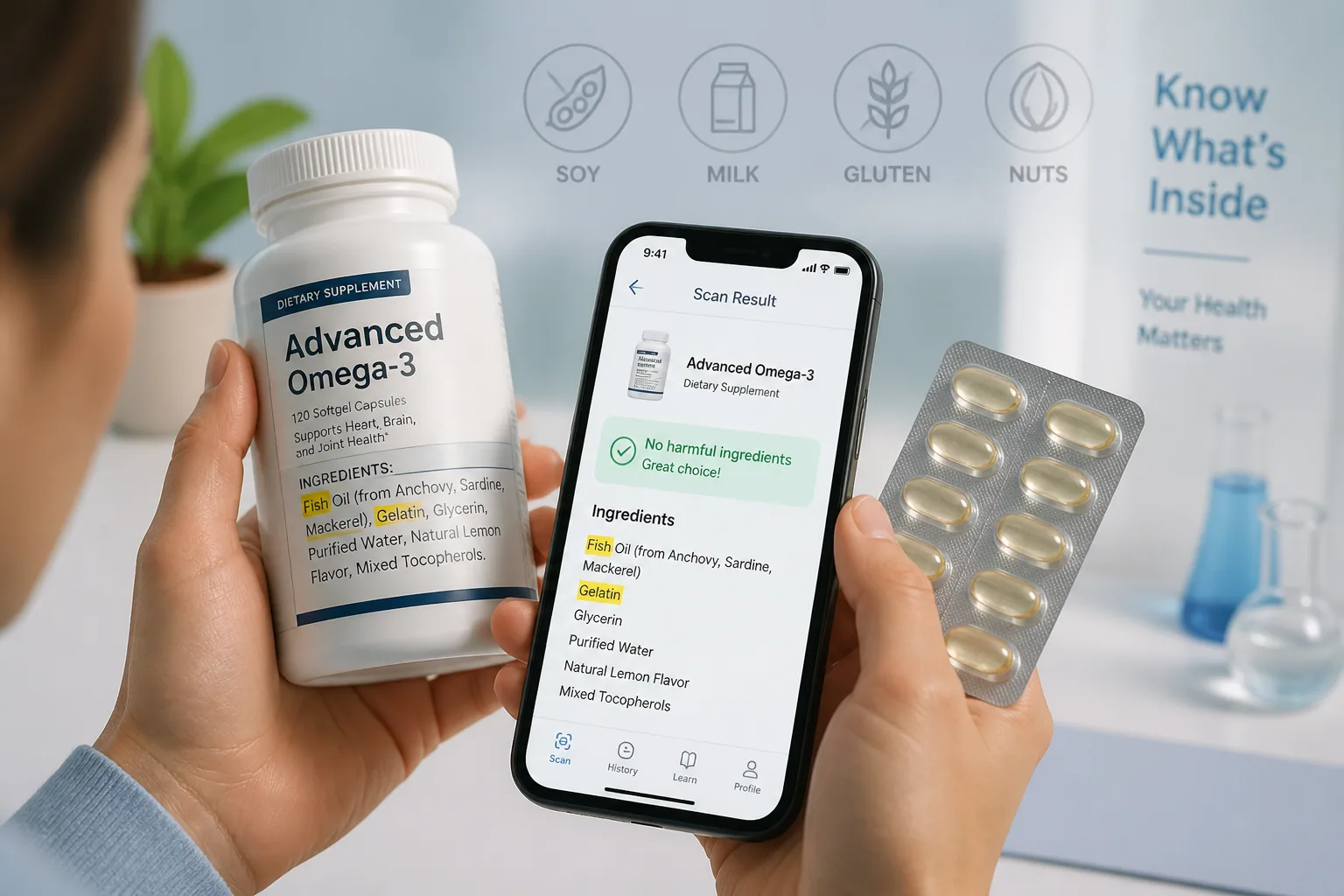
Also be cautious with capsules and coated tablets. A softgel may contain gelatin. A chewable tablet may have flavoring that is not fully defined. A generic product may swap one filler for another, so the exact ingredient list can change even when the active drug is the same. If you have a severe allergy, scan every new box, not just the first one you ever bought.
One especially important habit is to note when an ingredient source is unclear. Modified starch, for example, does not tell you whether the starch came from corn, potato, wheat, or another source. If the product matters enough, ask the manufacturer to clarify the source in writing.
How to Scan Medications and Supplements in the App
A scanning app can save a lot of time when you are standing in a pharmacy aisle or comparing several supplement bottles. The most useful workflow is to scan the barcode, review the allergen profile, and then check whether the product contains any of your personal red-flag ingredients. This is especially helpful for people who need to move quickly, such as parents shopping for a child with allergies or older adults managing multiple medications.
Bokha: Food Allergy Scanner App can help here by scanning product barcodes in less than a second and detecting 13 allergens, traces, and additives. It is designed mainly for food products, but it can still be a helpful first screen when you are comparing packaged items that may overlap with supplement or wellness categories. You can learn more here: https://findthe.app/bokha
For best results, use the scan as a first step, not the final decision. If the app shows a possible match or uncertain data, follow up with the packaging insert, the manufacturer, or a pharmacist. For allergy management, speed is useful, but accuracy is the priority.
What to Do When Barcode Data or Allergen Info Is Missing
Missing data happens often. A barcode may not resolve, the product may be new, or the label may not include enough detail. When that happens, do not rely on guesswork. Check the drug facts panel, the package insert, and the manufacturer’s website if available. If the ingredient source is still unclear, call the company and ask whether the excipient is derived from your allergen of concern.
For supplements, especially smaller brands, ingredient transparency can be inconsistent. If a label uses a proprietary blend or does not specify flavoring or capsule materials, that is a reason to be careful. When a product is essential, ask whether there is an alternative formulation with simpler excipients, fewer dyes, or a different capsule type.
If the product is time-sensitive, such as a pain reliever or emergency medication, a pharmacist can often help identify an equivalent option with a safer inactive ingredient profile. The key is to ask early, not after a reaction has already happened.
How to Check Prescription Drugs, Compounded Medications, and Custom Formulas
Prescription medications deserve the same scrutiny as over-the-counter products. The exact brand, generic manufacturer, dose form, and country of origin can all change the inactive ingredients. That is why a refill from a different manufacturer should be treated like a new product from an allergy standpoint.
Compounded medications need even closer review because they are custom-made. Their ingredients may come from a compounding pharmacy, and the final formula can vary based on the prescription and the pharmacy’s available supplies. Ask what fillers, flavorings, and capsule materials are used, and whether an allergen-free alternative is possible.
For custom formulas, it helps to keep a personal allergy list that includes both allergens and ingredients you want to avoid, such as lactose, gelatin, certain dyes, or specific oils. This makes conversations with pharmacists faster and reduces the chance of an overlooked ingredient being substituted later.
Questions to Ask Doctors, Pharmacists, and Manufacturers
If you want safer prescribing and purchasing, use direct questions. Ask whether the medication contains any excipients derived from milk, soy, wheat, egg, gelatin, or nuts. Ask whether the formulation changes between generic manufacturers. Ask if the product uses dyes, flavorings, or capsule shells that could be a problem for you.
When talking to a manufacturer, ask for the source of any unclear ingredient, not just the ingredient name. That is especially important for terms like starch, lecithin, flavor, or oil. If you are dealing with a serious allergy, ask whether there is written documentation or a product specification sheet that identifies the source.
For doctors, the most useful request is often not just a diagnosis-level question but a formulation question. Instead of asking only whether a medicine is safe, ask whether there is a version without your trigger ingredient. That can open the door to a different brand, a different dosage form, or a compounded option.
Tips for Buying Allergy-Safer Products Across Different Countries
Allergen disclosure is not identical everywhere. A product sold in one country may list excipients differently, and a local version may use a different capsule or filler. That means travelers, expatriates, and online shoppers should be cautious when buying medication or supplements from outside their usual market.
As a rule, read the full ingredient list every time, even if the front of the package looks familiar. If you use imported products, be extra careful with translated labels and region-specific formulations. When in doubt, compare the exact product name, strength, manufacturer, and dosage form, not just the brand alone.
It is also smart to keep a record of products that have already been checked and tolerated. That way, if you must switch brands, you can compare the inactive ingredients quickly instead of starting from zero.
A Simple Safety Checklist Before Taking Any New Medication or Supplement
Before you take a new product, pause and run through a short checklist. First, identify the exact product, including brand, strength, and dosage form. Second, review the active and inactive ingredients. Third, look for red-flag terms such as lactose, gelatin, soy, starch, flavoring, dye, or anything that could hide your allergen. Fourth, check whether the product was scanned in your app and whether the result was complete.
If the information is missing or unclear, do not assume it is safe. Ask the pharmacist, contact the manufacturer, or look for a different formulation. If you are starting a prescription, mention your food allergies before the medication is dispensed. If you are buying a supplement, remember that less regulation does not mean less risk.
The overall goal is not to become fearful of every pill or capsule. It is to become consistent. With a reliable routine, a careful label read, and a quick scan when possible, you can lower the chance of accidental exposure and make medication use safer for yourself or your family.