Food Insecurity & Food Allergies: How to Find Affordable Safe Foods Without Taking Risks
For many families, food insecurity means worrying about quantity. For people living with food allergies, it often means worrying about quantity and safety at the same time. That overlap creates a very real problem: when money is tight, the safest foods can become the hardest to afford, and the cheapest foods are not always safe to eat. The result is a daily balancing act between health, budget, and access.
This is not just a feeling, either. A recent U.S. study found that families with a child who has a food allergy had 1.39 times greater odds of experiencing food insecurity than families without a child food allergy, even after adjusting for income, race, insurance status, and other factors. The same study found even higher odds among families below 200% of the federal poverty level, which shows how sharply allergy management can compound financial strain. Source: https://pmc.ncbi.nlm.nih.gov/articles/PMC11805619/
Why Food Insecurity Hits the Food Allergy Community Harder
Food insecurity is hard on any household, but it becomes especially stressful when a child or adult must avoid one or more major allergens. A family can stretch a budget with rice, pasta, bread, cereal, frozen meals, and low-cost pantry staples. But if those staples contain milk, egg, wheat, soy, peanut, tree nuts, or other allergens, the list of affordable options shrinks fast.
That shrinking list matters because food allergy management is not optional. There is no safe way to “cheat” a true allergy when the risk includes hives, vomiting, breathing problems, or anaphylaxis. So when a family is forced to choose between buying enough food and buying safe food, the burden becomes both financial and medical.
The poverty connection is especially important. The study above found that households below 200% of the federal poverty level with a food-allergic child had 1.46 times greater odds of food insecurity, while even households at 200% to 399% FPL still had 1.26 times greater odds. That suggests the pressure does not disappear at slightly higher incomes. For many families, allergy-safe eating is expensive across the board, not just at the lowest income levels. Source: https://pmc.ncbi.nlm.nih.gov/articles/PMC11805619/
The Real Cost of Avoiding Major Allergens on a Tight Budget
One of the biggest myths about allergy-safe food is that it is only a little more expensive. In practice, the difference can be substantial. A 2026 FARE report estimated the societal cost of food allergy in the U.S. at $370.8 billion annually, or about $22,000 per patient per year. A large share of that cost is indirect, including lost wages, reduced productivity, and absenteeism, which means the financial impact reaches far beyond the grocery store. Source: https://www.foodallergy.org/sites/default/files/2026-02/FARE_NIR_FINAL 1.pdf
Research from other countries points in the same direction. In the hidden price review, Swedish families avoiding milk, egg, or wheat due to allergy reported excess food costs of about €2,085 to €2,892 per year compared with families without food allergies. Canadian families in the review had direct cost differences of about €1,592 per year, and 96% of that excess came from higher food bills. Source: https://pmc.ncbi.nlm.nih.gov/articles/PMC12412086/
Even in a U.S. context, the price gap can be striking. A Californian Latinx cohort found that diets avoiding six major allergens increased food costs by about 9.8% for families, 18% for couples without children, and as much as 36% for single-person households compared with a standard diet. For someone shopping on a fixed income, that difference can be the line between getting through the month and running out early. Source: https://pmc.ncbi.nlm.nih.gov/articles/PMC11781254/
When Cheap Alternatives Become Unsafe Choices
When budgets get tight, people naturally look for substitutions. But in allergy management, a cheap substitute is not always a safe substitute. Generic snack bars may contain shared allergens. Store-brand soups may use milk powder or soy. Budget baked goods often rely on wheat, egg, or traces from shared equipment. Even simple staples can be risky if ingredient lists change.
This is where food insecurity becomes dangerous. Families may start buying what is on sale, what is donated, or what is left after other shoppers have picked through the shelves. If labeling is unclear, if packaging is damaged, or if the household is juggling several allergies at once, the odds of making an unsafe purchase increase.
That risk is not abstract. In a U.S. survey, 67% of households managing food allergy said they had significant difficulty finding allergy-friendly substitute foods, and only about 20% said those substitutes were very affordable. In other words, even when a replacement exists, it often does not solve the budget problem. Source: https://www.foodallergy.org/sites/default/files/2025-04/FASS 2024 Impact Report_FINAL 1.pdf
How to Shop for Allergy-Safe Foods Without Overspending
The first step is to build a short list of dependable, low-cost safe foods and use that as your base. For many households, that may include plain rice, dried beans, oats if tolerated and verified safe, potatoes, frozen vegetables, fresh fruit, simple pasta alternatives, canned vegetables, and unseasoned meats or legumes. The key is to choose foods that are naturally simpler, then season them yourself with ingredients you know are safe.
It also helps to shop by ingredient, not by marketing. Words like “natural,” “healthy,” “free from,” or “made for kids” do not guarantee safety. Read the full label every time, especially for products you buy regularly, because manufacturers can change ingredients without warning.
One practical approach is to compare the cost per serving of a safe staple against a specialty substitute. Some allergen-free breads, crackers, and snacks are convenient, but they are not always the best use of a limited grocery budget. When possible, prioritize whole foods first, then use specialty products where they add the most value, such as school lunches, travel, or emergency snacks.
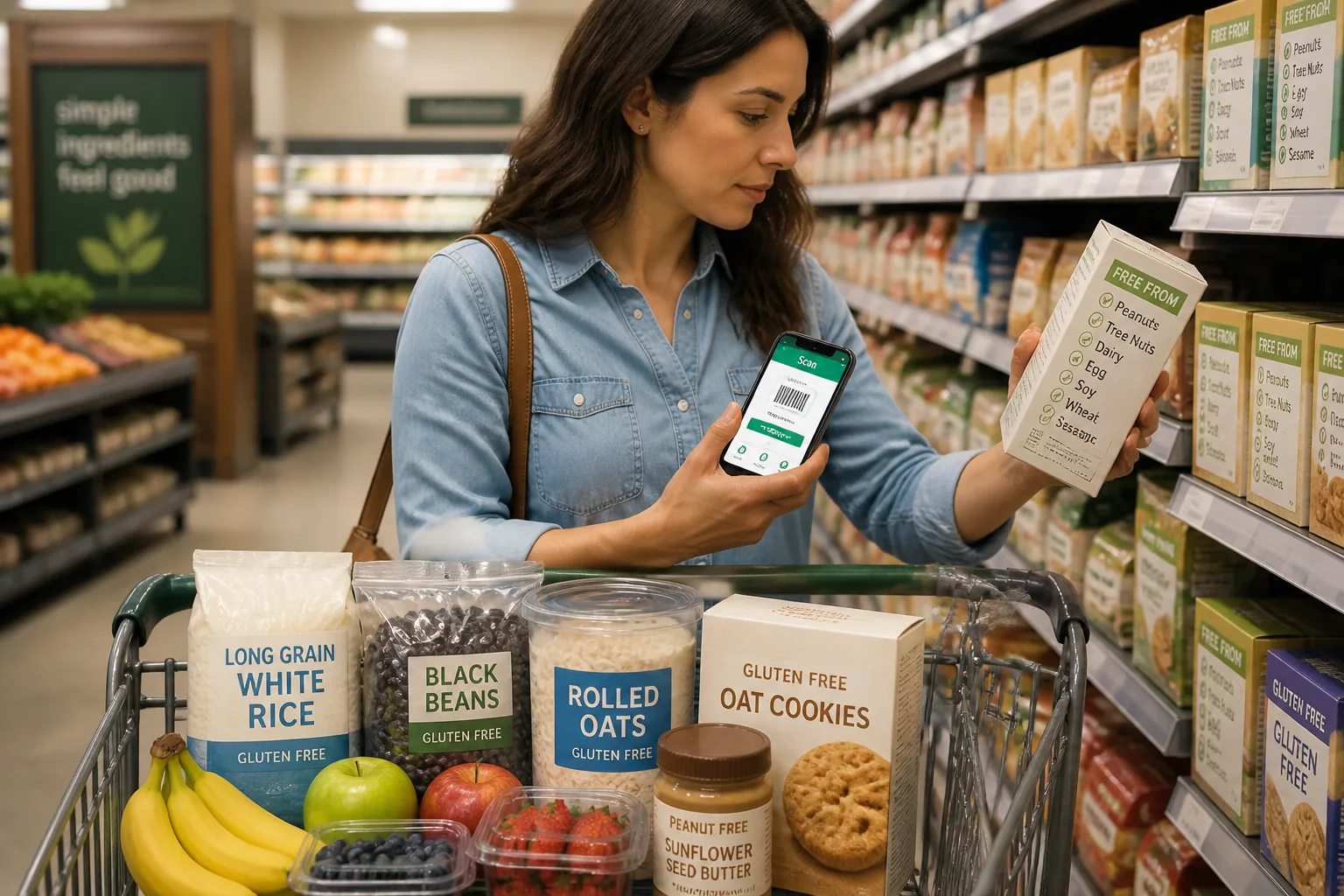
If you want to reduce the amount of time spent staring at labels in the supermarket, a barcode scanner can help. For example, Bokha: Food Allergy Scanner App lets you scan products and discover allergens in less than a second, which can make it easier to compare options quickly and avoid costly trial and error. You can find it here: https://findthe.app/bokha
Budget-Friendly Home Cooking and Meal Planning Tips
Home cooking is often the most affordable way to keep food allergy-safe meals on the table, but only if it is done strategically. Start by planning meals around one or two safe proteins, one starch, and one or two vegetables that can be reused in several dishes. For example, a pot of rice, a tray of roasted vegetables, and a batch of seasoned chicken or beans can become bowls, soups, wraps, or stir-fries over multiple days.
Batch cooking can cut both cost and stress. If a meal is already safe, doubling the recipe often saves money and helps on the days when work, school, or caregiving makes cooking harder. Soups, stews, chili, casseroles made with safe ingredients, and freezer-friendly portions can be especially useful.
A few small habits can also lower risk and waste. Keep a running list of safe brands, buy store brands only after checking labels carefully, and rotate pantry staples before they expire. When a sale appears on a trusted safe product, stock up if your budget allows. That creates a buffer for weeks when safe foods are harder to find or more expensive.
Another simple strategy is to separate “core safe foods” from “nice-to-have foods.” Core foods are the low-cost items that keep everyone fed without risk. Nice-to-have foods are the pricier substitutes that make meals easier or more familiar. When money is tight, centering your plan on core foods can prevent overspending on specialty items that may not be necessary every week.
Where to Find Help: Food Pantries, Community Programs, and Nonprofits
One of the most encouraging developments in this space is the growth of allergy-aware food support. Some organizations now offer pantry items or distribution models designed with allergens in mind, which can make a major difference for families who cannot safely use standard food aid.
Examples include S.A.F.E. Food Pantry in Maryland, the Food Equality Initiative in Missouri, Securing Safe Food nationwide, CHOP’s allergen-friendly food pantry in Philadelphia, and Garden of Health Food Bank in Pennsylvania. These programs show that food assistance can be adapted to real allergy needs instead of assuming that all donated food is safe for all families. Source: https://www.foodallergy.org/resources/food-banks-and-soup-kitchens
If you are looking for help, do not assume that a general pantry cannot support you. Call ahead and ask what allergen protocols they use, whether they can separate items, and whether they carry basic safe staples such as rice, beans, shelf-stable milk alternatives, or gluten-free products if needed. Even if a pantry is not fully allergen-aware, staff may be able to set aside items or connect you with another program.
Caregivers and advocates can also help by making donation lists that focus on safe staples, not only specialty snacks. Rice, canned beans, shelf-stable broth, seed butters if appropriate, plain pasta alternatives, and clearly labeled canned proteins can be more useful than random convenience foods.
Using Apps and Tech to Avoid Costly Trial and Error
Tech will not solve food insecurity, but it can reduce some of the hidden costs of allergy management. The main advantage is speed. When you can scan, search, and verify ingredients quickly, you spend less time decoding labels and less money on products that turn out to be unsafe.
Apps can be especially helpful in three situations. First, when you are comparing store brands and need to know which one is safe. Second, when you are shopping in a hurry and cannot review every label carefully in aisle after aisle. Third, when you are helping older adults, teenagers, or other caregivers build confidence in choosing safer foods on their own.
That said, no app should replace direct label reading for products with a serious allergy. Ingredient lists, allergen statements, and manufacturer updates still matter. The best use of technology is as a support tool that narrows choices, saves time, and helps households avoid repeated buying mistakes.
What Policy Changes Could Make Safe Food More Accessible
If we want to address this problem seriously, individual budgeting tips are not enough. The overlap between food insecurity and food allergy points to a structural problem: safe food is often treated as a niche product instead of a basic health need.
Policy could help in several ways. Public nutrition programs could require stronger allergen-aware options and clearer procurement standards. Schools and food banks could receive more funding for safe substitutions. Food labeling rules could become more consistent and easier to interpret. And research funding could better track how allergy costs affect low-income households over time.
There is also a strong case for supporting nonprofit distribution models that specifically serve allergy-affected families. The data already show that these households have higher odds of food insecurity and face extra costs for safe food. The next step is making sure relief systems are designed with that reality in mind, rather than expecting families to adapt alone.
Resources for Families, Caregivers, and Support Organizations
If you are managing food allergy on a tight budget, focus on three priorities: know your safest low-cost staples, build a short list of trusted brands, and connect with local or national support programs that understand allergy needs. That combination can reduce risk, protect health, and make grocery trips less overwhelming.
For caregivers, the most useful support often comes from consistency. Keep a shared list of approved foods, note where they were purchased, and update the list whenever a label changes. For advocates, the biggest impact may come from pushing food banks, schools, and social service agencies to recognize that standard food aid is not always safe food aid.
Most importantly, food allergy should never force a family to choose between safety and affordability. The research makes it clear that the burden is real, the costs are high, and the risk is not evenly distributed. With better planning, stronger community support, and more allergy-aware systems, families can find safer food without taking unnecessary risks.