Food Allergy-Friendly Air Travel: A Practical Guide for Safer Flights
Flying with a food allergy can feel like a small logistics problem that becomes a big stress problem fast. Between unknown ingredients, shared surfaces, tight boarding windows, and the reality that airports are built around convenience, it makes sense that many travelers feel on alert from the moment they book. The good news is that safer travel is very possible when you plan ahead, communicate clearly, and build a simple routine you can repeat on every trip. Food allergies are also common enough that you are far from alone: the CDC reports that about 6.7% of U.S. adults and 5.3% of children have a diagnosed food allergy in 2024.
This guide walks through the full journey, from researching airline policies before you book to finding safe food after you land. It is designed for frequent flyers, parents traveling with allergic children, and anyone who wants a practical, low-drama system for flying more confidently.
Why Air Travel Can Be Tricky for People With Food Allergies
Air travel adds several layers of risk that do not usually exist at home. You may not know exactly what is in a snack, who handled it before you, whether your seat area was cleaned properly, or whether a delay will leave you stuck with no safe meal options. Research suggests that allergic reactions during airport, transit, or inflight travel are uncommon overall, but they are still very real for the people affected. One review found that among travelers with preexisting food allergies, food-related allergic reactions in travel settings ranged from about 0.7% to 15%, with children and adolescents reaching up to 15% in some studies. Peanuts and tree nuts are also among the most common triggers reported during travel.
At the same time, it helps to keep perspective. A systematic review found that in-flight medical events due to allergic reactions are rare, about 0.7 events per million passengers, and allergic events make up around 2.2% of all in-flight medical events. So yes, the risk is real, but it is usually manageable with preparation. The goal is not to eliminate every uncertainty. It is to reduce the ones you can control.
How to Research Airline Allergy Policies Before You Book
Before you buy a ticket, check the airline’s allergy policy, accessibility page, and any special assistance section. Policies vary widely because there is no global law that defines a single best practice standard for food allergy travel. Some airlines may offer early boarding for cleaning, allergy-aware snack options, or a request to avoid serving a specific allergen, but they typically cannot guarantee an entirely allergen-free cabin.
Look for practical details rather than vague promises. Can you pre-notify the airline? Do they support a seat change if needed? Do they offer any allergen-aware meal service on longer flights? Are passengers allowed to bring their own food? If you are traveling internationally, check whether the airline’s website is available in your language and whether the destination country has specific customs or food import rules that could affect what you pack.
If the carrier is responsive, use that to your advantage. Delta, for example, states that notifying the airline of allergies may lead to accommodations such as refraining from serving peanuts for peanut allergies, offering non-peanut snacks, early boarding for cleaning, or seat changes, while still noting that an entirely allergen-free environment cannot be guaranteed. That is the right mindset to carry into any flight: ask for accommodations, but always assume personal responsibility for your own safety.
Questions to Ask About Snacks, Special Meals, and Allergen Handling
When you contact the airline, ask direct, specific questions. General requests are easier to misunderstand, but clear questions can help you plan better. Ask whether the airline serves snacks or meals that contain your allergen, whether any special meals are prepared in separate facilities, and how allergens are handled in the catering process. If you are especially sensitive, ask whether you should avoid consuming anything from the airline at all and whether the crew can note your allergy in the booking record.
It is also smart to ask about the timing of meal service. On some flights, the safest option is to eat before you board and bring your own food for the entire trip. On others, a sealed packaged snack may be acceptable if you can read the label and you trust the handling. Keep in mind that many airline snacks are manufactured off-site, repacked, or handled in environments where cross-contact can happen.
The key is to decide in advance what your personal threshold is. Some travelers are comfortable with a packaged item that is clearly labeled and from a familiar brand. Others prefer to avoid airline food completely. Both are valid choices if they help you stay safe and calm.
Your Pre-Flight Packing Checklist: Food, Medication, and Documents
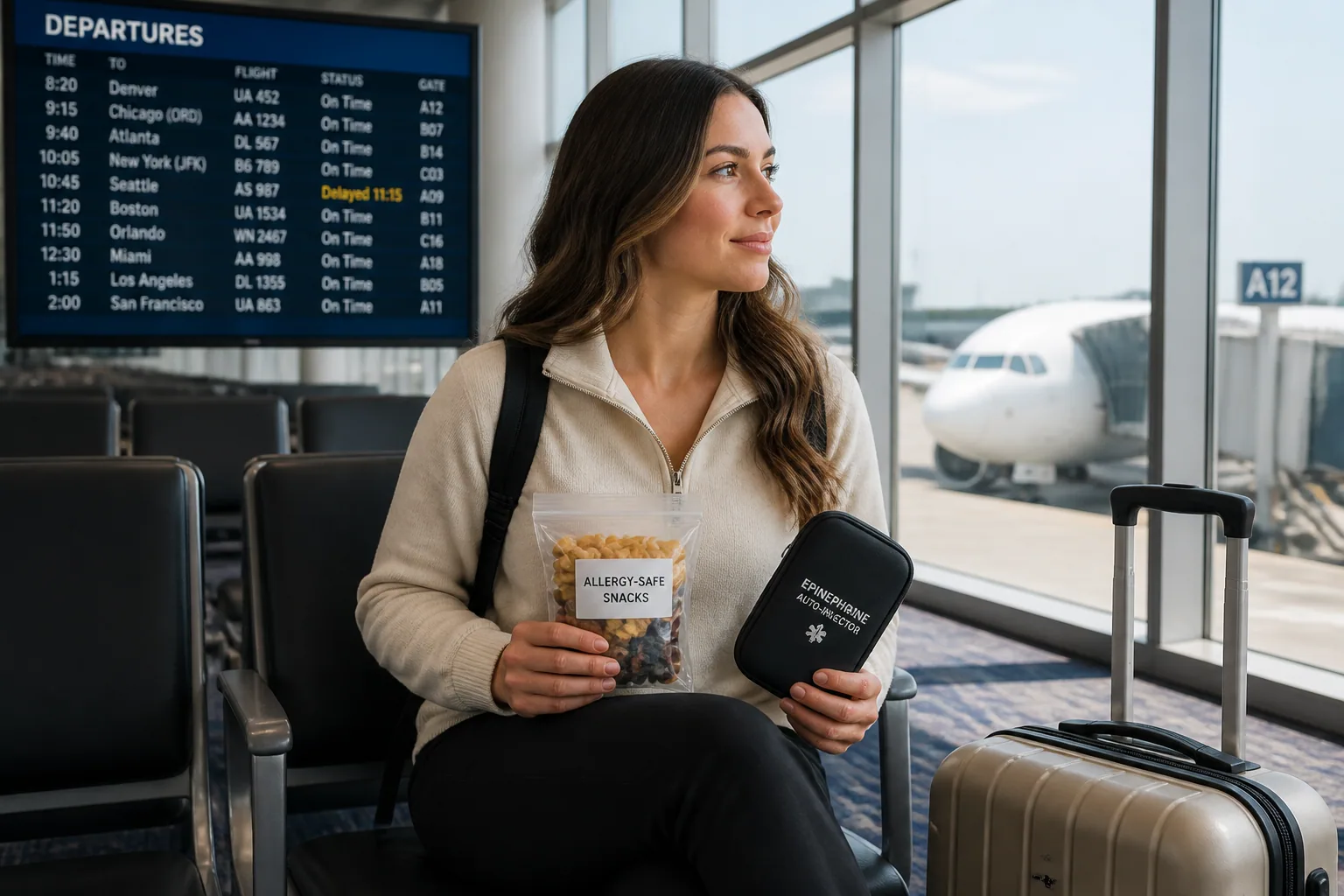
A good packing system removes a huge amount of guesswork. Start with food. Bring enough safe snacks and meals for the full journey plus delays, missed connections, and a buffer in case your arrival is late. Choose foods that travel well, are not temperature-sensitive unless you have the means to keep them cold, and are easy to eat without making a mess. Think shelf-stable items you already trust at home.
Next, pack your medication. The CDC Yellow Book recommends that travelers with severe food allergies carry multiple epinephrine auto-injectors, make sure they are unexpired, keep them in their original packaging, and have a travel or emergency plan. It may also be helpful to carry antihistamines if they are part of your doctor’s plan, plus a physician’s note if you are crossing borders or need to explain medical supplies at customs.
Your documents matter too. Keep allergy information, prescriptions, a short emergency plan, and any medical letters in an easy-to-reach part of your carry-on. If you are traveling with children, include a clear list of allergens and your emergency response steps. The goal is to make it easy for you, a travel companion, or a crew member to act quickly if needed.
Why Translation Cards Matter for International Travel
If you are flying internationally, translation cards can be one of the simplest and most effective tools in your kit. The CDC advises travelers with allergies to translate food allergy cards into local languages, research local dietary customs, and learn the labeling rules of the destination country. That matters because you cannot assume that ingredient lists, restaurant staff, or shop workers will understand your allergen in English.
A good translation card should name your allergen clearly, explain that even small amounts can cause a serious reaction, and list common hidden ingredients if relevant. If you have multiple allergies, keep the wording concise so it is easy to read. Show it before ordering, before accepting snacks, and before asking about packaged foods. In places where street food and unlabeled foods are common, the card can save you from having to explain your condition from scratch every time.
It is also useful to save a digital copy on your phone in case you misplace the paper version. For some travelers, this is especially helpful when moving through airports, taxis, hotels, and restaurants in a single day.
How to Navigate Airport Food Without Taking Unnecessary Risks
Airports are some of the hardest places to eat safely because the food environment is fast, crowded, and often poorly labeled. The safest strategy is usually to bring your own food, but if you need to buy something in the terminal, take your time and inspect it carefully. Stick to sealed packaged items from brands you already recognize when possible, and read ingredient labels every single time, even if the product looks familiar.
Avoid unlabeled baked goods, bulk snacks, salad bars, buffet-style counters, and anything that looks like it may have been handled by shared utensils. Cross-contact is hard to predict in airport food courts because preparation spaces are busy and turnover is high. If you are in doubt, it is better to skip the purchase and rely on what you packed.
This is also where a scanning tool can be useful. The Bokha Food Allergy Scanner App, available on iOS and Android, lets you scan product barcodes and check allergens in less than a second. It can detect 13 allergens, including gluten, peanut, egg, soy, tree nuts, wheat, and sulphites, plus traces and additives. For travelers trying to make faster decisions in unfamiliar terminals or foreign supermarkets, that kind of quick check can remove a lot of uncertainty: https://findthe.app/bokha
What to Clean Before You Sit Down at the Gate or on the Plane
A small cleaning routine can reduce contact with residue on high-touch surfaces. Before you sit down, wipe the tray table, armrests, seat belt buckle, call button, and your immediate space if you have access to wipes. If you are waiting at the gate, clean your hands before eating or touching your face. If your allergy is severe, wiping down the seat area early can help you feel more in control and lower the chance of accidental contact with residue from previous passengers.
You do not need a huge cleaning kit. A few travel wipes, hand sanitizer, tissues, and a sealable bag for trash are often enough. The point is to create a clean zone around yourself, not to sterilize the cabin. Even a simple routine can make the seat space feel more manageable.
How to Talk to Flight Crew Clearly and Early
Once you board, communicate early and respectfully. Tell the flight crew about your allergy before service starts, not after the snack cart is already in your row. Be specific about the allergen, whether you are carrying epinephrine, and what kind of help you may need. If you have already notified the airline during booking, mention that too so the crew can check the flight notes.
Keep your request simple. You are not asking the crew to become medical experts. You are letting them know what precautions matter most to you, whether that means avoiding a certain snack service, helping you identify ingredient information, or letting you know when food service will begin. The earlier you speak up, the more room there is for problem-solving.
If you are traveling with a child, it can help to tell the crew where the child’s medications are stored and what symptoms you watch for. That way, everyone knows where the emergency plan begins.
Which In-Flight Foods and Drinks Deserve Extra Caution
Not all in-flight food is equally risky, but some categories deserve extra scrutiny. Packaged snacks with simple ingredient lists are generally easier to assess than warm meals, mixed dishes, sauces, desserts, and heavily processed items with many additives. For highly allergic travelers, drinks can also be worth a second look if they contain flavorings, powders, creams, or toppings.
Read every label before opening anything, and do not assume that the same brand or product is identical in every country. Global food labeling laws vary, even though many countries require major allergens such as milk, eggs, soy, wheat, peanuts, tree nuts, fish, and shellfish to be listed. A review of international labeling practices notes that requirements differ regionally, so a product that feels familiar may still be labeled differently overseas.
Sesame is a good example of why labels matter. In the United States, the FASTER Act made sesame the ninth major allergen that must be declared on packaged foods starting January 1, 2023. That is useful if you are flying with a sesame allergy, but it also shows how allergen laws can change and why you should never rely on memory alone.
How to Reduce Cross-Contact During the Flight
Cross-contact prevention is really about habits. Wash or sanitize your hands before eating. Keep your own food sealed until you are ready to use it. Avoid placing food directly on tray tables unless you have already cleaned them. If possible, eat from your own container using utensils you packed from home.
If someone nearby is eating an allergen you react to, use your judgment and your doctor’s guidance. Some travelers choose to ask politely whether a neighbor would mind avoiding their own snack for a short period. Others prefer to focus on their own precautions and stay seated. There is no single right answer, but having a plan keeps the situation from feeling chaotic.
If you are on a long-haul flight, think about the entire journey in stages. Food service, rest periods, turbulence, and deplaning all create different risk moments. Break the trip into manageable segments instead of trying to anticipate every possible problem at once.
What to Do If Delays or Missed Connections Leave You Without Safe Food
Delays are one of the most common ways a well-planned trip becomes stressful. The answer is to plan for them before you leave. Bring extra food that does not require refrigeration or heating, and keep at least one emergency snack in an easy-access pocket rather than deep in your luggage. If your connection is tight, assume you may not have time to browse every terminal restaurant.
If you miss a connection, ask the airline quickly about options that do not compromise your safety. Sometimes airport shops carry sealed snacks with clear labels, and sometimes a hotel shuttle or nearby grocery store is the best route. If your food supply is low, prioritize getting something safe before you become hungry and less able to make careful choices.
This is another reason to keep your allergy documentation and medication in your carry-on, not checked baggage. Even if your food options disappear for a few hours, your emergency plan should still be intact.
How to Find Safe Grocery Stores and Meals After You Land
Once you arrive, the first safe meal is often easiest to find at a grocery store rather than a restaurant. Local supermarkets usually offer packaged foods with ingredient labels, and that can be much safer than navigating a menu while jet-lagged. If you are using a scanner app, this is a good moment to check unfamiliar products quickly and compare a few options before you buy.
When choosing a store or restaurant, look for places with clear menus, visible ingredients, and staff who seem willing to answer questions carefully. Hotels with kitchens or breakfast buffets can still be risky if allergen controls are weak, so always ask how food is prepared and whether cross-contact is possible. If a place feels rushed or dismissive, trust that instinct and look elsewhere.
For many travelers, the first 24 hours after landing are easier when the food plan is simple: one grocery stop, a few safe staples, and one restaurant only if you have time to vet it properly.
Understanding Food Labeling Differences at Your Destination
Food labeling laws are not identical around the world. While most countries require common allergens to be listed, the exact format, language, and rules for advisory statements can vary. That means your normal system for checking labels may need a few adjustments when you travel abroad. Some ingredients may be named differently, and some packaged foods may rely on region-specific terminology that is not obvious at first glance.
Before you go, learn the local names of your allergens and, if possible, the typical words used for hidden ingredients. A little research can prevent a lot of guesswork in stores and cafes. The same is true for traditional dishes and local dietary habits, which can affect whether a food is likely to contain your allergen even when it is not obvious from the name.
The safest mindset is simple: never assume familiarity means safety. Read the label, ask the question, and if something is unclear, choose a different item.
Smart Restaurant Strategies for Allergy-Safe Dining Away From Home
Restaurants can be enjoyable and safe if you approach them carefully. Start by choosing places that already seem allergy-aware, with clear ingredients, straightforward dishes, and a willingness to answer questions. Call ahead if you can, especially when traveling with a severe allergy or a child. Ask whether the kitchen can handle your request without cross-contact and whether there are specific dishes that are safer than others.
When you arrive, tell the server about the allergy early and repeat it clearly. Do not rely on one conversation if the order passes through multiple hands. Keep your request short and unambiguous, and if the response feels uncertain, do not hesitate to leave. That is not being difficult. It is being careful.
Street food, buffets, and unlabeled items are usually higher risk because ingredients are less visible and cross-contact is harder to control. If you are already tired, hungry, or rushed, that risk climbs quickly. In those moments, packaged food or a grocery store meal is often the smarter choice.
A Simple Travel Safety Routine You Can Use on Every Trip
The easiest travel plan is one you can repeat without thinking too hard. A simple routine might look like this: check the airline policy before booking, pack extra safe food and multiple epinephrine auto-injectors, carry translation cards if you are traveling internationally, clean your seat area when you board, tell the crew about your allergy early, inspect every label before eating, and keep backup food for delays and connections. That routine covers the most common pressure points without turning your trip into a project.
In the end, safer food allergy travel is less about perfection and more about layering smart habits. You cannot control every ingredient or every passenger around you, but you can control preparation, communication, and backup plans. With that approach, flying becomes much more manageable, and often much less stressful, than it first appears.