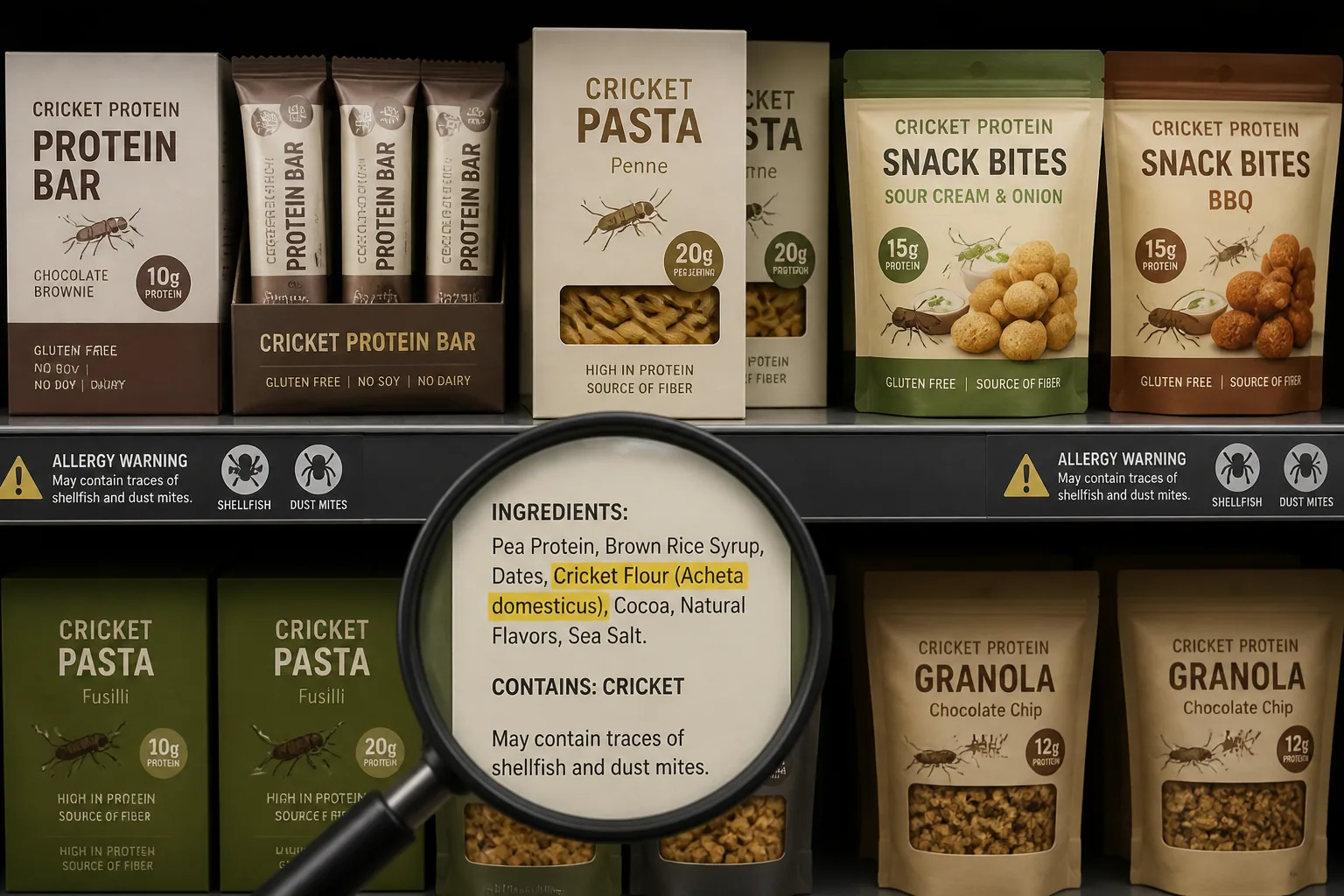
Emerging Risk Alert: Edible Insects, Hidden Allergens, and What Shoppers Need to Know
Edible insects are no longer a niche idea. You can now find them in protein bars, pasta, snacks, baked goods, and even ingredient blends marketed as more sustainable alternatives to traditional animal protein. For many shoppers, that sounds like a smart step forward. But there is another side to the story that matters a lot if you have food allergies. Insects are arthropods, just like shrimp, crab, and dust mites, and that means some of the same allergenic proteins can show up in insect-based foods. For allergy-aware consumers, this is not just a curiosity. It is a label-reading issue, a shopping issue, and in some cases, a real safety issue.
The goal of this article is to explain where the risk comes from, what the research says about cross-reactivity, why species and processing matter, and how to shop more carefully when insect ingredients appear on packaging. If you want a quick extra layer of protection in the aisle, a scanner like Bokha can help you check products faster at https://findthe.app/bokha.
Why Edible Insects Are Showing Up in More Foods
The rise of edible insects is tied to a broader push for sustainable protein. Insects are often promoted as efficient to raise, lower in land use, and potentially lower in environmental impact than conventional livestock. That makes them attractive to food brands looking for protein sources that fit modern sustainability messaging. As a result, insect flour, insect protein concentrate, and whole insect ingredients are appearing in more processed foods than many shoppers expect.
The important point is that these products do not always look like insects anymore. Once they are ground, baked, mixed into a matrix, or turned into an ingredient blend, they can be easy to miss. That is where the allergy concern starts to matter, because a food can look like an ordinary snack while still containing proteins that may trigger reactions in sensitive people.
The Allergy Concern Behind Sustainable Protein
The main concern is not that every person will react to edible insects. The concern is that some insect proteins overlap with proteins found in other arthropods. The best known examples are tropomyosin and arginine kinase, both of which are considered pan-allergens in arthropods. These proteins can be recognized by the immune system of people already allergic to shrimp, crab, or dust mites.
That means an insect product can be risky for someone who has never knowingly eaten insects before. If your immune system has already been trained to react to a related protein, it may respond to the insect version too. This is why edible insects are often discussed in the same breath as shellfish allergy, even though they are not the same food category.
What Science Says About Cross-Reactivity With Shellfish and Dust Mites
Research increasingly supports the idea that cross-reactivity is real, especially between insects and shellfish. A systematic review found that crustacean-insect cross-reactivity is clinically relevant, while the link with dust mite sensitization is more complicated and less consistently tied to symptoms. In other words, the immune overlap is not just theoretical, but it does not affect every allergic person in the same way.
One study on black soldier fly proteins found that tropomyosin variants from Hermetia illucens were recognized by sera from shrimp-allergic or mite-allergic individuals. That is a strong sign that the protein family matters and that black soldier fly ingredients deserve close attention from people with arthropod allergies. Source: https://www.sciencedirect.com/science/article/pii/S0308814623024676
Another study looked at the house cricket, Acheta domesticus, and found that its tropomyosin resists full gastrointestinal digestion and remains immunoreactive in shrimp-allergic patients. That is especially important because it suggests that cooking or baking does not automatically make the protein harmless. Source: https://pubmed.ncbi.nlm.nih.gov/33934031/
Tropomyosin is the headline allergen because it is one of the most established cross-reactive proteins across crustaceans, mites, and insects. If you are allergic to shrimp or other shellfish, this is the protein most often discussed in edible insect risk assessments. It tends to be stable enough to survive some forms of processing, which is why it keeps showing up in allergy studies.
Arginine kinase is another important pan-allergen. It is found in several arthropods and has been studied in black soldier fly. Research suggests that increasing heat and very acidic or alkaline pH can reduce IgE reactivity, but reduced binding does not automatically mean complete safety. The protein may be altered, but not necessarily rendered harmless. Source: https://www.sciencedirect.com/science/article/pii/S2666833525000528
In practice, this means the allergic risk is not based on one single molecule. It is about the full protein profile of the insect species, how the food is processed, and how much of the allergen remains accessible to the immune system after manufacturing.
Why Species Matters: Cricket, Mealworm, Black Soldier Fly, and Other Differences
Not all insects are equally reactive. That is one of the most important findings for shoppers to understand. Different species can show very different levels of IgE cross-reactivity with shrimp and shellfish, even when they contain similar amounts of tropomyosin. A study comparing yellow mealworm, house cricket, and desert locust found substantial differences in shellfish-IgE reactivity. Source: https://pubmed.ncbi.nlm.nih.gov/32067335/
This matters because labels are not always specific enough for consumers to judge risk on their own. If a product says insect protein without naming the species clearly, it becomes harder for allergy-aware shoppers to estimate whether the ingredient is closer to a known high-risk species or a lower-reactivity one. Since the science is still evolving, the safest approach is not to assume one insect is automatically safer than another.
How Processing Changes Allergenic Risk
Processing can change the structure of allergenic proteins, and that can lower IgE binding in some cases. Heat treatment, enzymatic hydrolysis, fermentation, and changes in pH may reduce allergenicity by breaking proteins into smaller fragments or altering their shape. But there is an important catch: lower binding in a lab test does not always equal true clinical safety.
Research on edible insects has shown that heat and hydrolysis can reduce allergenicity, yet not always eliminate it. Studies on cricket tropomyosin also suggest that even cooked or baked insect-based foods may still pose a risk, because important epitopes can remain intact enough to trigger an immune response. Source: https://pubmed.ncbi.nlm.nih.gov/33934031/
For shoppers, the practical takeaway is simple. Do not assume that a processed product is automatically safer just because the insect ingredient was roasted, baked, or fermented. Those steps can help, but they are not a guarantee.
The Role of Food Matrices in Triggering or Masking Reactions
The food matrix is the rest of the food around the insect protein. It includes fats, starches, sugars, fiber, and other proteins that can influence how allergens behave during digestion. In some cases, a matrix may protect allergenic epitopes from breakdown. In others, it may reduce exposure and slightly lower reactivity.
This is why the same insect ingredient can behave differently in a protein bar, a cookie, a pasta, or a powdered supplement. The matrix may partially shield the allergen from digestion, which can preserve the very structures the immune system recognizes. Research on edible insects and food processing has highlighted that these matrix effects can reduce allergenicity in some formulations, but do not reliably eliminate it. Source: https://www.sciencedirect.com/science/article/pii/S1939455119300511
That uncertainty is another reason allergy-aware consumers should read beyond the marketing claims. A product advertised as processed, baked, or high in fiber is not automatically low risk if the ingredient list still contains insect-derived proteins.
Labeling Gaps and What Shoppers May Miss
Labeling is one of the biggest weak points for consumers. In the European Union, insect ingredients used as novel foods must be identified by scientific name and common name, and the product must include a statement that the ingredient may cause allergic reactions. EU rules also require allergens to be clearly highlighted in ingredient lists. Source: https://www.europarl.europa.eu/doceo/document/P-9-2023-000812-ASW_EN.html and https://europa.eu/youreurope/business/product-requirements/food-labelling/general-rules/indexamp_en.htm
In the United States, the situation is less direct. FDA allergen rules require crustacean shellfish to be declared as a major allergen, but insect proteins are not currently defined as a major allergen category in the same way. That means a food containing insect ingredients may not be labeled in a way that clearly flags the risk for someone who is expecting a shellfish-style warning. Source: https://www.fda.gov/food/guidance-documents-regulatory-information-topic-food-and-dietary-supplements/food-allergensgluten-free-guidance-documents-regulatory-information
This is where shoppers can get caught out. A package may emphasize sustainability, protein content, or a clean ingredient list while the actual insect source is tucked into a less obvious line. If you have a known shellfish allergy, a dust mite allergy, or a history of reacting to arthropods, it is worth scrutinizing labels much more carefully than usual.
How to Read Ingredient Lists for Insect-Based Foods
Start by looking for the species name. Common examples include cricket, mealworm, black soldier fly, or their scientific names such as Acheta domesticus or Hermetia illucens. If the label only says insect protein, insect flour, or protein blend, that is a sign to be cautious and to seek more detail if possible.
Next, look for any allergen statement or precautionary language. In the EU, insect products may carry a specific warning that the ingredient may cause allergic reactions. In other markets, you may need to infer the risk from the ingredients themselves, which is less ideal. Also check whether the product contains shellfish, molluscs, or shared equipment warnings, especially if you have multiple food allergies.
It also helps to remember that a product can contain several different sources of risk at once. For example, a snack can include insect protein, cocoa, nuts, and soy. In that case, the insect ingredient might not be the only issue, but it may still be a hidden one if you are mainly scanning for the allergens you already know about.
Practical Safety Tips for Allergy-Aware Consumers
If you have a shellfish allergy, a dust mite allergy, or a history of reacting to arthropods, the safest default is to treat insect-based foods as higher risk until you have clear information. Do not rely on front-of-pack marketing alone. Read the full ingredients list, check for species names, and look for allergy warnings that mention insects explicitly.
If you are shopping for someone with a known allergy, consider avoiding products with vague protein claims unless the manufacturer provides a clear allergen statement. When in doubt, contact the brand directly. That is especially important for imported foods, specialty snacks, and products sold through smaller online retailers where labeling standards may vary.
If you are very sensitive, cross-contact matters too. Even if an insect ingredient is not part of your usual diet, it can appear in facilities that also handle shellfish, nuts, or other allergens. That means the presence or absence of a single allergen warning may not tell the whole story.
Using Bokha and Other Tools to Scan Products More Safely
Digital tools can make label checking easier, especially when you are shopping quickly. Bokha is a food allergy scanner app that lets you scan a product barcode and see allergens in less than a second. It detects 13 allergens, traces, and additives, which can be very helpful for routine supermarket decisions. You can learn more at https://findthe.app/bokha.
That said, app results are only as good as the database and the labeling behind them. Because insect proteins are not always declared in a way that maps neatly onto shellfish warnings, a scanner may not catch every insect-derived ingredient unless it is explicitly labeled or cross-referenced in the product data. So an app is a support tool, not a substitute for reading the label itself.
Used well, a scanner can save time and help you filter out obvious risks before you reach the checkout line. Used alone, it should not be your only line of defense.
What the Future of Insect Food Regulation Could Mean for Consumers
Regulation is likely to keep evolving as insect-based foods become more common. The science suggests real cross-reactivity risk for some consumers, but laws have not fully caught up with that reality in every market. Over time, we may see more consistent naming rules, more explicit warning language, and potentially better species-level disclosure on packaging.
That would be a welcome change. For now, the gap between scientific evidence and legal labeling means consumers have to be proactive. If you have a relevant allergy history, the safest move is to treat insect protein as a meaningful possible allergen, especially in processed foods where the species, amount, and matrix may all influence the final risk.
Edible insects may have a role in the future of sustainable food. But for allergy-aware shoppers, sustainability cannot come at the cost of hidden risk. Careful label reading, species awareness, and scanning tools like Bokha can help make that future a little safer.