Can Personalized Nutrition Reduce Food Allergy Risk? What Science Says in 2026
Food allergy prevention is entering a more personalized era. For years, parents were often given broad advice about when to introduce allergenic foods, which formula to choose, and how to read labels. In 2026, the conversation is getting more specific. Researchers are asking whether gut microbiome patterns, gene-diet interactions, and early immune training may help explain why some children develop allergies while others do not. At the same time, families are looking for practical tools that make feeding decisions easier and safer at home.
The short answer is this: personalized nutrition looks promising as a prevention strategy, but it is not a replacement for the best-supported measures we already have. Early introduction of allergenic foods remains a cornerstone. What 2026 science adds is a clearer picture of why individual responses may differ, and where tailored nutrition might eventually help reduce risk in more targeted ways.
Why Food Allergy Prevention Is Shifting Toward Personalization
Food allergies do not appear in a vacuum. They are influenced by early immune development, feeding patterns, genetics, microbiome composition, and environmental exposures. That is why a one-size-fits-all approach has started to look incomplete. Two babies can follow similar feeding advice and still have very different outcomes, which suggests that biological context matters.
A major reason for this shift is the growing understanding of immune tolerance. The immune system has to learn which food proteins are harmless. When that learning process is disrupted, allergic responses can develop. Recent NIH-funded work published in Science Immunology in March 2026 identified epitopes from soybean, corn, and wheat that interact with regulatory T cells, or Tregs, in mice to promote oral tolerance. That matters because Tregs are central to teaching the immune system not to overreact to food proteins. The study suggests that future prevention strategies may become more tailored to immune signaling rather than just broad dietary rules. Source: https://www.nih.gov/news-events/nih-research-matters/scientists-identify-proteins-tied-food-tolerance
Personalization is also attractive because feeding history differs so much between children. Birth mode, breastfeeding versus formula feeding, timing of solids, antibiotic exposure, and even stool microbiome patterns can all shape the immune environment. The question is no longer whether these factors matter at all. The question is which ones matter most, for whom, and at what stage.
What 2026 Research Says About Gut Microbiota and Allergy Risk
One of the strongest themes in 2026 research is the gut microbiome. The early gut ecosystem helps train immune responses, and lower diversity in infancy has repeatedly been linked with less immune tolerance. A 2026 review in Microorganisms summarized how microbiome development across the lifespan, including birth mode, feeding type, and early diet, influences food allergy risk. The review highlighted that greater early-life diversity and specific bacterial groups such as Bifidobacterium and Lachnospiraceae are associated with healthier immune tolerance patterns. Source: https://www.mdpi.com/2076-2607/14/5/970
A systematic review in Food Chemistry published in early 2026 went even further, showing that diet and microbiota interact through host-microbiota-metabolite pathways. The review found that certain carbohydrates, unsaturated fats, vitamins, minerals, plant compounds, and probiotics can meaningfully affect allergy symptoms and immune regulation. That does not mean every supplement helps every child. It does mean that the food environment can shape the gut in ways that influence allergy-related inflammation. Source: https://www.sciencedirect.com/science/article/pii/S0308814625046485
Experimental evidence is also becoming more specific. In an April 2026 mouse-model study in Scientific Reports, supplementation with the human milk-derived probiotic strain Bifidobacterium longum subsp. infantis CCFM1269 significantly reduced food allergy symptoms, including weight loss and diarrhea. The mechanism was not just a vague immune boost. Researchers observed lower IL-4 and IL-17A, higher IL-10 and IFN-gamma, stronger antioxidant activity, improved intestinal barrier proteins such as Occludin, Claudin-1, and ZO-1, and shifts in gut microbiota composition. Source: https://www.nature.com/articles/s41598-026-50287-7
That kind of result is promising because it connects several parts of the allergy puzzle at once: inflammation, barrier integrity, microbiome balance, and immune tolerance. Still, mouse data are not the same as proven human prevention strategies. The takeaway is not that one probiotic will prevent allergies, but that microbiome-targeted nutrition is becoming a serious research direction.
How Gene-Diet Interactions May Influence Immune Response
Gene-diet interactions are one of the most interesting parts of personalized nutrition, but also one of the easiest areas to overhype. In simple terms, a child’s genes may influence how the body responds to certain nutrients, microbial signals, or food proteins. At the same time, diet can influence which genes are expressed and how immune cells behave.
In food allergy research, the key idea is not that genes determine destiny. Rather, they may affect susceptibility, threshold, and timing. Some children may need a more careful feeding progression because their baseline immune environment is already primed for reactivity. Others may respond well to standard early introduction guidance without any special tailoring. The challenge is identifying these groups early enough to matter.
The April 2026 translational review on the Lachnospiraceae bacterial family adds another layer. It points out that this group is functionally heterogeneous, meaning not all strains do the same thing. The review suggests that diet-mediated modulation of particular Lachnospiraceae strains could become a route for functional foods designed to prevent food allergies. Source: https://www.sciencedirect.com/science/article/abs/pii/S0924224426000889
This is where personalized nutrition starts to look more realistic. Instead of asking, “What diet prevents allergies for everyone?”, researchers are beginning to ask, “Which microbial and immune pathways should be supported in this child?” That is a much more precise question, and one that may eventually lead to individualized prevention plans based on stool testing, family history, and early feeding tolerance patterns.
Early Allergen Introduction: What Parents Should Know
Despite all the excitement around personalization, the best-supported prevention strategy in 2026 is still early introduction of allergenic foods. The evidence for peanut and egg, in particular, remains strong. A clinical commentary published in April 2026 reviewed the LEAP, EAT, BEAT, and related trials and reinforced that introducing allergenic foods between about 4 and 6 months can lower food allergy risk. Source: https://www.sciencedirect.com/science/article/pii/S2213219826003296
The practical message for parents is straightforward: do not delay allergenic foods unnecessarily. For many infants, introducing peanut, egg, and other common allergens in age-appropriate forms during the complementary feeding window is part of prevention, not a risk to avoid. Of course, infants with severe eczema, known egg allergy, or prior immediate reactions may need a more individualized plan guided by a clinician.
The gap, as always, is in real-world implementation. The 2026 FARE National Indicator Report found that a considerable proportion of U.S. infants aged 7 to 42 months had not been introduced to common allergens by 6 months, showing that many families still miss the current guidance. Source: https://www.foodallergy.org/sites/default/files/2026-02/FARE_NIR_FINAL 1.pdf
That gap matters because prevention depends on timing. Even the strongest scientific advice does not help if parents do not hear it, or if they are unsure how to apply it safely. This is one area where personalized nutrition tools can help by organizing feeding schedules, reminders, and symptom tracking. But the tools should support medical guidance, not replace it.
Can Personalized Nutrition Plans Really Lower Risk?
At the moment, the answer is probably: sometimes, and not yet in a fully proven way. Personalized nutrition plans sound appealing because they can incorporate allergy family history, feeding type, eczema status, growth patterns, and possibly microbiome or genetic data. In theory, that should lead to more precise prevention.
But there is a difference between a plausible plan and a validated outcome. We have human evidence that early allergen introduction lowers risk. We also have emerging evidence that formula type may matter in high-risk infants. For example, a 2026 study of non-breastfed infants at high risk for allergy in Athens, Greece found that those fed a specific whey-based partially hydrolyzed formula during the first 6 months had a lower cumulative incidence of food allergy over 5 years, 10.5% versus 20.4% with standard formula, with reduced atopic dermatitis and other allergic manifestations. Source: https://pubmed.ncbi.nlm.nih.gov/42154372/
That result suggests that the feeding matrix can influence risk in some infants. Still, it does not mean every partially hydrolyzed formula will work the same way, nor does it mean formula is a universal prevention tool. It is one possible element of an individualized approach for specific high-risk situations.
Where personalized plans may be most useful today is in helping families stay consistent with evidence-based prevention while adapting to real-life constraints. That includes timing, texture, nutrient adequacy, and safe allergen exposure. In other words, personalization is currently more about implementation than about replacing core prevention science.
The Role of Apps, Food Scanners, and Digital Tracking Tools
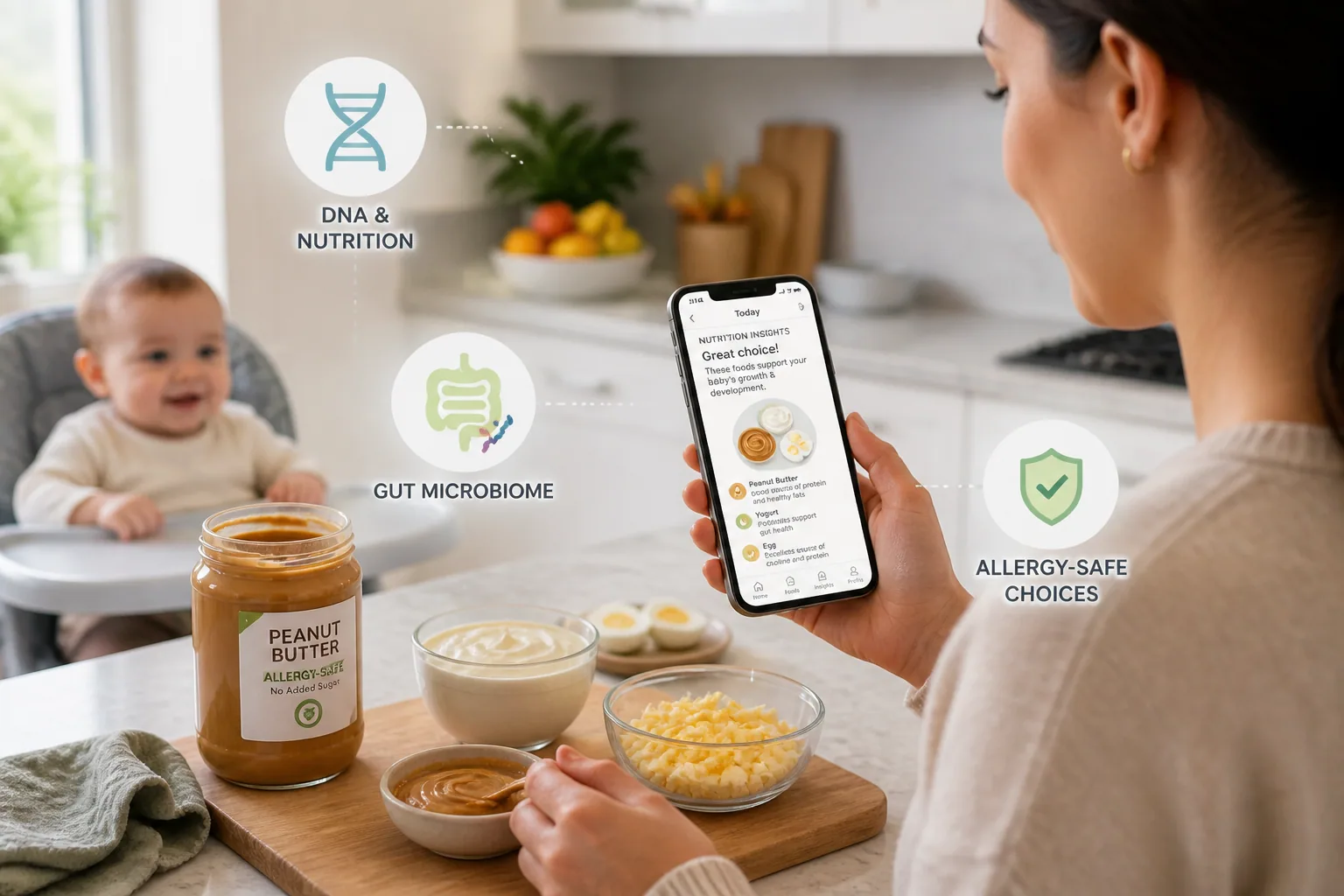
Digital tools are becoming a practical part of allergy management, especially for families already dealing with food allergies or strong allergy concern. Apps can help track foods introduced, note reactions, manage shopping, and flag known allergens. Several tools now offer AI-powered allergen detection through barcode or label scanning, personal allergen profiles, and nutrition insights.
As of 2026, these tools are useful for managing known allergies and for reducing day-to-day uncertainty. But the evidence that they prevent new food allergies is still limited. They can improve organization and confidence, yet they are not a substitute for immune training or clinician guidance. In other words, they help with execution, not with the underlying biology.
For families who want a simple way to check packaged foods quickly, a scanner app can be especially helpful. Bokha: Food Allergy Scanner App lets users scan product barcodes and identify allergens in less than a second, which can save time in the supermarket and help caregivers find foods that fit a child’s needs. You can learn more here: https://findthe.app/bokha
Used well, this kind of tool supports personalized nutrition by reducing label-reading burden and making it easier to follow a tailored feeding plan. Used poorly, it can create a false sense that technology alone is preventing allergy. The best role for digital tools is as a practical assistant, not a medical authority.
What Science Supports Today, and What Is Still Experimental
What science supports today is fairly clear. Early introduction of allergenic foods remains the most important evidence-based prevention strategy for many infants. Breastfeeding, when possible, remains beneficial for many reasons, though it is not a guaranteed allergy shield. For non-breastfed high-risk infants, certain formula strategies may be worth discussing with a clinician. And for all families, nutrition quality and feeding progression matter.
What is still experimental includes most microbiome-targeted interventions, gene-based feeding algorithms, and many probiotic or functional food claims. The 2026 microbiome studies are exciting, but they are not enough to justify broad consumer promises. The same is true for stool tests marketed as if they can predict or prevent allergies with certainty. Right now, most of these approaches are hypothesis-generating or early-stage rather than standard care.
A good rule is to ask whether the intervention has human clinical outcomes, not just lab markers. Did it reduce actual allergic reactions in infants? Did it change long-term incidence? Or did it only shift a biomarker in animals? Those are very different levels of evidence.
Practical Steps for Families With Higher Allergy Risk
If your family has a history of allergies, the best next step is not to chase every new trend. It is to build a prevention plan around the strongest available evidence and then personalize the details with medical support. Start by understanding your child’s risk factors, such as eczema, existing food reactions, family history, and feeding method.
Then focus on timing. Discuss early introduction of common allergens, especially peanut and egg, with your pediatrician if your infant has eczema or other concerns. Ask about texture, portion size, and how to introduce foods safely at home. If your baby is not breastfed and is considered high risk, ask whether formula choice should be part of the conversation.
You can also keep a simple feeding log. Record new foods, timing, and any symptoms such as hives, vomiting, coughing, rash, or changes in stool. This is one area where an app can help, especially if it also scans products and stores allergen details. But the goal is to make it easier to follow a clinically sound plan, not to self-diagnose.
Finally, avoid unnecessary restriction. Overly limiting diets can make it harder to maintain nutrient adequacy and can increase anxiety around food. Unless a clinician has told you otherwise, the goal is usually exposure in safe, age-appropriate ways, not avoidance by default.
Questions to Ask Your Pediatrician or Allergist
If you want a personalized prevention plan, these questions can help guide the discussion:
Does my child’s eczema, family history, or prior reaction history change the timing or method of allergen introduction?
Should peanut or egg be introduced at home, in the clinic, or after testing first?
If my baby is formula-fed, is there any evidence-based reason to consider a partially hydrolyzed formula?
Are there any signs that my child needs a referral to an allergist before starting solids?
Which symptoms should make me stop a food trial and seek medical advice?
Are apps or scanning tools helpful for our family, and which ones are appropriate for managing our current needs?
These questions help move the conversation from generic advice to a plan that fits your child’s real risk profile.
Bottom Line: How Personalized Nutrition Fits Into Allergy Prevention
In 2026, personalized nutrition is best understood as a promising support layer in food allergy prevention, not a full replacement for proven guidance. The science is increasingly clear that the gut microbiome, diet, and immune tolerance are tightly connected. Researchers are also uncovering gene-diet and microbiota-diet interactions that may one day allow more precise prevention strategies.
But the most practical evidence remains simple: introduce allergenic foods early when appropriate, follow medical advice for higher-risk infants, and use tools that make the plan easier to carry out. Microbiome therapies, functional foods, and genetic tailoring may eventually change how we prevent food allergies. For now, they are still largely emerging strategies.
So if you are a parent trying to do the right thing, the best approach is balanced optimism. Personalized nutrition may help refine allergy prevention in the future, and some early formula and microbiome findings are encouraging. But today, the smartest path is to combine solid clinical guidance, careful feeding, and practical digital tools to make prevention safer and more manageable.