Beyond the Shelf: Hidden Allergen Risks in Everyday Non-Food Items
When most people think about food allergies, they think about meals, snacks, and grocery labels. But for many allergy-conscious families, the real challenge goes far beyond the kitchen. Allergens can show up in toothpaste, shampoo, lotion, vitamins, pet treats, medications, craft materials, and even household cleaners. That means exposure can happen during a normal morning routine, a trip to the pharmacy, or while playing with a pet, not just at the dinner table.
This is what makes non-food allergen risk so tricky. Food labels are designed around clear disclosure rules, but non-food items often follow different standards, different terminology, and sometimes much less transparency. A product can look harmless and still contain milk-derived proteins, wheat starch, soy compounds, egg ingredients, or fragrance components that may matter to someone with allergies. Understanding where these risks hide is the first step toward reducing surprises and building safer routines.
Why Food Allergies Don’t Stop at Food
Food allergy management often starts with ingredient lists, but the body does not care whether an allergen came from a cookie or a cleanser. If a person is sensitive to milk, wheat, soy, egg, sesame, peanuts, tree nuts, fish, or shellfish, exposure can happen through products never meant to be eaten. This includes items used on the skin, placed in the mouth, inhaled indirectly, or handled frequently throughout the day.
That matters because many everyday products are built from the same raw materials used in food manufacturing. Proteins, oils, starches, extracts, and derivatives can move across categories. A moisturizer may use milk-derived proteins for conditioning. A medication may use lactose as an inactive ingredient. A pet treat may include dairy or wheat. A craft product may use wheat-based glue or soy-based components. Even if the exposure route is different, the risk can still be real for someone with a severe allergy.
The challenge is not only where allergens appear, but how they are labeled. In food, the major allergens are clearly defined in the U.S.: milk, eggs, fish, crustacean shellfish, tree nuts, peanuts, wheat, soybeans, and sesame, with sesame required to be declared on food labels as of January 1, 2023, according to the FDA: https://www.fda.gov/food/food-labeling-nutrition/food-allergies
The Non-Food Products Most Likely to Contain Hidden Allergens
Some product categories deserve extra attention because they are more likely to contain ingredients derived from major allergens or gluten-containing grains. Personal care items are one of the biggest examples. Shampoos, conditioners, face creams, body lotions, lip balms, makeup, and toothpaste can all contain hidden food-derived ingredients. The same is true for supplements and medications, which often use fillers, binders, coatings, and flavoring agents that come from common allergen sources.
Pet treats are another overlooked area. Dogs and cats do not share the same allergy concerns as humans, but the ingredients in their treats can still affect allergic family members through handling, residue, crumbs, saliva contact, or accidental transfer to a child’s hands. Household and craft products can also create exposure risks, especially if children touch them and then put their hands near their mouth or face.
The common thread is simple: the more a product is handled, applied, or used around the home, the more chances there are for exposure. That is why allergy awareness has to expand beyond the grocery aisle and into the medicine cabinet, bathroom shelf, cleaning closet, and pet supply drawer.
How Allergen Rules Differ Outside the Grocery Aisle
Food allergen labeling in the United States is relatively clear compared with many non-food categories. Outside food, the rules are much less consistent. Cosmetics, for example, do not have to identify major food allergens in the same way foods do. The FDA notes that cosmetics labeling does not mandate identification of major food allergens, and terms like “hypoallergenic” or “for sensitive skin” are not tightly regulated. Labels may simply list “fragrance” without revealing the full composition: https://www.fda.gov/cosmetics/cosmetic-ingredients/allergens-cosmetics
That creates a real blind spot. A person can carefully avoid allergens in packaged foods and still have little visibility into what is inside a moisturizer, shampoo, or cleanser. The same issue exists for many medicines. A 2019 study referenced by Food Allergy Research & Education found that about 93 percent of all medications contain one or more potential allergens, including major food allergens like dairy, and that lactose is used in about 20 percent of prescription drugs and 6 percent of over-the-counter medicines: https://www.foodallergy.org/resources/adina-act-overview-pdf
There are some signs of progress. The ADINA Act, or Allergen Disclosure in Non-food Articles Act, would require human drug labels to explicitly identify ingredients that are, or are derived from, a major food allergen or gluten-containing grain. The bill text is available here: https://www.congress.gov/bill/118th-congress/house-bill/4263/text
Current FDA draft guidance is still limited. The agency indicates that only oral drug products containing wheat starch as an inactive ingredient are likely to require further label disclosure, while companies are encouraged but not yet mandated to say “Contains no ingredient made from a gluten-containing grain (wheat, barley, rye).” That leaves many consumers with incomplete information when choosing medications: https://www.fda.gov/drugs/buying-using-medicine-safely/medications-and-gluten
Common Label Terms That Can Hide Major Allergens
One of the hardest parts of allergen avoidance is recognizing ingredient names that do not sound like allergens at all. A label may never say “milk” or “wheat,” yet still contain ingredients made from them. This is especially common in cosmetics, supplements, and medications, where ingredient naming often reflects chemistry rather than everyday language.
For milk, watch for names like casein, whey, lactalbumin, hydrolyzed milk protein, and lactose. Milk-derived ingredients are commonly used in skincare and haircare as moisturizers and conditioners, which means someone with a milk allergy may encounter them in products used daily: https://www.skincarelab.org/ingredient/milk-protein/
For wheat and gluten, look out for wheat starch, modified food starch, hydrolyzed wheat protein, and similar derivatives. Under U.S. law, if modified food starch is derived from wheat, it must be labeled as “modified food starch (wheat)” or carry a “Contains wheat” statement in the allergen section. That rule helps, but only when the product falls under the relevant labeling framework: https://nationalceliac.org/celiac-disease-questions/is-modified-food-starch-gluten-free/
For soy, egg, peanut, and tree nut ingredients, the challenge is similar. They may appear as proteins, extracts, oils, lecithins, or flavoring agents. Fragrance and flavor can also be complicated because the source materials are not always visible to consumers. That is why ingredient recognition matters as much as label reading.
Toiletries, Cosmetics, and Personal Care: What to Watch For
Bathroom shelves are full of hidden variables. Toothpaste can contain dairy-derived ingredients, which is why non-food labeling gaps are such a concern. A tragic 2019 case cited in advocacy materials from Food Allergy Research & Education involved an 11-year-old girl who died after using a prescription toothpaste containing dairy. It is a sobering example of how dangerous overlooked exposures can be when allergen disclosure is incomplete: https://www.foodallergy.org/resources/adina-act-overview-pdf
Shampoo, conditioner, lotion, lip products, and makeup deserve the same scrutiny. Milk proteins are sometimes added to support texture or conditioning. Other products may include soy derivatives, nut oils, or fragrance blends that are difficult to decode from the label alone. The label “natural” is not a safety guarantee, and “hypoallergenic” does not mean allergen-free.
For parents, one of the most frustrating scenarios is buying a children’s shampoo or lotion that seems gentle and then discovering it contains a familiar allergen hidden in the ingredient list. The risk is often not immediate consumption, but repeated skin contact, hand-to-mouth transfer, or accidental contact with the face and eyes.
Supplements, Vitamins, and Medications: The Overlooked Risk Zone
Supplements and medications are where many people lower their guard, precisely because these products are associated with health. But health-focused does not always mean allergy-safe. Pills, capsules, gummies, chewables, powders, and syrups can all contain allergens as inactive ingredients, flavor systems, or coating agents.
This is especially important for families managing celiac disease or gluten sensitivity, since excipients can vary by brand, dosage, and manufacturer. The FDA’s draft guidance only specifically highlights oral drug products containing wheat starch, and even then the labeling approach remains limited. That means consumers often need to check each product carefully, especially when switching from one generic to another.
The research on medication exposure is striking. If about 93 percent of medications contain one or more potential allergens, as FARE notes in its ADINA Act overview, then the medicine cabinet is not a low-risk zone by default. It is an area where ingredient review should be routine, not occasional.
A practical example is a parent choosing a flavored chewable vitamin for a child with food allergies. The product may look harmless, but flavorings, binders, colorants, and coatings can introduce unexpected risks. The same applies to cough syrups, probiotic gummies, and prescription tablets that rely on dairy-derived fillers or gluten-related starches.
Pet Treats, Craft Supplies, and Household Products That Can Trigger Exposure
Pet treats can be surprisingly relevant in an allergy-safe home. According to Allergy & Asthma Network, pet treats may contain dairy, wheat, soy, peanuts, fish, shellfish, and egg, and FALCPA does not apply to pet food, which means there is less mandatory transparency than people may expect: https://allergyasthmanetwork.org/news/is-pet-food-a-food-allergy-risk/
That creates a messy reality in homes with children. A dog chew can leave residue on a countertop. A child can touch a pet treat, then rub their eyes or eat a snack. A treat bag can be stored near human food by accident. None of that is rare, which is why pet products deserve a place in allergy planning.
Craft and household products can also be overlooked. Glue, paint, slime ingredients, modeling compounds, and cleaning sprays may contain proteins, starches, or fragrance components that matter to sensitive users. The risk increases when children use them without supervision or when products are shared across the home.
Real-World Stories of Unexpected Allergen Encounters
The most memorable allergy mistakes are often not dramatic kitchen accidents. They are the small, ordinary moments that felt safe. A child brushes their teeth with a medicated toothpaste and the ingredient list was never checked. A parent applies a lotion after a shower and later realizes it contains milk protein. A family gives a chewable supplement because it was sold in the wellness aisle, not the candy aisle, and assumes it must be fine.
These scenarios are so common because non-food products feel separate from the allergy conversation. But in practice, they are part of the same daily ecosystem. The more products enter that ecosystem, the more likely a hidden allergen is to appear somewhere unexpected.
That is why the 2019 toothpaste case matters beyond the individual tragedy. It illustrates a broader truth: if labeling systems are not built to catch major food allergens in non-food products, families have to act as their own investigators. That is exhausting, and it leaves room for mistakes.
Practical Steps to Reduce Everyday Non-Food Allergen Risk
A safer routine starts with simplifying the product environment. Fewer products means fewer opportunities for hidden ingredients. Standardizing on a small set of checked and trusted items, rather than constantly trying new brands, can reduce risk and stress.
It also helps to create separate review habits by category. Personal care products should be checked for milk-derived ingredients, fragrance ambiguity, and nut oils. Medications should be checked for inactive ingredients, starch sources, and flavoring systems. Pet treats should be reviewed just like human snacks, especially if children handle them. Household and craft items should be treated as potential contact exposures, not just background supplies.
When possible, keep a running list of safe products and the ingredients that triggered concern in the past. That turns every future shopping trip into a faster decision. It is also wise to contact manufacturers when labels are vague, particularly for prescription drugs, specialty cosmetics, and niche supplements.
Another important habit is reducing cross-contact at home. Store risky products separately, wash hands after handling pet treats or personal care items that contain allergens, and teach children not to share toiletries. These are small steps, but they lower the chance that an invisible ingredient turns into a visible reaction.
How Bokha Can Help Identify Hidden Risks Faster
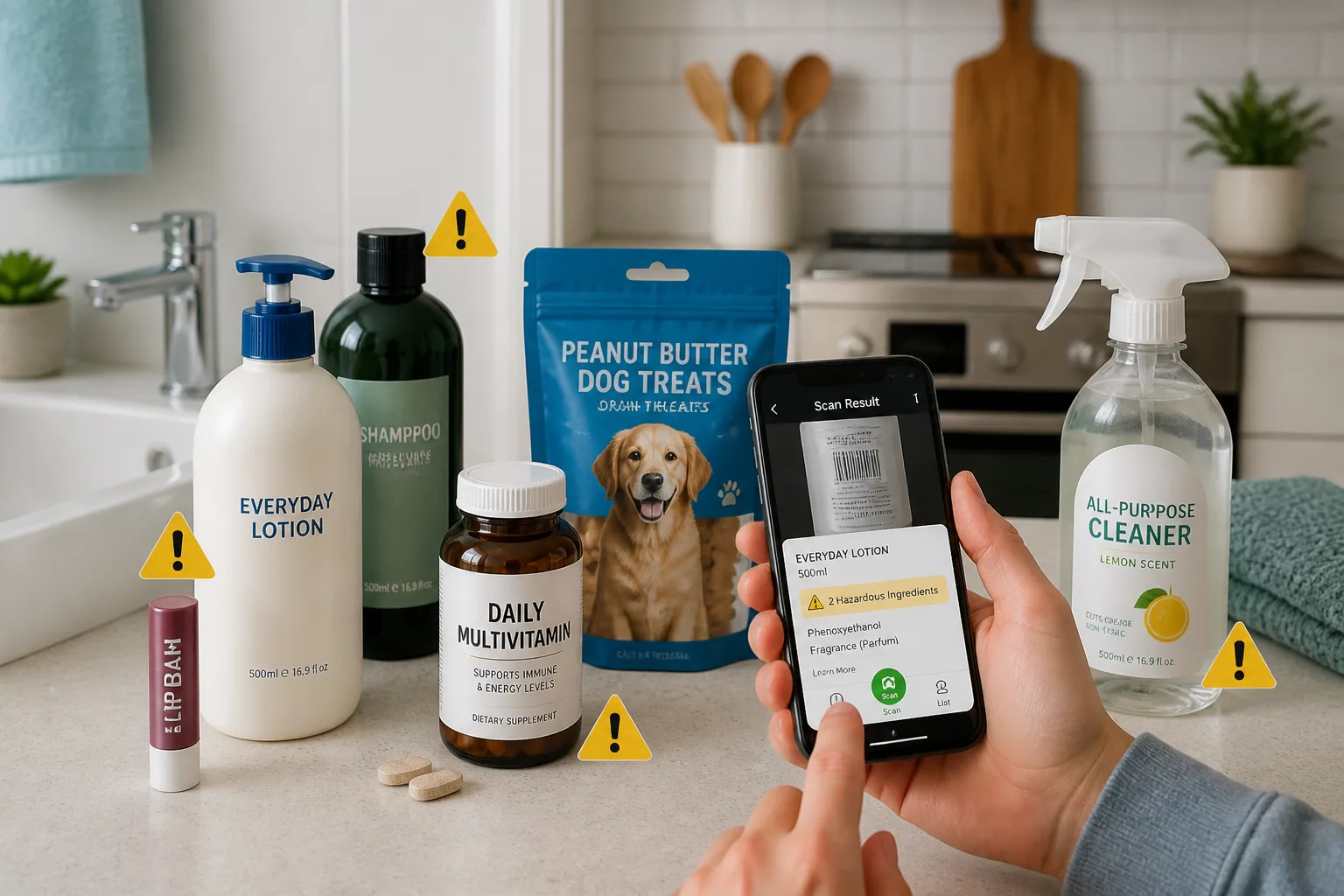
For people who are already spending too much time decoding labels, a faster check can make daily life easier. Bokha, the Food Allergy Scanner App, lets you scan product barcodes and discover allergens in less than a second. It detects 13 allergens, traces, and additives, which can help users move faster when evaluating products across the supermarket and beyond: https://findthe.app/bokha
That kind of shortcut is especially helpful when you are comparing many products or trying to avoid repeating ingredient checks on items you buy regularly. While no app replaces medical advice or a careful review of product labels, a quick scanning tool can reduce friction and help people spot potential risks sooner.
In a world where allergens hide in places most shoppers do not expect, speed matters. The easier it is to check a product, the more likely families are to make safer choices consistently.
A Simple Daily Checklist for Allergy-Safer Living
A practical checklist can make the non-food world feel more manageable. Start by checking anything that touches skin, lips, or hands. Then review anything swallowed, chewed, or inhaled. Finally, do not forget items your child, partner, or pet might handle and bring into shared spaces.
Ask four basic questions before using a product: What ingredients are listed? Are any names hiding a known allergen? Does the category have weaker labeling rules than food? Is there any chance of transfer through hands, surfaces, or residue? If the answer to any of those is unclear, pause and verify before using it.
The goal is not to live in fear of every product. It is to recognize that food allergies are not limited to food, and to build habits that reflect that reality. With a little structure, better label literacy, and the right tools, families can turn a confusing landscape into a safer one.