Beyond the Major 9: Rare Food Allergens You Might Be Missing
Most people who live with food allergies learn the major allergens first: milk, egg, peanut, tree nuts, wheat, soy, fish, shellfish, and sesame. But once those are on your radar, there is still another layer to understand. Rare food allergens can be just as disruptive, sometimes more confusing, and often harder to identify because they do not always appear in the places you expect. A reaction to a seed, a spice blend, a raw apple, or a mammalian meat product can easily be mistaken for intolerance, reflux, pollen symptoms, or even a random viral illness.
That is why rare allergens matter more than you might think. They are not rare because they are harmless, but because they are less commonly recognized, less consistently reported, and sometimes misdiagnosed for years. If you already know how to manage common allergens, going deeper can help you spot patterns earlier, ask better questions, and build a safer routine at home and when eating out.
What Counts as a Rare Food Allergen?
A rare food allergen is not defined by a single universal number. In practice, it is usually an allergen with lower prevalence, limited awareness, or weaker reporting compared with the standard top allergens. Some are uncommon overall, like certain seed allergies or additive reactions. Others are relatively underrecognized because symptoms are inconsistent, delayed, or tied to a specific context, such as pollen season or a tick bite history.
This is one reason rare allergies are easy to miss. If a food does not sit on a standard label warning, people may not suspect it. If a symptom shows up hours later, the trigger may not seem connected. And if the reaction is mild at first, it is often explained away as a sensitivity rather than an allergy. Over time, that can delay diagnosis and increase risk.
Seed Allergies Beyond the Usual Suspects
Seed allergies are one of the clearest examples of food allergens that can be overlooked. Sesame gets the most attention because it is now widely recognized as a major allergen in many places, but other seeds can also trigger serious reactions. Sunflower seed, perilla seed, flaxseed, poppy seed, mustard seed, and chia seed all come up in allergy discussions, depending on region and eating habits.
The numbers help show why these can be missed. One European review found sunflower seed allergy prevalence in adults around 0.05% to 0.07%, with many pediatric populations showing 0% at most sites. That sounds small, but it still represents real patients who can react strongly. In a pediatric allergy clinic cohort of 235 children with sunflower seed allergy, 25.9% of reactions met anaphylaxis criteria, while 52.8% were mild skin, mucosal, or gastrointestinal symptoms. The study also reported diagnoses rising by about 21% per year across the period reviewed, which suggests awareness is increasing but the issue is far from rare for the families affected. Source: https://pmc.ncbi.nlm.nih.gov/articles/PMC11560651/
A Korean study of anaphylactic triggers in children found perilla seed as the most common seed trigger at 3.2%, followed by sunflower seed at 1.6% and sesame at 0.8%. That is a helpful reminder that seed allergies vary a lot by culture, cuisine, and exposure. Source: https://pmc.ncbi.nlm.nih.gov/articles/PMC12683745/
For anyone with suspected seed allergy, the hard part is that seeds hide in breads, crackers, granola, salad toppings, seasoning blends, oil mixes, and health foods. They also appear in niche ingredient lists where consumers may not expect them. If seeds have ever caused throat itching, hives, swelling, vomiting, or unexplained stomach pain, it is worth bringing that pattern to an allergist.
Oral Allergy Syndrome and Fruit-Vegetable Triggers
Oral Allergy Syndrome, also called Pollen-Food Allergy Syndrome, is another condition that is commonly overlooked because the symptoms can seem mild or strangely specific. People often notice itching, tingling, or swelling in the mouth, lips, or throat after eating raw fruits or vegetables. This is not the same as a typical primary food allergy. It is often linked to pollen sensitization, where the immune system mistakes proteins in certain raw plant foods for pollen proteins.
OAS occurs in approximately 5% to 8% of people with pollen allergy, and only about 1% to 2% of cases result in severe reactions such as anaphylaxis. Source: https://journals.sagepub.com/doi/10.2500/ajra.2018.32.4489
That low severe-reaction rate is one reason people underestimate it, but the condition still matters. Symptoms can affect daily eating, especially during pollen season. A person may tolerate cooked apples but react to raw apples, or react to raw carrots, celery, peaches, melons, or hazelnuts only in certain forms. Cooking often changes the proteins enough to reduce symptoms, which is useful information but not a reason to self-diagnose casually.
If you notice a pattern where only raw produce causes issues, especially with seasonal allergies in the background, that is a clue worth tracking. It can be very helpful to note the food, whether it was raw or cooked, the time to symptom onset, and whether pollen allergies were active at the time.
Alpha-Gal Syndrome: When Meat Becomes the Problem
Alpha-gal syndrome is one of the most unusual food allergy patterns because the trigger is mammalian meat and some mammal-derived ingredients, and the reaction is often delayed. Instead of symptoms arriving immediately, people may react several hours later, which makes the connection easy to miss. It is linked to sensitization after certain tick bites.
The CDC estimates AGS may affect up to 450,000 people in the United States, while only about 110,000 suspected cases were identified between 2010 and 2022. That gap strongly suggests underdiagnosis. Source: https://www.cdc.gov/alpha-gal-syndrome/about/index.html
The CDC has also reported that suspected AGS cases cluster where lone star ticks are common, particularly in the southern, mid-Atlantic, and south-central U.S., though cases have been found outside known tick ranges as well. Source: https://www.cdc.gov/mmwr/volumes/72/wr/mm7230a2.htm
This is a perfect example of why rare allergies can be misread. If someone gets hives, digestive distress, flushing, or swelling late at night after dinner, they may suspect spoiled food, reflux, or a stomach bug. Because the timeline is delayed, the meat connection is not obvious unless you know to look for it.
People with suspected alpha-gal syndrome should discuss symptoms with a qualified health professional, especially if reactions include breathing changes, dizziness, or swelling. Delayed reactions can still be serious, and the exposure pattern can extend beyond obvious meat dishes to broths, gravies, gelatin, and other mammalian ingredients.
Spice, Additive, and Hidden Ingredient Reactions
Spices and additives can be easy to overlook because they are often treated as background ingredients, not primary allergens. Yet studies show that spice allergy, excluding the common allergens, is unusual but real. One data set found that food allergy to spices is about 2% of total food allergies, and among adults spices account for 6.4% of food allergies in adults. Source: https://pubmed.ncbi.nlm.nih.gov/12078423/
Additive reactions are also uncommon in the general population, with hypersensitivity estimated around 0.01% to 0.23%, though rates may be higher, about 2% to 7%, among people with atopic conditions. Source: https://pubmed.ncbi.nlm.nih.gov/19390435/
That means ingredients like colorants, preservatives, flavor enhancers, spice extracts, and certain seasoning blends should not be dismissed automatically if symptoms keep recurring without an obvious culprit. The challenge is that labels may group these under broad terms, or the problem may come from a compound ingredient within a prepared food rather than the headline item on the package.
If symptoms show up after restaurant food, deli items, flavored snacks, or international dishes, it may be worth looking beyond the usual suspects. Sometimes the issue is not the main food at all, but a spice blend, sauce, marinade, or additive used for texture, preservation, or color.
Why Rare Allergies Are Often Missed or Misdiagnosed
Rare allergies are often missed for a few simple reasons. First, symptoms can look nonspecific. Skin itching, stomach upset, congestion, or fatigue can be blamed on many things. Second, the reaction may be delayed, as with alpha-gal syndrome, which makes food diaries harder to interpret. Third, the trigger may be seasonal or form-specific, as with oral allergy syndrome, so the same food might not always cause symptoms.
There is also a reporting problem. If an allergen is not one of the top nine, it may not be routinely discussed in general education, and people may not hear about it until they see an allergist or have a major reaction. That is why unexplained symptoms deserve attention rather than guesswork. Patterns matter, and so does professional testing when appropriate.
A practical way to reduce confusion is to keep notes on what you ate, how it was prepared, how long it took symptoms to start, whether exercise or alcohol was involved, and whether the same food was tolerated in another form. That kind of detail can make a big difference in identifying rare triggers.
How to Read Labels When Your Allergen Is Not a Standard One
Reading labels with a rare allergen requires a different mindset. If your issue is not one of the standard major allergens, you often need to scan the full ingredient list, not just the bold allergy statement. Look for alternate names, botanical names, spice blends, natural flavors, emulsifiers, and ingredients derived from plants or animals that may not be obvious at a glance.
For seed allergies, pay attention to breads, crackers, snacks, salad toppers, tahini, flavored oils, and nutrition bars. For oral allergy syndrome, the label may not help as much because the risk depends on freshness, ripeness, and whether the food is raw or cooked. For alpha-gal syndrome, the ingredient may be gelatin, broth, lard, tallow, or a meat-derived flavor base rather than an obvious steak or burger.
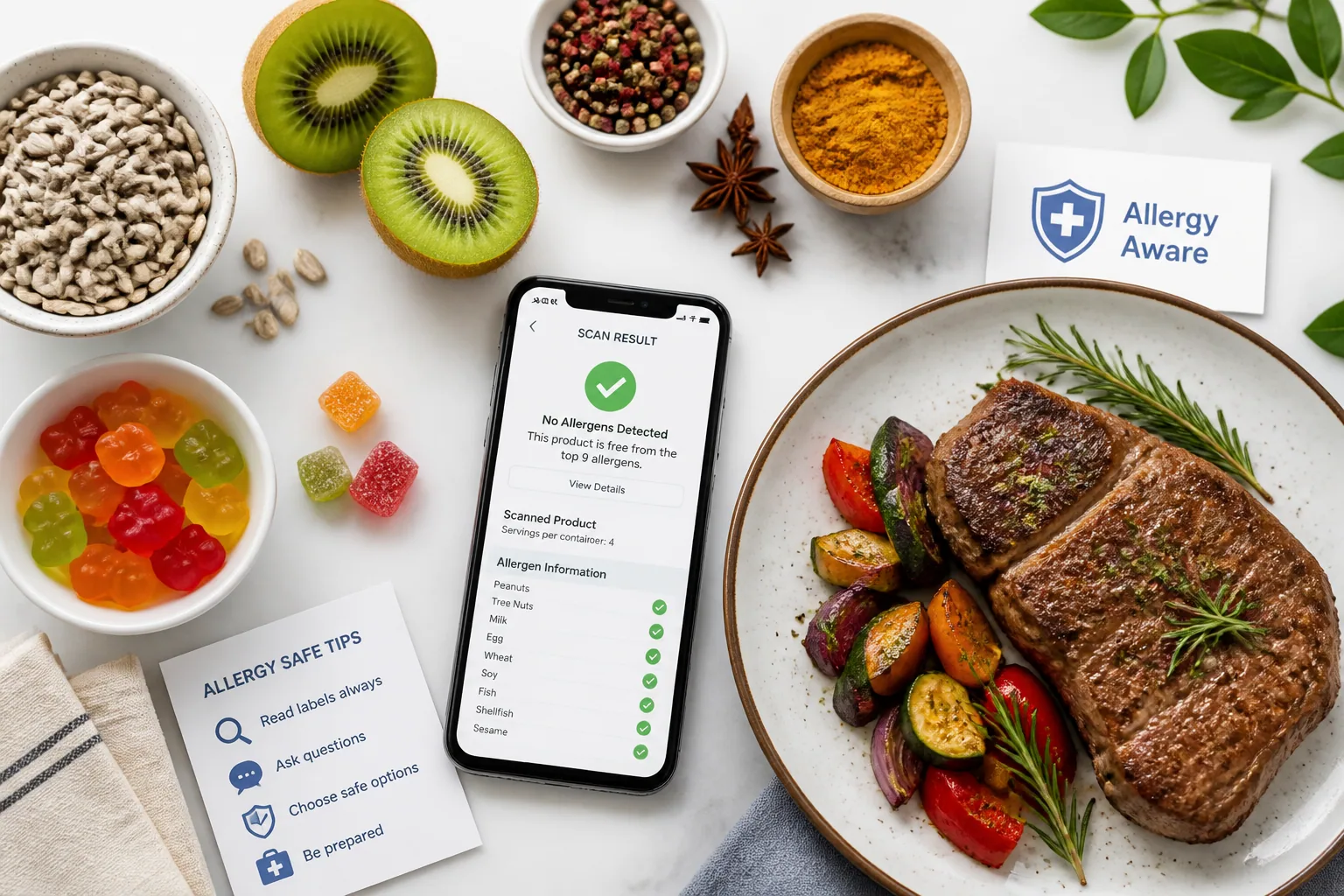
This is also where a tool like Bokha: Food Allergy Scanner App can be useful for everyday shopping. It scans product barcodes in less than a second and can identify 13 allergens, traces, and additives, which can save time when you are comparing packaged foods. You can learn more here: https://findthe.app/bokha
Still, no scanner can catch everything, especially uncommon allergens or ingredients that are not included in the product database. A scanner is best used as a helper, not as the final authority. When you are dealing with a rare allergy, manual label reading and expert guidance still matter.
Cross-Contact Risks at Home, School, and Restaurants
Cross-contact is a major issue for rare allergens because kitchens are full of shared surfaces, utensils, fryers, prep tools, and storage containers. If your trigger is a seed, spice, or hidden ingredient, it may be present in tiny amounts that are easy to miss but still enough to cause symptoms. Shared toasters, condiment jars, baked goods, and bulk bins can be common trouble spots.
At home, it helps to create separate containers, label foods clearly, and keep high-risk ingredients apart from safe foods. At school or in childcare settings, staff need specific instructions that go beyond generic allergy awareness. For restaurants, cross-contact is often the bigger concern than the menu item itself, especially when sauces, seasonings, or marinades are made in-house.
The best approach is to ask targeted questions. What oil is used? Are seeds added to bread or garnish? Is the seasoning mix pre-made? Are pancakes or vegetables cooked on the same surface as allergen-containing items? The more unusual the allergen, the more important those details become.
Can an Allergy Scanner App Catch Rare Allergens?
An allergy scanner app can be very helpful, but it has clear limits. Apps are strongest when the allergen is already in the product data, clearly listed on the label, or covered by a known database entry. That makes them useful for checking common allergens quickly and reducing shopping stress.
Where they fall short is with rare allergens, regional ingredients, recipes that change often, or foods with vague labeling such as spice blends, natural flavors, and restaurant meals. An app can flag known allergens, traces, and additives, but it cannot reliably identify every uncommon seed, pollen-related fruit trigger, or delayed-response pattern like alpha-gal syndrome. It also cannot interpret your personal medical history.
So the balanced answer is this: use scanner apps as a support tool, especially for packaged foods, but do not let them replace symptom tracking, label reading, or medical evaluation. They are a convenience layer, not a diagnosis.
When to See an Allergist About Unexplained Symptoms
If you keep having unexplained symptoms after eating, it is time to see an allergist or another qualified health professional. This is especially important if reactions involve hives, swelling, wheezing, throat tightness, repetitive vomiting, faintness, or delayed nighttime symptoms after dinner. Those patterns can point toward uncommon triggers that are easy to miss without a structured evaluation.
Bring as much information as you can: food logs, pictures of labels, restaurant receipts, timing of symptoms, and any link to pollen seasons, tick exposure, or specific cuisines. A good history often matters as much as the food itself. An allergist can help determine whether the issue is a true allergy, a cross-reactive syndrome, or something else entirely.
You should never assume that a rare allergen is too unusual to matter. In medicine, uncommon does not mean insignificant. The goal is not to self-label every symptom, but to get the right explanation before the next reaction becomes more serious.
Building a Practical Safety Plan for Uncommon Allergies
A practical safety plan starts with knowing your pattern. Identify the foods, forms, and settings that seem risky. Write down your safest options. Keep emergency steps clear. If you have been prescribed rescue medication, make sure it is current and easy to access. Tell family members, caregivers, teachers, and close friends what your specific triggers are and what to do if a reaction starts.
For daily life, focus on habits that reduce uncertainty. Read labels every time, because formulations change. Ask about cross-contact before eating food prepared by others. Keep a symptom diary. Use scanner apps for quick checks on packaged foods, but verify anything that feels unclear. And if symptoms remain unexplained, revisit the possibility of a rare allergen with a clinician.
Rare food allergies can be frustrating because they are easy to overlook and hard to name. But once you know what to look for, they become much more manageable. The combination of pattern tracking, careful label reading, practical avoidance strategies, and professional evaluation can turn a confusing set of symptoms into a clear plan.