Allergies and Nutrition at School: Guidelines, Challenges, and How Smart Tools Can Help
Food allergy safety at school matters more than ever. In the U.S., about 8% of children, or roughly 1 in 13, live with a diagnosed food allergy, which means many classrooms include several students who may be at risk during meals, celebrations, art projects, and even routine transitions. The CDC also notes that 40% of children with food allergies have needed emergency department treatment for allergic reactions, which is a reminder that school planning is not just about comfort or convenience, but about real health protection. https://www.cdc.gov/school-health-conditions/food-allergies/index.html
The challenge for schools is that allergies are not managed in one place. They involve cafeterias, classrooms, recess, buses, field trips, staff training, ingredient checks, emergency response, and communication with families. That is why strong allergy practices need to be built into daily school routines instead of handled only when a student has a reaction.
The Main U.S. Guidelines and Policies Schools Should Know
There is no single national rule that perfectly covers every allergy situation in every school, but several important federal laws often apply. These include Section 504 of the Rehabilitation Act, the Individuals with Disabilities Education Act (IDEA), the Americans with Disabilities Act (ADA), and the Richard B. Russell National School Lunch Act. Together, they can shape how schools provide accommodations, nutrition access, disability protections, and meal service support. https://www.cdc.gov/school-health-conditions/media/pdfs/20_316712-a_fa_guide_508tag.pdf
On top of federal law, schools are often guided by state or district policy. As of 2024, 11 states have published statewide guidelines for school district food allergy policies, and in some states those guidelines are issued jointly by departments of education and health. In many other places, the responsibility is left to individual districts, which can lead to uneven standards from one school to the next. That variation makes it especially important for families and staff to understand what their own school is required to do.
One of the most useful recent frameworks is FARE’s FAMS: Expert Recommendations for K-12, published in September 2024. It includes 34 guidelines that cover practical areas like training all school staff in preventing allergen exposure, reading labels carefully, recognizing allergic reactions, washing hands properly, cleaning surfaces, and identifying hidden allergen sources such as art supplies. https://www.foodallergy.org/resources/fams-expert-recommendations-pdf
How Schools Are Expected to Handle Meals, Classrooms, and Emergencies
In an ideal setup, allergy safety starts with clear planning. That usually means written allergy action plans, communication between parents and school leaders, identified emergency contacts, and staff who know exactly what to do if symptoms appear. It also means considering the full school day, not just lunch. Students may eat breakfast in the classroom, share snacks during group work, use science or art materials that contain allergens, or encounter food during celebrations.
For meals, schools should know student allergen needs in advance, review ingredient information carefully, and make reasonable accommodations where required by policy or law. For classrooms, teachers should think about food-free routines when possible, separate eating areas when needed, and cleanup procedures that actually reduce allergen exposure. For emergencies, schools need fast recognition, access to epinephrine according to policy, and staff training that does not depend on a single nurse being available.
Unfortunately, the reality is often less consistent. In the EPIPEN4SCHOOLS pilot survey, 11% of U.S. schools reported at least one anaphylactic event during the school year. That means severe allergic reactions are not rare edge cases. They are events schools should expect to be prepared for.
Where Schools Still Struggle With Allergy Safety
A major weak point is staff training. Research has shown that many teachers and school employees have limited formal allergy education, even though they regularly care for students with food allergies. In a scoping review, only 20 to 40% of staff in many studies had ever received food allergy training, while 83 to 100% reported caring for students with food allergies. That gap creates a situation where responsibility is high, but preparation is often low. https://pmc.ncbi.nlm.nih.gov/articles/PMC8879822/
Training gaps also show up in emergency response. One study found that only 28.9% of schools trained most staff to recognize anaphylaxis, while 30.9% trained all staff. In 36% of schools, only the nurse and selected staff received this training. Even more concerning, in over half of schools, 54.2%, only the nurse and selected staff were allowed to administer epinephrine, while just 21.9% allowed all staff to do so. When a reaction can become life-threatening within minutes, those limitations matter. https://pubmed.ncbi.nlm.nih.gov/35923028/
Another problem is that allergy management can be treated as a single issue instead of a systems issue. A student may be protected during lunch but still exposed in class. A teacher may know about an allergy but not know the hidden ingredients in a craft supply. A cafeteria may have good label checks but poor communication about a special event breakfast. Real safety requires coordination across all those settings.
Cross-Contact Risks During Lunch, Snacks, and Celebrations
Cross-contact is one of the hardest risks to eliminate because it happens so easily. A shared serving spoon, a crumb on a table, a reused tray, or a hand that touched an allergen and then touched another food can all become a problem. Even well-intentioned class celebrations can create exposure risks when ingredients are unclear or when multiple foods are placed on the same surface.
The basics still matter. A study measuring peanut allergen residue found that handwashing with soap and water or wipes removed detectable allergen, while antibacterial hand sanitizer or water alone did not reliably do so. The same research found that common cleaning agents removed allergen from surfaces in most cases. This is a useful reminder that schools should rely on evidence-based cleaning and handwashing practices rather than assumptions. https://pubmed.ncbi.nlm.nih.gov/15131582/
For staff, the practical takeaway is simple. Before and after snack time, before shared classroom food, and after any event involving meals, students need effective handwashing with soap and water. Surfaces need proper cleaning. And schools should not assume that a quick wipe or sanitizer is enough to remove allergens.
Hidden Allergens in Classroom Materials and Non-Food Items
Food allergies do not stop at the lunch table. Hidden allergens can appear in materials that seem unrelated to eating, including finger paints, paste, playdough, soaps, and animal feed. These risks are especially important for younger children and for students with developmental delays who may put materials in their mouths or have trouble avoiding contact. The American Academy of Pediatrics and FARE both highlight these non-food sources as practical concerns in school settings. https://publications.aap.org/pediatrics/article/156/6/e2025073168/203214/Management-of-Food-Allergy-in-Schools-Clinical
This is one reason broad staff education is so valuable. If only cafeteria workers think about allergens, schools will miss the art room, the science lab, the classroom sink, the sensory table, and the bin of shared supplies. FAMS specifically calls out hidden allergen sources like art supplies, which is a useful sign that allergy safety has to extend beyond food service operations.
Schools also need to think about cleaning products and air quality. Exposure to cleaning chemicals and disinfectants can worsen allergic and respiratory issues such as asthma, rhinitis, and eczema, and compounds like fragrance chemicals, VOCs, glycol ethers, and propylene glycol have been implicated. That does not mean schools should avoid cleaning, but it does mean they should choose products and routines carefully, especially in spaces with vulnerable students. https://www.epa.gov/iaq-schools/managing-asthma-school-environment
How Parents Can Build a Strong Allergy Plan With the School
Parents do a lot of the invisible work that keeps allergy management successful. The first step is usually a detailed written plan, often including medical instructions, emergency contacts, known triggers, symptom history, and any accommodations the child needs in class, in the cafeteria, on the bus, or during field trips. The more specific the plan is, the easier it is for staff to act quickly and consistently.
It also helps to keep communication simple and ongoing. Parents should make sure the nurse, classroom teacher, cafeteria manager, and principal all know the allergy plan, not just one person. If the child is old enough, they should also understand their own safe routines, such as not sharing food, washing hands before eating, and speaking up if something is unclear.
Another practical step is ingredient review. Families can ask how menus are checked, how substitutions are handled, and how celebrations are managed. It is better to clarify early than to discover a risk after the fact. Because school food changes often, and because packaged snacks can vary by brand or batch, families benefit from a system that makes ingredient checks faster and more reliable.
Practical Steps for Teachers and Staff to Reduce Daily Risks
Teachers and staff can make a big difference with small daily habits. The most important are consistent handwashing, careful cleaning of surfaces, clear rules around food sharing, and a willingness to slow down when ingredient information is uncertain. Staff should also know where allergy action plans are kept and how to reach emergency medications or trained responders quickly.
A strong classroom routine can include reminders before snack time, separate storage of student food when needed, ingredient checks for every shared item, and a plan for substitutes, volunteers, and specials teachers who may not know the class as well. Training should not be limited to the homeroom teacher. Lunch monitors, recess staff, bus drivers, office staff, paraprofessionals, and coaches all need enough awareness to recognize problems and respond appropriately.
Schools should also revisit their policies regularly. A rule that works on paper may fail in practice if staff turnover is high or if new products and food traditions keep entering the building. Allergy safety is strongest when it is treated as part of normal school operations instead of a special exception.
Smarter Ingredient Checks: How Apps and Barcode Scanners Can Help
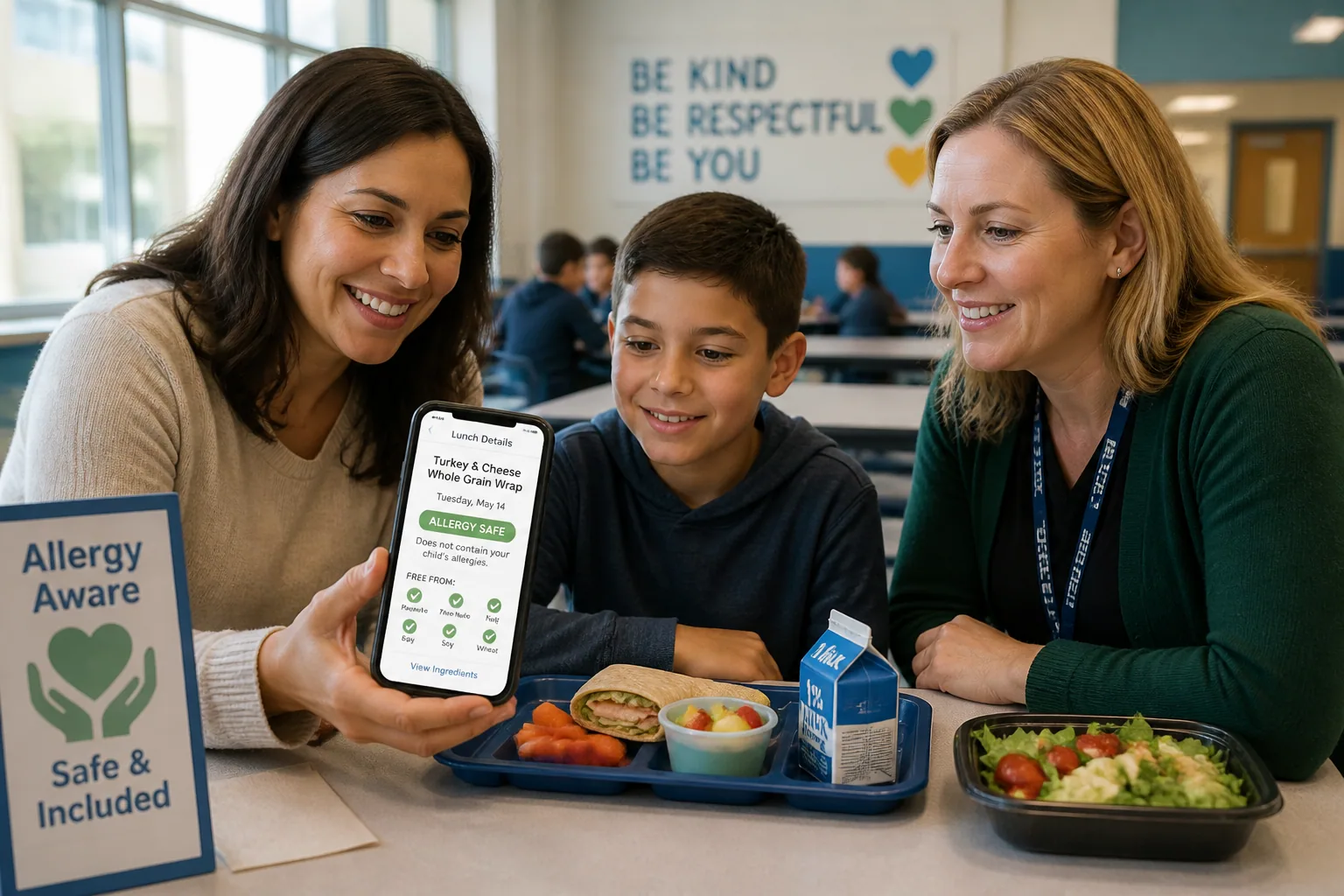
One of the most stressful parts of food allergy management is uncertainty. Labels change, packaging is confusing, and ingredients may be hard to identify quickly during busy school days. This is where smart tools can help. Barcode scanners and ingredient-checking apps can reduce guesswork, especially for packed lunches, classroom snacks, and shared items brought in for events.
The key benefit is speed. When a parent or teacher can scan a package and get a clearer answer in seconds, it becomes easier to make safer decisions without delaying lunch service or classroom routines. This is not a replacement for school policy or medical advice, but it is a helpful layer of support in a setting where mistakes can happen easily.
A useful option here is Bokha: Food Allergy Scanner App, which lets users scan product barcodes and check allergens in less than a second. It is available on iOS and Android, and it detects 13 allergens, traces, and additives, which can make it especially helpful when families and schools are trying to sort out what is safe for a child with multiple sensitivities. https://findthe.app/bokha
How Bokha Can Support Parents, Educators, and Students
Bokha can fit naturally into everyday school routines because it helps take some of the pressure off ingredient checking. Parents can use it when choosing lunchbox items or class snacks. Teachers can use it when reviewing items for celebrations or rewards. Older students can also use it to build confidence and gradually learn how to evaluate packaged foods on their own.
For schools, the real value is consistency. A barcode scanner does not replace staff training, but it can support it by making ingredient review more accessible and less time-consuming. When people are juggling dozens of details at once, a tool that quickly flags potential allergens can help reduce uncertainty and encourage better decisions.
It is also helpful for families managing more than one sensitivity, since Bokha checks multiple allergens and traces along with additives like colorants and preservatives. That broader visibility can be useful in school settings where snacks and treats are often packaged rather than homemade.
Creating a Safer, Less Stressful School Experience for Everyone
Food allergy safety at school works best when everyone shares the responsibility. Parents bring medical knowledge and daily experience. Teachers bring classroom awareness. Nurses and administrators coordinate plans and emergency response. Cafeteria staff manage meals. Students learn habits that protect themselves and their classmates. Each role matters.
The goal is not to create fear around food. It is to create a school environment where children with allergies can participate safely and confidently. That means better policies, better training, cleaner routines, clearer communication, and smarter tools that make it easier to check ingredients and reduce risk.
When schools combine strong guidelines with practical habits, the result is a calmer day for everyone. Meals are less stressful, classroom activities are easier to plan, and emergency readiness becomes part of the culture instead of an afterthought. That is the real promise of thoughtful allergy management: not just avoiding reactions, but helping every child learn in a setting that feels safer and more predictable.